
When your child’s future is on the line, understanding your rights isn't just important—it's everything. So many parents come to us hoping for a 50/50 custody arrangement, believing it's the fairest path forward. But here in Texas, an equal split of parenting time is anything but automatic. The real key is knowing how to show a court that this schedule is truly what’s best for your child.
This guide will walk you through what 50/50 custody really means in Texas, how judges make these critical decisions, and what you can do to build the strongest possible case for equal time with your child.
What 50/50 Custody Really Means in Texas

When parents in Texas talk about "custody," they're usually juggling two separate but equally important ideas: conservatorship (who gets to make the big decisions) and possession and access (the actual parenting time schedule). Getting a handle on this distinction is the absolute first step toward building a strong case for equal parenting time.
The Two Pillars of Texas Custody: Rights vs. Time
The court system starts by figuring out who has the legal authority to make critical decisions for your child. It might surprise you, but in nearly all cases, Texas law starts with the assumption that naming both parents as Joint Managing Conservators is in the child’s best interest.
This means you and the other parent will share the rights and duties of raising your child. Think of it like being co-CEOs of a very important, very small company. You’ll both have a say in major decisions about:
- Education: Choosing schools, tutors, and educational programs.
- Healthcare: Making medical, dental, and psychological decisions.
- General Welfare: Guiding your child's religious or moral upbringing.
But here’s the kicker: being named a Joint Managing Conservator does not automatically get you a 50/50 schedule. The physical time each parent spends with the child—the possession schedule—is a completely separate issue. To dive deeper into this crucial concept, check out our guide on conservatorship in Texas.
To make this clearer, let's break down the key terms you'll hear in a Texas custody case.
Plain-English Explanations of Texas Custody Concepts
This quick reference table helps you see the difference between your decision-making rights and the actual parenting time schedule.
| Legal Term | Plain English Meaning | How It Affects 50/50 Custody |
|---|---|---|
| Joint Managing Conservatorship | A shared responsibility where both parents have the legal right to make important decisions for their child. | This is the starting point for most Texas cases. It’s about sharing parental rights, not necessarily sharing parenting time equally. |
| Possession and Access | The physical parenting time schedule—the calendar that shows who has the child and when. | This is where the 50/50 battle is fought. You must prove to a judge that an equal schedule is in your child's best interest. |
Understanding these two distinct parts of a custody order is the foundation for everything that follows.
Why the Standard Texas Schedule Isn't 50/50
While sharing decision-making is the standard, the default parenting schedule—known as the Standard Possession Order (SPO)—is nowhere near an even split. The SPO assigns one parent as the "primary," meaning their home is the child's main residence for school enrollment and other purposes.
The other parent, often called the "non-primary," typically gets the kids on the first, third, and fifth weekends of a month, plus some holiday time and a chunk of the summer. It's a workable schedule for many, but it's not equal. To get an equal schedule, you have to convince the judge that it's truly in your child's best interest.
The bottom line is that Texas is not a 50/50 state by default. Equal parenting time has to be earned and justified case-by-case, not just assumed.
How Texas Determines Custody: The "Best Interest of the Child"
When a judge is asked to create a custody order, they aren’t just looking at what the parents want. Their entire decision boils down to one powerful, guiding principle woven throughout the Texas Family Code: the “best interest of the child.” This isn’t just a vague idea; it’s the legal measuring stick that every single ruling has to meet.
Understanding this concept is the key to building a strong case for 50/50 custody in Texas. It forces a shift in perspective—away from what feels fair to you and toward what demonstrably benefits your child. Your job is to show the court that an equal parenting schedule is the absolute best way to support your child’s happiness, stability, and overall well-being.
The Holley Factors: What Judges Consider
So, how does a judge figure out what’s actually in a child’s best interest? They don’t just pull it out of thin air. Texas courts lean on a specific set of guidelines known as the “Holley Factors,” which stem from a landmark Texas Supreme Court case. Think of these factors as a checklist the judge uses to get a complete picture of your family’s unique situation.
While there are quite a few, some of the most critical ones include:
- The Child’s Needs: This covers the whole spectrum—from emotional and physical well-being to any special needs they might have. The court wants to know which parent is best equipped to handle these day-to-day realities.
- Parental Abilities: The judge will assess each parent's ability to provide a safe, stable, and loving home. This also includes your capacity to co-parent without conflict and put your child's needs ahead of your own feelings about your ex.
- Stability of the Home: Kids thrive on routine. A predictable and consistent environment is crucial for their development, so the court will look hard at the stability of each parent’s proposed home.
- The Child’s Wishes: If a child is 12 years or older, the judge can meet with them privately to hear their preference. While what the child wants is important, it’s not the final word. The judge will weigh their maturity and reasoning against all the other factors.
- Acts or Omissions: The court will look at a parent's track record. This includes both the good and the bad—things like a history of being actively involved in the child’s life, but also any history of domestic violence, neglect, or substance abuse.
A judge has a lot of leeway when weighing these factors. There's no magic formula, which is exactly why presenting clear, compelling evidence on each point is so incredibly important for your case. Your attorney's job is to help you frame your story through the lens of these legal standards.
Turning the Law into Your Roadmap
These factors aren't just legal hurdles to clear; they are your roadmap to proving that a 50/50 custody schedule truly serves your child’s best interest. For every single factor, you have an opportunity to show the court why having equal time with both parents is the best path forward.
For instance, you can demonstrate how both of you have unique but equally important parenting skills (parental abilities) or how living near each other ensures a consistent school and social life for your child (stability). By focusing your arguments on these specific points, you elevate the conversation from a battle between parents to a collaborative plan for your child’s future. To really get a handle on this, you can learn more about how Texas courts apply the Holley Factors in custody cases in our detailed guide. This knowledge empowers you to gather the right evidence and make the strongest possible argument for the equal parenting time you and your child deserve.
Overcoming Common Hurdles to a 50/50 Schedule
For many mothers and fathers, a 50/50 possession schedule feels like the most natural way to keep both of you at the center of your child's life. And while Texas courts are more open to these arrangements than ever before, they are far from automatic. You have to prove it's the right move for your child.
Several common, real-world challenges can get in the way. But if you see them coming and plan ahead, you can build a strong, workable plan that a judge can get behind.
Navigating High Parental Conflict
Let's be blunt: if you and your ex are constantly at each other's throats, a judge is going to be hesitant about a 50/50 schedule. High-level conflict is one of the biggest roadblocks. The court’s main worry is that a schedule requiring frequent handoffs and constant cooperation will just throw your child into a war zone.
The last thing a judge wants is to create an unstable, emotionally damaging environment. It's your job to show that you can rise above the conflict.
- Use Co-Parenting Apps: Tools like OurFamilyWizard or AppClose can be a game-changer. They create a business-like, documented record of your conversations, forcing you to stick to logistics instead of rehashing old fights.
- Propose a Rock-Solid Parenting Plan: Don't just ask for 50/50—show the court how it will work. A detailed plan that spells out how you'll handle disagreements, share information, and make joint decisions proves you're thinking ahead.
Sometimes, the conflict runs deeper. It might feel like the other parent is actively trying to push you out of your child's life. If you're dealing with that kind of toxic dynamic, it’s critical to understand your options for addressing parental alienation in your custody case.
Addressing Practical and Logistical Issues
Even when parents get along, simple logistics can make a 50/50 plan look impractical to a judge. Things like the distance between your homes, demanding work schedules, or the needs of very young children can all be deal-breakers if you don't have a good answer for them.
For example, if you live in different school districts, a week-on/week-off schedule is probably a non-starter. Who is going to handle that commute every day? Similarly, if one parent has an unpredictable, on-call job, how can they reliably manage an equal split without a strong support system? For infants and toddlers, courts often lean toward schedules with shorter, more frequent visits with each parent to avoid long separations.
You have to acknowledge these hurdles and come to the table with creative, concrete solutions. Proposing a 2-2-5-5 schedule to cut down on daily travel or showing that you have a network of family ready to help can turn a potential weakness in your case into a real strength. It shows the judge you're not just fighting for your time—you're planning for your child's stability.
Practical 50/50 Schedules for Texas Families
Let’s move from legal theory to the real world. What does 50/50 custody in Texas actually look like day-to-day for a family? When you walk into a courtroom, you’re not just asking a judge for “equal time”—you’re proposing a specific, workable possession schedule that truly serves your child’s best interests. A well-thought-out plan shows the court you’re a proactive parent focused on creating stability, not just winning a fight.
There’s no magic bullet here; the “perfect” 50/50 schedule is the one that fits your family. It depends on your kids’ ages, how far apart you and your ex live, and your work commitments. Below are some of the most common and effective arrangements we see Texas families use to build a balanced and predictable routine.
Of course, getting there isn't always a straight line. The journey to a stable schedule means tackling hurdles like lingering conflict, distance, and just plain tricky logistics.
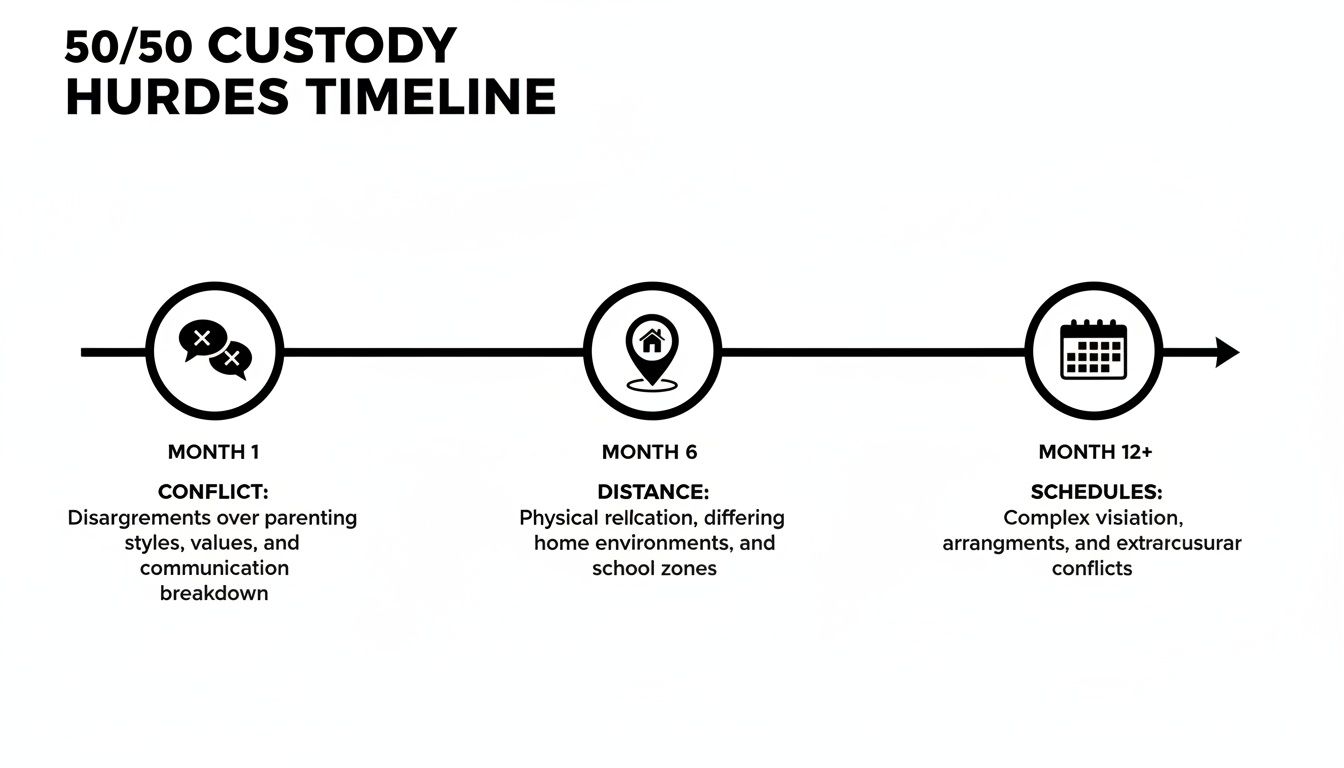
As you can see, conflict and distance are often the first major roadblocks. They have a direct impact on which schedules are even possible.
Week On, Week Off Schedule
This is one of the simplest and most popular 50/50 arrangements, especially for school-aged kids who can handle a little more time between seeing each parent.
- How It Works: Your child spends one full week with you, then the next full week with the other parent. Exchanges usually happen on a set day, like Sunday evening, to get everyone ready for the school week.
- Pros: This schedule drastically cuts down on handoffs, which can reduce conflict and give your child a stable, week-long routine. It allows for real, uninterrupted parenting time.
- Cons: A whole week away from one parent can feel like an eternity for very young children. It also pretty much requires parents to live close enough to the same school to make daily transportation work.
The 2-2-5-5 Rotating Schedule
The 2-2-5-5 schedule is a fantastic option that guarantees each parent gets weekend time while keeping the school week consistent. It’s a bit more complex on paper, but it’s highly effective in practice.
- How It Works:
- Parent A has the child for two days (say, Monday and Tuesday).
- Parent B gets the next two days (Wednesday and Thursday).
- Parents then alternate having the child for a long three-day weekend (Friday, Saturday, and Sunday).
- Pros: This setup ensures a child never goes more than a couple of days without seeing either parent. It also splits the weekends fairly, so one parent doesn't get stuck with all the "fun" time.
- Cons: The frequent exchanges demand excellent communication and a solid co-parenting relationship. That rotating weekend can be tough to track without a shared calendar everyone actually uses.
Making any 50/50 schedule work requires strong organization and planning from both parents. For some great insights on building those skills, this guide on time management strategies for parents is a fantastic resource.
The 2-2-3 Rotating Schedule
Another popular choice that prevents long gaps between visits is the 2-2-3 rotation. This schedule repeats every single week, which makes it incredibly predictable for kids.
- How It Works:
- Parent A has the child for two days.
- Parent B has the child for the next two days.
- Parent A then gets the three-day weekend. The next week, the roles flip.
- Pros: It’s a very consistent and balanced schedule. The weekly routine is always the same—only the weekend parent changes. This often works great for younger children who need to see both parents frequently.
- Cons: Just like the 2-2-5-5, it means frequent handoffs and requires a high degree of cooperation. The parent who has the mid-week days might feel like they're missing out on "quality time."
The best schedule is the one that puts your child's stability first. When you propose a schedule in court, be ready to explain exactly why it works for your child’s age, their school routine, and their emotional needs.
How 50/50 Custody Affects Child Support

It’s one of the first questions we hear from parents considering an equal possession schedule: “If we have our child for the exact same amount of time, do I still have to pay child support?” It’s a completely logical question, but the answer often surprises people.
The short answer is yes, a child support obligation almost always exists even with a 50/50 custody arrangement. In Texas, the courts see parenting time (possession) and financial support as two separate, parallel duties. The main goal of child support isn't just to cover costs, but to ensure your child has a consistent and stable standard of living in both homes.
Why Equal Time Doesn't Erase the Support Obligation
The Texas Family Code uses a specific formula to calculate child support, and that formula is driven primarily by the parents' incomes, not just the number of overnights. The law operates on the core principle that both parents are financially responsible for their child. An equal possession schedule is a huge factor in the final calculation, but it doesn't just wipe the slate clean.
Think of it this way: the day-to-day costs of raising a child—a safe home, food in the fridge, clothes, school supplies, and activities—don't disappear in one household just because the child is at the other parent's house. Child support is the legal tool used to help balance those costs, particularly when one parent has a significantly higher income.
In a 50/50 custody case, the higher-earning parent will almost always be ordered to pay some amount of child support to the lower-earning parent. The purpose is to level the playing field and give the child similar financial resources in each home. This prevents a situation where a child’s quality of life takes a dip every time they switch houses, simply because of a big gap in parental income.
How Judges Calculate Support in 50/50 Cases
Because the standard, guideline-based child support formula was really designed for a more traditional schedule (like a Standard Possession Order), judges have to get a bit creative when it comes to 50/50 custody in Texas. While there isn't a single, rigid method set in stone, the most common approach is what we call an "offset" calculation.
Here's a simplified breakdown of how that usually works:
- Calculate Support for Parent A: The court first runs the numbers to see what Parent A would owe Parent B if Parent B had primary custody, using state guidelines.
- Flip the Calculation: Next, the court does the exact opposite, calculating what Parent B would owe Parent A if Parent A had primary custody.
- Find the Difference: The parent who has the higher calculated obligation pays the difference between the two amounts.
For example, let's say the formula shows Parent A would owe $1,000 per month, and Parent B would owe $600 per month. The judge would likely order Parent A to pay Parent B $400 per month ($1,000 – $600 = $400). This method respects the shared financial duty of both parents while still accounting for any income disparity.
Even with 50/50 custody in Texas, child support is still part of the equation. Obligations are often reduced but rarely eliminated, ensuring that support flows from the higher earner to help balance household costs for the child's benefit. As you can discover more insights about these financial facts on jamiegrahamlaw.com, this approach is common nationwide because it recognizes consistent financial support as a vital resource for families.
Trying to figure out the financial side of a custody case can feel like a maze, but it's an absolutely critical piece of planning for your family's future. When you understand how support actually works, you can set realistic expectations and fight for an outcome that is fair, predictable, and sustainable for everyone.
Building Your Case for 50/50 Custody
Knowing your legal rights is one thing, but that knowledge needs to become a game plan. Securing a 50/50 custody arrangement in Texas isn't just about telling a judge you want equal time; it’s about proving you have a practical, child-focused strategy to make it successful.
This is where you stop reading the rulebook and start taking action. It means you’ll need to gather the right documents, keep track of your involvement, and tell your family’s story in a way that puts your child’s well-being front and center. A winning case is built piece by piece, long before you ever see the inside of a courtroom.
Key Takeaway: Your Strategy for Success
A rock-solid case for 50/50 custody in Texas comes down to convincing the court of three things. As you prepare, keep these three pillars in mind:
- Everything Ties Back to the "Best Interest" Standard: Every email, photo, or argument you present must answer one question: "How does this benefit my child?" You’re not just asking for equal time; you're explaining how it creates stability, meets your child’s emotional needs, and preserves their bond with both parents.
- Show, Don't Just Tell, Your Co-Parenting Skills: A judge is far more impressed by action than words. Use co-parenting apps, keep your texts and emails respectful, and make a real effort to solve problems with your ex. Proving you can be a team player is one of the most powerful arguments you can make.
- Bring a Detailed, Practical Schedule to the Table: Don’t make the judge guess what you want. Show up with a specific, written possession schedule—like a Week On/Week Off or a 2-2-5-5 rotation—and be ready to explain exactly why that plan is the perfect fit for your child's age, school routine, and daily life.
When you proactively address the court's biggest concerns—your child's stability and your ability to cooperate—you're no longer just a parent fighting for your rights. You become a parent advocating for your child's future.
Your Next Steps
Ready to get started? Here’s a simple roadmap to begin building a case that a judge will take seriously:
- Gather Your Proof: Start collecting anything that shows you’re an involved parent. This means report cards you’ve signed, emails you've exchanged with teachers, medical records from appointments you took them to, and photos from school plays or soccer games.
- Keep a Parenting Journal: From today forward, document everything. Log the time you spend with your child, what you do together, and any examples of successful co-parenting. This journal will become a goldmine of specific, powerful examples for your attorney.
- Consult a Family Law Attorney: This is the most important step. A seasoned lawyer can look at your situation, spot the strengths and weaknesses in your case, and craft a strategy that fits the facts and the judge you’ll be in front of. They are the ones who can take all your hard work and turn it into a compelling legal argument.
Answers to Your Top 50/50 Custody Questions
When you're trying to build a stable, equal parenting schedule, a lot of questions pop up. It’s natural to feel a bit overwhelmed by the “what-ifs.” Below, we’ve tackled some of the most common questions Texas parents ask us, answered in plain English.
Can My Child Tell the Judge Who They Want to Live With?
This is one of the first questions parents ask, and it’s an important one. In Texas, once a child turns 12 years old, they have the right to speak privately with the judge. They can share their preference about which parent they want to have the exclusive right to decide where they live.
But here’s the key part: the child’s preference is just one piece of a much larger puzzle. A judge is required to listen, but their final decision will always come down to the child's overall best interest, not just their wishes.
What if My Ex Won’t Agree to a 50/50 Schedule?
If you and the other parent just can't get on the same page about a 50/50 custody schedule, a judge will have to make the call. This is the exact moment when having a strong legal advocate in your corner becomes absolutely essential to protect your relationship with your child.
Your attorney's job is to help you build a compelling case that shows why an equal schedule is what’s best for your child. This isn't just about what you want; it's about proving it with evidence, like:
- A detailed history of your hands-on involvement as a parent.
- Proof that your home is a stable and safe environment.
- Evidence of your commitment to co-parenting respectfully and effectively.
The court will only make a final decision after hearing from both sides and weighing all the evidence presented. A disagreement doesn’t slam the door on your goal. It just means you need to be ready to prove your case in court, keeping your child’s well-being as the central focus of every argument.
How Do Holidays Work in a 50/50 Schedule?
You can bet that nearly every 50/50 custody in Texas order includes a very specific holiday and school vacation schedule. These detailed rules are designed to override the regular weekly schedule, which is a lifesaver for preventing future arguments over important family traditions.
Typically, parents will alternate the major holidays each year. For instance, you might get the kids for Thanksgiving in odd-numbered years, and your ex gets them in even-numbered years. Christmas and summer breaks are also usually split up to make sure both parents get to create lasting memories.
Steps to Modify a Custody Order to 50/50
Yes, you can absolutely ask the court to modify an existing custody order. However, you can’t just walk in and ask for a change because you want one. You must prove two critical things to the court:
- There has been a “material and substantial change” in the circumstances of a parent or the child since the original order was signed.
- Switching to a 50/50 schedule is now in the child's best interest.
What counts as a "material and substantial change"? It could be a parent moving much closer to the other, a job schedule changing to allow for more time with the child, or the child’s own needs evolving as they get older. An experienced family law attorney can help you figure out if your situation meets the legal standard for a modification.
If you need help with a child custody or visitation case in Texas, our experienced attorneys can guide you every step of the way. Contact The Law Office of Bryan Fagan, PLLC today for a free consultation.