
When your child’s future is on the line, understanding your rights matters most. Navigating a custody dispute is one of the most stressful experiences a parent can face, but when your co-parent starts making false accusations of abuse, neglect, or unfitness, it can feel like the ground is crumbling beneath you.
The question is terrifying: can a parent lose custody for false accusations?
The answer is a firm yes. In Texas, family court judges view knowingly false statements not as a minor misstep, but as a serious threat to a child's well-being and a blatant misuse of the court's authority. This behavior can, and often does, have severe consequences for the parent who makes the false claim.
The High Stakes of False Accusations in Custody Battles
Going through a custody battle is emotionally draining. When baseless accusations are added to the mix, it’s a gut punch—personal, painful, and deeply unfair.
However, these tactics can backfire spectacularly. Texas family law is built on a single, guiding principle: every decision must be in the best interest of the child.
A parent who is willing to lie to a court demonstrates a stunning lack of judgment. It signals to a judge that they are more focused on their own agenda than on their child’s emotional stability. This directly contradicts what it means to be a responsible, loving parent and can severely damage their own case.
Why Texas Courts Take Dishonesty So Seriously
A judge's primary duty is to create a safe, stable, and nurturing environment for a child. False allegations do the exact opposite by injecting chaos, fear, and trauma into an already difficult situation.
Specifically, lies like these can:
- Destroy the parent-child bond: Falsehoods plant seeds of fear and distrust, potentially poisoning a child's relationship with a perfectly loving parent.
- Cause emotional trauma: Dragging a child through unnecessary investigations, interviews with strangers, and court appearances based on a lie is emotionally damaging.
- Prove a parent's unfitness: A parent who lies to a judge shows they cannot co-parent effectively or make decisions that genuinely put their child first.
This isn't a rare problem. An international survey revealed that 10% of Americans reported being falsely accused of abuse, with roughly a third of those accusations surfacing during a custody fight. You can dive deeper into these global trends on false allegations and see just how deeply they impact families.
Potential Consequences for the Accusing Parent
When a judge concludes that a parent has deliberately fabricated claims, the consequences can be swift and severe. These aren't just slaps on the wrist; they can permanently reshape the family's future.
Let’s break down what a parent might face for weaponizing the court system.
| Consequence | What This Means for the Parent | Impact on the Child's Well-Being |
|---|---|---|
| Loss of Custody or Visitation Rights | The court could strip them of primary custody (conservatorship) or severely limit their time with the child. | Protects the child from a parent who prioritizes conflict over stability and helps repair the relationship with the targeted parent. |
| Financial Penalties | The lying parent could be ordered to pay the other parent's attorney's fees and court costs. | Holds the parent financially accountable for the resources wasted on investigating false claims. |
| Contempt of Court Charges | Lying under oath (perjury) is a crime. The parent could face fines or even jail time. | Sends a strong message that manipulating the legal system to harm a co-parent will not be tolerated. |
| Court-Ordered Counseling or Classes | A judge might mandate anger management, parenting classes, or psychological evaluations. | Aims to address the underlying issues that led the parent to make false claims in the first place. |
These outcomes are a clear signal from the Texas legal system: the truth is non-negotiable when a child’s future is on the line. The courts are designed to protect children, not to be used as a weapon in a parental feud.
How Texas Determines Custody: The "Best Interest of the Child" Standard
To understand why false accusations can completely upend a custody case, you need to grasp the most important rule in Texas family law: every decision a judge makes must be in the best interest of the child. This isn't just a suggestion—it's the legal standard that guides every custody order, possession schedule, and parental right.
When making these life-altering decisions, a judge doesn't rely on a gut feeling. They follow a specific set of guidelines laid out in the Texas Family Code, often referred to as the "Holley Factors." These factors provide a roadmap for determining what environment will allow a child to thrive physically, mentally, and emotionally.
The Holley Factors: What Judges Look For
The Holley Factors are a list of criteria that help a judge see the full picture of a family's life. While no single factor automatically outweighs the others, a parent's choice to make false accusations directly conflicts with several of them.
Some of the key Holley Factors include:
- The emotional and physical needs of the child, both now and in the future.
- Any emotional or physical danger the child might be in.
- The parental abilities of each person seeking custody.
- The stability of the home each parent can provide.
- Each parent's willingness to encourage a positive relationship between the child and the other parent.
When one parent lies, they are essentially telling the court that they cannot prioritize their child's stability and emotional health. It's powerful evidence against them. For a closer look at these criteria, check out the top considerations for determining the best interest of the child in Texas custody cases.
Understanding Conservatorship, Possession, and Access
In Texas, the term "custody" is formally known as conservatorship, which outlines a parent's legal rights and responsibilities. The court's goal is nearly always to keep both parents deeply involved in their child's life.
This typically means parents are named Joint Managing Conservators (JMCs). As JMCs, both parents share the rights and duties of raising their child, including making major decisions together about education and medical care. The possession schedule (often called a visitation schedule) dictates when the child lives with each parent.
However, when a parent's actions—like making false accusations—prove harmful, a judge has other options.
A judge can name one parent the Sole Managing Conservator (SMC). This gives that parent the exclusive right to make most decisions for the child, including where they live. The other parent is often named a Possessory Conservator, left with limited rights and, frequently, a supervised possession schedule.
The infographic below shows how a false accusation can start a domino effect, leading to a court ruling that devastates a parent's relationship with their child.
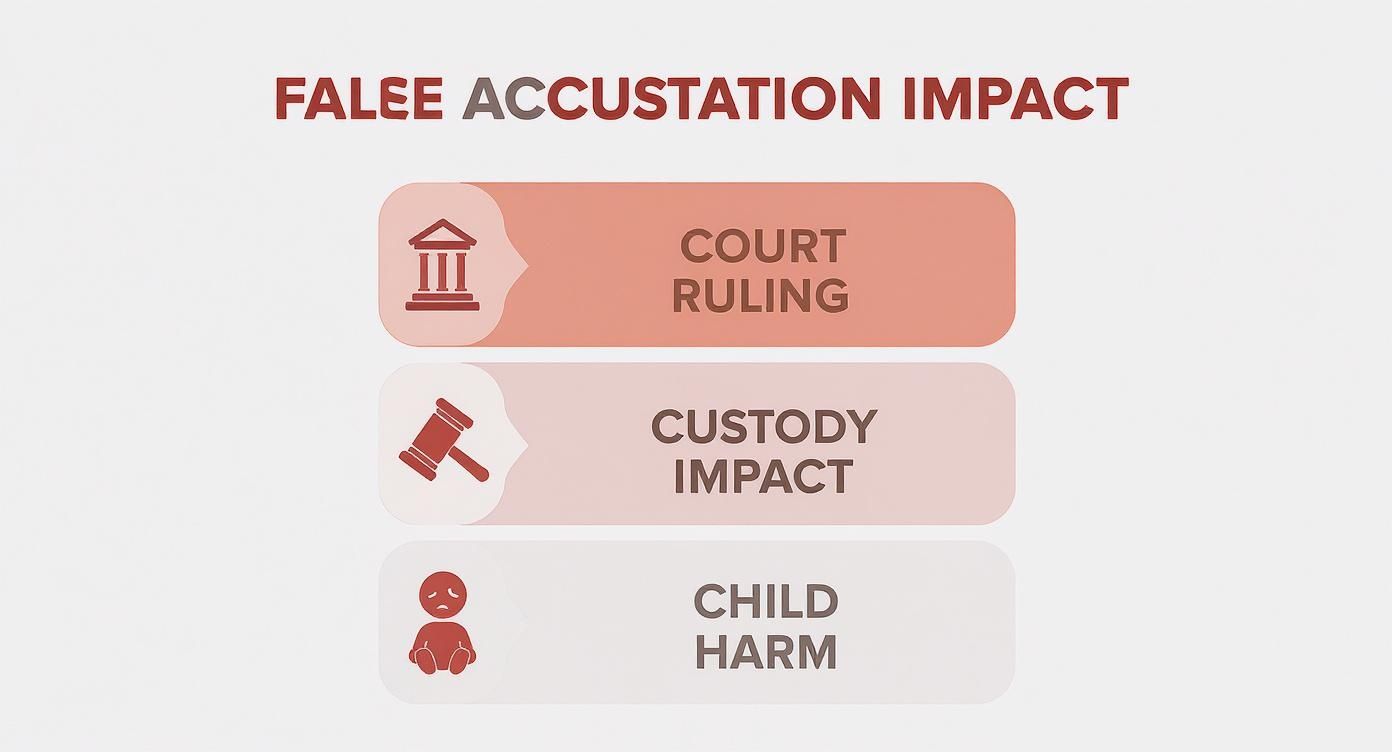
This visual draws a straight line from a court finding of dishonesty to severe, lasting consequences for the parent-child bond. It’s a stark reminder of why judges act so decisively to shield children from this kind of manipulation.
Steps to Take When Falsely Accused

Being hit with a false accusation in a custody battle can feel like the ground has vanished beneath your feet. It’s scary, infuriating, and profoundly unfair. But you are not powerless. The Texas family court system operates on evidence, and your path forward is to systematically dismantle the lies with facts.
Proving a negative—that something didn’t happen—is a challenge. It demands a calm, organized, and strategic approach. This isn't the time for emotional arguments; it’s about laying out a clear, truthful story backed by credible proof. This is your chance to show the judge not just your innocence, but your stability and unwavering commitment as a parent.
The Power of Documentation
When you're fighting falsehoods, your best weapon is a fortress of facts. Every text, email, and documented interaction helps paint the true picture for the court. Your first move should be to gather and preserve every piece of evidence that contradicts the claims being made against you.
Think of yourself as a detective building a case for the truth. The goal is to create a timeline and an evidence file so solid that the other parent's story simply falls apart under the weight of reality.
Here are the key pieces you should be collecting:
- Written Communication: Save every single text message, email, and social media post or message. These digital breadcrumbs often reveal the other parent’s real motivations, their state of mind, or glaring contradictions in their narrative.
- A Detailed Journal: Keep a calendar or a journal to document every interaction, every canceled visit, every notable event. Stick to the facts—dates, times, and exactly what was said or done. Objectivity is your ally.
- Financial Records: Receipts, bank statements, and credit card bills are surprisingly powerful. They can establish alibis, proving where you were and what you were doing at a specific time, making it impossible for a lie to stand.
Meticulous records demonstrate your credibility and responsible character to the judge, which is a massive advantage in any custody case.
Using Witnesses and Experts to Support Your Case
While your paper trail is essential, nothing beats an independent voice to vouch for you. Neutral third parties who can speak to your character and your parenting skills are invaluable. Their testimony isn't just another round of "he said, she said"—it's an objective assessment from someone with no skin in the game.
These witnesses can be people like:
- Teachers, coaches, or daycare staff who see your involvement and your child's well-being up close.
- Neighbors or neutral family friends who have witnessed your day-to-day interactions with your child.
- Therapists or counselors who can offer a professional perspective on your family’s dynamics.
In more serious cases, the court might appoint its own expert, like a custody evaluator or a psychologist. These professionals conduct in-depth interviews and evaluations to give the judge an unbiased recommendation, which can be a game-changer for exposing fabricated claims.
Key Takeaway: A judge's decision hinges on the burden of proof. While your accuser has to provide evidence to back up their claim, your job is to present stronger, more believable evidence that dismantles it. You want to make the truth the easiest and most logical conclusion for the judge to reach.
Unfortunately, false accusations are a known tactic in family court. A national survey revealed that 27% of false accusations in the U.S. happen during child custody disputes, showing just how often people try to use this strategy to gain an unfair advantage. You can read more about this troubling trend from the full survey findings on false allegations. For more tips on building a strong defense, our guide on how to prove a parent is unfit offers additional strategies you can adapt to fight back against lies.
Legal Consequences for Lying in Court
When your child’s future is on the line, the truth is everything. So, what happens when a judge discovers a parent has knowingly made false accusations? Texas law gives courts real teeth to protect your child and penalize a parent who tries to game the system.

These penalties are not about punishment for its own sake. They are about restoring a safe and stable environment for the child. A parent who lies to the court has shown incredibly poor judgment and a willingness to put their own agenda ahead of their child’s well-being. A judge’s response is designed to protect the child, first and foremost.
How a Judge Can Modify Custody and Possession Orders
The most direct consequence for a dishonest parent is a change to the custody arrangement, known legally as the conservatorship order. A judge can modify existing orders in several powerful ways to hold the accuser accountable.
One of the most common outcomes is a change to the possession order—the court-ordered schedule that dictates when the child is with each parent. If you were falsely accused, the judge might:
- Increase your parenting time: The court may award you more overnights or longer periods of possession to help you repair the damage done to your relationship with your child.
- Impose supervised visitation on the other parent: If a judge feels the other parent's behavior is actively harmful, they can order that their time with the child be supervised by a neutral third party.
In more serious situations, a judge can completely overhaul the conservatorship. While Texas law presumes that making parents Joint Managing Conservators is in a child’s best interest, that presumption is shattered by proven false allegations. This gives a judge a compelling reason to name you the Sole Managing Conservator, granting you the exclusive right to decide where your child lives and make the big decisions about their life.
Financial Consequences for False Allegations
Lying in court doesn't just come with emotional and custodial costs—it can also have significant financial repercussions. Defending yourself against baseless accusations takes time, energy, and money. Texas courts recognize how unfair this is.
Under the Texas Family Code, a judge can order the parent who made the false claims to pay your attorney’s fees and court costs. This isn't just about reimbursement; it acts as a powerful deterrent, sending a clear message that using the legal system to harass a co-parent will not be tolerated.
A judge can find that a lawsuit was filed in bad faith or for the purpose of harassment and order sanctions. This ensures that the parent who acted responsibly is not financially punished for defending the truth.
This financial accountability helps level the playing field and prevents one parent from using their financial advantage to bully the other with groundless litigation.
False Accusations as Parental Alienation
Often, a false allegation isn't just a one-off lie. It’s part of a larger, more destructive pattern of behavior called parental alienation. This is when one parent actively tries to damage or completely destroy the child’s relationship with the other parent.
Courts see this behavior for what it is: a severe form of emotional abuse. A parent who engages in alienation is fundamentally failing to act in their child's best interest. When a judge sees evidence of this, they are likely to take decisive action to protect the child from more harm, which could include ordering family therapy or making significant changes to custody.
In the most extreme cases, it can even be a factor in decisions about the termination of parental rights, a topic you can learn more about in our guide to parental rights termination in Texas. Proving that the false accusations are part of a broader alienation strategy can dramatically shift the entire outcome of your case.
Protecting Your Child (and Your Case) During the Process
While the court process unfolds, your most important job remains the same: protecting your precious relationship with your child. Facing false accusations is emotionally draining, but this is the moment to demonstrate your strength, your stability, and your unwavering love.

How you handle yourself right now will not only fortify your bond with your child but will also send a powerful message to the court about your character. This is your chance to prove you're the loving, responsible parent you know you are.
Staying Child-Focused Amidst the Chaos
The single most powerful thing you can do is keep your child out of the conflict. It’s natural to feel angry and betrayed, but your child should never be your confidant or a messenger. Venting to them or badmouthing the other parent can cause immense emotional damage and is often seen by the court as parental alienation—a major red flag.
Instead, your job is to create a safe harbor. Your time together should be a sanctuary from the storm of the custody case.
- Be Present: Put away your phone and legal papers when you're with them. Play, help with homework, and stick to familiar routines as much as possible. Consistency is their anchor right now.
- Listen Actively: Your child might be confused or anxious. Let them share their feelings without judgment. Reassure them that they are loved by both parents and that the grown-up problems are not their fault.
- Prioritize Their Well-being: Your child's mental health is paramount. If you notice your teen is struggling, getting them help is essential. Resources like a parent's guide to therapy for teens can be a lifeline.
Following Court Orders is Not Optional
One of the quickest ways to damage your own case is to disregard court orders, no matter how unfair they feel. Strictly following every detail of a temporary possession schedule shows the court you respect the legal process and are a reliable co-parent.
Never give the other parent ammunition to use against you. By following every rule to the letter—showing up on time, facilitating communication as ordered, and respecting boundaries—you build a reputation as the stable, cooperative parent a judge can trust.
If the other parent breaks the rules, do not retaliate. That just drags you down to their level. Instead, calmly document the violation and report it to your attorney. Your consistent, by-the-book approach strengthens your position and highlights the contrast between your behavior and the accuser's.
When you're hit with false accusations, your every move is under a microscope. How you react can either build your credibility or tear it down.
Effective vs. Ineffective Responses to False Accusations
| Your Response | Do This to Strengthen Your Case | Avoid This to Protect Your Case |
|---|---|---|
| Communication | Keep all communication with the other parent brief, factual, and focused only on the child. Using a co-parenting app creates a clean record. | Engaging in arguments, sending emotional texts, or firing back with your own accusations. |
| Court Orders | Follow every detail of the possession order and any other temporary rulings, even if you hate them. Document your compliance. | Withholding visitation, showing up late for exchanges, or ignoring court-mandated communication rules. |
| Social Media | Go completely dark. Do not post anything about your case, your ex, or your feelings. Assume the judge will read every word. | Posting vague complaints, emotional rants, or any details about the accusations. It will be used against you. |
| Interactions | Stay calm and polite during all exchanges. If things are tense, arrange for pickups and drop-offs in a neutral, public place. | Confronting the other parent, involving the children in disputes, or showing any visible anger or frustration. |
Ultimately, the best defense is demonstrating—through your actions, not just your words—that you are the stable, child-focused parent. Let your conduct speak for itself.
Key Takeaways and Next Steps to Protect Your Family
Going through a custody battle laced with false accusations is tough, but you are not without options. Texas law has powerful tools to hold dishonest parents accountable. Your job is to stay focused on the truth while shielding your child from the emotional crossfire.
Remember the basics: document everything, follow court orders to the letter, and keep your child out of the conflict. Every action you take should reinforce your role as the stable, reliable parent a judge can trust. When you're under a microscope like this, your calm, principled response becomes your most powerful piece of evidence.
Finalizing Your Strategy
The most important step is getting expert legal guidance tailored to your specific situation. You don’t have to fight this alone. A seasoned family law attorney can help you organize your evidence, anticipate the other side’s moves, and build a compelling case that shines a light on the best interests of the child.
Key Takeaway: While a parent can lose custody for making false accusations, the outcome hinges on presenting clear, convincing evidence to the court. Your proactive, strategic approach—guided by smart legal counsel—is the key to protecting your parental rights and securing your child's future.
Beyond the courtroom, it is also wise to understand how to protect personal information online. In high-conflict cases, locking down your digital footprint is an essential part of safeguarding your family from misuse of private data.
You have the power to move forward with confidence. By focusing on the facts, keeping your child at the center of every decision, and arming yourself with the right legal support, you can dismantle false claims and prove your unwavering commitment to your family.
If you need help with a child custody or visitation case in Texas, our experienced attorneys can guide you every step of the way. Contact The Law Office of Bryan Fagan, PLLC today for a free consultation.
Frequently Asked Questions About False Accusations
Navigating a custody case is hard enough. When your co-parent makes claims that are not just hurtful but completely untrue, it’s easy to feel overwhelmed. Below are clear answers to the questions we hear most often from parents in your exact situation. Our goal is to provide clarity and empower you to fight back with the truth as your strongest ally.
What Is the Difference Between an Unproven and a Proven False Allegation?
This is a critical distinction in the eyes of the court. An unproven allegation is a claim where the other parent fails to provide enough evidence to convince the judge. They made an accusation but couldn't back it up to the required legal standard. The judge doesn't find enough proof to act, so the case moves on.
A proven false allegation is far more serious. This occurs when you can show the court with clear and convincing evidence that the accusation was deliberately fabricated. It’s not just a "he said, she said" situation; it's you providing proof of their lie. Courts come down hard on this intentional deception because it shows a willingness to manipulate the system and harm both you and your child.
How Does a False Report to CPS Affect My Custody Case?
A false report to Child Protective Services (CPS) is a common and incredibly damaging tactic. CPS must investigate every report, which can be a nightmare for the accused parent. However, a baseless claim will almost always backfire on the accuser.
Once CPS closes the investigation and rules the report "unfounded" or "ruled out," that official finding becomes a powerful piece of evidence in your custody case. It’s a clear signal to the judge that the other parent is willing to weaponize a state agency to gain an advantage—a major red flag that they are not acting in the child’s best interest.
This official documentation from CPS can become the cornerstone of your argument to modify custody or ask the court for sanctions against the other parent for their destructive behavior.
How Long Does It Take to Resolve These Cases?
There’s no one-size-fits-all timeline. Disproving a lie isn't an overnight fix; it takes time to build a methodical, strategic case to expose the truth.
Several things can affect how long it takes:
- The seriousness and complexity of the allegations.
- The amount of evidence you need to gather (emails, texts, witness interviews, etc.).
- Whether the court orders a custody evaluation or psychological assessment.
- The specific schedule and backlog of the court handling your case.
While it can take several months to build a rock-solid defense, a seasoned family law attorney can help manage your expectations and work to resolve matters as efficiently as possible. The goal is always the same: protecting your relationship with your child.
If you need help with a child custody or visitation case in Texas, our experienced attorneys can guide you every step of the way. Contact The Law Office of Bryan Fagan, PLLC today for a free consultation.