Skip to content
When your child’s future is on the line, understanding your rights matters most. Navigating child custody can feel overwhelming, especially when your family is spread across different states. The good news is, there's a specific federal law designed to be your map: the Uniform Child Custody Jurisdiction and Enforcement Act (UCCJEA).
This law is crucial because it decides which state has the legal power—or jurisdiction—to make and enforce custody decisions. Its main job is to ensure only one court is in charge, preventing messy and confusing legal battles that hop from one state to another. For Texas parents, understanding how this works is the first step toward protecting your relationship with your child, no matter the distance.
When Your Child's Future Crosses State Lines

Facing a custody dispute that spans more than one state can leave any parent feeling anxious and overwhelmed. You might be worried about your co-parent moving away with your child or wondering how you can possibly enforce your parental rights from hundreds of miles away. These feelings are valid, and you are not alone.
Thankfully, there’s a clear legal framework designed to bring order to these exact situations. Texas, along with 48 other states, has adopted the UCCJEA to create a consistent, predictable process for families like yours. The entire point is to protect your child’s stability and ensure their case is heard in the state where they have the most significant connections.
Why This Law Is Your First Line of Defense
Think of the UCCJEA as the official rulebook that picks the referee for your custody case. It was created to stop a chaotic scenario where parents might try to "forum shop"—that is, hunt for a court in another state they think will give them a more favorable outcome.
By setting clear rules for jurisdiction, the UCCJEA makes sure that:
- Only one state has authority: This prevents conflicting custody orders from different courts, which would create a nightmare of confusion for your child and your entire family.
- The "home state" comes first: The law gives priority to the state where your child has lived for the six consecutive months right before a custody case is filed. This court is in the best position to decide what’s in your child's best interests.
- Your child's stability is everything: The whole framework is built around the "best interests of the child," which is the guiding principle in all Texas custody matters under the Texas Family Code Chapter 153.
Navigating an interstate custody case involves a mountain of paperwork. The efficiency of any legal team is boosted by effective legal case management software, which helps keep critical information and deadlines organized to build a strong case for your family.
This guide will walk you through these rules in plain English, empowering you with the knowledge to protect your parental rights, no matter how many miles separate you.
How Texas Determines Custody: The "Home State" Rule
The cornerstone of the UCCJEA is the concept of the "home state." A court in your child’s home state is the primary venue because it has the most insight into your child's life—their school, doctors, friends, and community connections.
Under Texas law, the home state is the state where your child has lived with a parent for at least six consecutive months right before a custody case is filed.
So, if your child has lived in Texas for the last six months, Texas courts almost certainly have jurisdiction. Even if the other parent moves to another state and files a case there, the UCCJEA requires that court to recognize Texas as the proper authority.
This stability is the bedrock of your child's well-being. The UCCJEA is a powerful tool for both mothers and fathers, providing a clear path forward and ensuring decisions are made in a consistent, fair legal environment.
How the UCCJEA Protects Your Family
The UCCJEA is designed to work for families, not against them. Here’s a simple breakdown of what its core principles mean for you:
- Clarity and Consistency: It designates one state—the home state—to make initial custody decisions, which eliminates confusion and legal gamesmanship.
- Enforcement Power: It allows Texas to enforce a custody order from another state, and vice versa. This means your Texas order is respected and legally binding almost anywhere in the U.S.
- Preventing Parental Kidnapping: It works alongside federal laws to deter a parent from wrongfully taking a child to another state to start a new custody case.
"The UCCJEA is not just a set of rules; it's a shield for your child. It ensures their life isn't disrupted by a legal tug-of-war and that decisions are made in the place they call home."
To help you see these rules in action, here’s a simplified table breaking down the key concepts.
Core UCCJEA Principles at a Glance
| UCCJEA Principle | What It Means for Texas Parents |
|---|---|
| Home State Jurisdiction | The state where your child lived for 6 straight months before filing is the only state that can make the first custody order. |
| Exclusive, Continuing Jurisdiction | Once the home state makes an order, it keeps control of the case unless everyone moves away or the child loses connections to that state. |
| Enforcement of Out-of-State Orders | A valid custody order from another state is just as powerful as a Texas order. You can register it here and have it enforced. |
| Temporary Emergency Jurisdiction | In rare cases of immediate danger to the child, a Texas court can step in, even if it's not the home state. This is a temporary fix. |
The UCCJEA gives you a predictable framework, which is a huge relief during a stressful time. Of course, there are rare exceptions. In emergencies where a child is in immediate danger, a court can exercise what's called temporary emergency jurisdiction. To see exactly when this might apply, you can learn more in our guide on Texas custody emergency jurisdiction.
How Texas Determines Jurisdiction When Things Aren't Simple
Figuring out which state’s court has the power to make a decision is the first—and most critical—step. The Uniform Child Custody Jurisdiction and Enforcement Act (UCCJEA) lays out a clear roadmap, but it goes deeper than the simple “home state” rule. Knowing how this works helps you predict the court’s first move.
The whole point is to find the single court best equipped to rule in your child’s best interests. This is all about preventing chaotic, state-hopping legal battles and giving your child much-needed stability.
Beyond the Home State Rule
Life isn’t always neat, and the six-month home state rule doesn't always fit. What if your family just moved? What if you have deep roots in multiple states? The UCCJEA has a clear order of operations for these scenarios.
This decision tree breaks down the logic a Texas court will use to figure out if it has jurisdiction over your child custody case.
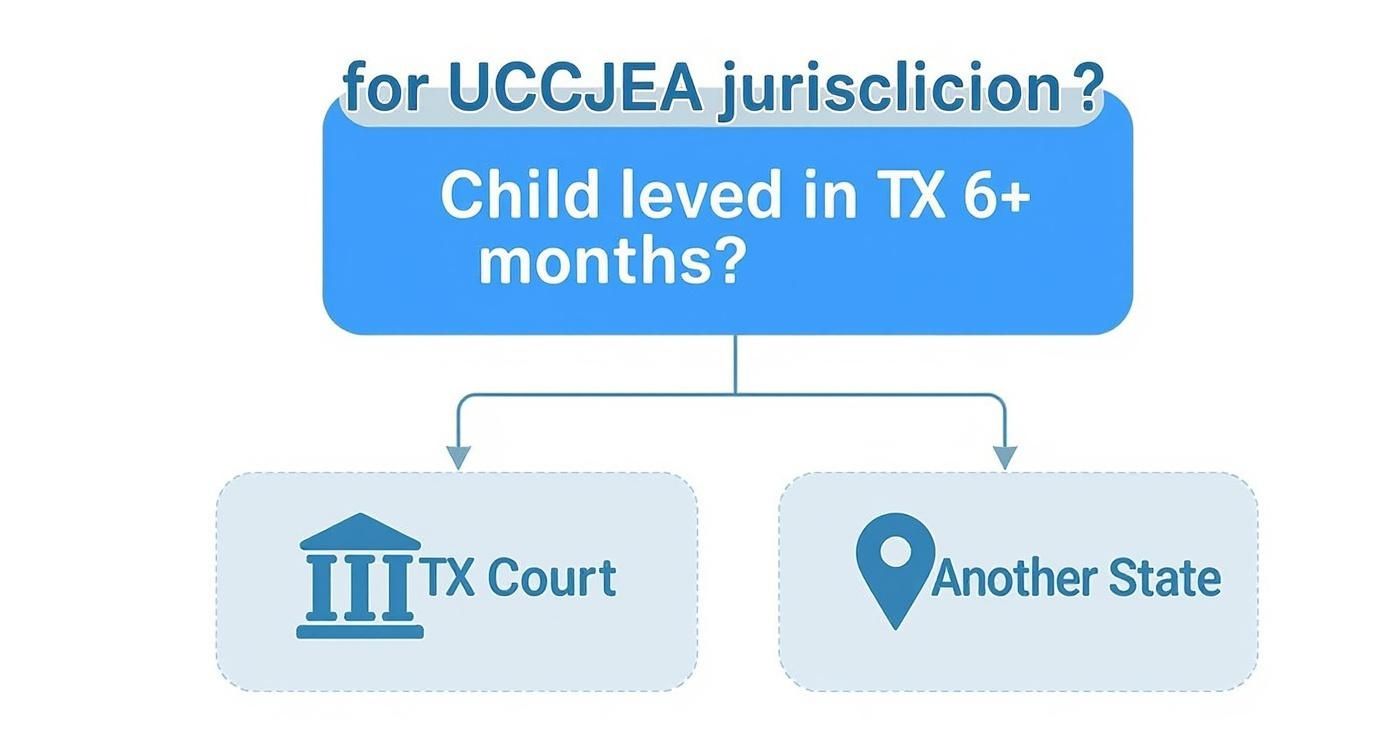
If your child hasn't lived in any single state for a full six months, the court then looks for the state with “significant connections.” This is where Texas might be able to step in, even if your child recently moved out of state.
A court will weigh things like:
- Where grandparents, aunts, uncles, and other important relatives live.
- The location of the child’s doctors, therapists, and long-time caregivers.
- Where the child has gone to school or played on sports teams.
- The state where most of the evidence about the child’s life, care, and relationships is located.
Here’s a practical example: Let’s say your child lived in Texas for four years but moved to Oklahoma with your co-parent just two months ago. If all their grandparents, their pediatrician, and their school records are still in Texas, a Texas court could argue it has significant connections and is the right place to hear the case.
What if a Custody Order Already Exists?
If a court in another state has already made a custody order, that state almost always keeps control of the case. This is a powerful concept called “exclusive, continuing jurisdiction.” Think of it this way: the original court doesn't just lose its authority because you or your child moves across state lines.
The purpose of exclusive, continuing jurisdiction is to create consistency and stop parents from "judge shopping" for a more favorable outcome in a new state. The original court knows your case history and is seen as the best place to handle any future changes.
This means you’ll almost always have to go back to that original court to ask for changes to your possession schedule or other custody terms. A Texas court simply can't modify another state's order unless that state agrees to give up its power. This usually only happens when both parents and the child have all moved away from that original state. You can learn more about how exclusive, continuing jurisdiction works in our detailed guide.
Steps to Enforce Your Custody Order Across State Lines

When your child’s future is on the line, that signed custody order is more than just a piece of paper. It’s a legally binding command designed to protect your relationship with your child. But what happens when the other parent lives in another state and decides to ignore it?
That feeling of helplessness can be overwhelming. It’s easy to worry that the distance makes your Texas order powerless. That’s not the case. The law provides powerful tools to make sure your court-ordered time is respected, no matter where your co-parent lives.
Your First Step: Registering the Out-of-State Order
If your custody order was issued in a state other than Texas, the very first thing you need to do is register it with a Texas court. This is a formal process that tells the Texas legal system, “This order from another state is valid, and I need you to recognize its authority here.”
Registering your order is a straightforward but absolutely critical step. It gives Texas courts and law enforcement the power to treat the order as if it were their own, allowing you to take immediate action if a violation happens.
"The UCCJEA was designed to give parents peace of mind. By allowing you to register and enforce your order in any member state, it ensures that your parental rights don't stop at the state line."
Once it’s registered, you can move forward with enforcement just like you would with a Texas-issued decree. Think of this process as your legal foothold, turning a document from another state into an enforceable tool right here in Texas.
Taking Legal Action Through an Enforcement Suit
When your co-parent is denying your court-ordered possession and access (visitation) or breaking other terms of your agreement, your main legal tool is to file a Petition for Enforcement. This is a formal request asking a Texas judge to step in and force the other parent to comply with the existing order.
Filing an enforcement action sends a crystal-clear message: you take your parental rights seriously, and you expect the court's decree to be followed. It’s the moment you shift from asking for compliance to legally demanding it.
When you file, you have to be specific about the violations. Be ready to detail:
- Dates and times of every instance of denied possession.
- The specific clauses of the order that were violated.
- Any attempts you made to try and resolve the issue directly with the other parent.
A clear, well-documented petition is your best friend here. If you're struggling to track down your paperwork, our guide on how to obtain a copy of your final custody order in Texas can help you get the documents you need to get started.
Potential Consequences for Non-Compliance
A Texas judge has significant power to penalize a parent who willfully ignores a custody order. These aren't just slaps on the wrist; they are serious consequences designed to compel future compliance and make up for the harm done to your parent-child relationship.
If the court finds your co-parent in contempt, it can order a number of remedies:
- Make-up visitation time to compensate for the periods you were forced to miss.
- Fines and an order to pay your attorney’s fees and court costs.
- In severe or repeated cases, jail time of up to six months for each violation.
On top of that, federal laws like the Parental Kidnapping Prevention Act (PKPA) work hand-in-hand with the UCCJEA. These laws are designed to stop a parent from taking a child to another state to "shop" for a more favorable custody ruling. They give priority to the original order and support the swift, safe return of a child.
You are not powerless when facing a co-parent across state lines. The law is firmly on your side, providing a clear path to hold them accountable and protect your precious time with your child.
Key Takeaways: Your Next Steps for Protecting Your Family
Knowing the law is one thing, but taking decisive action is what safeguards your child's future. When you're dealing with custody across state lines, the path forward demands a clear head and a firm commitment to protecting your parental rights. At the end of the day, you are your child’s most powerful advocate. Feeling empowered comes from knowing exactly what to do next.
Your Interstate Custody Checklist
Your journey through an interstate custody case really boils down to a few core principles. Keep these front and center, and you'll be in a much better position to make smart, strategic decisions that align with the court’s main focus: the best interest of your child.
- Jurisdiction is Everything: Always confirm which state has the authority to hear your case under the UCCJEA. In almost every situation, this will be the child's "home state."
- Documentation is Your Proof: Keep a meticulous record of every communication, visitation denial, and support payment. A detailed log is some of the most powerful evidence you can have.
- Formalize Everything: Never rely on a verbal agreement for relocation or major changes to your possession schedule. If it's not in a signed court order, it is not legally enforceable.
- Act Promptly: Don't sit on your rights. Any delay in enforcing your order can be misinterpreted by a court and make it harder to get the outcome your child deserves.
If you're the one planning an interstate move, it's crucial to prepare for both the legal process and the logistical details. This resource offers an essential checklist for relocating to another state that can help you get organized.
The choices you make today will shape your child's stability tomorrow. By acting with intention and seeking experienced legal guidance, you can transform uncertainty into a secure and positive outcome for your family.
You don’t have to walk through this legal minefield alone. Having a trusted advocate in your corner can make all the difference, ensuring your rights are protected every step of the way.
Common Questions from Texas Parents
When your family is split across state lines, the questions can feel endless. You're worried about your rights, your child’s future, and what the law actually says. Below, we've tackled some of the most common concerns we hear from Texas parents in plain, straightforward language.
Can I move out of Texas with my child if there is no custody order?
Even without a formal custody order, moving a child out of Texas without the other parent’s consent is a significant legal risk. The other parent can—and likely will—file an emergency action in Texas. Since Texas is almost certainly your child's "home state," a judge could order you to bring the child back immediately. Acting first and asking for permission later can seriously damage your credibility in court. It is always better to get a court order or written agreement first.
What if two different states issue custody orders?
This is the exact chaotic situation the UCCJEA was created to prevent. This law establishes that only one state gets to be in charge. The first state to correctly establish "home state" jurisdiction holds the authority. Any order from a second state is usually considered invalid. If you find yourself in this kind of legal tug-of-war, you need to contact an experienced attorney right away to protect your child's stability.
The entire purpose of the UCCJEA is to give children stability. By ensuring only one state calls the shots, it stops the chaotic back-and-forth that ultimately hurts the child the most.
How long does it take to make my out-of-state order enforceable in Texas?
The timeline depends on your needs. Registering an out-of-state order in Texas so it can be enforced here is a relatively quick administrative process—sometimes just a few weeks. However, if you need to file a formal enforcement action because the other parent is violating the order, that process is longer. It involves filing a legal petition, serving the other parent, and getting a hearing scheduled. An experienced family law attorney can help you navigate this process as efficiently as possible to protect your time with your child.
If you need help with a child custody or visitation case in Texas, our experienced attorneys can guide you every step of the way. Contact The Law Office of Bryan Fagan, PLLC today for a free consultation at https://texascustodylawyer.net.