
When your child’s future is on the line, every second counts. An emergency custody order in Texas is a powerful legal tool designed for exactly these moments—it's a temporary court order that provides immediate protection for a child believed to be in imminent danger of physical or emotional harm. This isn't your standard custody hearing; it's a rapid, urgent intervention reserved for the most serious circumstances, and understanding your rights matters most.
What Is an Emergency Custody Order?

Think of an emergency custody order as the legal equivalent of a first responder. Its one and only job is to get a child out of a dangerous situation right now and create a safe, stable environment while the courts sort out the bigger picture. Unlike a standard custody case that can take months to resolve, this process is built for speed.
This type of order is often granted ex parte—a legal term that simply means a judge can make an initial ruling based on one parent's side of the story, without the other parent even being present. This only happens when there's a real fear that notifying the other parent would put the child at even greater risk, like giving them a chance to disappear with the child or cause more harm.
It’s absolutely critical to understand that this is a temporary fix. It's a legal "band-aid" meant to last for a short time, usually around 14 days. It is not a permanent custody change. Its purpose is to protect the child now and pave the way for a more detailed follow-up hearing where both parents get to present their cases.
The Legal Foundation for Emergency Action in Texas
These urgent actions aren't just made up on the fly; they're grounded firmly in Texas law. The process for getting an Emergency Custody Order (ECO) is designed specifically for situations where a child's safety is on the line.
Under Texas Family Code Chapter 105, courts can issue these orders when a child is in immediate danger from abuse, neglect, or other hazardous conditions. Because of the urgency, courts don’t hand these out lightly. The law allows them to act fast to protect a child's welfare, prioritizing safety above all else.
Demystifying Key Custody Terms
When you're thrown into an emergency custody situation, you're going to hear a lot of legal jargon. Knowing what these terms actually mean can help lower your stress and give you the confidence to move forward.
Here are a few core concepts in plain English:
- Conservatorship: This is simply the Texas legal term for custody. It outlines a parent's rights and responsibilities to make important decisions for their child, such as those concerning education and healthcare. In most cases, Texas courts prefer a Joint Managing Conservatorship, where both parents share these rights and duties.
- Best Interest of the Child: This is the single most important rule a Texas judge follows for any decision involving a child. The court will always put the child’s physical and emotional well-being first, considering their safety, needs, and stability above all else.
- Possession Schedule: This is the detailed calendar that determines when the child will be with each parent. It’s what most people think of as a visitation schedule.
- Temporary Restraining Order (TRO): A TRO often goes hand-in-hand with an emergency filing. It’s a court order that can immediately stop a parent from doing certain things, like taking the child out of school, harassing you, or trying to hide financial assets.
The core principle is simple: if a child is in immediate danger, the court's priority is to protect them first and sort out the details later. This legal framework ensures that a parent's fear for their child's safety can be met with swift, decisive action.
Seeking an emergency order is a serious step, but for a parent, grandparent, or caregiver facing a true crisis, it is an essential lifeline. It validates your concerns and gives you a clear path to ensuring your child’s immediate safety. To learn more, check out our guide on understanding Texas custody emergency jurisdiction, which goes into more detail on these urgent matters.
When You Can Get an Emergency Custody Order
How do you know if your family’s crisis is a true legal emergency? It’s a question that keeps any parent up at night when they’re facing a scary situation with their child. In Texas, courts don’t grant emergency custody orders lightly. They are reserved for situations where a child faces a clear and immediate threat of physical or emotional harm.
Not every gut-wrenching disagreement qualifies. The legal bar is set incredibly high because these orders can temporarily strip a parent of their fundamental rights, often without them even being in the room to defend themselves.
The key phrase is imminent danger. This isn't about something that happened last year or a general worry about the other parent's new partner. It’s about a real, credible threat that could harm your child right now or in the very near future. You have to show the judge that waiting for a regular hearing would be like leaving your child in a burning building.
This infographic gives you a quick visual breakdown of the thought process you should go through before taking this serious step.
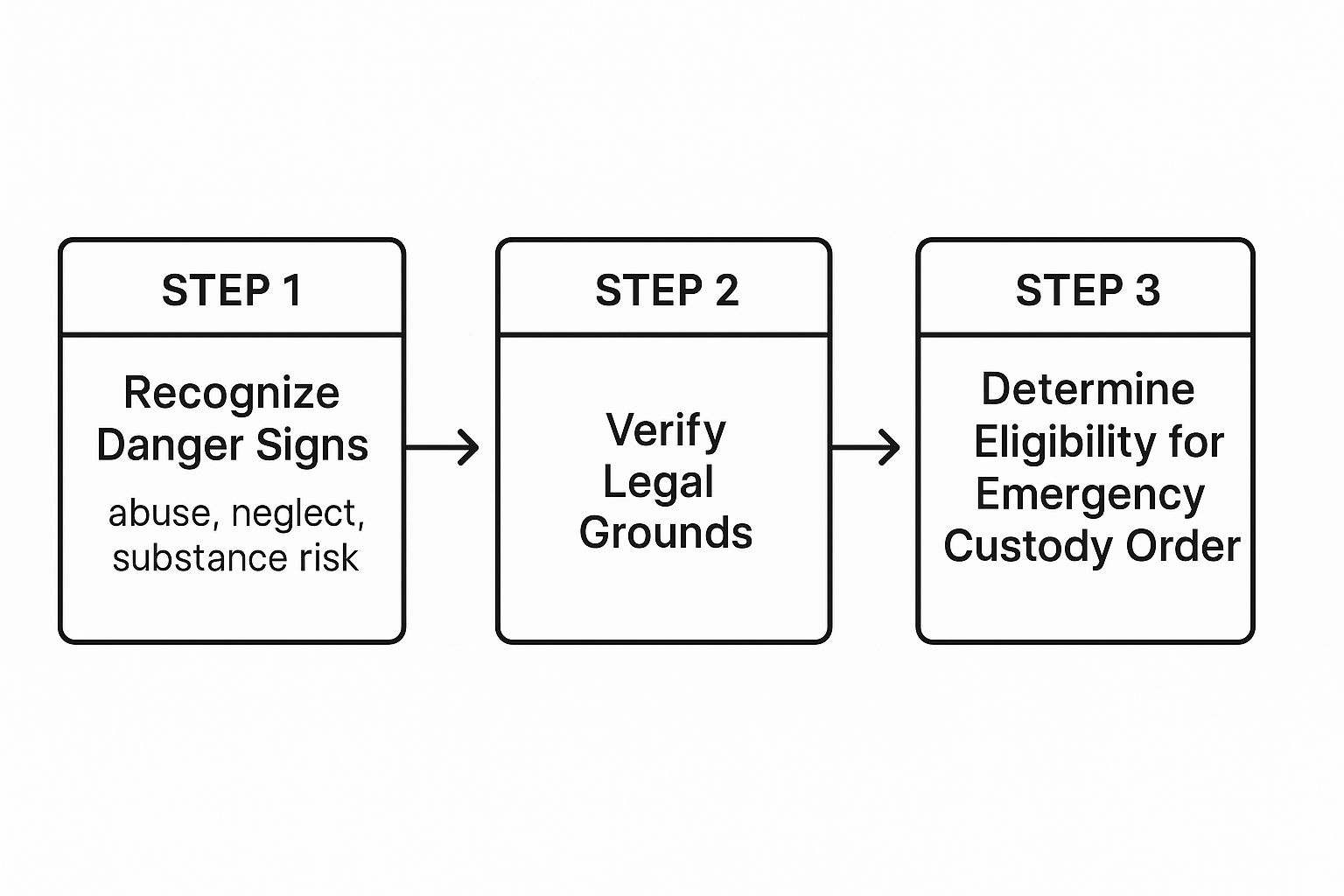
Walking through these steps—from spotting the danger to making sure it meets the legal test—is a crucial mental checklist for any parent considering an emergency order.
Grounds That Justify an Emergency Order
To get a judge to act, you need to present cold, hard facts—not just feelings or fears. Vague accusations that the other parent is "unstable" won't cut it. The judge needs concrete proof of an immediate threat.
Here are some common situations that typically meet that high standard in Texas:
- Physical or Sexual Abuse: This is the most straightforward reason. Any credible evidence of recent physical harm, injury, or sexual abuse directed at the child is grounds for immediate action. For example, if your child comes home with unexplained bruises and tells you the other parent did it, that's an emergency.
- Severe Neglect: This is more than just a messy house or a picky eater. We're talking about a parent failing to provide basic necessities like food, shelter, medical care, or proper supervision to the point that it creates a dangerous environment. Leaving a young child home alone for hours is a clear example.
- Parental Substance Abuse: A parent’s drug or alcohol use becomes an emergency when it directly endangers the child. This isn't about having a beer after work; it’s about driving drunk with the child in the car, exposing the child to illegal drug use, or being so impaired they can’t safely care for the child.
- Credible Threats of Abduction: If the other parent has flat-out threatened to take your child and run, or has started taking steps to do so (like quitting their job, selling their house, or getting a passport for the child behind your back), a judge can issue an emergency order to keep the child in the state.
The court has one job here: protect the child. The entire legal process is designed to move at lightning speed when a child is at risk, prioritizing their well-being above all else.
The Difference Between an Emergency and a Disagreement
It is absolutely vital to know the difference between a true emergency and a serious co-parenting conflict. Disagreements over parenting styles, bedtimes, diets, or screen time—while incredibly frustrating—do not rise to the level of imminent harm. An emergency order is not the right tool to settle a fight over homework or video games.
A judge is looking for evidence that a child’s physical safety or emotional well-being is genuinely at risk. For example, a fight over screen time is a parenting issue. But if a parent is exposing a child to violent, graphic, or sexually inappropriate online content that is causing obvious emotional distress, that could cross the line into emotional endangerment. Emergency Custody Orders in Texas are granted mostly in cases involving this type of immediate danger, with family violence and neglect being leading causes for these urgent interventions. You can discover more insights about these emergency interventions on flatironlegal.com.
To help you see the line more clearly, here’s a breakdown of what often qualifies versus what usually doesn’t.
Valid vs. Insufficient Grounds for an Emergency Custody Order
| Situation | Likely Qualifies for ECO? | Why or Why Not? |
|---|---|---|
| Parent was arrested for a DWI with the child in the car. | Yes | This is a direct, immediate threat to the child's physical safety. The parent's impaired judgment created a life-threatening situation. |
| Parent allows the child to stay up too late and eat junk food. | No | This is a difference in parenting style, not imminent harm. It doesn't create an immediate threat to the child's physical or emotional safety. |
| Parent has a history of drug use but is currently in recovery and passing tests. | No | The danger is not "imminent." While it's a valid concern for a standard hearing, there is no immediate threat if they are sober. |
| Parent is threatening to take the child out of the country and has applied for passports. | Yes | This shows a credible, immediate risk of international abduction. The parent is taking concrete steps to flee. |
| Parent refuses to help with homework and the child's grades are slipping. | No | While serious, this is an educational and co-parenting issue, not a matter of immediate physical or emotional danger. |
| Child comes home with bruises and says the other parent's partner did it. | Yes | The child is being physically abused in the other parent's home, which constitutes an immediate and ongoing danger. |
Understanding this distinction is crucial. Filing an emergency motion without strong enough grounds can damage your credibility with the court and waste time and money. For both mothers and fathers, it's important to know that in many cases where the situation is serious but not an immediate emergency, a standard Temporary Orders hearing is the better and more effective path forward.
How to File for an Emergency Order Step by Step

When you believe your child is in immediate danger, the legal system can feel like an intimidating maze of paperwork and procedures. It's overwhelming. But breaking the process down into clear, manageable steps can turn that mountain into a series of hills you can climb, one at a time.
Taking that first step is often the hardest, but it’s the most critical one you can make. This guide is designed to walk you through exactly what’s needed to file for an emergency custody order in Texas, giving you a roadmap to follow so you can act with confidence.
Step 1: Draft the Initial Legal Documents
The very first thing you need to do is formally ask the court to step in. This isn’t a single form, but a collection of legal documents that work together to open your case and state what you’re requesting.
At the core is the Petition in Suit Affecting the Parent-Child Relationship (SAPCR). This is the main document that kicks off any custody case in Texas. Alongside it, you’ll file an Application for a Temporary Restraining Order (TRO) and Temporary Orders, which is your specific request for emergency action.
Think of these documents as laying the legal foundation for everything that follows. They identify the parents and the child, confirm the court has the authority to hear your case, and officially ask the judge to grant an emergency order to protect your child’s immediate safety. When drafting these critical papers, many attorneys and individuals use tools like legal dictation software to work more efficiently and ensure every detail is captured accurately.
Step 2: Write a Powerful Sworn Affidavit
If the legal petition is the skeleton of your case, the affidavit is its heart and soul. An affidavit is your story, told in a written statement that you sign under oath, swearing that every word is true. It’s your one chance to speak directly to the judge before they make an initial decision.
A weak affidavit will sink your case before it even starts. This isn't the place for vague feelings or general complaints. It needs to be a detailed, fact-based narrative that paints an undeniable picture of the imminent danger your child is in.
To make your affidavit as effective as possible, keep these tips in mind:
- Be Specific and Factual: Don't say the other parent is "irresponsible." Instead, describe exactly what happened: "On Tuesday, May 21, 2024, at 8:00 PM, John Doe left our six-year-old child, Jane, home alone for three hours while he went to a bar."
- Use a Chronological Order: Tell the story as it unfolded. Start with the earliest relevant event and build up to the most recent incident that made you realize you needed to file.
- Include Dates, Times, and Locations: The more precise you are, the more credible your story becomes. Specific details show the judge you're recalling actual events, not just making accusations.
The affidavit is often the first—and sometimes only—document a judge will read before deciding whether to grant an ex parte order. It must be clear, credible, and focused on demonstrating immediate harm.
Step 3: File with the Correct Court
Once your documents are drafted and your affidavit is signed and notarized, the next step is filing them with the right court. In Texas, family law cases are handled in district courts or county courts at law. It is absolutely crucial to file in the correct county—which is almost always where the child has lived for the past six months.
Filing in the wrong county can cause massive delays or even get your case thrown out, forcing you to start all over. To make sure you’re in the right place, our guide on filing for custody in the correct Texas county offers more detailed tips. After you file, the court clerk will give your case a cause number and assign it to a specific judge.
Step 4: Attend the Ex Parte Hearing
With your case officially filed, your attorney will take your TRO application and affidavit to the judge for an ex parte hearing. The term "ex parte" just means the hearing can happen with only your side present, without notifying the other parent ahead of time. This is only allowed in genuine emergencies where giving advance notice could put the child in even greater danger.
This is usually a very brief meeting. The judge will read your affidavit and might ask a few questions to clarify the facts. Their only goal is to decide if your child is truly in immediate danger. If they agree, they will sign the TRO. That order goes into effect the moment it’s signed and sets a formal hearing within 14 days where both parents can appear and be heard.
Building Your Case with Strong Evidence
An emergency custody order is won or lost based on the strength of your proof. When you walk into a courtroom asking a judge to take the drastic step of removing a child from a parent, your words alone just won't cut it. You have to present a clear, compelling case built on solid evidence that proves there's an immediate and serious risk to your child’s well-being.

Think of it as creating a factual story that a judge can quickly understand and act on. Your goal is to show, not just tell, the judge why waiting for a standard hearing would put your child in harm's way. A well-organized case with credible proof is the most powerful tool you have.
The Power of Your Sworn Affidavit
The affidavit is the absolute cornerstone of your emergency filing. It's your sworn testimony in writing, and it’s often the first and only thing a judge reads before making an initial decision. It has to be detailed, factual, and laser-focused on establishing a clear pattern of danger.
A strong affidavit includes:
- Specific Dates and Times: Instead of saying "he's always drunk," you need to state, "On Friday, June 7, 2024, at 6:00 PM, he drove with our child in the car after drinking six beers."
- Direct Quotes: If the other parent said something threatening, quote it directly. For example, "He told me, 'If you try to leave, you'll never see your son again.'"
- Descriptions of Events: Paint a clear picture of what happened. Describe the environment, the specific actions taken, and how the child reacted.
This level of detail transforms your affidavit from a list of complaints into a credible account of events. It gives the judge the concrete facts needed to justify an emergency custody order in Texas.
Gathering Different Types of Evidence
While your affidavit tells the story, your supporting evidence is what proves it. Think of it like building a puzzle. One piece might be a text message, another a police report. When you put them all together, they reveal the full picture of the danger your child is facing. To build your case effectively, you have to understand the different types of evidence, especially documentary evidence, and how it's used in court.
The judge’s primary duty is to protect the child based on the Texas Family Code’s “best interest of the child” standard. Your evidence must clearly show that immediate intervention is necessary to uphold that duty.
Key Evidence to Collect
Organizing your proof is just as important as gathering it. You want to present a clear, easy-to-follow case that highlights the most critical information without overwhelming the judge.
Here are some of the most impactful types of evidence to include:
- Police Reports and CPS Records: Official reports from law enforcement or Child Protective Services are incredibly powerful. They provide a neutral, third-party account of incidents involving violence, neglect, or substance abuse.
- Medical Documents: Records from a doctor or hospital detailing injuries, or a therapist's notes on a child's emotional distress, offer professional validation of the harm being caused.
- Digital Communications: Save every relevant text message, email, and social media post. A screenshot of a threatening message or a photo of a parent passed out from substance use can be undeniable.
- Photos and Videos: Visual evidence can be extremely compelling. A photo of a trashed, unsafe home environment or a video of erratic behavior speaks volumes in a way words sometimes can't.
- Witness Statements: A written statement from a credible, neutral third party—like a teacher, school counselor, or neighbor who has witnessed the dangerous behavior—can significantly strengthen your case. Their unbiased observations can corroborate your story and add immense credibility.
By carefully collecting and organizing these pieces of evidence, you empower the judge to see the situation through your eyes and take the decisive action needed to protect your child. This preparation is the key to successfully obtaining an emergency custody order and ensuring your child's immediate safety.
What Happens After the Judge Grants the Order
When a judge signs your emergency order, the feeling is pure relief. You’ve just taken a huge, necessary step to get your child out of harm’s way, and a court has agreed the danger is real. It’s a massive victory, but it's important to know this is the first step, not the last one.
Think of the emergency order—often called a Temporary Restraining Order (TRO)—as a legal shield. It’s designed for immediate, short-term safety. Under Texas law, this shield typically only lasts for 14 days.
This initial order was granted ex parte. That’s a legal term meaning the judge made the decision based only on your side of the story because of the immediate danger. Now, the process has to shift to give the other parent their legal right to be heard. The emergency order is really just a bridge to a more formal hearing where both of you can present your cases.
Serving the Other Parent and Preparing for the Next Hearing
Once the judge signs the order, it’s not automatically in effect. The other parent has to be officially notified through a legal process called "service." This is a critical step you absolutely cannot skip.
You can't just hand the papers to them yourself. An authorized third party, like a sheriff's deputy or a professional process server, has to do it. This official delivery does two key things:
- Provides Legal Notice: It formally tells the other parent that a court case exists and that an order has been issued against them.
- Sets the Next Court Date: The paperwork includes the date, time, and location of the follow-up hearing.
This next court date is usually a Temporary Orders Hearing, and it’s scheduled fast—within that 14-day window while the emergency order is still active. At this hearing, the judge will listen to both sides and decide on a more detailed temporary custody plan that could stay in place for the rest of your case. Getting a handle on what to expect is crucial, and you can learn more by reviewing the typical Texas child custody case timeline.
Remember, the emergency order is a temporary safeguard. The upcoming Temporary Orders Hearing is your opportunity to present your full case and argue for a longer-term arrangement that continues to protect your child's best interests.
What if the Emergency Order is Denied?
Hearing a judge deny your request is devastating. It can feel like your worst fears were just dismissed. But a denial is not the end of the road. It just means the situation didn't meet the extremely high legal bar for imminent physical or emotional harm that’s required for an immediate, one-sided (ex parte) order.
A denial doesn't mean the judge thinks you're wrong. It simply means they need to hear from both sides before making any decisions that affect parental rights.
If your request is denied, your attorney will immediately pivot to setting a standard Temporary Orders Hearing. It still happens on an accelerated timeline, and it gives you a formal chance to present all your evidence and make your case for the protections your child needs. It’s just a different path to the same destination: keeping your child safe.
Common Questions About Emergency Custody in Texas
When your child’s future is on the line, the questions can feel overwhelming. The fear and uncertainty of an emergency situation bring a rush of urgent concerns about what to do next. We’ve been there with countless parents, and in this section, we’re providing direct, clear answers to the most common questions we hear about getting an emergency custody order in Texas. Our goal is to give you the practical clarity you need to move forward with confidence.
How Fast Can I Get an Emergency Custody Order?
The entire process is built for speed. In many cases where a child is in immediate danger, it's possible to file a petition and have an initial hearing with a judge on the very same day or within 24 to 48 hours.
This first hearing is usually ex parte, which is a legal way of saying only your side is present. If the judge agrees that there’s a genuine, imminent threat, they will sign a Temporary Restraining Order (TRO) that goes into effect immediately. A follow-up hearing where both parents will be present is then scheduled, usually within 14 days.
What if I Don't Have a Police Report?
While official documents like police or CPS reports are incredibly powerful, they aren’t the only way to prove your case. Far from it. The court will consider any credible evidence that shows a threat to your child's safety.
Strong evidence can also include:
- A Detailed, Sworn Affidavit: Your own written testimony is the cornerstone of your case. Be specific with dates, times, and descriptions of what happened.
- Digital Communications: Text messages, emails, or social media posts that contain threats, admissions, or show a parent’s instability can be undeniable proof.
- Photos and Videos: Visual evidence speaks volumes. A picture of an unsafe environment, injuries, or a parent's incapacitation can make the danger real for a judge.
- Witness Statements: Corroborating statements from neutral third parties like teachers, counselors, or neighbors can add significant weight to your claims.
Remember, a judge’s primary goal is to assess the immediate risk to the child. A collection of compelling evidence, even without a police report, can effectively demonstrate that risk and justify an emergency order.
Does an Emergency Order Permanently Change Custody?
No, and this is a critical point to understand. An emergency order is a temporary solution—think of it as a legal "band-aid" designed to protect a child right now. It does not permanently change your underlying custody arrangement, which Texas law calls “conservatorship.”
That said, what happens in these early stages matters. The evidence presented and the judge's findings at the emergency hearing can significantly influence the final outcome of your case. These initial decisions often set the tone for the long-term custody determination made later on.
What Happens if the Judge Denies My Request?
Hearing a judge deny your request can be heartbreaking, but it is not the end of the road. A denial usually means the situation, while serious, didn't meet the very high legal standard of "imminent physical or emotional harm" required for an immediate, one-sided order.
It’s not a judgment on you or your credibility; it's a procedural decision based on a strict legal threshold. Your attorney can immediately pivot and file a standard Request for Temporary Orders. This process addresses the same safety and custody issues on a slightly less urgent timeline but is still a powerful and effective tool for protecting your child as your case moves forward.
Key Takeaways and Next Steps
You’ve already taken the first, and often hardest, step: educating yourself. Understanding what an emergency custody order in Texas really is gives you a foundation, but now it’s time to turn that knowledge into action. The path forward from here isn’t about panic; it’s about a clear, strategic approach.
Think of it like preparing for a storm. You know it’s coming, so you gather your supplies, board up the windows, and have a solid plan. Securing your child's well-being works the same way. Your immediate priorities are documentation, organization, and getting professional legal guidance on your side—fast.
Your Immediate Action Plan
Before you ever step foot in a courthouse, you need to build your case. Each one of these tasks creates a stronger foundation, showing the judge you’re a proactive, responsible parent focused squarely on your child’s best interests.
- Document Everything: Start a journal or log right now. Write down every incident, conversation, or concern with dates, times, locations, and the specific details. No detail is too small.
- Organize Your Evidence: Gather all of your proof—text messages, emails, photos, police reports—and put it all into a single, organized folder. A well-prepared case is always a more persuasive one.
- Seek Professional Guidance: Please, don’t try to do this alone. The Texas Family Code is a maze, and one wrong turn can have serious consequences for your child.
The Texas family court system is built to shield children from harm. A knowledgeable attorney is your most powerful tool for making that system work for your family and ensuring the judge hears your story, loud and clear.
If you need help with a child custody or visitation case in Texas, our experienced attorneys can guide you every step of the way. Contact The Law Office of Bryan Fagan, PLLC today for a free consultation.