
When you learn your child may not be safe, everything else drops away. You stop thinking about schedules, school pickups, and polite co-parenting, and you start thinking about one thing, getting your child protected right now. That's exactly where emergency and ex parte custody orders come in, and it's also where many parents get blindsided by the legal reality, getting the order is only the first battle.
Texas courts can move fast when the facts show immediate danger, but they do not hand out emergency relief because parents are angry, scared, or locked in a bad breakup. Judges want concrete proof, a narrow legal basis, and a showing that waiting for the normal process could put a child at risk. In plain English, these orders are for true emergencies, not for gaining an advantage in a custody fight.
When Your Child's Safety Cannot Wait
A parent usually calls a lawyer after something has already happened, not before. Maybe your child came home with an unexplained injury. Maybe the other parent texted threats about taking the child out of state. Maybe you found messages, photos, or location-sharing evidence that made your stomach turn. In that moment, you do not need theory. You need a path.
Emergency custody relief exists for moments like that. Courts use it when the harm is urgent enough that a normal hearing would come too late. That is the same emergency-first logic reflected in custody practice and in other court systems that treat emergency procedures as short-term interventions for immediate danger, not permanent changes. A judge is looking for a present risk, not a general history of conflict.
What Texas judges care about first
Texas family courts still center everything on the best interests of the child, which is the core standard under Texas Family Code Chapter 153. That phrase sounds broad, but in an emergency it gets very practical. The court wants to know whether a child needs protection now, whether one parent can keep the child safe, and whether delay itself would make things worse.
That's why emergency custody is different from a standard dispute over possession schedules or joint managing conservatorship. A normal case can usually wait for notice, responses, and a hearing. A true emergency cannot. If the facts are strong enough, the court can act before the other parent is present, because the child's safety comes first.
Practical rule: If the situation can safely wait for a regular hearing, it usually doesn't belong in emergency court.
For Texas parents, that distinction matters. Mothers, fathers, and grandparents often assume urgent feelings are enough. They're not. You need facts that show immediate danger, and you need to present them clearly. If you're sorting out what happens while a case is still pending, this overview on Temporary Custody Orders During a Texas Case is a useful companion because it explains the ordinary temporary path emergency relief is meant to bypass.
Understanding Emergency and Ex Parte Custody Orders
People mix these terms up all the time, and that confusion can cost a parent time. Emergency custody order is the umbrella idea. Ex parte means the judge can act without the other parent being in the room or heard first. In practice, emergency relief is often requested ex parte because the whole point is to prevent harm before notice would do more damage.
The key point is simple. An ex parte order is not a final custody win. It is a temporary shield, designed to hold only until the court can hear both sides. Courts do this because due process still matters, but child safety can justify a short delay in giving the other parent notice.
| Feature | Emergency Ex Parte Order | Standard Temporary Order | Final Custody Order |
|---|---|---|---|
| Notice to the other parent | Usually no prior notice | Yes, the other side is usually notified | Yes, both sides have had their day in court |
| Main purpose | Stop immediate harm | Stabilize custody while the case is pending | Set long-term custody and possession rights |
| Timing | Fast, sometimes same-day review | Scheduled hearing after notice | Entered after trial or settlement |
| Legal focus | Immediate danger, irreparable harm, urgent risk | Interim parenting arrangement | Best interests of the child after full evidence |
That table is the heart of it. Emergency relief is about the crisis right now. Temporary orders are about managing the case while it moves forward. Final orders resolve custody for the long haul, including decision-making, possession schedules, and conservatorship terms.
Texas Family Code Chapter 153 still frames the bigger custody picture. Joint managing conservatorship is common in Texas, but it does not mean both parents automatically share equal parenting time. It means both may have rights and duties, though one parent may still have the exclusive right to decide where the child lives or how specific decisions are made. In an emergency, those rights can be narrowed temporarily if the court finds that's necessary for safety.
A parent should also understand the difference between a strong filing and a rushed one. Courts see emergency requests as exceptional, not routine. The more the request looks like a shortcut in a custody fight, the less likely it is to survive.
Legal Standards Texas Courts Use to Grant Emergency Relief
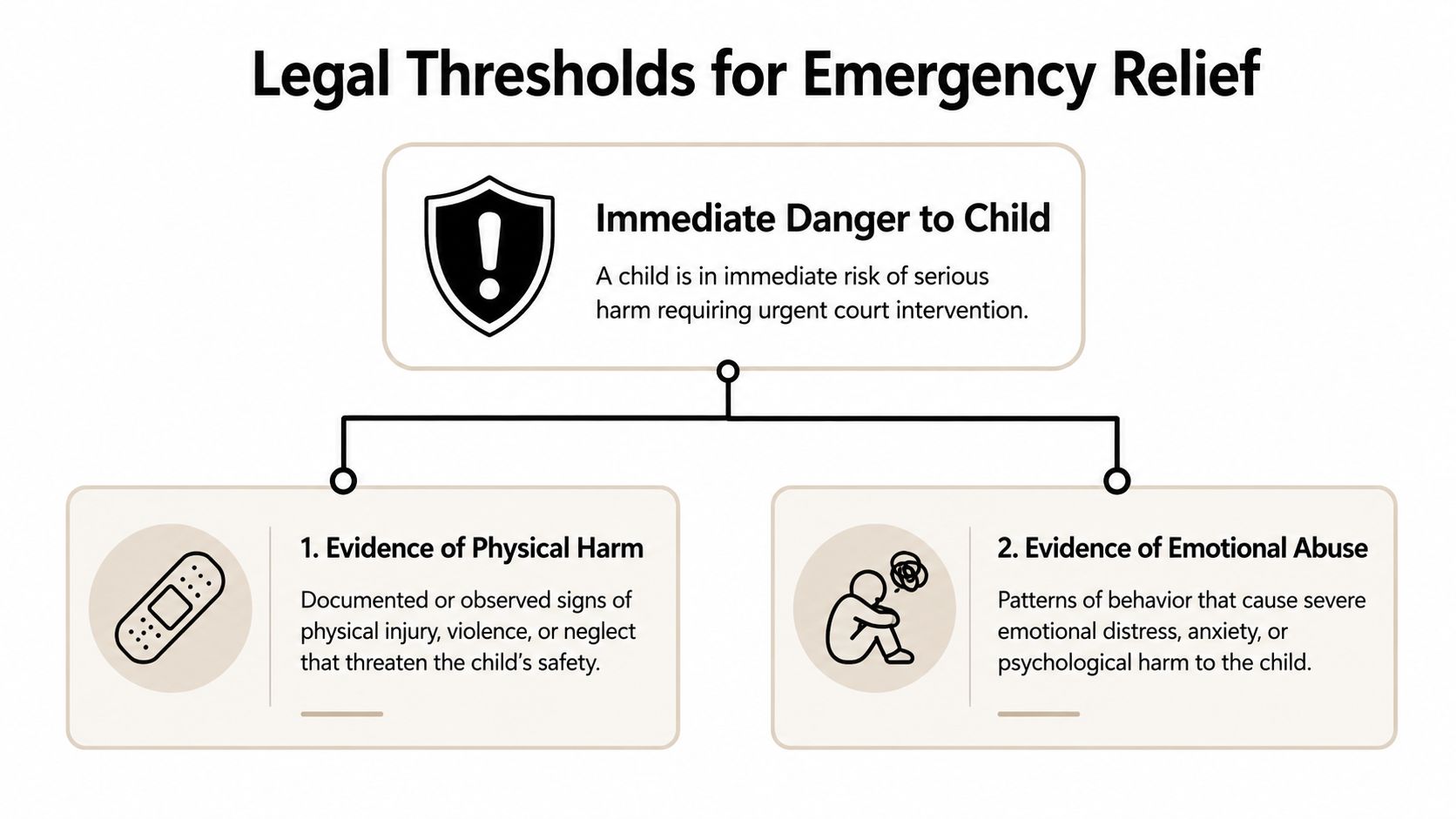
Texas judges do not grant emergency custody because one parent is difficult, controlling, or impossible to negotiate with. They grant it when the evidence points to immediate danger or irreparable harm. That is the standard that matters, and it is a high one for a reason. Emergency orders cut off the other parent's chance to respond before the first ruling, so the court wants a clear, specific, evidence-backed story.
What moves a judge
Courts look for a real danger tied to a specific child, not general fear or frustration. That can include the risk that a child will be taken away, hidden, or exposed to violence, but the key is always the same, the harm has to be immediate enough that waiting would be unsafe. Emergency power is narrow by design. Courts use it only when the child is in danger, not when a parent wants faster relief in an ordinary custody dispute. For a Texas-focused overview of that threshold, see this Texas custody guide.
Texas self-help materials say an emergency ex parte request must show immediate danger, including irreparable harm, a risk the child will be taken from California, or loss or damage to property. California's filing guidance also requires very specific paperwork and mechanics, which reinforces the bigger point. Emergency court is rule-driven and tightly limited. The same logic applies in Texas.
Bottom line: If the facts look like a regular custody disagreement, the court will probably send you back to the normal process.
Best interests still control
The best interests of the child standard does not disappear just because the filing is urgent. It still sits on top of everything else. If the judge thinks the child is safer staying put than moving, or that the requested order reaches farther than needed, the request can be narrowed or denied.
Parents need to think like proof gatherers, not arguers. A judge is not weighing who is more upset. The court is weighing risk, timing, and credibility. The parent who can show those things with clarity is in the stronger position.
Evidence and Affidavit Requirements That Make Your Filing Strong
Emergency custody lives or dies on evidence. A bare accusation rarely gets far, and it should not. Courts want proof that can be checked, not just a parent's fear written in a hurry. That means your affidavit needs dates, times, specific acts, and a direct explanation of why the child faces immediate harm.
The most persuasive filings usually include concrete records like police reports, medical records, CPS documentation, photos, text messages, and sworn witness statements. Courts are more likely to trust evidence that already exists outside the parent's memory. That's especially true when the issue involves injury, neglect, intoxication, stalking, or threats.
Digital evidence matters more than most parents realize
A lot of emergency harm now shows up on a phone screen. Screenshots, location data, message logs, and records from encrypted apps can matter a great deal if they are preserved correctly. What hurts parents is not always the absence of evidence. It's sloppy evidence, incomplete screenshots, missing timestamps, or messages that can't be tied clearly to the other parent.
That's why digital proof has to be handled carefully. Save the original file if you can. Capture the full thread, not just one dramatic line. Preserve the date, sender, recipient, and surrounding context. If the issue involves threats or online abuse, keep the content exactly as it appeared before it disappears.
The public court materials in California show that judges and clerks are still formalizing how short-notice emergency requests work, but they rarely explain what digital proof is strong enough and what is too speculative. That gap is real, and Texas parents feel it too. A declaration that says “I'm scared” won't carry the same weight as a message thread showing a specific threat tied to a pickup time, a location, or an abduction risk.
Preserve the record first, argue second. If a message matters, save it before the other side deletes it.
What belongs in the affidavit
A good affidavit tells a short, factual story. It should explain what happened, when it happened, who saw it, what documents support it, and why the child is in danger right now. It should also avoid exaggeration. Judges notice when a filing reads like a vent session instead of a sworn statement.
If you need a practical model for how a strong initial packet is assembled, the article on how to file emergency custody is a helpful reference for organizing your paperwork before anything is submitted. That kind of preparation matters because emergency filings are often decided on the written materials first.
Filing Steps and What Happens After the Order Is Granted
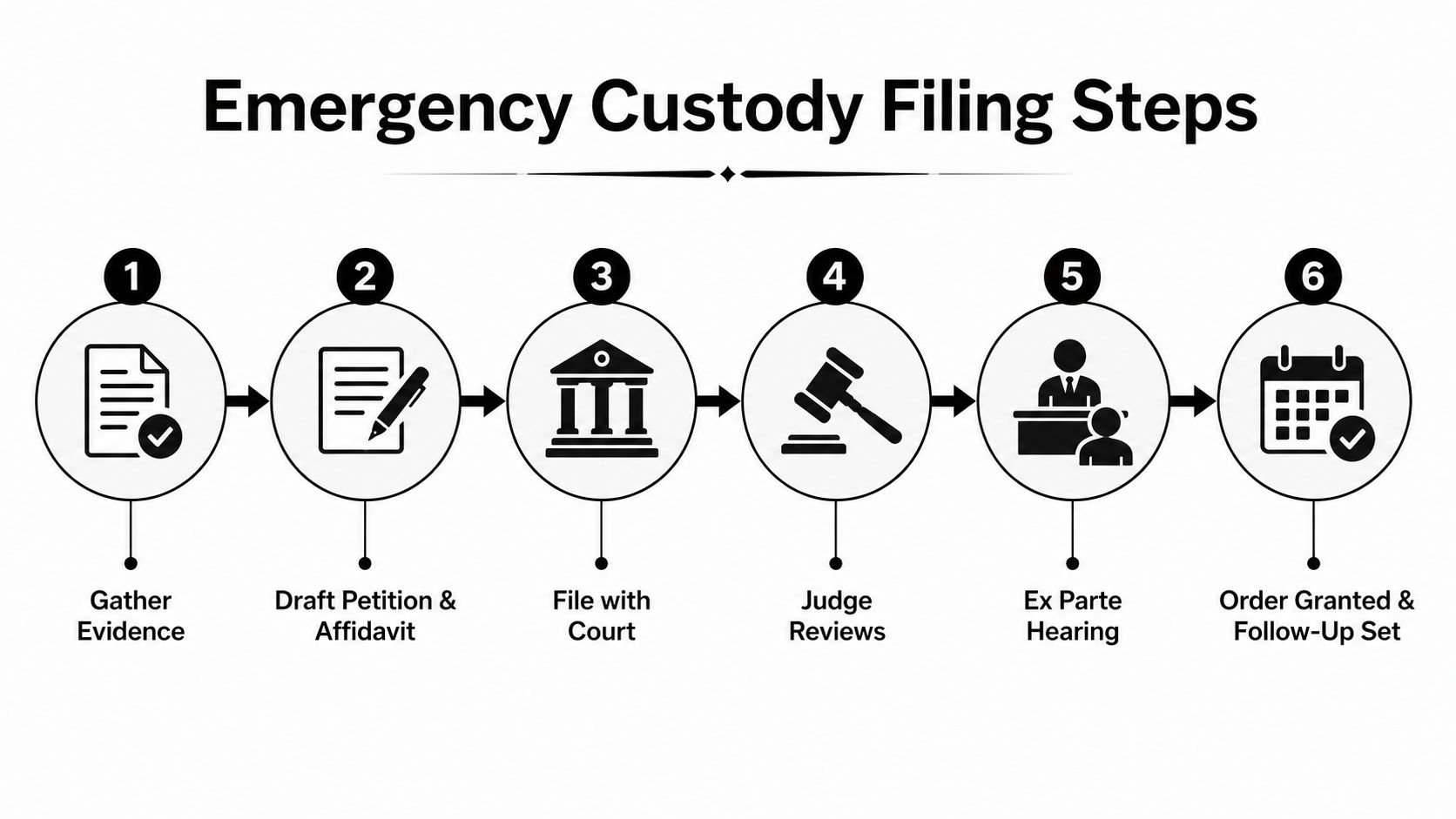
Emergency custody is procedural as much as it is emotional. You gather evidence, draft the petition and affidavit, file them, and then wait for judicial review. In some counties, that review can happen fast. The entire point is to get a judge in front of the facts before the child is exposed to more harm.
The first filing has to be clean
Missing documents, bad venue choices, and vague declarations can sink an otherwise serious request. California's self-help materials, for example, require the original plus two copies and a $60 fee unless waived. Texas procedures differ by court, but the lesson stays the same, the filing has to be complete. A parent who is under pressure should expect to get every detail right the first time.
If the judge grants the order, the other parent has to be served, and the court sets a follow-up hearing. That hearing is where the temporary order gets tested. The emergency order may hold, it may be narrowed, or it may be dissolved. The parent who won the first round still has work to do.
What to do after the order is granted
Keep records of every exchange, every pickup, and every message. Don't treat the order like a permanent victory. Treat it like the short-term protection it is. Also, be ready for the return hearing as soon as the judge signs anything, because the other side will show up with its own version of the facts.
Practical rule: The stronger your paper trail after the order is signed, the better your chances at the next hearing.
If the court denies the request, that does not always mean you're out of options. The parent can still pursue standard temporary orders, seek other protective relief, or return with better evidence when the record is stronger. For a broader look at the courtroom sequence, see what happens at a temporary orders hearing in Texas custody cases.
Why Many Emergency Orders Fail at the Follow-Up Hearing
A parent usually thinks the emergency hearing is the hard part. It is not. The test comes later, when both sides stand in court and the judge decides whether the order deserves to stay in place. Weak affidavits, overstatement, and sloppy documentation get exposed fast.
The most common failure point is simple, the proof never matched the emergency claim. A parent may have had real frustration or a real co-parenting problem, but if the record does not show immediate danger, the court can narrow the order or let it expire. Jurisdiction problems can also sink a rushed filing, especially if the child was not in the right place for the court to act or the papers went to the wrong court.
A multi-state study of extreme risk protection order petitions reported that ex parte petitions often moved on to a final hearing, and that grant rates varied widely from state to state. Those numbers come from protection-order practice, not custody law, but the lesson carries over to Texas family court. Emergency relief is usually won or lost on the quality of documentation and local court practice. The same study also described petitions involving suicidal threats, interpersonal violence threats, and threats to both self and others, which shows how seriously courts treat concrete risk when the facts are specific and supported.
The same risk shows up after the first order is signed. If your packet is thin, the follow-up hearing becomes the place where the court learns the story was weaker than it first appeared. That damages credibility, and judges remember it.
For parents trying to understand the next stage, how a temporary orders hearing works in Texas custody cases explains the courtroom sequence that usually follows emergency relief. If you are also trying to keep your intake documents organized, lead form backend articles can help with the mechanics of form flow, but custody court still turns on proof. The filing has to survive cross-examination, not just online submission.
The parents who hold up best at the return hearing stay disciplined from the start. They use verified facts. They keep the evidence organized. They avoid exaggeration. They are ready to show why the danger is ongoing, not isolated.
How an Experienced Texas Custody Attorney Protects Your Family
Emergency custody is not the time for guesswork. An experienced Texas family law attorney can tell you quickly whether your facts meet the emergency threshold or whether you need a different strategy, such as temporary orders, enforcement, or a modification. That honest assessment matters, because filing the wrong thing in the wrong way can waste precious time and weaken your position.
A good attorney helps gather the right evidence, turn it into a coherent affidavit, and prepare you for the follow-up hearing where the fight happens. That includes organizing texts, photos, medical records, and witness statements so the judge sees a clear pattern, not a pile of random documents. It also means preparing mothers, fathers, and grandparents for the practical side of custody litigation, since Texas courts still care about stable parenting, possession schedules, and the child's daily routine.
The Law Office of Bryan Fagan, PLLC works with Texas families on custody, visitation, paternity, child support, modifications, and emergency orders. If your case is moving beyond emergency relief, related resources like Modifying a Texas Custody Order and custody matters involving family violence can help you understand the broader options available. The firm serves families across Houston, Dallas, Austin, San Antonio, The Woodlands, and surrounding communities.
If your child may be in danger, don't wait and hope things settle down. The Law Office of Bryan Fagan, PLLC can help you evaluate emergency custody options, prepare the right evidence, and protect your parental rights in court. Visit Law Office of Bryan Fagan, PLLC to schedule a free consultation and get clear guidance on your next move.