
When your child’s future is on the line, understanding your rights as a parent matters most. For many Texas families, there's a common belief that a biological connection is enough to grant a father legal rights like custody or visitation. Unfortunately, it isn't.
If you are an unmarried parent trying to secure your role in your child’s life, you are not alone. This guide is here to walk you through the essential and non-negotiable process of legally establishing paternity, the first step toward creating a stable, secure future for your child.
Why Paternity Is the First Step for Custody in Texas
In the eyes of Texas law, there’s a huge difference between being a biological father and being a legal father. While a mother who gives birth is automatically considered a legal parent, the same isn't true for unmarried dads.
Just having your name on the birth certificate isn't always enough to secure enforceable rights. Without a legal order, you have no guaranteed right to see your child, make decisions about their schooling, or have a say in their medical care.
Establishing paternity is the first legal hurdle you must clear to seek custody rights in Texas. It's the official process that recognizes you as the child’s parent, creating a durable parent-child relationship under the Texas Family Code.
The Difference Between a Biological and a Legal Parent
Think of it this way: biology gives you a child, but the law gives you parental rights. This distinction is the entire reason establishing paternity is so critical for any dad wanting to be involved in his child's life.
- Biological Parent: This is simply your genetic connection to a child. While it’s the starting point, it carries almost no legal weight on its own for unmarried fathers.
- Legal Parent: This is a person the court recognizes as having all the rights and responsibilities of a parent. This status is what allows you to go to court and ask for custody, visitation, and a voice in your child's upbringing.
Without a court order establishing you as a legal parent, your ability to be in your child’s life can be limited or even completely denied by the other parent. This one legal step transforms your role from a simple biological link to a legally protected one.
Securing Your Rights Through Paternity
Successfully establishing paternity opens the door to everything you want to achieve as a parent. It's the key that lets you ask a court for specific orders regarding your child, including custody (known as conservatorship in Texas), visitation schedules (possession and access), and the right to make important life decisions.
This process isn't just about gaining rights for yourself; it's about providing stability and security for your child. It ensures they are legally entitled to support from both parents and can receive benefits like inheritance and social security. It solidifies your role and empowers you to be the parent your child deserves.
How to Establish Legal Paternity in Texas: Two Main Paths
So, you know why you need to establish legal paternity. The real question now is how. In Texas, there are two primary ways for a father to be legally recognized. Which one is right for you depends entirely on whether you and the child's mother are on the same page.
One path is simple and built on agreement. The other involves the courts and is designed for situations where there’s doubt, disagreement, or a parent is simply unwilling to cooperate. Let's break down both options.
The Cooperative Route: Voluntary Acknowledgment of Paternity (AOP)
When both parents are absolutely certain about who the father is and are working together, the simplest and fastest route is the Voluntary Acknowledgment of Paternity (AOP).
This is a legal document, usually presented to unmarried parents at the hospital right after the child is born. By signing it, both the mother and the father are swearing under penalty of perjury that the man is the biological father. Once that form is filed with the Texas Vital Statistics Unit, it has the same legal weight as a court order. It's a powerful tool, but it should only be used when there is zero doubt about paternity.
We cover this form in much more detail in our guide to the Acknowledgement of Paternity.
This decision tree gives a good visual breakdown of how biological and legal parentage connect.
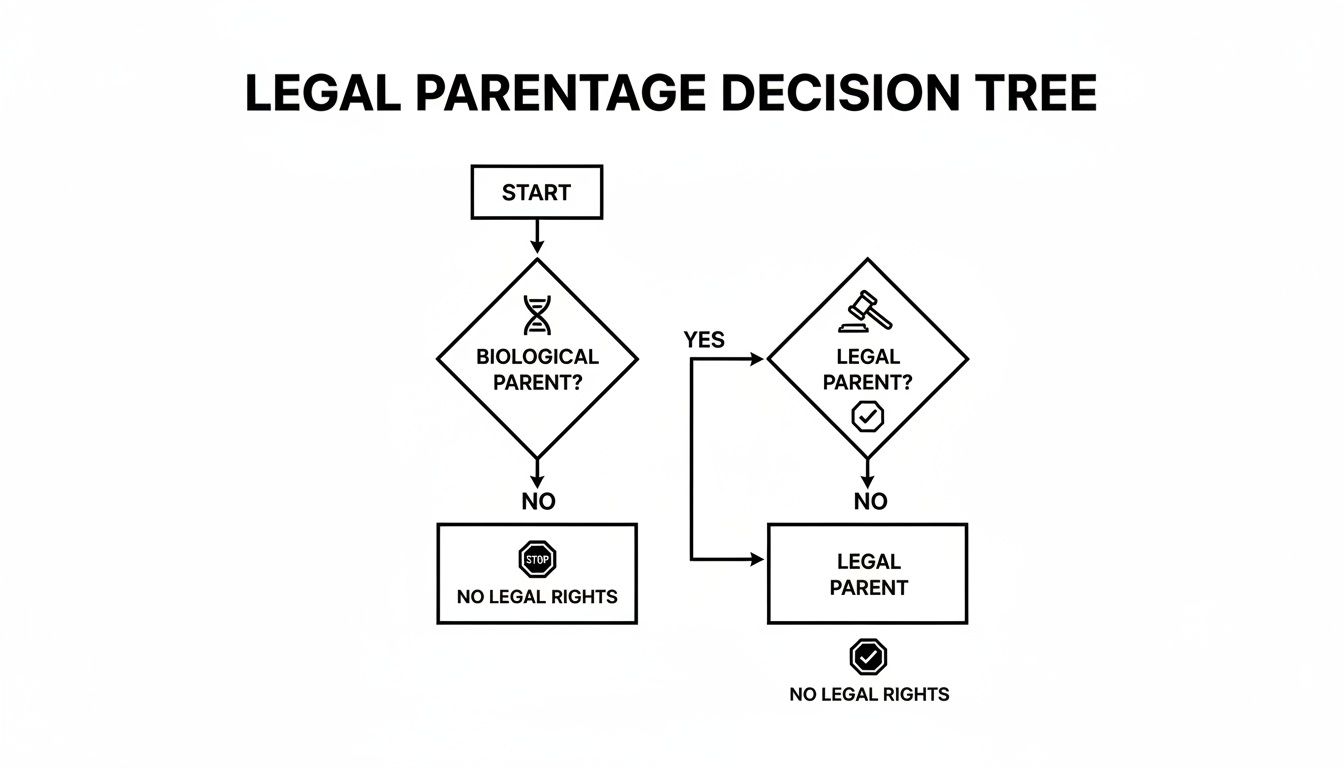
As you can see, being the biological father is just step one. It’s the legal recognition that grants you enforceable rights to custody and visitation.
The Court-Ordered Route: A Suit to Adjudicate Parentage
What happens when there's a question mark? Maybe the mother isn't sure, the presumed father has doubts, or one parent refuses to sign the AOP. This is when you have to get the court involved by filing a Suit to Adjudicate Parentage.
This legal action asks a judge to step in and officially determine who the child's legal father is. The core of this process is almost always court-ordered genetic testing. If someone refuses to submit to a DNA test, a judge can compel them. With 99.9% accuracy, a DNA test provides the scientific certainty courts need to make a final decision.
A paternity suit isn't necessarily an attack. Think of it as a tool for clarity. It’s designed to provide a definite, legally-binding answer for the child's sake, ensuring that rights and responsibilities are built on fact, not just assumptions.
Once the DNA results are back, the judge issues a final Order Adjudicating Parentage. This court order makes the father-child relationship official, giving the father all the legal rights and duties that come with it. From that point forward, he has the legal standing to file for conservatorship (custody), possession schedules, and to establish child support.
To help you weigh your options, here’s a look at how these two methods stack up against each other.
Comparing Paternity Establishment Methods in Texas
| Feature | Voluntary Acknowledgment of Paternity (AOP) | Court-Ordered Paternity (Suit to Adjudicate Parentage) |
|---|---|---|
| When to Use | Parents are 100% certain of paternity and agree. | Paternity is uncertain, disputed, or one parent is uncooperative. |
| Process | Sign a legal form, usually at the hospital. | File a lawsuit, attend hearings, and undergo DNA testing. |
| DNA Testing | Not required. Based on sworn statements. | The central component. Court-ordered and scientifically conclusive. |
| Timeline | Fast. Can be completed in days. | Can take several months, depending on court schedules and cooperation. |
| Cost | Low cost, often just filing fees. | More expensive, involving court costs, attorney fees, and DNA testing fees. |
| Legal Finality | Legally binding, but can be challenged within a limited time. | A final, conclusive court order that is extremely difficult to overturn. |
| Result | Establishes legal fatherhood. | Establishes legal fatherhood and can simultaneously address custody, visitation, and support. |
Ultimately, choosing between these two paths comes down to your family's specific situation. The AOP is quick and inexpensive but requires total agreement. A court-ordered suit is more involved but provides undeniable legal finality, protecting your rights with the full backing of the Texas judicial system.
How Paternity Impacts Your Custody Rights and Visitation Schedule
So you’ve established paternity. That’s a huge win, but it’s not the finish line. Think of it as the key that just unlocked the courtroom door. Now, you can finally ask for what you’ve wanted all along: a protected, meaningful role in your child’s life.
This is where we move from biology to legal rights—from proving you’re the father to defining what that means in the eyes of Texas law.

The next step involves concepts like "conservatorship" and "possession and access." It might sound like a bunch of legal jargon, but these are just the tools a judge uses to build a parenting plan. Understanding them is your next power move.
Demystifying Texas Custody Terms in Plain English
First things first: Texas doesn't really use the word "custody." The Texas Family Code has its own language to spell out a parent's rights and duties. Getting comfortable with these terms will make you feel a lot more in control as you move forward.
Here are the main ideas you need to know:
- Conservatorship: This is all about your right to make major decisions for your child. It covers big-picture choices on their education, non-emergency medical care, and mental health.
- Possession and Access: This is the nuts and bolts of the visitation schedule. It’s the court-ordered calendar that details exactly when the child will be with each parent—weekdays, weekends, holidays, and summers.
- Child Support: This is the financial duty one parent has to help the other with the costs of raising the child. It's a separate issue, but it gets handled once paternity is locked in.
Simply put, conservatorship is your decision-making power, and possession is your parenting time. The judge will make orders for both.
Understanding Joint Managing Conservatorship (JMC)
In Texas, the starting point and strong legal preference is for Joint Managing Conservatorship (JMC). This means both parents share the rights and duties of raising their child.
It’s important to know this does not automatically mean a 50/50 split of parenting time. What it does mean is that both parents get a say in the major decisions affecting the child’s life.
Under a typical JMC order, parents work together on things like:
- Choosing the child’s school.
- Approving non-emergency medical treatments.
- Agreeing on any psychological or psychiatric care.
Even with JMC, a judge will usually name one parent the "primary" conservator. This is the parent who has the right to decide where the child lives (often within a certain geographic area) and who receives child support. The other parent is the "possessory" conservator and follows a set visitation schedule.
Texas courts presume that a JMC is in the child’s best interest. This is a crucial advantage because it means the law starts on your side when you’re fighting to be an active, decision-making parent.
The reality on the ground, however, can be tougher. While Texas courts favor JMC in over 90% of cases after paternity is established, fathers often get far less possession time—statistically, just 33%, or about 120.5 days per year. This highlights the uphill battle many dads face. Proving your fitness as a parent is vital to securing a schedule that truly reflects your commitment.
The "Best Interest of the Child" Standard
Every single decision a Texas judge makes about your child boils down to one guiding principle: the best interest of the child. This is the legal standard they use to decide which parenting arrangement will best support a child's physical, mental, and emotional health.
It’s not about what seems "fair" to you or the other parent. It's about what is best for your kid. While the phrase sounds a bit vague, the Texas Family Code gives judges a list of specific factors to consider, often called the "Holley Factors."
These factors include:
- The child's emotional and physical needs, now and in the future.
- Any emotional or physical danger the child could face.
- The parenting skills of each person seeking custody.
- The stability of each parent's home.
- Any actions or failures to act that suggest an improper parent-child relationship.
- The plans each parent has for the child's upbringing.
By establishing paternity, you’ve earned the right to stand before a judge and make your case based on these factors. You can show the court your stable home, your deep bond with your child, and your thoughtful plans for their future. You can prove you’re not just a biological father, but a capable, loving, and essential one.
We take a deeper dive into these factors in our guide to the basics of custody in Texas.
What Happens if a Parent Is Deemed Unfit?
While JMC is the norm, there are rare cases where a court will name one parent the Sole Managing Conservator (SMC). This only happens when the court believes that naming both parents as joint conservators would seriously harm the child's physical or emotional well-being.
An SMC has the exclusive right to make nearly all decisions for the child. This is an extreme measure reserved for situations involving family violence, substance abuse, neglect, or such intense conflict that co-parenting is simply impossible. Proving a parent is "unfit" requires clear and convincing evidence, as courts are very reluctant to strip a parent of their decision-making rights entirely.
Understanding Child Support and Financial Duties
Once you establish paternity, you create a legal connection to your child that comes with precious rights and serious duties. One of the most significant of these is financial support. For many parents, the topic of child support feels intimidating or even adversarial, but it helps to see it for what it is: a core part of providing for your child's future.
When you formalize your legal parentage, you’re not just opening the door to custody and visitation. You're also stepping into a legal framework designed to make sure your child has what they need to thrive. This system applies to both parents, ensuring the financial load of raising a child is shared fairly.
How Paternity Triggers Child Support
Under Texas law, every legal parent has a duty to financially support their child. As soon as paternity is legally established—either through a signed Acknowledgement of Paternity (AOP) or a court order—the issue of child support comes front and center.
The court will typically name one parent the "primary conservator" (the parent the child lives with most of the time) and the other the "possessory conservator." It's the possessory conservator who is usually ordered to pay child support to the primary parent. This isn't a penalty; it’s simply the legal mechanism to ensure both parents contribute to the child's daily expenses like housing, food, and clothing.
Calculating Child Support in Texas
Texas courts don't just pull a number out of thin air. They follow a specific formula laid out in the Texas Family Code to calculate child support, which brings a level of consistency and predictability for families across the state.
The guideline amount is based on the paying parent's net monthly resources. This includes most sources of income after taxes and the cost of the child's health insurance premiums are taken out. For one child, the standard calculation is 20% of the paying parent’s net monthly resources. That percentage goes up with each additional child.
It’s important to remember that this is just a guideline. A judge can deviate from this percentage if there's a good reason, such as a child’s special needs or other factors that make the standard amount unfair to the child or a parent.
The Empowerment of Financial Responsibility
While the idea of paying child support can feel daunting, establishing paternity actually empowers you in this process. Without legal standing, you have no say in how support is decided. Once you become a legal parent, you gain the right to make sure the support order is calculated correctly and fairly based on accurate financial information.
You can present evidence of your income, make sure all deductions are properly applied, and argue for a deviation from the guidelines if your situation warrants it. By becoming a legal father, you also gain the standing to demand fair custody arrangements and ensure that any support calculations are precise and just.
And what if your circumstances change down the road and you become the primary caregiver? Your established legal status is what gives you the power to go back to court and request child support from the other parent.
For a more detailed breakdown of how the numbers work, check out our guide on how to calculate child support in Texas.
Beyond Child Support: Other Financial Benefits
The financial connection created by establishing paternity goes far beyond monthly support payments. It also unlocks a critical safety net of benefits for your child that are only available to them once you are their legal father.
These benefits are a huge deal and include:
- Inheritance Rights: Your child gains the legal right to inherit from you, even if you pass away without a will.
- Social Security Benefits: If you become disabled, retire, or pass away, your child may be eligible to receive Social Security benefits based on your work record.
- Health and Life Insurance: Establishing paternity is the key to adding your child to your health insurance plan and naming them as a beneficiary on a life insurance policy.
These aren't just minor perks; they are life-altering protections that provide long-term security for your child. By taking the step to establish paternity, you are giving your child access to a future that is more financially secure, no matter what happens.
Critical Deadlines and Special Circumstances to Know
When it comes to establishing paternity in Texas, the clock is always ticking. The legal process isn’t something you can put on the back burner—it’s built around strict deadlines that can either secure your parental rights or close the door on them forever.

Missing one of these windows can have permanent consequences. Whether you’re an unmarried father fighting for recognition or a mother needing to formalize parentage for support and custody, paying attention to these dates is non-negotiable.
The Four-Year Statute of Limitations
One of the most unforgiving deadlines in Texas paternity law is the four-year statute of limitations for challenging paternity. This rule is a big deal when a man is already considered the legal father—usually because he was married to the child's mother when the child was born.
If you believe you're the biological father of a child who already has a presumed father, you generally have only four years from the child's birth to file a lawsuit to contest it. The same four-year clock applies to a presumed father who discovers he might not be the biological dad and wants to dispute his legal status.
Once this four-year period runs out, it becomes nearly impossible to undo the legal presumption of fatherhood. The court will almost always prioritize the child’s need for stability over a biological claim that comes too late.
The Texas Paternity Registry and Its Critical Deadline
For unmarried men who believe they’ve fathered a child, the Texas Paternity Registry is one of the most powerful and proactive tools available. It’s a confidential state database where you can formally register your claim to paternity.
Why is this so important? Filing with the registry serves as official notice that you intend to assert your parental rights. It's especially vital if you're worried the mother might place the child for adoption without your knowledge. To protect your rights, you must register before the child is born or no later than 31 days after the birth. If you miss this tight deadline, your parental rights could be terminated without you ever getting a say.
Handling Complex and Special Scenarios
Family law is never one-size-fits-all. In our years of practice, we have seen just about every complicated situation you can imagine. A good attorney knows that your family's future requires a strategy tailored to your unique circumstances, not a generic template.
Here are a few special scenarios we help parents navigate all the time:
- Military Parents: Deployments and out-of-state assignments can throw a wrench into any paternity suit or custody plan. We work with service members to build realistic possession schedules and use legal protections to safeguard their rights while they’re serving.
- Parental Relocation: What happens when the other parent wants to move far away with the child? Establishing your paternity is the first legal step you must take to get the standing to either block the move or negotiate a new custody order that protects your relationship with your child.
- Grandparent Intervention: Sometimes grandparents have to step up for their grandkids. If paternity was never legally established, it creates a huge roadblock for grandparents who need to seek visitation or conservatorship because the parents are unfit or unable to care for the child.
No matter how tangled your situation feels, there’s always a path forward. Whether you're up against a tight deadline, a military deployment, or a cross-country custody fight, the key is to act quickly and get advice from someone who truly understands the ins and outs of Texas family law.
Key Takeaways and Your Next Steps
You've made it through the legal maze of establishing paternity in Texas. You know the why and the how. Now comes the most important part: turning that knowledge into action. This isn't just about paperwork; it's about cementing your role in your child's life and protecting that relationship for years to come.
Think of it this way: establishing legal paternity is the foundation of your entire parental rights house. Without it, everything else—custody, visitation, decision-making—is built on shaky ground.
From Information to Action
The road to establishing paternity for custody in Texas can feel daunting, but it's a path many parents have walked. And it’s completely manageable, especially when you know what to do next. The end goal is a court order that officially recognizes you as a legal parent, giving you clear, enforceable rights.
This single legal step is what unlocks your ability to fight for:
- Conservatorship: The right to have a say in your child's education, healthcare, and upbringing.
- Possession and Access: A court-ordered visitation schedule you can count on, protecting your time with your child.
- Fair Child Support: A financial order that’s calculated correctly under Texas law, ensuring your child’s needs are met without placing an unfair burden on one parent.
Make no mistake: taking the steps to establish paternity isn’t an aggressive move. It’s an act of responsibility and love. It gives your child the profound security of knowing they have two legal parents who are invested in their future, both emotionally and financially.
You don't have to figure this out on your own. The Texas legal system has its own language and rules, and a small misstep can unfortunately have big consequences for your family.
If you need help with a child custody or visitation case in Texas, our experienced attorneys can guide you every step of the way. Contact The Law Office of Bryan Fagan, PLLC today for a free consultation.