Skip to content
When your child’s future is on the line, understanding your rights as a father matters most. It’s easy to feel overwhelmed or worry the system is stacked against you, but Texas law is designed to be gender-neutral. Courts focus on one thing above all else: the best interest of the child. This means you, as a father, have the same fundamental rights as the mother to build and maintain a strong, healthy relationship with your child.
Navigating a custody case can feel like learning a new language while your emotions are running high. The good news is that the Texas Family Code, specifically Chapter 153, provides a clear framework built to keep both loving parents actively involved in their children's lives. This guide offers plain-English explanations and practical guidance to help you protect that precious bond.
Your Foundational Rights as a Father in Texas

The entire Texas custody process is geared toward ensuring your child benefits from having two supportive parents. In fact, Texas law starts with the presumption that it’s in a child's best interest for both parents to be named Joint Managing Conservators. This legal starting point is a powerful tool for any father seeking to secure his role.
To navigate this process, you’ll hear two terms over and over again: "conservatorship" and "possession." Thinking of them this way makes it much simpler:
- Conservatorship: This is your right to make the big decisions. It’s your legal authority to have a say in major life choices, like where your child goes to school, what kind of medical care they receive, and their religious upbringing.
- Possession and Access: This is the nuts and bolts of your parenting time. It’s the court-ordered calendar—often called a "possession schedule"—that spells out exactly when your child will be with you, including weekends, holidays, and summer vacations.
Let’s break down the essential legal concepts that form the foundation of every custody order in Texas.
Key Legal Concepts for Texas Fathers
Understanding this vocabulary from the start will empower you to follow the legal process and protect your role in your child's life.
| Legal Term | Plain-English Meaning | Why It's Critical for Fathers |
|---|---|---|
| Paternity | The legal recognition of a father-child relationship. | This is the key that unlocks all your other rights. Without it, you have no legal standing. |
| Conservatorship | The rights and duties of a parent to make decisions for a child. | This gives you a legal voice in your child's education, healthcare, and overall upbringing. |
| Possession Order | The court-ordered schedule for when each parent has the child. | This defines your physical parenting time and ensures your relationship can grow. |
| Child Support | Financial payments made by one parent to the other for the child's care. | This is a legal obligation for both parents, designed to meet the child’s needs. |
In Texas, the law begins with the belief that a fit father should be an active, legally recognized part of his child's life. The court's goal isn't to pick a "winner" but to create a stable, predictable routine that serves the child’s emotional and physical well-being.
Think of this guide as your roadmap. We’ll walk you through each step, from establishing legal paternity—the key that unlocks every other right—to understanding child support and what to do if your court orders aren't being followed. By the end, you’ll have the knowledge to confidently protect your role as a parent.
Securing Your Legal Role: How Texas Determines Paternity
For an unmarried father in Texas, establishing legal paternity is the single most important step you can take. It is the foundation upon which all other parental rights are built. Without it, you are on the legal sidelines with no enforceable right to custody (conservatorship) or visitation (possession).
Texas law provides two clear pathways to officially secure your role as a dad in the eyes of the court.
The Voluntary Path: Acknowledgment of Paternity
The simplest and most direct route is by signing an Acknowledgment of Paternity (AOP). This is a straightforward legal form that both parents sign, usually at the hospital after the child is born.
When you sign an AOP, you are legally declaring that you are the child’s biological father. Once filed with the Texas Vital Statistics Unit, it carries the same weight as a court order. It is a powerful document that instantly creates the legal parent-child relationship, giving you all the rights and responsibilities that come with it.
It’s critical to be 100% certain of paternity before signing an AOP. Once the deadline to challenge it passes, it becomes incredibly difficult—and sometimes impossible—to reverse.
The Court-Ordered Path: Adjudicating Parentage
If an AOP was never signed, or if there is uncertainty about fatherhood, the issue must be resolved in court through a "suit to adjudicate parentage." This is the formal legal process for a judge to officially determine a child's parentage.
The process typically involves a few key steps:
- Filing a Petition: One parent files a lawsuit asking the court to legally identify the child’s father.
- Genetic Testing: The court will almost always order DNA testing. This simple cheek swab provides scientifically definitive results.
- Court Order: If the DNA test confirms you are the father, the judge will sign an order that legally establishes you as the parent.
This court order serves the same purpose as the AOP—it officially establishes your paternity and becomes the legal bedrock for any future orders about custody, visitation, and child support. Our detailed guide on how to establish paternity can provide more in-depth information.
This flowchart shows the two main roads to becoming a legal father—the essential first step before any court will consider making custody orders.
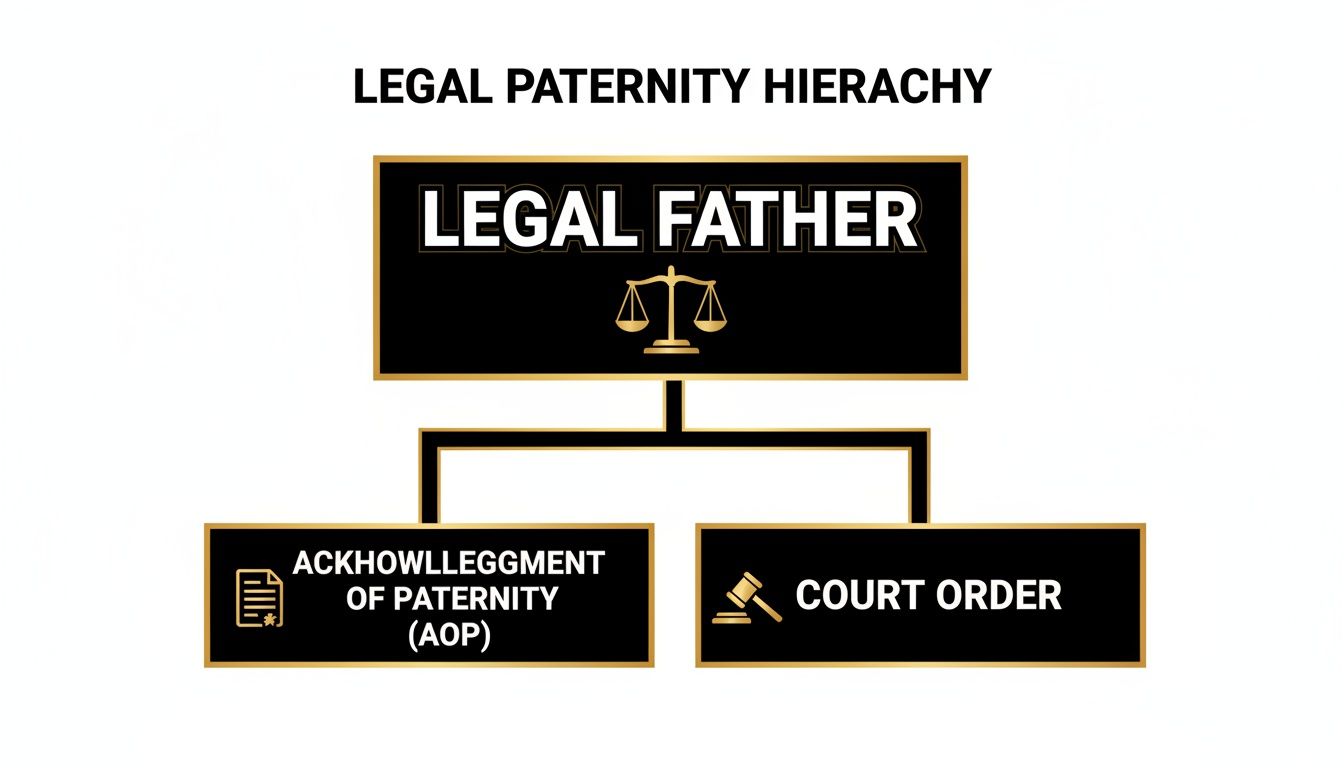
As you can see, whether you sign a voluntary Acknowledgment of Paternity (AOP) or get a court order, locking in your legal status is the non-negotiable foundation for all your parental rights.
Understanding Custody: Conservatorship and Possession Orders
Once you’ve legally established you’re the father, the next step is defining your day-to-day role. This is where Texas law uses two key concepts: conservatorship and possession orders. These orders create an official, enforceable rulebook for your co-parenting relationship, providing your child with much-needed stability. They transform your rights from an abstract idea into a concrete plan you can rely on.
What Is Conservatorship in Texas?
In simple terms, conservatorship is about your right to make the big decisions in your child's life. It’s your legal authority to have a say in their education, healthcare, and general well-being.
Texas law doesn't play favorites; it starts with the presumption that both parents should have these rights and responsibilities. The court’s default is to name both parents as Joint Managing Conservators. This means you share the duty of making major decisions. It’s important to know this doesn't automatically mean a 50/50 split of time with your child, but it absolutely means you both get a seat at the table for the choices that matter most.
In most Joint Managing Conservatorship cases, one parent is named the "primary" conservator. This parent usually has the exclusive right to determine where the child lives and is often the one who receives child support payments.
Only in rare and serious situations—like proven family violence or substance abuse—will a court name one parent as the Sole Managing Conservator. This gives that parent the exclusive power to make most major decisions alone. This is not the norm and is only ordered when it is proven to be in the child's "best interest."
Joint vs. Sole Managing Conservatorship
| Feature | Joint Managing Conservatorship (Presumed Best) | Sole Managing Conservatorship (Less Common) |
|---|---|---|
| Decision-Making | Both parents share rights and duties. Major decisions are made together or allocated by the court. | One parent has the exclusive right to make most major decisions without the other's consent. |
| Child's Residence | One parent is typically given the exclusive right to determine the child's primary residence. | The Sole Managing Conservator has the exclusive right to determine the child's residence. |
| Child Support | The "non-primary" parent typically pays child support to the primary parent. | The Sole Managing Conservator receives child support from the other parent (the Possessory Conservator). |
| When It's Used | This is the standard in Texas, as it's presumed to be in the child's best interest. | Reserved for cases with a history of family violence, abuse, neglect, or severe parental conflict. |
| Parental Involvement | Encourages active involvement and cooperation from both parents in the child’s life. | Limits the decision-making role of one parent, who is usually named a Possessory Conservator. |
This table shows why Texas courts lean so heavily toward joint conservatorship—it’s built on the idea that kids do best when both parents are actively involved.
What Is a Possession Order?
While conservatorship is about your rights, a possession order is about your time. It’s the detailed, court-ordered calendar that spells out exactly when your child will be with you. This schedule is designed to be crystal clear and legally enforceable, which reduces confusion and potential arguments. A well-organized calendar is a lifesaver; our complete guide to coparenting calendars can help you stay organized.
The goal is to give your child a routine they can count on. The most common tool for this is the Texas Standard Possession Order.
The Texas Standard Possession Order Explained
The Standard Possession Order (SPO) is the default schedule that Texas courts use when parents live within 100 miles of each other. It is legally presumed to be in the child’s best interest and provides a predictable schedule for parenting time.
Here’s what the SPO generally looks like for the non-primary parent:
- Weekend Visits: Possession of the children on the first, third, and fifth weekends of a month.
- Holiday Time: The schedule alternates major holidays like Thanksgiving and Christmas, so both parents are guaranteed time to make memories.
- Summer Vacation: A continuous period of possession in the summer, usually 30 days.
This framework isn't set in stone and can be customized to fit a family’s unique situation. But it provides a solid, reliable foundation that ensures your right to consistent, meaningful time with your child is backed by the full force of the law.
Navigating Child Support Rights and Responsibilities
The financial side of co-parenting can be stressful. It helps to reframe how you think about child support: it is not a payment to the other parent; it is your child’s fundamental right to be financially supported by both of you. Understanding your rights and obligations here is a huge part of being an involved father.
The Texas Family Code provides a clear, structured system for calculating support, which removes much of the guesswork from the equation. This clarity allows you to fulfill your obligations while protecting your relationship with your child.
How Texas Calculates Child Support
Texas courts use a straightforward, guideline-based formula to determine child support amounts. The process is designed to be predictable and fair, focusing on the non-primary parent’s income and the number of children involved.
Here’s a simplified look at how it works:
- Determine Net Resources: The court calculates the paying parent's monthly net resources. This includes all income from wages, self-employment, and other sources, after subtracting taxes and the cost of the child's health insurance.
- Apply Percentage Guidelines: A set percentage is then applied to these net resources based on the number of children the support is for.
One of the most critical things to understand is that, under Texas law, child support is a completely separate legal obligation from visitation. Your duty to pay support and your right to see your child are not connected. One cannot be withheld because of a conflict over the other.
This structure ensures that the financial support your child receives is consistent and based on a clear legal standard, which is vital for their stability.
Common Child Support Percentages in Texas
The Texas Family Code lays out specific percentages for calculating support, assuming the paying parent has no other children they are legally obligated to support from another relationship.
| Number of Children | Percentage of Net Resources |
|---|---|
| 1 Child | 20% |
| 2 Children | 25% |
| 3 Children | 30% |
| 4 Children | 35% |
| 5 or More Children | 40% |
These percentages can be adjusted if the paying parent has other children to support, ensuring the calculation is equitable across all legal responsibilities.
Health Insurance and Other Responsibilities
Beyond the monthly payment, fathers have other financial duties. Most custody orders require one parent to provide health and dental insurance for the child. Typically, the parent who can get coverage at the most reasonable cost through their employer is ordered to do so, and this cost is factored into the final child support calculation.
Child support is almost always paid through wage withholding. This system automatically deducts payments from the paying parent's paycheck. You can learn more by reading our guide to understanding an income withholding order. This automated system ensures payments are timely and properly documented, providing security for both the child and the parents.
Steps to Modify or Enforce a Custody Order

Life doesn’t stand still. A court order that made perfect sense a year ago might be unworkable today. The good news is that your custody, visitation, and child support orders aren’t carved in stone; they can be updated to match your family's new reality.
Just as importantly, a court order isn't a suggestion—it's the law. When the other parent doesn't follow the rules, you have powerful legal tools to protect your rights and your relationship with your child.
When You Can Modify a Custody Order
To change an order, you must prove there has been a “material and substantial change in circumstances” since the last order was signed. This means something significant has happened that makes the current order unworkable or no longer in your child’s best interest.
Common examples that justify a modification include:
- A Parent Relocates: A long-distance move can make the current visitation schedule impossible.
- Major Job or Schedule Changes: A significant, long-term change in work hours or income may require adjustments to the possession schedule or child support.
- Your Child's Needs Change: A teenager’s needs and schedule are very different from those of a young child.
- A Parent Remarries: The arrival of a stepparent can create a new family dynamic.
- Safety or Stability Concerns: If you believe your child's environment with the other parent has become unsafe or unstable, this is a compelling reason to seek a change.
To successfully modify an order, it's not enough to just prove something changed. You also have to convince the judge that the new arrangement you're proposing is in your child's best interest. That is the guiding principle for every decision a Texas family court makes.
What to Do When the Other Parent Ignores the Order
It is incredibly frustrating when the other parent denies your court-ordered time with your child. You do not have to accept it. The court provides a powerful solution called a Petition for Enforcement.
This is a formal legal action where you ask a judge to force the other parent to follow the order. If the judge finds that the other parent knowingly violated the possession schedule, they can face serious consequences.
The enforcement process generally includes these steps:
- Document Everything: Keep a detailed log of every violation. Note dates, times, and what happened. Save texts, emails, and any other proof that you were denied your time.
- File a Petition for Enforcement: Your attorney will file an official petition that spells out each specific violation.
- Go to Court: At the hearing, you will present your evidence. The other parent will have a chance to respond.
If the court finds the other parent violated the order, the judge can order make-up parenting time, impose fines, or even order jail time for contempt of court. Protecting your father rights in Texas means holding the other parent accountable to the orders that protect your relationship with your child.
Key Takeaway: Your Next Steps to Protect Your Rights
You’ve learned about the legal framework for fathers' rights in Texas. Reading this guide is an important first step, but protecting your relationship with your child requires proactive, deliberate action.
It all boils down to a few core truths. Establishing legal paternity is the non-negotiable ticket to entry—it unlocks every other right. From there, understanding conservatorship (your voice in big decisions) and a possession order (your enforceable schedule) gives you the structure needed to build a stable, lasting presence in your child's life.
As you plan your next move, keep these principles at the forefront:
- Paternity is Your Starting Line: Without it, you're legally a stranger. Make this your first priority.
- Conservatorship is Your Voice: This guarantees your right to weigh in on your child's education, healthcare, and well-being.
- A Possession Order is Your Shield: Your time with your child is a legally protected right. If it is violated, you have the power to enforce it.
Navigating a custody case isn't just about knowing the law—it's about knowing how to make the law work for your family. Personalized legal guidance is what turns knowledge into a successful outcome for you and your child. Your role as a father is priceless, and Texas law is built to support your involvement.
If you need help with a child custody or visitation case in Texas, our experienced attorneys can guide you every step of the way. Contact The Law Office of Bryan Fagan, PLLC today for a free consultation.