
When your child’s future is on the line, understanding your rights as a parent matters most. The thought of a custody battle is overwhelming, and many parents come to us saying, “I want full custody.” But what does that really mean in a Texas family court?
The legal system has its own language, and "full custody" isn't a term you'll find in the Texas Family Code. Knowing the correct terms and what they mean is the first step toward building the strongest case for your child's well-being. This guide is here to provide clarity and empower you with the knowledge you need.
What "Full Custody" Actually Means in Texas Law

In Texas, we don't use the term "custody." Instead, the law focuses on conservatorship. This legal concept is less about where a child sleeps each night and more about which parent has the right to make critical decisions for their future. Getting this distinction right is crucial, as it shapes your entire legal strategy.
The starting point for every Texas judge is the belief that keeping both parents actively involved is in a child’s best interest. This is called Joint Managing Conservatorship, and it is the standard arrangement in the vast majority of cases. Think of it as a legal co-parenting partnership where both you and the other parent share the rights and responsibilities of raising your child. Even if one parent has the right to decide where the child lives, both parents typically have a say in major decisions.
The Power of Sole Managing Conservatorship
When you tell a lawyer you want "full custody," what you are really asking for is to be named the Sole Managing Conservator. This is a much higher legal standard to meet and is only granted in specific, often difficult, circumstances where one parent's involvement could be harmful to the child.
As a Sole Managing Conservator, you are given the exclusive power to make key decisions for your child, often without needing the other parent's input or consent. This is the single biggest difference from a standard joint arrangement.
This level of authority isn't awarded lightly. Courts reserve it for situations with clear evidence that the other parent's involvement would harm the child's physical or emotional well-being. To truly grasp the difference, it helps to compare the two side-by-side.
For a deeper dive into what it takes to win this arrangement, you can learn more about Sole Managing Conservatorship in our detailed guide.
Here’s a plain-English breakdown of what separates these two roles.
Joint vs. Sole Managing Conservatorship at a Glance
This table compares the fundamental differences in parental rights between the standard joint arrangement and what is commonly known as "full custody."
| Parental Right or Duty | Joint Managing Conservatorship (Standard) | Sole Managing Conservatorship ('Full Custody') |
|---|---|---|
| Designate Child's Residence | Usually assigned to one parent, often with a geographic restriction. | Exclusive right to determine where the child lives, with no geographic limits. |
| Make Educational Decisions | Typically a shared right, requiring both parents to agree. | Exclusive right to make all decisions about schooling. |
| Consent to Medical Care | Shared right, though one parent may have the final say in an emergency. | Exclusive right to consent to all medical, dental, and psychological care. |
| Receive Child Support | The parent who designates residence typically receives child support. | Exclusive right to receive child support payments from the other parent. |
| Day-to-Day Decisions | Each parent makes decisions during their period of possession. | The Sole Managing Conservator holds primary decision-making power. |
As you can see, being named the Sole Managing Conservator centralizes nearly all major parental authority in one person. The other parent becomes a Possessory Conservator with more limited rights, primarily focused on visitation (called "possession" in Texas).
How Texas Determines Custody: The "Best Interest of the Child"
Asking a Texas court for "full custody"—what we legally call Sole Managing Conservatorship—is an uphill battle. It’s important to know that from the start. Texas law is built on the strong presumption that keeping both parents involved is what’s best for a child. A judge won’t strip one parent of their rights just because the other parent asks for it. It isn't about who loves the child more; it's about proving, with solid evidence, that leaving the child with the other parent would present a genuine risk to their physical or emotional health.
To make this critical decision, judges use a set of guidelines from a famous Texas case. These are often called the “Holcomb Factors.” Think of these less like a rigid checklist and more like a lens through which the court examines every part of your child's world and each parent's fitness to create a safe, supportive home.
The Holcomb Factors Explained
When a judge is weighing a custody decision, they look at the big picture through these specific factors:
- The Child’s Needs: What does your child need right now, both emotionally and physically? What will they need in the future?
- Parental Abilities: This is a hard look at each parent's capacity to be a stable, loving, and safe caregiver.
- Stability of the Home: The court compares the consistency and security each parent can offer.
- Danger to the Child: This is a critical factor. Any actions—or failures to act—that could put the child in physical or emotional danger will be scrutinized heavily.
- The Child’s Wishes: If the child is 12 or older, the judge can speak with them privately to hear their preference. It's important to know their wishes aren't the final word, but they are given serious consideration.
Of all these, proving the other parent presents a danger to the child often becomes the core of a sole custody case. And that’s where your evidence truly matters.
Proving an Environment is Harmful to a Child
To get Sole Managing Conservatorship, you must overcome the legal presumption that a joint arrangement is best. This means showing the court that giving the other parent significant rights would actively harm your child's physical health or emotional development. It’s a high bar, and you can’t clear it with vague claims or personal disagreements.
Under the Texas Family Code, a court will only restrict a parent's rights if there's a proven history or pattern of family violence, child neglect, or substance abuse. A single bad argument or a one-time mistake almost never qualifies; you need to show a consistent pattern of behavior that puts your child at risk.
Simply not liking the other parent's new partner or disagreeing with their parenting style won’t be enough. You have to draw a direct line from their behavior to a clear, negative impact on your child. You can read more about how to get sole custody in Texas to get a deeper sense of the kind of proof the court is looking for.
For instance, a judge is more likely to find a parent's environment harmful if you can provide real proof of things like:
- Substance Abuse: Evidence of ongoing drug or alcohol abuse, such as failed drug tests, DUI arrests, or credible testimony from witnesses who saw them intoxicated while responsible for the child.
- Family Violence or Neglect: This requires documentation. Police reports, protective orders, photos of injuries, or statements from teachers or counselors who have noticed signs of abuse are powerful.
- Extreme Instability: A parent who cannot hold a job, moves constantly, or exposes the child to a revolving door of new partners creates a chaotic environment.
- Parental Alienation: This is when one parent actively tries to destroy the child's relationship with the other parent. It's a form of emotional abuse, and courts take it very seriously when it can be proven.
Building this kind of case means you have to become a careful record-keeper. Save every threatening text message. Keep a detailed journal of missed visits or concerning incidents. Gather statements from people who have witnessed the behavior firsthand. Your goal is to paint a clear, undeniable picture for the judge, showing that Sole Managing Conservatorship isn't just something you want—it's what your child genuinely needs to be safe and thrive.
Steps to Pursuing Full Custody in Texas
Knowing you need to protect your child is one thing; navigating the legal maze to do it is another. The Texas court system has a specific, step-by-step process for custody cases. While it may seem intimidating, understanding the roadmap can help you feel more in control of the journey ahead.
This guide will walk you through the major stages of pursuing Sole Managing Conservatorship. Each step builds on the last, moving your case from the starting line, through the fact-gathering phase, and finally to a resolution.
Step 1: Filing the Initial Petition
The process officially begins when your attorney files a document called the Original Petition in Suit Affecting the Parent-Child Relationship (SAPCR). This is the legal document that opens the courthouse doors. It tells the judge who is involved, what you are asking for (to be named Sole Managing Conservator), and the reasons why you believe it is in your child's best interest.
Once the petition is filed, the other parent must be officially notified. This critical step is known as service of process. It ensures they are aware of the lawsuit and have a fair opportunity to respond.
Step 2: Seeking Immediate Protection with Temporary Orders
A full custody case can take months to resolve. To protect your child in the meantime, you can ask the court for a Temporary Orders Hearing. This allows a judge to set ground rules that will stay in place while the case is ongoing.
These orders can address urgent issues, such as:
- Deciding where the child will live temporarily.
- Creating a temporary possession (visitation) schedule.
- Ordering one parent to pay temporary child support.
- Prohibiting harmful behaviors, like substance abuse or speaking negatively about the other parent in front of the child.
These orders provide much-needed safety and structure right from the start and are fully enforceable by law.
Step 3: Gathering Evidence Through Discovery
After initial orders are in place, the case moves into the discovery phase. This is the formal, legal process for gathering facts and evidence from the other party. If you think of your case as a puzzle, discovery is how you collect all the pieces you'll need to present a complete picture to the judge.
Discovery isn't about slinging mud; it's a structured, court-supervised method for getting to the truth. The facts you uncover here will become the backbone of your argument, whether in mediation or a final trial.
Common discovery tools include:
- Requests for Production: Formally asking the other parent for documents like bank statements, text message logs, or school records.
- Interrogatories: A list of written questions that the other party must answer under oath.
- Depositions: Out-of-court testimony where your attorney can question the other parent or key witnesses face-to-face, with every word recorded by a court reporter.
This is your opportunity to build a documented history of behaviors that show why naming you the sole managing conservator is crucial for your child's well-being.
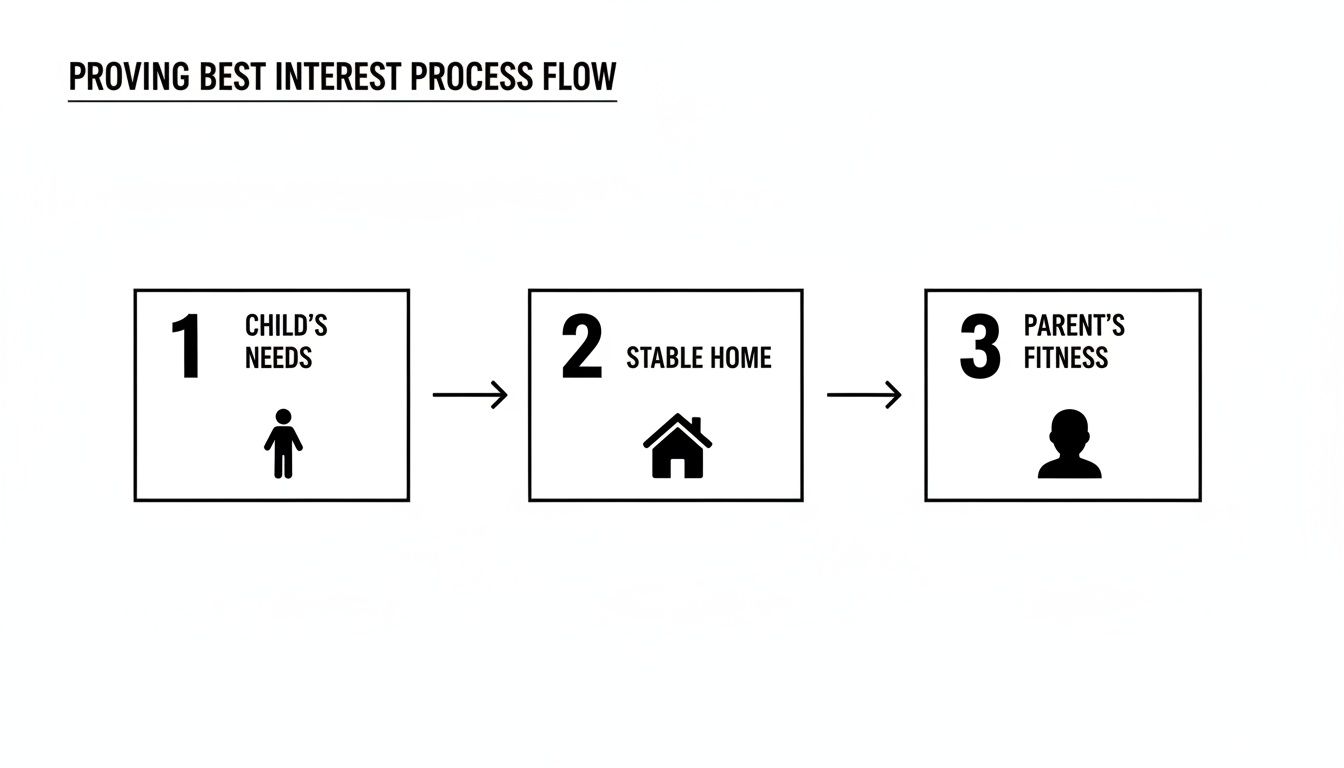
As you can see, the goal is to connect the dots for the judge—linking the evidence you've gathered to your child's specific needs, the stable home you provide, and any issues with the other parent's fitness.
Step 4: Attempting Resolution Through Mediation
Before a final trial, nearly every Texas court will require you and the other parent to attend mediation. This is a confidential negotiation session guided by a neutral third-party mediator. The goal is to find common ground and work out an agreement yourselves, outside of court.
If you reach a Mediated Settlement Agreement (MSA) and both parties sign it, the agreement becomes legally binding and resolves the case. It’s a powerful way to end the conflict on your own terms, saving significant time, money, and emotional strain. If you can’t agree, the case proceeds to the final step.
Step 5: The Final Trial
When all attempts at settlement have failed, the last resort is a trial before a judge. Here, both sides present their evidence, call witnesses, and make their final arguments.
After hearing all the testimony, the judge will issue a ruling based on what they believe is in the child’s best interest. That decision is turned into a legally binding Final Order, which will govern everyone’s rights and responsibilities moving forward.
Building Your Case With Compelling Evidence

When you walk into a courtroom asking for sole managing conservatorship, your feelings and accusations—no matter how valid—are not enough. A Texas judge must rule based on what you can prove, not just what you say.
Building a case for "full custody" means shifting from a worried parent to a careful record-keeper. You must gather concrete proof to tell a clear and persuasive story. Your goal is to show the judge, with undeniable facts, why this arrangement is essential for your child’s safety and well-being.
The Role of Witnesses and Experts
Hard evidence isn't just about documents. People who have witnessed the other parent’s behavior firsthand can provide powerful testimony. These witnesses offer a neutral perspective that can validate your concerns and lend credibility to your case.
Potential witnesses could be:
- Teachers or school counselors who have noticed changes in your child.
- Family members or trusted friends who have seen concerning incidents.
- Therapists, doctors, or coaches involved in your child's life.
In especially complex cases, the court might appoint a neutral expert to investigate the family dynamics and make a recommendation.
A court-appointed expert acts as the "eyes and ears" of the judge. Their report is not the final word, but it carries significant weight in the courtroom.
These court-appointed experts often include:
- Amicus Attorney: An attorney appointed to represent the child's best interests. They conduct interviews with everyone involved—parents, the child, and other witnesses—before making a recommendation to the judge.
- Custody Evaluator: A licensed mental health professional who performs an in-depth investigation of the family, often including home visits, psychological testing, and extensive interviews, before issuing a detailed report.
By combining solid evidence with compelling witness accounts, you create a full picture for the judge. You are no longer just telling them what you believe; you are showing them why being named Sole Managing Conservator is the only path forward to give your child a safe, stable, and nurturing future.
Checklist of Essential Evidence for Your Custody Case
Think of evidence as the building blocks of your case. Each text message, report card, or police report is a brick that strengthens your request for sole managing conservatorship. Working with your attorney to gather and organize these items is one of the most critical steps in the process.
Here’s a look at the types of evidence that can make a real difference in court.
| Evidence Category | Specific Examples | Why It Matters to the Court |
|---|---|---|
| Communications | Text messages, emails, voicemail recordings, social media posts or direct messages. | Shows patterns of harassment, threats, admissions of substance abuse, or attempts to alienate the child from you. |
| School & Medical Records | Report cards, attendance logs, notes from teachers, doctor's appointment records, therapy notes. | Can highlight instability, neglect (missed appointments), or the negative impact of the other parent's behavior on the child. |
| Financial Documents | Pay stubs, bank statements, credit card bills, tax returns. | Can demonstrate an inability to provide a stable home or reveal spending habits that put a child at risk (e.g., on drugs or gambling). |
| Legal & Criminal Records | Police reports from domestic calls, CPS investigation files, DUI convictions, or other criminal charges. | This is powerful, objective evidence of behavior that directly endangers a child's safety and well-being. |
This isn't just about collecting a pile of papers; it's about weaving them together to tell a coherent story. For a more detailed look at what kinds of proof carry the most weight with a judge, take a look at our guide on how to prove the best interest of the child.
When Custody Cases Get Complicated
Just when you think you have a handle on your custody case, life can add new, complex layers. A parent’s military service, a job opportunity in another state, or even just confirming a child's legal father can make an emotional process even more challenging. In these moments, knowing how Texas law applies is essential for protecting your child and your parental rights.
Military Deployments and Custody Orders
Serving our country is a profound sacrifice, but it shouldn't mean sacrificing your parental rights. Texas law specifically recognizes the unique challenges military parents face. A judge cannot use a future deployment as the sole reason to rule against you in a custody decision.
If you are deployed, the Texas Family Code allows you to designate a trusted person—like a grandparent or new spouse—to temporarily exercise your possession schedule while you are away. This ensures your child stays connected with your side of the family and that your parenting time is preserved for your return.
Relocation and Moving Out of State
Most Texas custody orders include a geographic restriction, which defines the area where the primary parent can establish the child's residence (usually the current county and those surrounding it). If you want to move outside that zone, you can't just pack up and go.
You must either get written, notarized permission from the other parent or get the judge’s approval to lift the restriction. To succeed, you have to prove the move is in the child’s best interest. The court will consider the reason for the move, its impact on the child's relationship with the other parent, and whether a realistic long-distance visitation schedule is possible.
Warning: Moving a child without the court’s permission is a serious violation. A judge can order you to return the child immediately and could even strip you of your right to decide where the child lives.
Establishing Paternity for Unmarried Parents
For unmarried parents, a father must be legally recognized before he can seek custody or visitation rights. Until paternity is established, he has no enforceable rights as a parent.
Paternity can be established voluntarily by signing an Acknowledgement of Paternity (AOP), usually at the hospital, or through a court order, which may require a DNA test. For fathers, this is the essential first step. For mothers seeking child support, it is also a necessary legal requirement.
When Grandparents Can Seek Custody
In some specific and often tragic situations, a grandparent may have the legal standing to ask for conservatorship of a grandchild. This is a high legal bar to clear because Texas law strongly presumes that a child belongs with their parents.
However, a grandparent can file a custody lawsuit if they can prove that the child's current home environment with the parents would seriously harm their physical health or emotional well-being. This typically arises in devastating circumstances involving parental drug abuse, neglect, abandonment, or incarceration.
Common Questions About Full Custody in Texas
When you’re in the middle of a custody battle, your mind is probably racing with a thousand questions. It’s a stressful, uncertain time, and the unknown can feel overwhelming. Getting clear, honest answers is the first step toward taking back control. Here, we’ll tackle some of the most common questions we hear from parents fighting for what’s best for their children in Texas.
How Much Does It Cost to Get Full Custody?
There is no single answer, as the cost of a custody case depends almost entirely on the level of conflict between you and the other parent.
If you can reach an agreement in mediation, your legal fees will be on the lower end. However, if the case requires extensive investigation, expert witnesses, and a full trial, the costs will be significantly higher.
Factors that influence the final cost include:
- The attorney’s hourly rate.
- The need for court-appointed experts, like a custody evaluator.
- The length of the discovery process.
- Whether you settle or go to trial.
Understanding different law firm pricing models is helpful, but the most important step is having a candid conversation with your attorney about fees from the start.
Can My Child Choose Who to Live With?
This is a common question, and the answer is nuanced. In Texas, once a child is 12 years of age or older, they can express their preference to the judge about which parent they want to live with. The judge is required to interview the child privately.
However, the child’s choice is not binding. It is just one factor the judge must consider under the "best interest of the child" standard. The judge will weigh the child's maturity and their reasons for the preference before making a final decision.
A child's preference is influential, but it does not override the judge's duty to determine what is truly in the child's overall best interest. The court is trained to look beyond superficial reasons and focus on the child’s long-term well-being.
If I Get Sole Custody Can I Stop Visitation?
Winning sole managing conservatorship does not automatically give you the right to cut the other parent out of your child’s life. The non-custodial parent is almost always named the Possessory Conservator and granted a specific visitation schedule (a "possession order").
To deny visitation completely, you must prove to the judge that allowing the other parent any access would endanger your child’s physical or emotional well-being. This requires powerful evidence of serious, ongoing issues like family violence or severe substance abuse. Even then, a judge is more likely to order supervised visitation as a safer alternative before terminating parental rights altogether.
How Long Will My Custody Case Take?
The timeline for a Texas custody case can vary widely. If you and the other parent agree on all issues, you could finalize your case in as little as 61 days, the state's mandatory waiting period.
Realistically, however, most cases involving a request for sole custody are contested and can take six months to a year, or sometimes longer.
The timeline depends on:
- The level of conflict: More fighting means more time.
- The court's schedule: Getting hearings and a trial on the judge’s calendar can take months.
- The discovery process: Gathering evidence, taking depositions, and involving experts all add to the timeline.
Facing a long legal battle is difficult, but each step is designed to ensure the final decision is fair and fully informed.
Next Steps: Take Control of Your Family's Future
Navigating a full custody case in Texas requires more than just determination—it requires strategy, evidence, and experienced legal guidance. You don't have to face this challenge alone. By understanding the law and your options, you can take proactive steps to protect your child and build a stable future for your family.
Remember these key takeaways:
- Texas law prioritizes Joint Managing Conservatorship, where both parents share rights and responsibilities.
- "Full custody" is legally known as Sole Managing Conservatorship and is only granted if you can prove the other parent's involvement would harm the child.
- The court's decision is always based on the "best interest of the child," which is determined by a set of legal factors.
- Strong evidence—not just accusations—is essential to building a successful case.
If you need help with a child custody or visitation case in Texas, our experienced attorneys can guide you every step of the way. Contact The Law Office of Bryan Fagan, PLLC today for a free consultation.