
When the relationship with your grandchild is on the line, understanding your rights matters most. While Texas law does allow grandparents to go to court and ask for visitation, it's crucial to know that the legal bar is set incredibly high. Getting grandparent visitation rights in Texas isn’t just about showing you love your grandchild; it means proving to a judge that denying you access would actually cause significant harm to the child's physical or emotional well-being.
The Fight to See Your Grandchildren in Texas
There’s a unique bond between a grandparent and a grandchild. Being shut out from that relationship is more than just disappointing—it's a deep, emotional blow. If you've been cut off from your grandchild's life, the feelings of frustration, sadness, and helplessness can be overwhelming. We want you to know that those feelings are completely valid. You're not the only one going through this. Countless grandparents across Texas find themselves in this exact spot, grieving a lost connection while trying to make sense of a confusing legal system.

Think of this guide as your roadmap. We're going to walk through the world of grandparent visitation rights in Texas, step-by-step, and translate all the dense legal language into plain English. Right from the start, it's vital to grasp that Texas law fiercely protects a parent’s right to decide who their child sees. The U.S. Supreme Court has been clear: fit parents are presumed to be acting in their children’s best interests. This creates a significant legal mountain for grandparents to climb.
Understanding the Legal Landscape in Plain English
However, the law isn't a complete dead end. It provides a very specific, though narrow, pathway for grandparents to seek visitation through the courts. To have any chance of success, you have to do much more than prove you have a wonderful, loving relationship. You need to come to court with compelling evidence that meets a very strict legal standard.
This guide will help you:
- Manage your expectations: We’ll be upfront about the legal challenges and what a judge is really looking for.
- Understand your options: You will learn the concrete steps involved in filing a case.
- Build your strongest case: We will talk about the kinds of evidence you need to have a fighting chance.
Consider this your first step toward getting some clarity and feeling empowered. The road ahead isn't easy, but understanding your legal footing is the most critical part of fighting for the relationship that means so much to both you and your grandchild.
How Texas Determines Grandparent Visitation Rights
Before you can even ask a Texas judge to grant you time with your grandchild, you have to get your foot in the courthouse door. This is the first, and often toughest, hurdle. In the legal world, this is called having standing.
Think of it like having a ticket to a concert. Without that ticket, it doesn't matter how much you want to see the show; you can't get in. Standing is your legal ticket to be heard by the court, and Texas law is very particular about who gets one.
The courts start with a powerful assumption: that good parents act in their children’s best interests. This means the Texas Family Code—the book of laws governing family matters—doesn't automatically give grandparents the right to sue for visitation. Instead, it carves out very specific, limited situations where a grandparent is legally allowed to file a lawsuit for what's known as possession of or access to a grandchild.
Figuring out if you have standing is everything. It stops families from going through the emotional and financial pain of a lawsuit that was destined to fail from the start.
The Legal Grounds for Standing
To get that ticket into the courthouse, you must first be the biological or adoptive parent of the grandchild’s mom or dad. That part’s straightforward. The next part is trickier: you must also prove that your family's situation fits one of the specific scenarios laid out in the law. These are almost always situations where the normal family unit has been seriously disrupted.
When you file your petition, the court requires a sworn statement—an affidavit—where you lay out the facts. You have to clearly state which legal scenario gives you standing. But that’s not all. You must also make a powerful claim: that denying you access to your grandchild would significantly impair the child's physical health or emotional well-being. That is a very high bar to clear.
So, how do you know if you qualify? Here’s a quick rundown of the most common situations that give a grandparent standing in Texas.
How to Qualify for Grandparent Visitation in Texas
This table breaks down the specific legal situations that can give a grandparent the right to file a lawsuit for visitation in Texas. It's crucial to see if your circumstances match one of these scenarios before taking any legal action.
| Legal Scenario | What You Need to Show the Court |
|---|---|
| Your Child Is Deceased | You can petition for visitation if your child, who is the parent of your grandchild, has passed away. |
| Your Child Is Incarcerated | If your child has been in jail or prison for at least three months before you file your petition, you likely have standing. |
| Your Child Is Incompetent | If a court has legally declared your child to be incompetent, this can give you the right to sue for visitation. |
| Your Child Does Not Have Access | If a court order has terminated your child's parental rights or specifically denies them possession of or access to the grandchild, you may have standing. |
| Your Child Has Abused or Neglected the Grandchild | If a court has previously made a finding that your child abused or neglected the grandchild, this can serve as grounds for you to file a lawsuit. |
Think of this table as a checklist. If you can't tick one of these boxes, the court will likely dismiss your case right away. The journey of how to file for custody in Texas, or in this case visitation, always starts with proving you have the right to be there in the first place.
What Is Not Enough for Standing
It’s just as important to understand what doesn’t give you standing. It can be heartbreaking, but a deep, loving bond with your grandchild is not enough on its own to get you into court. You cannot file a lawsuit simply because:
- You don't agree with the parent's lifestyle or how they're raising your grandchild.
- The parent is being difficult and making it hard for you to visit.
- Your grandchild tells you they miss you and want to see you.
A Texas court will always presume that a fit parent is doing what's best for their child. Your entire case has to be built around overcoming this presumption, and that starts by proving you meet the strict legal requirements for standing.
If you don't meet one of these specific conditions, a judge has no choice but to dismiss your case. This is why your first move should be an honest conversation with a family law attorney who knows this area of law inside and out. They can help you figure out if you truly have the legal key to open that courthouse door.
Why the Supreme Court Changed Grandparent Rights
To really get a handle on the challenges grandparents face in Texas, we need to talk about one single, game-changing U.S. Supreme Court case. This isn't just a history lesson; it’s the legal bedrock you're standing on today. The case, Troxel v. Granville, completely flipped the script on how courts, including those right here in Texas, weigh a parent's rights against a grandparent's wishes.
The backstory is a familiar, heartbreaking one. After their son passed away, paternal grandparents wanted to spend more time with their granddaughters. The children's mother, Tommie Granville, was fine with some visits but felt the grandparents' demands were becoming too much. So, the grandparents took her to court, using a Washington state law that let practically anyone sue for visitation if they could argue it was in the "best interest of the child."
But the U.S. Supreme Court ultimately sided with the mother. In doing so, it laid down a powerful legal principle that you’ll hear in every Texas family courtroom:
There is a fundamental presumption that a fit parent acts in the best interest of their child.
What that means in plain English is that the law starts with the assumption that a good, capable parent knows what’s best for their own child—and that includes deciding who the child sees and when. The Court found that forcing visitation on a fit parent against their judgment was an unconstitutional intrusion on their fundamental right to raise their children.
The Ripple Effect in Texas Law
That ruling sent a shockwave through Texas family law. Before the Troxel decision, the path for some grandparents was a bit more straightforward. But once the highest court in the nation had spoken, Texas had to bring its laws in line with this powerful constitutional shield for parents.
The landmark Troxel v. Granville decision in June 2000 fundamentally changed the game for grandparent visitation rights nationwide. By striking down a vague state law, the court affirmed that fit parents are presumed to act in their child's best interests. This 2000 ruling had an immediate and lasting impact, forcing the Texas legislature to weave these new constitutional protections into our family code. One of the biggest changes was the removal of a provision that allowed grandparents to sue for visitation just because the parents were divorced. That one change slammed the courthouse door on an entire category of grandparents, creating the much stricter legal landscape we have now. You can explore more insights on how this case shaped current Texas law.
This Supreme Court decision is the "why" behind the strict legal standing requirements we covered earlier. The infographic below breaks down the basic decision tree to help you see if you might even qualify to file a lawsuit under today's rules.
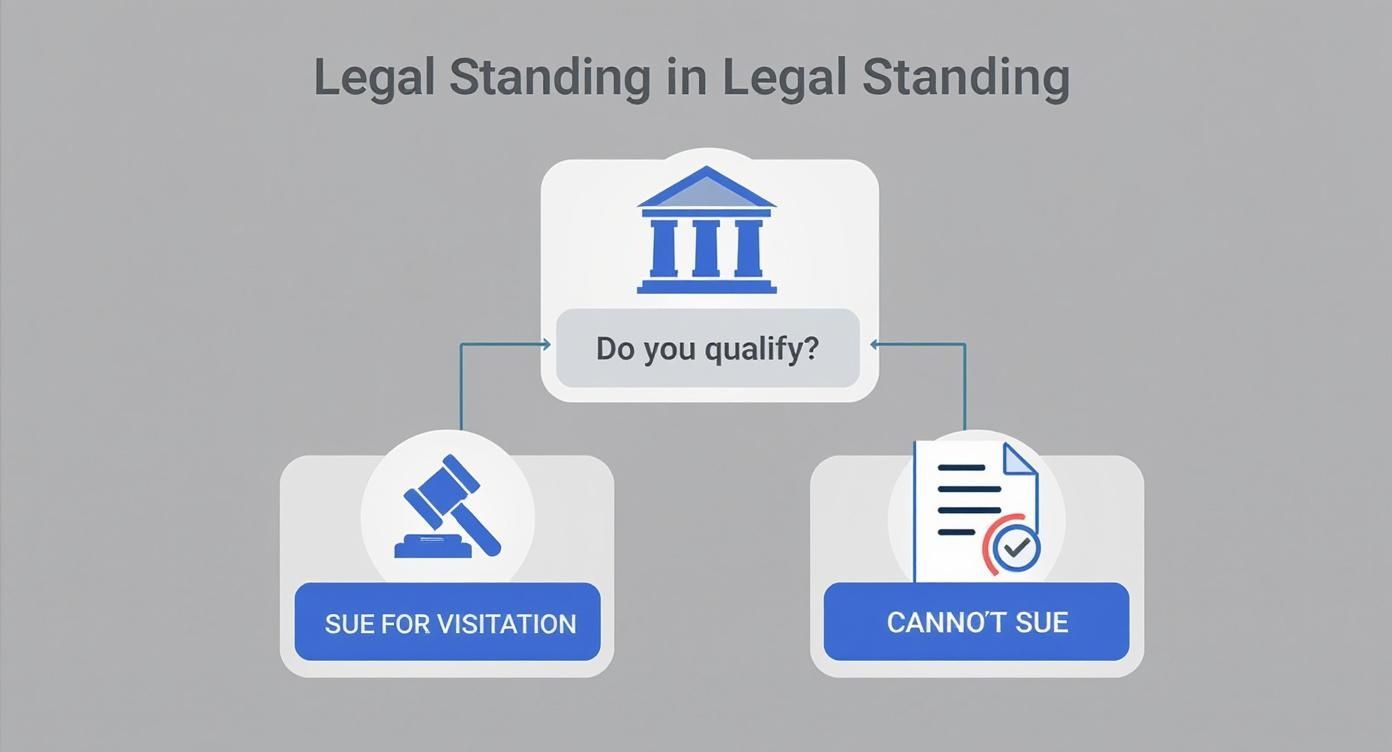
As you can see, meeting those specific qualifications isn't just a suggestion—it's the non-negotiable ticket you need just to get your case heard.
What This Means for Your Case Today
Because of this monumental Supreme Court precedent, the burden on you is much, much higher than simply showing you're a loving grandparent who would be a great influence. You're not just asking a judge to make a call on what’s “best” for your grandchild in a general sense.
Instead, your job is to overcome that powerful legal assumption that the child's parent is making the right call. This is precisely why Texas law now demands that you prove something far more serious: that denying you access would cause actual harm to your grandchild's physical or emotional well-being. It’s a tough hill to climb, and it was put there by the highest court in the country. This is the legal reality every grandparent has to confront before walking into a Texas courtroom to fight for visitation.
Proving That Your Grandchild Would Be Harmed
Once you’ve cleared the first hurdle and established you have the legal right, or standing, to file a lawsuit, you get to the real heart of the matter. For most grandparents, this is the toughest part of the fight, both emotionally and legally. The court needs you to prove that keeping you away from your grandchild would cause them actual, demonstrable harm.

This isn’t just a feeling or a vague idea. The Texas Family Code is crystal clear: you have to show, by a preponderance of the evidence (meaning it's more likely than not), that cutting off your relationship would "significantly impair the child’s physical health or emotional well-being." This high standard comes directly from the landmark Troxel Supreme Court case, which gives a fit parent the presumption that they're acting in their child's best interest. Your job is to bring enough compelling evidence to the table to overcome that legal presumption.
So, let's unpack what "significant impairment" really looks like in a Texas courtroom.
What "Significant Impairment" Means in Plain English
Think of it this way: "significant impairment" is a whole lot more than just sadness. It’s not enough to tell a judge your grandchild will miss you or that they light up when you visit. While those things are absolutely true, they don't meet the high bar the law sets. The harm has to be something you can see and measure—something concrete and substantial.
Imagine a child's emotional well-being as a sturdy foundation. The court needs to see evidence that taking you out of the picture would cause a real crack in that foundation, not just a temporary scuff mark. It’s the difference between a child being disappointed and a child showing genuine distress that affects their daily life.
To make your case, you have to connect the dots for the judge and draw a straight line from your absence to the child’s suffering.
Building Your Case with Concrete Evidence
Your own testimony, no matter how heartfelt, almost never cuts it alone. A judge needs to see objective, verifiable proof that your grandchild would be harmed without you. This means you need to start gathering strong evidence that paints a clear and undeniable picture for the court.
Here are the kinds of evidence that really carry weight:
- School Records: Has there been a sudden, unexplained drop in grades? Are there notes from teachers about behavioral changes? Increased absences can also be a powerful red flag for emotional distress.
- Medical and Counseling Records: If your grandchild is in therapy, a counselor's testimony or their records (if admissible) can directly tie their anxiety or depression to losing contact with you.
- Testimony from Third Parties: Teachers, school counselors, coaches, or even close family friends who can speak to the child’s negative changes in behavior or mood can be incredibly effective witnesses.
- Proof of a Primary Caregiver Role: If you were the one primarily taking care of the child for a long time, you can argue that removing you is a deeply destabilizing event—almost like them losing a parent.
A powerful legal argument often revolves around proving you provided a stable, safe, and nurturing environment that the child came to depend on for their emotional and physical development. Your absence, in that case, creates a void that is actively harmful.
When showing a court how your absence harms a grandchild, focusing on specific areas like their cognitive development in early childhood can be a compelling strategy. Demonstrating that your absence is negatively impacting their developmental milestones can make a strong impression.
The Connection to the "Best Interest of the Child"
At the end of the day, even after you’ve proven significant impairment, the court must still find that giving you visitation is in the best interest of the child. This is a separate but closely related legal standard. In Texas custody cases, the court looks at a list of factors (often called the "Holley factors") to determine what is truly best for a child's overall well-being. Proving harm gets you over the biggest legal wall, but the final decision always comes back to what is best for the child’s emotional, physical, and developmental needs. The process for how to prove the best interest of a child involves this holistic look.
Often, the evidence you use to show significant harm will do double duty as evidence for why visitation is in their best interest. For instance, if a child's grades shot up while you were helping with their homework every day, it proves both that your absence is harmful and that your presence is a clear benefit.
The legal standard for grandparent visitation in Texas is undeniably tough. It forces you to move past emotion and build a case on solid facts that show a real, significant, and negative impact on your grandchild.
Steps in a Grandparent Visitation Case
Filing a lawsuit to see your grandchildren can feel like stepping into a different world, one with its own language and rules. The thought of courtrooms and legal papers is enough to make anyone anxious. Our goal here is to pull back the curtain and give you a clear, step-by-step roadmap of the legal journey ahead.
Knowing what's coming can give you a sense of control and confidence in a situation that often feels powerless.

The legal process for securing grandparent visitation rights in Texas is a structured path. While every case has its own unique twists and turns, they all follow the same fundamental stages. Let's walk through each one, so you can feel prepared for the road ahead.
Step 1: Filing the Lawsuit
The first official step is filing an Original Petition in Suit Affecting the Parent-Child Relationship. This is the formal legal document that kicks off your lawsuit. It tells the court who you are, who the parents and child are, and—most importantly—why you believe you have the legal right to sue for visitation.
Crucially, this petition must include your sworn affidavit. This isn't just a simple statement; it's a detailed account of the facts that give you standing and an explanation of how denying you visitation would significantly harm your grandchild's well-being.
Once filed, you must formally notify the parents of the lawsuit. This is called service of process. You can't just mail them a copy or tell them about it over the phone. A neutral third party, like a sheriff's deputy or a private process server, has to legally deliver the paperwork. This ensures everyone is properly aware that a court case has begun.
Step 2: Discovery and Information Gathering
After the lawsuit is filed and served, the discovery phase begins. This is often the longest and most important part of the case. Think of it as the official fact-finding mission where both sides gather the evidence they need to build their arguments.
Discovery involves several powerful legal tools:
- Requests for Production: This is where you ask the other side to provide documents, like school records, medical bills, or even relevant emails and text messages that support your case.
- Interrogatories: These are written questions sent to the other party that they must answer in writing, under oath.
- Depositions: This involves questioning the parents, and potentially other key witnesses, in person and under oath with a court reporter transcribing everything.
This is where you collect the hard proof needed to show the court that your grandchild would be harmed without you. A skilled attorney is essential during this stage to know exactly what to ask for and how to use the information you gather.
Step 3: Mediation and Negotiation
Before a case ever goes before a judge for trial, Texas courts almost always require the parties to attend mediation. This is a confidential meeting where you, the parents, and your respective attorneys sit down with a neutral third-party mediator. The mediator’s job isn’t to pick a side but to help you find common ground and negotiate a settlement.
Mediation offers a powerful opportunity to resolve your dispute outside of the courtroom. It gives you more control over the outcome and can save a significant amount of time, money, and emotional strain compared to a trial.
Even if you don’t reach a final agreement on every single issue, mediation can help narrow down what you're actually fighting about. It is a critical and often productive step in the legal process. You can learn more about the general legal journey by reviewing our guide on the Texas child custody case timeline, which covers many similar stages.
Step 4: Hearings and Trial
If mediation doesn't lead to a full agreement, your case will proceed to court for a hearing or a final trial. A temporary orders hearing might happen early on to set some ground rules while the case is ongoing.
The final trial is where it all comes together. This is where you and your attorney present your evidence, call witnesses to testify, and make your legal arguments directly to the judge. The parents will have the chance to do the same. After hearing from both sides, the judge will make a final ruling based on the evidence presented and the strict standards of Texas law. Having a confident and experienced attorney by your side during this final stage is absolutely critical.
Key Takeaways and Next Steps
Trying to understand grandparent visitation rights in Texas can feel like you’ve been handed a heavy, complicated puzzle with half the pieces missing. Let’s pull all the threads together and focus on the core ideas and practical steps you can take right now.
This journey takes more than just love for your grandchild; it demands emotional strength, a solid game plan, and a very real understanding of the legal mountain you might have to climb.
Reinforcing the Core Legal Truths
The Texas legal system is built on a few non-negotiable principles. Keeping these truths front and center is the first step toward building a realistic strategy.
- Parental Rights Come First: In Texas, the law starts with a powerful presumption: fit parents act in their child's best interest. This is the single biggest legal hurdle you'll need to clear.
- Standing is Non-Negotiable: You can't just walk into court because you want to. You must first prove you have a legal right to file a lawsuit by meeting very specific criteria, like if your own child (the grandchild's parent) is deceased or incarcerated. Without it, the courthouse doors are closed to you.
- Harm is the Standard: This is the heart of your case. You have to prove that your grandchild will suffer significant emotional or physical harm without a relationship with you. Simply being a loving, positive influence isn’t enough to meet this high legal bar.
Practical Steps to Consider Now
Before you even think about filing anything, it's time to take a deep breath and get organized. Preparation is your best friend in this process.
Start gathering any documents that could help tell your story—photos, emails, school records, or even medical reports that show your deep involvement in your grandchild's life. It's also smart to think through the emotional and financial toll a lawsuit could take on everyone involved. While your focus is on visitation, it can be useful to have a broader understanding of legal frameworks, such as understanding guardianship, which also deal with securing legal authority through the courts.
Key Takeaway: The single most important step you can take is to get personalized legal advice. An experienced family law attorney can look at the unique facts of your situation and give you an honest, no-nonsense assessment of your chances in court.
If you need help with a child custody or visitation case in Texas, our experienced attorneys can guide you every step of the way. Contact The Law Office of Bryan Fagan, PLLC today for a free consultation.
Common Questions About Grandparent Rights
Trying to figure out grandparent visitation rights in Texas can leave you with more questions than answers. The whole situation is emotionally charged, and when you add legal hurdles on top, it's easy to feel completely overwhelmed. Here are some of the most common concerns we hear from grandparents, answered in plain English.
Can a Parent Legally Keep Me from Seeing My Grandchild?
Yes, unfortunately, they can. Under both Texas law and the U.S. Constitution, parents who are deemed "fit" have a fundamental right to raise their children as they see fit. That includes deciding who their kids spend time with—and who they don't.
Texas courts always start with the presumption that a fit parent is acting in their child's best interest. So, unless you can meet the incredibly high legal standard of proving that not seeing you would cause significant harm to the child, a parent’s decision to block visitation is legally protected.
What if I Was My Grandchild's Primary Caregiver?
This is a game-changer. If you had actual care, control, and possession of your grandchild for at least six months, your case becomes much stronger. This history isn't just a nice memory; it's powerful evidence showing that cutting you out of the child's life would pull the rug out from under them and cause real emotional harm.
Proving you served as a primary caregiver helps shift the argument from simply "wanting to see the child" to demonstrating that your absence creates a harmful void in their daily life and stability.
What Does It Cost to File for Grandparent Visitation?
The costs can really vary. You’ll have initial court filing fees and the cost of formally serving the parents with the lawsuit. If the case goes to mediation, there will be fees for that, too. By far, the biggest expense is usually attorney's fees, which will depend on how complicated the case gets and how hard the other side fights back.
What Is the Difference Between Visitation and Custody?
Think of it this way: visitation is about time, while custody is about decisions.
- Possession and Access (Visitation): This is the right to see a child on a set schedule. It does not give you the right to make decisions for the child.
- Conservatorship (Custody): This is a much bigger deal. It gives a person the legal right to make major life decisions for a child—things like where they go to school, what medical care they receive, and their religious upbringing. Getting visitation rights is tough for grandparents; winning custody is an even higher legal mountain to climb.
If you need help with a child custody or visitation case in Texas, our experienced attorneys can guide you every step of the way. Contact The Law Office of Bryan Fagan, PLLC today for a free consultation.