
As a grandparent, there's nothing more frightening than the thought of being cut off from your grandchildren, especially when their well-being is at stake. It’s a fear we hear all the time. In Texas, the law gives parents fundamental rights to raise their children as they see fit, which means that grandparents do not have automatic rights to visitation or custody.
But that doesn't mean you're out of options. When your grandchild’s future is on the line, understanding your rights matters most. Under very specific circumstances laid out in the Texas Family Code, you can ask a court to step in and secure legally protected time with your grandchild.
How Texas Law Views Grandparents' Rights

When your grandchild’s well-being is on the line, figuring out your legal options is the first step toward peace of mind. Let’s be clear: the legal journey for grandparents seeking custody or visitation in Texas is an uphill battle, but it’s not an impossible one. The law is built to protect family stability and defaults to the decisions of fit parents. Because of this, grandparents have to meet a very high legal bar to be successful in court.
Our goal here is to give you clarity and confidence. We’ll walk you through the key concepts in plain English, helping you understand the path forward so you can effectively advocate for what’s best for your grandchild.
The Parental Presumption in Texas
At the heart of every single case involving grandparents' rights is the "parental presumption." This is a powerful legal principle that assumes fit parents know what’s best for their children and act in their best interests.
A judge will always begin with the belief that a parent’s decision—even if it's to limit or deny a grandparent access—is the right one. To win a case for visitation or custody, you must bring compelling evidence to overcome this presumption. It isn't enough to show you're a loving, stable presence; you must prove that the parent's decision is actively harming the child.
Standing: The First Hurdle You Must Clear
Before a judge can even hear your side of the story, you have to prove you have "standing" to file a lawsuit. Think of standing as your ticket to get into the courthouse. If you don't have it, the court is legally barred from hearing your case, no matter how serious your concerns are.
The rules for standing are strict and spelled out in the Texas Family Code. This is the absolute first thing you and your attorney must establish. Generally, you can get standing by showing that:
- You have had actual care, control, and possession of the child for at least six months.
- You are filing your lawsuit within 90 days of that period ending.
It’s crucial to understand the difference between having the right to file a case and actually winning it. These are two completely separate challenges you'll face.
Grandparent Legal Standing vs. Winning Custody
This table breaks down the two distinct legal hurdles grandparents must clear: first, earning the right to file a case (standing), and second, proving their case for custody or visitation.
| Legal Concept | What It Means for Grandparents | Key Requirement |
|---|---|---|
| Standing | This is your "ticket" to the courthouse. It's the legal right to file a lawsuit in the first place. Without it, a judge can't even listen to your request. | Proving you meet specific statutory criteria, like having had actual care, control, and possession of the child for at least six months. |
| Winning Custody/Visitation | This is the main event. After you have standing, you must convince the court that granting you rights is in the child's best interest and overcomes the parental presumption. | Presenting compelling evidence that the parent's actions are causing significant physical or emotional harm to the child. |
As you can see, just getting your foot in the courthouse door is a major step. But once you’re in, the real work of proving your case begins.
Of all the hurdles grandparents face when seeking custody or visitation, none is more critical—or more misunderstood—than the concept of “standing.” Think of it as the legal right to even walk through the courthouse doors and ask a judge to hear your case. Without it, the door is locked, and a judge legally cannot listen to your story, no matter how compelling it is.
This isn't about whether you're a loving, capable grandparent. Standing is a strict, black-and-white legal requirement. The Texas legislature put these rules in place to protect parents' fundamental right to raise their children without constant interference. If anyone could sue for custody of any child, families would be thrown into chaos. So, the law sets a very high bar.

The Six-Month Rule: Your Most Common Path to Standing
For grandparents in Texas, the most common way to establish standing is by meeting the “six-month rule,” which comes directly from the Texas Family Code § 102.003(a)(9). This is a very specific requirement that often trips people up.
To satisfy the rule, you must prove that you had “actual care, control, and possession of the child for at least six months.” Let’s be clear: this means much more than being the fun grandparent who hosts weekend sleepovers or picks the kids up from school occasionally.
- Actual Care: This means you were the one providing for the child’s daily needs. You were buying the groceries, making the meals, taking them to doctor’s appointments, and making sure their homework got done.
- Control: This means you were the person making the significant day-to-day decisions for the child, stepping into a parental role.
- Possession: This means the child lived with you in your home as their main residence for that entire six-month stretch.
You have to show the court that you were, for all intents and purposes, the child's primary caregiver for a continuous period of at least six months.
Don't Miss the 90-Day Filing Window
Proving the six months of care is only half the battle. The other, equally critical part is the timing. The law demands that you file your lawsuit—officially called an Original Petition in Suit Affecting the Parent-Child Relationship (SAPCR)—no later than 90 days after that period of care, control, and possession has ended.
This is a hard deadline. If you wait until day 91, you will lose your standing. The court's hands will be tied, and your case will almost certainly be dismissed. The logic behind this strict window is to encourage prompt legal action when a child's living situation changes, ensuring stability is restored as quickly as possible.
For example, let's say your grandchild lived exclusively with you from January 1st to July 1st. You’ve met the six-month requirement. But on July 1st, the child moves back with a parent. The clock starts ticking. You have until roughly the end of September (90 days) to file your lawsuit. If you wait until October, it's too late.
Understanding and proving standing is the absolute first step. Unlike some states, Texas law under Family Code Sections 153.432-153.434 does not grant automatic visitation rights to grandparents. Instead, it offers this narrow path. Successfully showing that you meet the six-month rule and filed within the 90-day window, as required by Section 102.003, is the only way to get your key to the courthouse. To learn more about these complex requirements, you can explore further details on grandparent rights in Texas on marble.co.
How to Get Visitation ("Possession and Access")
So, you’ve managed to prove you have standing and have earned your ticket into the courthouse. That’s a huge step, but the next challenge is often even tougher. To secure court-ordered time with your grandchild—what Texas law calls “possession and access”—you have to meet an incredibly high standard.
You must prove to a judge that denying you time with your grandchild would cause “significant impairment” to their physical health or emotional well-being. This is a heavy, emotional thing to prove. It's not about showing that you love your grandchild or that you provide a fun, stable home. The court needs to see concrete evidence that your absence would actively harm the child.
Overcoming the Fit Parent Presumption
The biggest hurdle you'll face is the “fit parent presumption.” This is a cornerstone of Texas family law, and it means the judge starts with the assumption that a fit parent always acts in their child’s best interest. If a parent decides to limit or cut off your time with their child, the court presumes they have a good reason for it.
Your job is to overcome, or rebut, this powerful presumption. You have to convince the court that the parent’s decision is not in the child’s best interest and is, in fact, harmful. You need to shift the judge's focus from the parent’s rights to the child's well-being.
The reality is that more grandparents than ever are stepping into primary caregiver roles. Across the U.S., 7.1 million grandparents live with their grandchildren, and 2.3 million are their main caregivers. This is especially true in Texas hubs like Houston, which has over 100,000 of these households.
Even so, the law remains strict. Under Texas Family Code §153.433, a grandparent can only get court-ordered access if a parent is deceased, incarcerated, found incompetent, or has no court-ordered possession of their own. On top of that, you still have to prove that denying you access would harm the child. It’s a tough legal battle, and courts grant this rarely—legal reviews show a success rate of only 12-18% statewide.
Building a Case for Significant Impairment
To prove significant impairment, you need more than just your word. Your feelings and opinions, while completely valid, won't be enough to sway a judge. The court needs objective proof that your specific relationship is vital to the child’s stability and happiness.
Here are the kinds of evidence that build a compelling case:
- Therapist or Counselor Testimony: This is often your strongest piece of evidence. A mental health professional who has worked with the child can testify that losing the relationship with you would cause emotional harm, like anxiety or depression.
- School Records and Teacher Testimony: Has the child’s behavior changed at school? If their grades have dropped, they've had disciplinary issues, or they seem withdrawn since your access was cut off, teachers and school counselors can provide crucial, unbiased observations.
- Detailed Affidavits and Journals: Written statements from neighbors, friends, or other relatives who have seen your close bond can be incredibly helpful. Keeping your own detailed journal, documenting your involvement and any negative changes you see in the child, can also be a powerful tool.
- Medical Records: If the child has started showing physical signs of stress—like recurring stomachaches or headaches—a doctor’s testimony can help connect these symptoms to the emotional distress of your absence.
It’s a difficult and emotional standard to meet, but it’s not impossible. With the right evidence and a solid legal strategy, you can show the court that protecting your relationship is truly in your grandchild’s best interest. For a deeper dive, you might be interested in our guide on grandparent visitation rights in Texas. An experienced attorney can help you pinpoint and gather the most effective evidence for your unique situation.
How to Seek Full Custody (Conservatorship)
When your grandchild’s future is on the line, simply having visitation rights sometimes isn't enough. If you genuinely believe your grandchild is in a dangerous or unstable environment, you might be facing the monumental step of seeking full custody. In Texas, this means asking the court to appoint you as the child's Managing Conservator—the person with the legal right to make major decisions for them.
This is the most significant legal action a grandparent can take, and it's reserved for the most serious circumstances. It requires meeting the highest possible standard of proof because you're asking a court to do something extraordinary: interfere with a parent's fundamental rights for the sake of a child's safety.
Proving Significant Impairment to Health or Well-Being
To ask a court to remove a child from a parent and place them in your care, you have to clear an incredibly high bar. You must not only have "standing" (the right to file the case), but you must also satisfy the demanding threshold set by Texas Family Code §102.004.
The law is very specific. A grandparent can file for custody if they can show that the child's "present circumstances would significantly impair the child's physical health or emotional well-being." This is a much heavier burden than what's required for visitation.
It’s not enough to argue that you could provide a better home, more opportunities, or a more structured life. You have to present clear, convincing evidence that the child’s current home with their parent is actively damaging or dangerous.
What Scenarios Justify Seeking Full Custody?
A judge will only consider stripping a parent of their rights in extreme situations. The court’s primary duty, above all else, is to protect the child. Scenarios that might rise to this level often involve:
- Parental Substance Abuse: If a parent’s addiction to drugs or alcohol directly endangers the child, such as leaving them unsupervised, exposing them to illegal activity, or being unable to provide basic care.
- Neglect: This can mean failing to provide adequate food, shelter, clothing, medical care, or supervision. A child consistently left in unsanitary conditions or without basic necessities is a red flag for the court.
- Abandonment: If a parent has voluntarily left the child and has not provided financial support or maintained a meaningful relationship for an extended period.
- Family Violence or Abuse: Any form of physical, sexual, or emotional abuse toward the child—or even in the child’s presence—is a critical factor.
- Parental Incarceration or Criminal Behavior: When a parent is in jail for a significant amount of time or is engaged in criminal activity that puts the child at risk.
- Severe Mental Illness: If a parent's untreated mental health issues prevent them from being able to safely care for the child.
Securing custody often becomes a last resort for grandparents in heartbreaking situations. With over 50,000 child welfare investigations in Texas each year and 15% of those substantiated for neglect, grandparents are frequently the ones who must step up to shield their grandchildren from harm.
Gathering the Evidence You Will Need
Because the "parental presumption" (the legal idea that a child is best off with their parent) is so strong, your case has to be built on a foundation of undeniable facts. Your attorney's job will be to help you gather the critical evidence needed to convince a judge that your intervention is necessary. This often includes:
- CPS Reports: If Child Protective Services has ever been involved, their records can be some of the most powerful evidence of danger or neglect.
- Police Records: Documentation of domestic violence calls, arrests, or other police involvement at the parent's home is crucial.
- Witness Testimony: Statements from teachers, neighbors, family members, or therapists who have witnessed the parent's harmful behavior or its negative effect on the child.
- Medical and School Records: These can show physical signs of neglect (like untreated medical issues) or the emotional toll the environment is taking (like a sudden drop in grades or behavioral problems).
- Photos and Videos: Visual proof of unsafe living conditions, neglect, or a parent’s substance abuse can be incredibly persuasive in a courtroom.
Ultimately, the court's decision will be guided by one single principle: the best interest of the child. While proving significant impairment is the legal key that unlocks the courthouse door, showing that you can provide a safe, stable, and loving home is what will assure the judge that granting you custody is the right choice. For more information, you might be interested in our detailed look at the differences between custody and guardianship in Texas.
Steps to File for Grandparent Custody in Texas
Stepping into a Texas family courtroom to fight for your grandchild can feel like navigating a maze blindfolded. The legal terms, the paperwork, the deadlines—it’s enough to overwhelm anyone. But knowing the road ahead is the first step toward taking back control. When you understand the process, you can focus on what truly matters: your grandchild.
Let's walk through the path you'll take, from filing the first document to reaching a resolution, so you know exactly what to expect.
This flowchart gives you a bird's-eye view of how a custody case unfolds, starting from the moment you identify a risk to your grandchild.
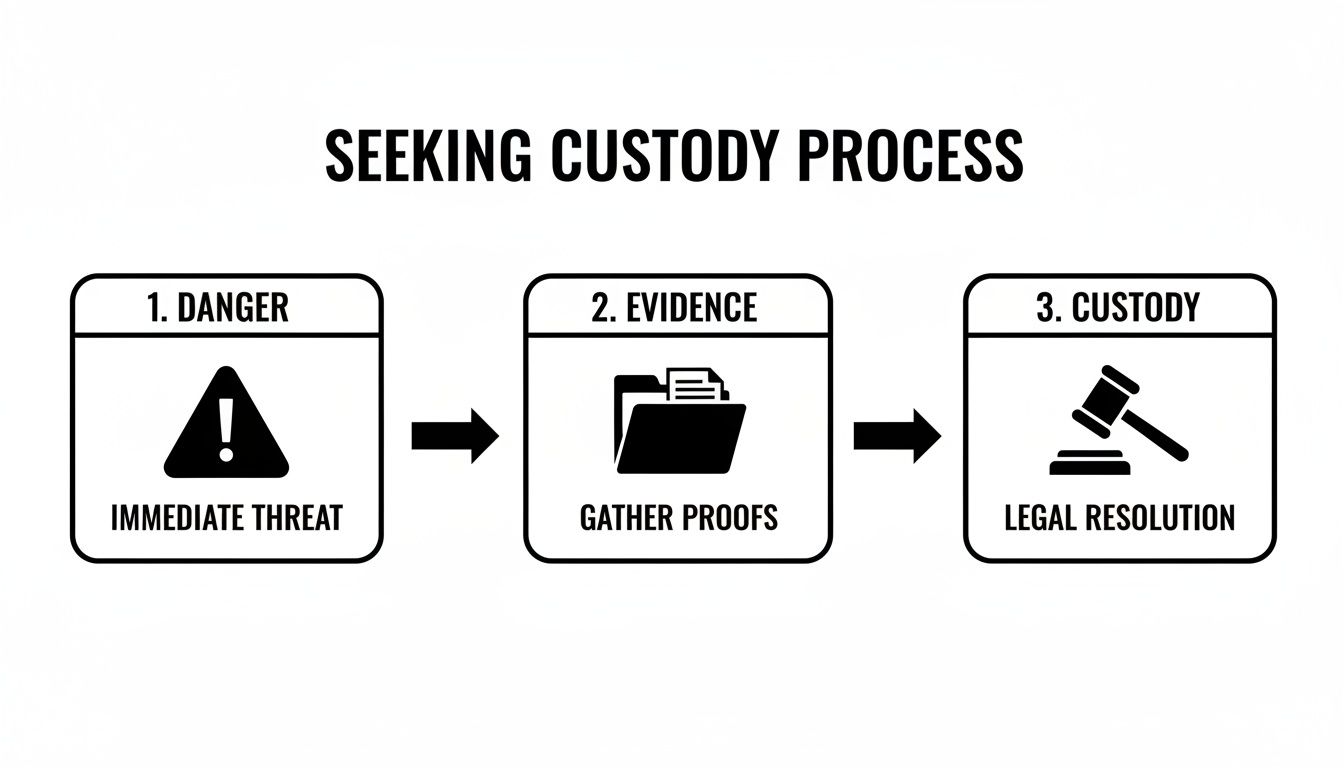
As you can see, the journey begins with an immediate threat, moves into a critical evidence-gathering stage, and leads to a formal legal resolution.
Step 1: Filing the Lawsuit and Getting Temporary Orders
The first official move is to file an Original Petition in a Suit Affecting the Parent-Child Relationship (SAPCR). This is the legal document that kicks off your case. It tells the court who you are, how you're related to the child, the legal grounds you have to sue (standing), and what you’re asking the judge to order.
Almost immediately after, your attorney will push for a Temporary Orders Hearing. This is one of the most important early hearings in your case. A judge will make temporary rules to keep things stable while the lawsuit is pending. These orders can be a lifeline.
The judge could order things like:
- Granting you temporary custody of your grandchild.
- Creating a temporary possession schedule (the Texas term for a visitation schedule) for the parents.
- Ordering the parents not to interfere with your care of the child.
These orders are designed to protect the child's safety and provide stability right away. Once the petition is filed, the parents must be officially "served," which is the formal legal process of notifying them about the lawsuit so they have a chance to respond. If you want to get a head start on understanding the initial forms, our guide on the SAPCR form in Texas is a great resource.
Step 2: The Discovery Phase: Gathering Your Evidence
After the initial flurry of filings and temporary orders, your case moves into the “discovery” phase. This is the formal, court-supervised process for gathering all the facts and evidence you’ll need to prove your case. Think of it as the investigation stage of your lawsuit.
During discovery, your lawyer will use several key legal tools to build a strong argument:
- Requests for Production: Formally asking the parents for documents, which could be anything from financial statements and report cards to revealing text messages and emails.
- Interrogatories: Sending a list of written questions that the parents must answer completely and under oath.
- Depositions: Questioning the parents or other important witnesses in person, under oath, with a court reporter transcribing every word.
This entire stage is about unearthing the concrete proof needed to show the judge that giving you custody or visitation is truly in your grandchild’s best interest.
Step 3: Mediation: A Chance to Find Common Ground
In Texas, judges almost always require you and the parents to try to work things out before heading to a final, contested trial. This happens in mediation, a private and confidential meeting where everyone sits down with their attorneys and a neutral third-party mediator. The mediator’s only job is to help you find a middle ground and reach an agreement.
Mediation puts the power back in your hands. If you reach a deal, you get to decide the outcome—not a judge who has only known your family for a few hours. It's almost always less expensive, less stressful, and gives you the best chance to preserve any remaining family harmony.
If you can find a solution in mediation, your lawyers will write up a Mediated Settlement Agreement which becomes an Agreed Final Order that the judge will sign, and your case will be over. But if you can't reach an agreement, your case will be set for a final trial, where the judge will hear the evidence from both sides and make the final decision for you.
Your Next Steps: A Grandparent’s Action Plan
You’ve reached the point where you know something has to change. The legal road for a grandparent fighting for their grandchild in Texas is complex, and it's easy to feel overwhelmed by the sheer weight of it all. But that powerful love you have for your grandchild is your greatest asset. Now, it’s time to turn that love into a clear, strategic plan.
This is an uphill battle, there’s no doubt about it. But knowing exactly what to do next can shift your perspective from anxious and uncertain to empowered and in control.
Your Action Checklist
If you truly believe your grandchild is in a harmful environment or that being cut out of their life would cause them significant emotional harm, you need to move with purpose. Emotional reactions won't win a court case, but a well-documented, factual argument just might. Here’s a practical checklist to get you started.
- Start a Detailed Journal—Today: This is non-negotiable. Document everything. Every phone call, every visit, every interaction you have regarding your grandchild. Note any concerning statements or behaviors from the parents, with dates and times. Most importantly, record any changes you see in the child’s mood, health, or appearance. This journal will become the backbone of your case.
- Gather Your Paperwork: Start a folder and collect every document that could possibly support your claims. Think school report cards, medical records showing neglect, and photos of you and your grandchild sharing happy moments. Dig up copies of texts and emails between you and the parents. If Child Protective Services (CPS) or the police have ever been involved, do your best to obtain copies of their reports.
- List Your Witnesses: Who has seen your bond with your grandchild firsthand? Who can speak to the instability or danger in the parents' home? This could be anyone from teachers and neighbors to family friends or a therapist. Make a list of these people, because their unbiased testimony can be incredibly powerful.
- Avoid Common Pitfalls: Do not get into arguments with the parents, especially over text or on social media—those messages will be used against you in court. Never violate any existing court orders or even informal agreements about visitation. Your job is to stay calm, focused on the child, and let your attorney manage the difficult communications.
Key Takeaway
The legal path for grandparents is demanding, but it is not impossible. The judge’s decision will boil down to one thing: the best interest of the child. Your entire goal is to build a mountain of undeniable evidence showing that your presence is essential for your grandchild's safety, stability, and emotional health.
It’s easy to feel buried under the pressure, but always come back to why you started this fight—for the love of your grandchild. Taking these organized, deliberate steps is the most effective way to protect that precious bond. You have options, and you have more strength than you know.
Frequently Asked Questions About Grandparents' Rights
When you're fighting for your grandchildren, the legal jargon and what-ifs can feel overwhelming. We get it. You have practical, urgent questions, and you need straight answers from someone who has been in these trenches before. Let's tackle some of the most common questions we hear from grandparents across Texas.
Can I get custody if my grandchild's parent is in jail?
Yes, this is a situation where grandparents can, and often should, step in. If your grandchild's parent is incarcerated, the court's number one priority shifts to finding a safe, stable home for the child. Their world has just been turned upside down.
If the other parent is also out of the picture—or is simply not a safe option—you as a grandparent likely have the standing needed to file for conservatorship (the Texas term for custody). An experienced attorney can help you move quickly to file for temporary orders, which can place the child in your care right away while the bigger legal picture gets sorted out.
What if both parents agree to my visitation?
That's fantastic news. If both parents are on board with you having a consistent role in your grandchild's life, you might not need to go to court at all. Many families successfully manage this with a simple, informal agreement.
However, a word of caution: handshakes don't hold up in court. To protect that precious relationship from a future disagreement or change of heart, it's a smart move to formalize the arrangement. We can help you draft an Agreed Order that, once signed by a judge, makes your visitation schedule legally enforceable. It’s the best way to get true peace of mind.
Do I pay child support if I get custody?
This is a common source of confusion, so let's clear it up. If the court names you the managing conservator of your grandchild, you are their primary caregiver. You are the one providing the home, the meals, and the daily support—so no, you would not be ordered to pay child support.
In fact, the opposite is often true. You may be able to receive child support from the child's biological parents to help you with the financial costs of raising them. As part of the custody process, your lawyer can file a request for child support on your behalf.
If you need help with a child custody or visitation case in Texas, our experienced attorneys can guide you every step of the way. Contact The Law Office of Bryan Fagan, PLLC today for a free consultation at https://texascustodylawyer.net.