
An uncontested Texas custody case may finish in about 2 to 4 months, while a contested case often takes a year or longer. In urgent situations, a court can sometimes act within hours or days to put short-term protections in place, but final orders usually take much longer.
When your child's routine, school schedule, holidays, and sense of stability all feel uncertain, time starts to feel heavier than usual. Many parents aren't just asking how long a custody case takes in texas. They're really asking when life will feel steady again.
Texas cases move by milestones, not by one simple deadline. That matters because it helps explain why one family signs paperwork, attends a short final hearing, and moves forward in a few months, while another spends many more months dealing with hearings, document requests, mediation, and trial settings.
Your Custody Case Timeline What Texas Parents Should Expect

Custody in Texas usually means conservatorship
Texas parents often use the word custody, but Texas law usually talks about conservatorship, possession, and access. Conservatorship refers to the parents' rights and duties. Possession and access refer to the parenting schedule, meaning when each parent has time with the child.
In many cases, the court names parents Joint Managing Conservators. In plain English, that often means both parents share major decision-making rights, even if one parent has the right to determine the child's primary residence. Texas courts focus on the best interests of the child, which means the judge looks at what arrangement supports the child's safety, stability, emotional needs, and healthy development.
Why parents experience the timeline so differently
A Texas family-law source explains that custody timing is measured by milestones, not by a fixed finish date. It also notes that divorce-linked custody matters usually can't be finalized before the state's 60-day waiting period, that contested matters often exceed a year, and that a Temporary Restraining Order may be granted within 24 to 72 hours in urgent cases, as discussed in this Texas custody timeline overview.
That mix of fast emergency relief and slower final resolution can feel confusing at first. The easiest way to understand it is this: a judge can sometimes put a bandage on a problem quickly, but building a full, durable parenting order takes more steps.
If you're still at the very beginning, this guide on how to file for custody in Texas can help you understand what starts the process.
Practical rule: The court can address immediate risk quickly, but the more issues parents disagree on, the more stops the case has to make before final orders are signed.
What parents can control early
You can't control the court's calendar. You can control how organized and realistic you are.
A few early choices often shape the pace of the case:
- Narrow the dispute: If parents can agree on school decisions, exchange logistics, or holiday possession, the court has less to decide.
- Prepare documents early: Delays often start when a parent is missing records, messages, school information, or a workable proposed schedule.
- Focus on the child, not the breakup: Judges tend to respond better to clear parenting concerns than to general complaints about the other parent.
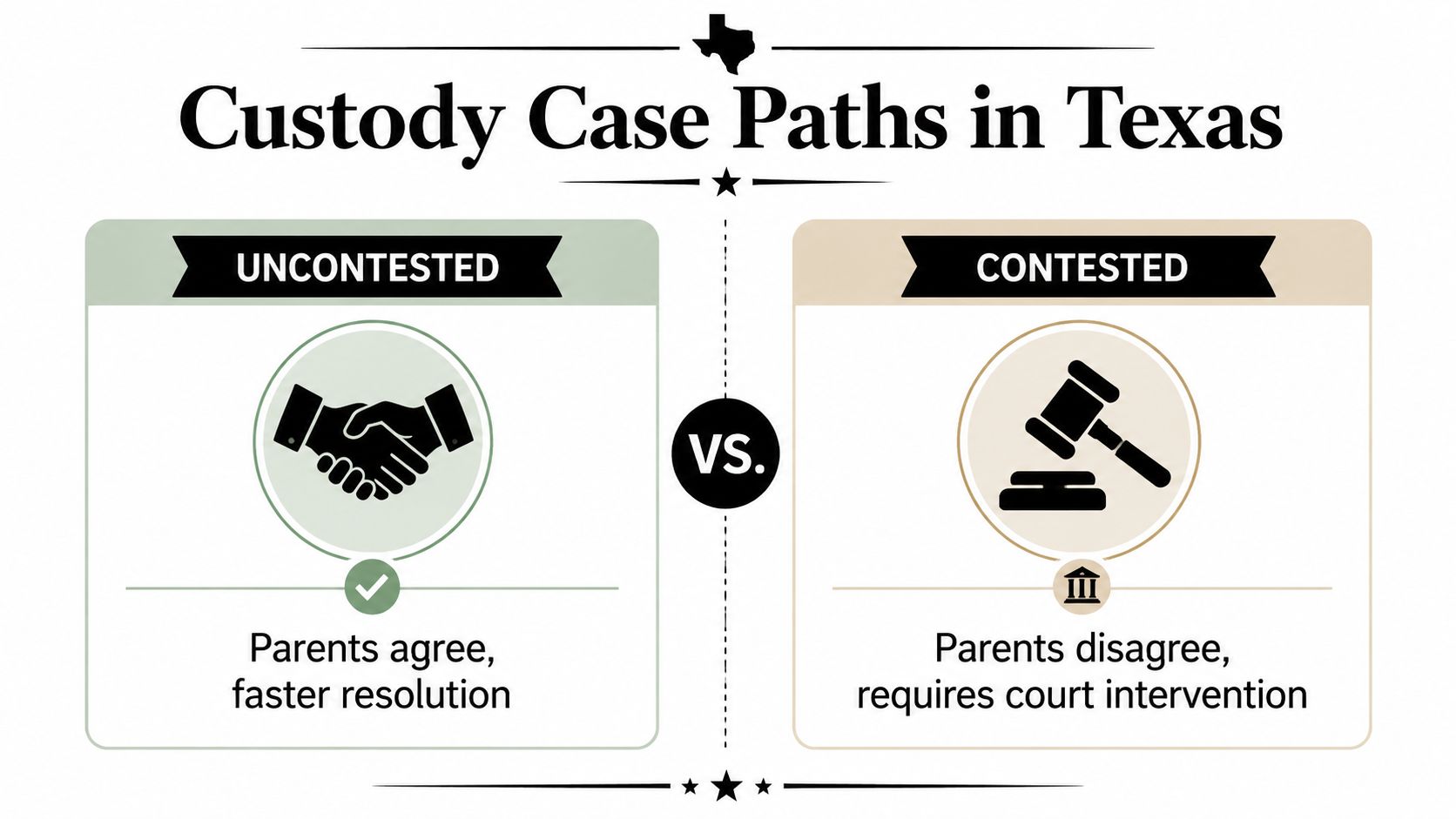
Uncontested vs Contested The Two Roads of a Custody Case
The biggest reason one case moves faster than another is simple. Agreement shortens the road. Disagreement adds stops.
An uncontested case is like taking the highway to the same destination. A contested case is more like taking a route with traffic lights, detours, and construction. Both can get you to final orders. One usually gets there with far fewer interruptions.
What makes a case uncontested
A case is generally uncontested when both parents agree on the major terms before the court has to step in and decide them. That doesn't mean the parents are close friends or that the separation was easy. It means they reached workable agreements on the issues that usually slow a case down.
Those issues often include:
- Primary residence: Which parent has the right to decide where the child primarily lives
- Possession schedule: Weekends, weekdays, holidays, summer, and exchange logistics
- Decision-making rights: School, medical, and other important parental rights
- Child support terms: Financial support and related details when support is part of the case
What turns a case into a contested one
A case becomes contested when parents can't agree on one or more important terms and need the court to resolve the dispute. Sometimes the disagreement is broad. Sometimes it's only one issue, but that one issue is big enough to affect everything else.
A Texas family-law source reports that an uncontested custody case may conclude in about 2 to 4 months, while contested matters often extend to a year or longer because disputes trigger hearings, mediation, and discovery, while agreement allows the case to bypass those bottlenecks, as explained in this discussion of Texas custody timing.
The clock doesn't just measure time. It measures unresolved issues.
A side-by-side view of the two paths
| Path | Typical pace | What drives the timeline | Parent control |
|---|---|---|---|
| Uncontested | About 2 to 4 months | Agreement allows the case to move toward final paperwork and hearing | Higher |
| Contested | Often a year or longer | Hearings, information exchange, mediation, and possible trial | Lower once disputes escalate |
What works and what doesn't
Parents often ask whether being "firm" makes a case move faster. Usually, it doesn't. Clear positions help. Stubbornness usually slows things down.
What tends to work:
- Reasonable proposals: A parent who can offer a detailed, child-focused schedule often creates momentum.
- Prompt responses: Returning documents and answering questions quickly keeps the case from stalling.
- Settlement at the right time: Many cases don't need full agreement on day one. They need enough agreement to avoid unnecessary litigation.
What usually doesn't work:
- Using the case to punish the other parent
- Refusing to exchange information
- Fighting over every detail, even minor ones
- Waiting until trial to become organized
The Express Lane Finalizing an Uncontested Case in Months
An agreed case is still a legal case. It isn't a shortcut around procedure. It's a way to avoid the longer detours.
The basic sequence in an agreed case
In an uncontested matter, the court still expects the paperwork and deadlines to be handled correctly. Texas Law Help explains that, after filing, the case must still clear procedural steps, and in divorce-linked custody matters the 60-day waiting period creates a floor of roughly two months even for cooperative parents, as outlined in this Texas filing and post-filing process guide.
That means the fastest cases are not the ones where parents rush. They're the ones where parents prepare carefully and stay consistent.
A typical agreed path often looks like this:
- One parent files the case. This starts the legal process.
- The other parent responds or signs the needed paperwork. That keeps service issues from causing delay.
- Both sides finish the agreed terms. This includes conservatorship language and a possession schedule that is practical in daily life.
- The case is presented for final approval. A judge still has to sign orders.
Why cooperation helps so much
When parents resolve issues early, they often avoid the slowest parts of family litigation. They may not need a temporary orders fight. They may not need broad discovery. They may not need a trial setting at all.
Mediation can also help close the last remaining gaps. If you're considering that option, this article on what happens in custody mediation explains how the process often helps parents move from conflict to final agreement.
A good agreed order isn't just fast. It's specific enough to prevent the next fight.
What parents should include in a strong agreement
The fastest order isn't always the best order. If the terms are vague, parents often end up back in court later.
A practical agreement should address:
- Exchange details: Time, place, transportation, and how holiday exchanges work
- School-year routine: Homework, extracurricular activities, and notice expectations
- Communication rules: How parents share updates and how children contact the other parent
- Special issues: Travel, medical needs, counseling, or unique family schedules
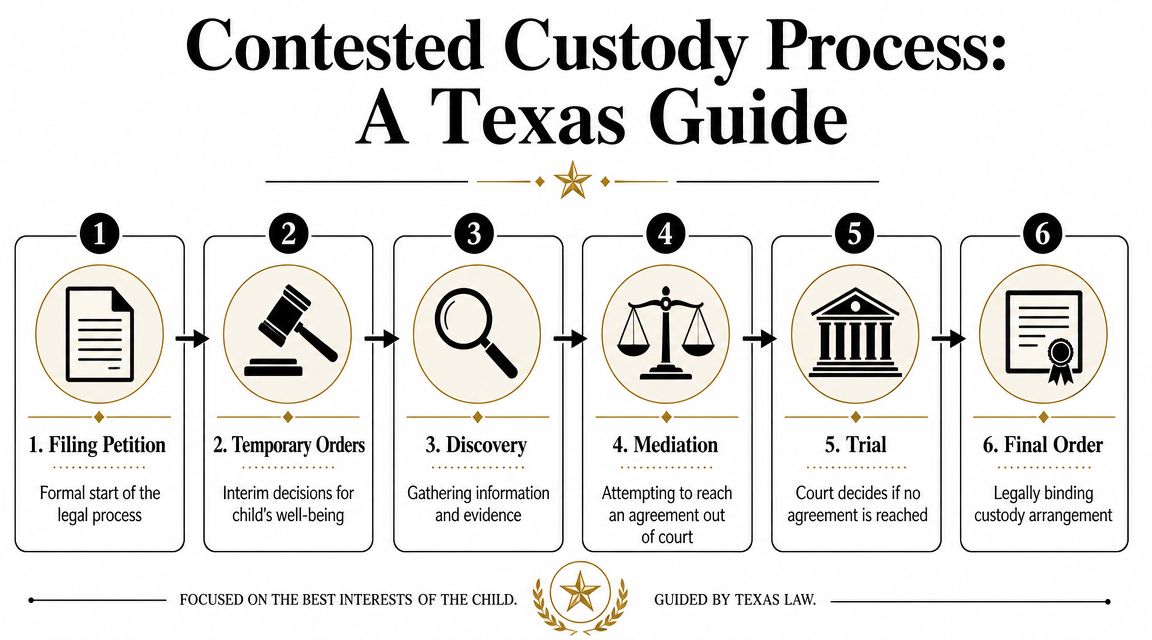
Navigating the Contested Case A Step-by-Step Timeline
A contested case usually feels long because it isn't one event. It's a chain of separate stages, and each stage has its own purpose.
Filing and the first deadlines
The case begins when one parent files a petition. Then the other parent must be formally served unless service is waived. A contested Texas custody case follows a defined sequence. The responding parent typically has 20 days to file an answer, discovery responses are generally due within 30 days of service, and a court-ordered social study may take 60 to 90 days, which shows how each disputed step adds time, according to this Texas contested custody timeline resource.
That sequence matters because missed deadlines create new problems. A parent who ignores service or waits too long to gather records can turn a difficult case into a slower one.
Temporary orders set the rules while the case is pending
In many contested cases, parents need structure before final orders are ready. Temporary orders can address where the child stays, how exchanges happen, who pays support, and what rules apply while the case is open.
These hearings don't end the case. They stabilize it.
Temporary orders are the court's way of saying, "We need workable rules now, even though the final decision comes later."
This short video gives a helpful overview of how temporary issues can fit into a Texas family case:
Discovery, mediation, and case evaluation
After temporary issues are addressed, the case usually moves into fact-gathering. That's the stage where both sides exchange information, review records, and identify what evidence supports their position.
That phase often includes:
- Document exchange: School records, medical records, communication logs, and other relevant material
- Written discovery: Questions and requests that each side must answer
- Mediation efforts: A structured attempt to reach agreement before trial
- Possible neutral investigations: In some cases, the court may order a social study or other evaluation
Each one serves a purpose. Each one also adds time.
Trial and final orders
If parents still can't settle, the case goes to trial. Trial is where the judge hears testimony, reviews evidence, and decides conservatorship, possession, and related issues.
By that point, the timeline has usually stretched because the court has had to do the work the parents couldn't finish themselves. That's why contested cases often feel slower than expected. The delay usually isn't random. It's built into the number of decisions the judge has to make.
Timelines for Emergency Modification and Military Cases
Not every custody matter starts with a brand-new case between two parents who have no prior orders. Many families come to court because something changed, or because something urgent happened.

Emergency cases move differently
When a child may face immediate harm, the court can sometimes act very quickly. Texas Law Help notes that for urgent matters, a Temporary Restraining Order can be granted within hours or days, and that a modification case may move faster than an initial suit if parents only dispute a limited number of terms, as explained in this SAPCR and custody case overview.
That doesn't mean the entire case is over in hours or days. It means the court can enter short-term protective relief while the larger dispute continues through the normal process.
If you're facing a serious safety concern, this article on an emergency custody hearing in Texas can help you understand what emergency relief is designed to do.
Modification cases can be narrower
A modification asks the court to change an existing order rather than create one from scratch. That can matter a lot for timing.
If the parents only disagree about one or two specific terms, the case may be more focused. For example, one parent may seek a change to the exchange schedule, school restrictions, or pick-up logistics after a job change or relocation. A narrower dispute often means less evidence, fewer witnesses, and fewer issues for the judge to resolve.
Military and relocation cases often need more planning
Military families and relocating parents usually face a different kind of time pressure. The issue isn't always conflict alone. It's coordination.
Common pressure points include:
- Deployment schedules: Parenting plans may need temporary adjustments and very clear communication rules
- Distance between homes: Long-distance possession creates travel and holiday planning issues
- Existing school and medical routines: The farther a move reaches into the child's daily life, the more likely the case becomes fact-heavy
For mothers, fathers, and grandparents involved in these cases, the practical lesson is the same. Specific plans tend to move better than broad requests. A judge can work with a proposed calendar, transportation terms, and school-based reasoning. A judge has a harder time working with frustration alone.
In special-circumstance cases, urgency can speed up short-term relief, but complexity still slows down final resolution.
Your Next Steps and Frequently Asked Questions
The parents who usually move through the system more effectively aren't always the least emotional. They're often the most prepared. They keep records. They respond quickly. They know which issues matter and which fights aren't worth extending the case.
If you're trying to shorten the path where possible, focus on what the court needs.
Steps that often help the process move better
- Organize your evidence: Keep school records, medical information, calendars, and communications in one place.
- Use clear proposals: Judges and mediators respond better to practical parenting plans than to broad complaints.
- Be realistic about settlement: You don't have to give up important rights, but refusing every compromise usually increases delay.
- Work with counsel who handles these cases regularly: For example, Law Office of Bryan Fagan, PLLC represents Texas parents in custody, modification, support, and emergency matters, which can help families manage the sequence of filings, hearings, and negotiation with more structure.
Frequently asked questions
Can we finish faster than two months
Sometimes parents are surprised to learn that cooperation doesn't always mean immediate finalization. In divorce-linked custody matters, there is still a required waiting period before final orders can usually be entered. In other family situations, agreed relief can happen much faster, but the exact path depends on the kind of case.
Does the county matter
Yes, in practical terms it can. Court schedules, hearing availability, and local procedures can affect pace. The legal steps remain similar, but the waiting time between steps can differ from one court to another.
Does asking for primary custody make the case take longer
Not by itself. What slows a case is the amount of disagreement and the amount of proof needed. If both parents dispute where the child should primarily live, how school decisions will be made, or whether a move should happen, the case usually takes more work.
What does best interests of the child really mean
It means the court is looking for the arrangement that best supports the child's well-being. That includes stability, safety, the child's needs, and each parent's ability to care for the child. It's not about which parent is more angry, more persuasive online, or more eager to "win."
Key takeaway
The answer to how long a custody case takes in texas depends less on a single deadline and more on how many decisions still need to be made. Agreement usually shortens the path. Unresolved issues lengthen it. The more organized and child-focused you are, the better positioned you are to avoid unnecessary delay.
If you need help with a child custody or visitation case in Texas, our experienced attorneys can guide you every step of the way. Contact The Law Office of Bryan Fagan, PLLC today for a free consultation.