
When your child’s future is on the line, understanding your rights as a father isn't just important—it’s the most empowering step you can take. To build a strong custody case in Texas, you need to show the court that you are an active, stable, and essential part of your child’s life.
The good news? Texas law begins with the presumption that keeping both parents involved is in a child’s best interest, giving you strong and equal footing from the start.
How Texas Law Views a Father's Rights

Many fathers worry that the legal system is biased against them. The first thing we tell our clients is to set that myth aside.
Texas law is gender-neutral. It operates on a single, powerful principle defined in Texas Family Code Chapter 153: determining the “best interest of the child.” In plain English, this means the court’s primary focus isn’t on what each parent wants, but on creating a stable, safe, and nurturing environment for the child.
This "best interest" standard is your greatest asset. It means you start on equal legal ground with your child's mother and have the same right to request custody. The court values your role as a father; your job is to demonstrate why that role is indispensable to your child's well-being.
The Presumption of Joint Managing Conservatorship
The law actually presumes that appointing both parents as Joint Managing Conservators is in the child’s best interest. This is a huge advantage for fathers seeking to stay deeply involved in their children's lives.
Joint Managing Conservatorship is the legal term for custody where both parents share the rights and responsibilities of making major decisions for a child. This doesn’t automatically mean a 50/50 time split, but it ensures you always have a say in your child's upbringing.
These shared decisions are the big ones—the choices that shape your child's future. They typically include:
- Education: Choosing schools and being involved in your child’s academic progress.
- Healthcare: Making crucial medical, dental, and psychological decisions.
- Religion: Guiding your child's religious or spiritual upbringing.
- Legal Matters: Providing consent for things like marriage or enlisting in the military.
For a judge to rule against this joint arrangement, the other parent must prove that your involvement would actively harm the child's physical or emotional well-being. This is a very high bar, empowering you to confidently seek shared parental authority. For more details on this, you can learn more about a father's right to custody in our dedicated article.
Key Texas Custody Terms Explained
Navigating the legal terms in a custody case can feel like learning a new language. This quick-reference table breaks down the key concepts you'll hear in court.
| Legal Term | Plain-English Explanation | What It Means for You |
|---|---|---|
| Conservatorship | This is what Texas calls "custody." It defines your legal rights and duties as a parent. | This is the core of your case—the right to be a decision-maker in your child's life. |
| Joint Managing Conservator | Both parents share decision-making power on major issues (school, health, etc.). | This is the starting presumption in Texas, giving you a strong legal basis to ask for an equal say. |
| Possession and Access | This refers to the physical time you spend with your child—the parenting schedule or visitation calendar. | This is the "when" and "where" of your time with your child and is determined separately from decision-making rights. |
| Standard Possession Order (SPO) | The default visitation schedule in Texas, often giving one parent possession on the first, third, and fifth weekends of a month. | This is a baseline, not a limit. You can and should seek more time if it's in your child's best interest. |
Possession Schedules and Child Support
While conservatorship covers your decision-making authority, possession and access refers to the physical time you spend with your child. Many fathers achieve schedules that go far beyond the old "every other weekend" model, including expanded standard orders or even 50/50 splits.
Finally, Child Support is a related but separate issue. It is calculated using state guidelines and is meant to ensure your child’s financial needs are met, regardless of who has primary physical possession. Both parents have a legal duty to support their child financially.
Step 1: Establish Paternity to Secure Your Legal Standing

Before a court can grant you custody or visitation, you must be legally recognized as the child’s father. Without this crucial step, you are essentially a legal stranger to your child in the eyes of the court. This is the absolute foundation of your entire custody case.
For fathers who were married to the child's mother when the child was born, Texas law provides a presumption of paternity, meaning the law automatically considers you the legal father.
However, if you and the mother are not married, the responsibility is on you to take action. This isn’t just paperwork; it’s the first and most powerful way to declare your commitment to being in your child’s life.
Two Paths to Legal Fatherhood
For unmarried fathers in Texas, there are two main ways to establish your legal rights. The path you take depends on your relationship with the child’s mother.
- Voluntary Acknowledgment of Paternity (AOP): This is the simplest route. Both you and the mother sign a legal form, usually at the hospital after birth, that officially names you as the father.
- Court Proceeding (Suit to Adjudicate Parentage): If you and the mother cannot agree, either parent can file a lawsuit asking a judge to legally establish paternity.
Signing an Acknowledgment of Paternity (AOP) is a cooperative and efficient way to secure your rights. Once filed with the Texas Vital Statistics Unit, it carries the same weight as a court order.
A court proceeding becomes necessary if the mother refuses to sign the AOP or disputes your paternity. In this case, a judge can order genetic (DNA) testing to settle the issue.
A court order establishing paternity allows the judge to immediately put orders in place for custody (conservatorship), visitation (possession and access), and child support at the same time, saving you time and legal fees.
Taking action to establish paternity in Texas is the single most important first move you can make. It proves to the court that you were committed from day one and opens the door to securing your rightful place in your child's life.
Step 2: Build Your Case Around the "Best Interest of the Child"
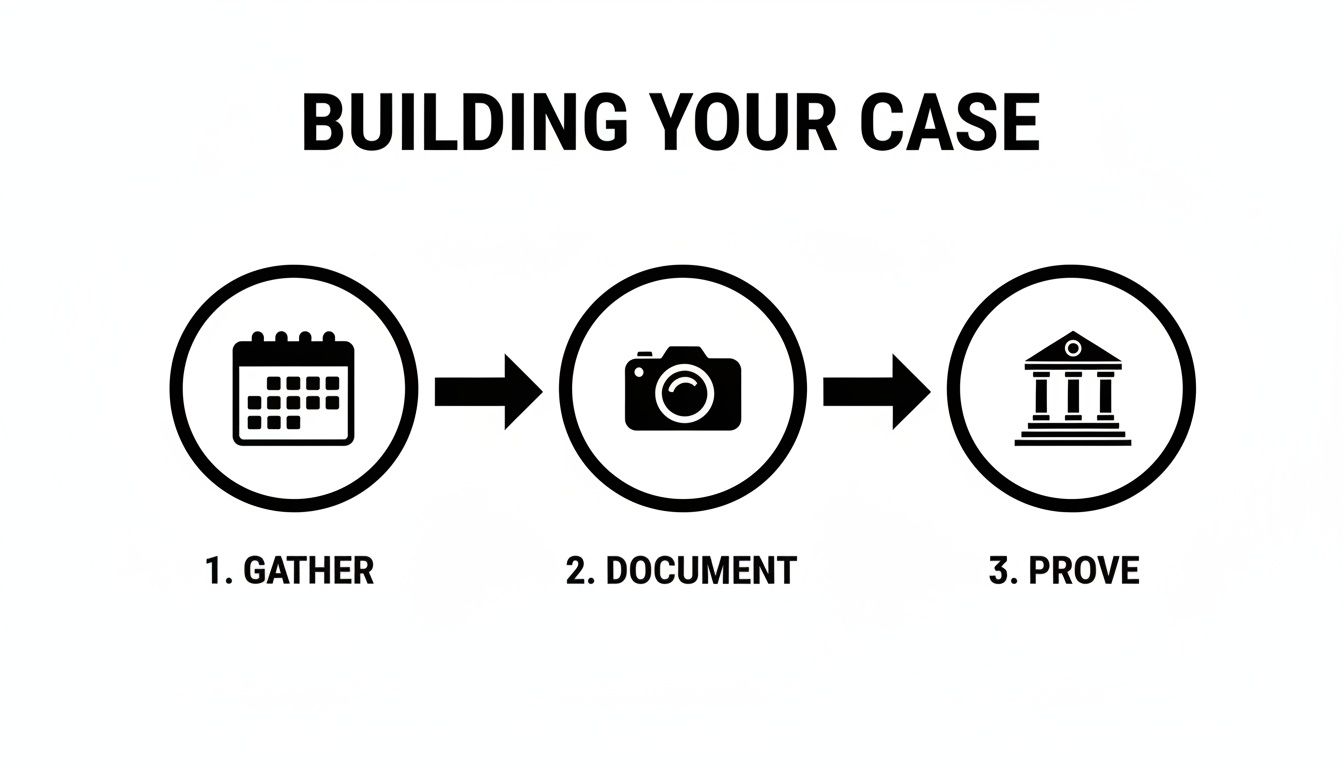
A strong custody case is built on evidence that you are an active, positive, and irreplaceable part of your child’s life. You need to connect the dots for the judge, showing exactly how your involvement serves your child's best interests. To do this, Texas courts use a set of guiding principles called the "Holley Factors" to evaluate each parent.
What are the Holley Factors?
The Holley Factors are the real-world benchmarks a judge uses to decide what's best for a child. Your case strategy should be built around proving your strengths in each of these areas. Key factors include:
- The child’s emotional and physical needs.
- Any emotional or physical danger to the child, now or in the future.
- The parenting abilities of each person seeking custody.
- The stability of the home each parent provides.
- Any actions or failures to act that show an unhealthy parent-child relationship.
Your mission is to build a mountain of proof showing that you excel in these areas.
How to Prove Your Value as a Father
In court, your word alone isn't enough. You have to show, not just tell. Every claim you make about being a great dad must be backed by tangible proof.
Documentation is your best friend in a custody case. A judge’s decision often comes down to which parent provides the most organized, credible, and thorough proof of their involvement. Your memory will fade, but a well-kept calendar or saved email is forever.
It's also crucial to show the court you understand the emotional weight a custody battle places on a child. Acknowledging the impact of divorce on a child's mental health demonstrates that you are a thoughtful parent focused on your child's total well-being.
Start Building Your Evidence Portfolio Today
- A Detailed Calendar: Log every overnight visit, every weekend, and every holiday. Note every time you handled school pickup or took your child to the doctor.
- School and Medical Involvement: Save every email from teachers and coaches. Keep photos of you at school events and records of medical appointments you attended.
- Communication Records: Keep all texts and emails with the other parent professional and child-focused. This shows the court you are a mature co-parent.
This consistent, organized evidence is the bedrock of your case. It elevates you from a father asking for more time to a parent proving your indispensable role. To learn more, see our guide on how to prove the best interest of the child.
Step 3: Navigate the Court Process with Confidence
Stepping into a Texas family court can feel intimidating, but knowing the key stages of the legal process will empower you to make strategic decisions for your child’s future.
The Critical Importance of Temporary Orders
The Temporary Orders hearing is often the first time you’ll appear before a judge. The rulings made here aren't final, but they are incredibly powerful. They establish the "status quo" for the rest of your case by dictating:
- Who gets to decide where the child lives for now.
- A temporary possession schedule.
- Who pays temporary child support.
- Rules for how you and the other parent communicate.
Making a strong impression at this stage is vital. A favorable Temporary Order paints you as a competent, involved father from the start and can create momentum that is hard to reverse.
Mediation: Your Opportunity to Control the Outcome
Before a final trial, Texas law requires you and the other parent to attend mediation. This is a confidential meeting with a neutral third-party mediator whose job is to help you negotiate a settlement.
Mediation is your chance to control your family's future. If you succeed, you leave with a Mediated Settlement Agreement (MSA)—a binding contract that you helped create, rather than leaving the decision in a judge's hands.
If you can’t reach an agreement, the final step is trial, where a judge will make a final, binding ruling based on the evidence presented.
Handling Special Circumstances
- False Allegations: If you are falsely accused of abuse or neglect, stay calm and strategic. Your focus must be on dismantling the claims with credible evidence, such as texts, emails, and statements from credible witnesses who can speak to your character.
- Relocation Cases: If one parent wants to move away with the child, the judge’s decision will be based entirely on what is in the child’s best interest—not the parent's desire to move.
- Sole Managing Conservatorship: Some fathers ask for "full custody," known in Texas as Sole Managing Conservatorship (SMC). This is reserved for serious cases where you can prove the other parent has a history of family violence, substance abuse, or abandonment that would harm the child. While recent divorce and custody statistics show this is awarded to fathers in only a small fraction of cases (around 6.3%), it is possible when necessary to protect a child.
Key Takeaways for Texas Fathers
Going through a custody case is a journey, but you can take charge by focusing on strategic moves that secure a stable, loving future for your child.
- Establish Paternity: If you are unmarried, this is your non-negotiable first step. It is the key that unlocks all your parental rights.
- Document Everything: Your most powerful tool is evidence. Keep a detailed calendar, save all communications, and document your involvement in your child's school and health.
- Stay Child-Focused: In all communications and court appearances, demonstrate that you are a mature, stable, and collaborative parent. Judges look for parents who can work together for their child.
- Understand the Process: Know the importance of Temporary Orders and embrace mediation as your best opportunity to shape the outcome.
Your consistent, documented involvement is the foundation of a powerful argument for why your child needs you. These actions don’t just build a legal case; they build a stronger bond with your child that will last a lifetime.
Frequently Asked Questions from Texas Fathers
Can I really get 50/50 custody as a father in Texas?
Yes, it is more possible now than ever. While not automatic, courts are increasingly granting 50/50 possession schedules when it is proven to be in the child's best interest. You must show consistent, hands-on involvement and demonstrate that the logistics (like living close to the other parent) make a shared schedule practical and stable for your child.
Does it matter who files for custody first?
Strategically, it can. Filing first (becoming the "Petitioner") allows you to present your case first and, more importantly, request immediate Temporary Orders. This helps establish a positive "status quo" from day one, proving your role as a committed, capable father right from the start.
What is the average cost of a custody case for a father?
The cost of a Texas custody case is driven almost entirely by one thing: conflict. An uncontested case settled in mediation will always be more affordable than a high-conflict battle that goes to trial. The best way to control costs is to stay organized, be open to a reasonable settlement, and work efficiently with your attorney to achieve your most important goals.
If you need help with a child custody or visitation case in Texas, our experienced attorneys can guide you every step of the way. Contact The Law Office of Bryan Fagan, PLLC today for a free consultation.