
When your child’s future is on the line, understanding your rights matters most. Facing a custody case can feel overwhelming, but you are not alone in this journey. In Texas, the law starts with a hopeful assumption: that your child deserves to have both parents actively involved in their life. What most people call "joint custody" is legally known as a Joint Managing Conservatorship. Think of it as being co-CEOs of your child's life—it's about sharing major decisions and responsibilities, not necessarily splitting time 50/50.
This guide is here to walk you through the process with clarity and empathy, helping you feel more in control as you make the best decisions for your family.
Understanding Joint Custody in Texas

When parents go their separate ways, one of the biggest anxieties is figuring out how they'll continue to raise their child together. The word "custody" can sound final and intimidating, but Texas law actually starts from a place of optimism: it presumes that it's best for a child to have both parents deeply involved in their life.
This legal preference is what we call a Joint Managing Conservatorship. This setup isn't about perfectly equal parenting time. Instead, it’s laser-focused on ensuring both you and the other parent share the rights and duties that come with raising your child.
Over the years, Texas courts have leaned heavily toward joint managing conservatorship as the ideal path for parents who can work together after a separation. Under Texas Family Code Section 153.002, the single most important factor in every judicial decision is the "best interest of the child." This standard almost always supports arrangements where kids can maintain a real, meaningful relationship with both parents.
The Building Blocks of Joint Conservatorship
A Joint Managing Conservatorship is built on a few key components that will define your co-parenting relationship for years to come. Getting a handle on these elements from the start can help you navigate your case with a lot more clarity and confidence.
Here's what it breaks down to:
- Shared Decision-Making: This is the heart of joint conservatorship. Both parents typically get a say in major decisions about the child's education, medical care, and religious upbringing.
- Designation of a Primary Parent: Even when decision-making is shared, one parent is usually designated as the "primary" managing conservator. This parent has the exclusive right to decide where the child lives (usually within a specific geographic area) and is the one who receives child support payments.
- Possession and Access: This is just the legal term for the visitation schedule. While you and the other parent can agree on any schedule that works, Texas provides a default Standard Possession Order (SPO) that lays out a detailed calendar for when the child will be with each of you.
Here's a quick look at how these pieces fit together.
Joint Managing Conservatorship at a Glance
This table breaks down the key components of joint custody in Texas, explaining the legal term, who holds what role, and what is shared.
| Concept | What It Means in Plain English | Primary Goal |
|---|---|---|
| Joint Managing Conservators | Both parents are co-decision-makers. | To keep both parents actively involved in the child's life. |
| Primary Conservator | The parent who establishes the child's main residence and receives child support. | To provide a stable "home base" for the child. |
| Possessory Conservator | The non-primary parent who has visitation rights according to a schedule. | To ensure the child has consistent, quality time with both parents. |
| Rights and Duties | The list of parental responsibilities, such as making medical or educational decisions. | To clearly define who is responsible for what, reducing future conflict. |
Understanding this structure helps you see the big picture: creating a stable, predictable life for your child is the ultimate goal.
Rights and Duties Are the Foundation
The Texas Family Code provides a specific list of rights and duties that are usually shared between joint managing conservators. This framework is designed to create stability and encourage cooperation. While a judge can absolutely customize this list based on a family's unique situation, the goal is always to empower both parents to act in their child's best interest.
For parents who were never married, it's critical to remember that these rights aren't automatic. Often, the first step is to learn more about how to establish paternity to secure your legal standing as a parent.
A huge misconception we see all the time is that joint custody means no one pays child support. That's simply not true. The primary managing conservator, who provides the child's main home, is entitled to receive child support to help with daily expenses, regardless of how much decision-making authority the parents share.
Grasping these fundamentals helps demystify the legal process. When you understand that "joint custody" in Texas is about shared responsibility, not just a 50/50 time split, you can better focus on creating a stable, loving environment for your child, even if it's across two homes.
How Texas Determines Custody: The Best Interests of the Child
When a judge is making a decision about your child, it can feel like your entire world is hanging in the balance. It’s a moment packed with anxiety, but understanding how they make that decision can give you back a sense of control and purpose. Every single choice a Texas court makes about joint custody is guided by one powerful legal standard: the best interest of the child.
This isn't some vague, fuzzy idea; it's a specific legal framework that judges are required to follow. Think of it as a checklist the court uses to see the complete picture of your child's life and figure out what they need to truly thrive. This standard ensures the final custody order is all about your child's well-being—not about rewarding one parent or punishing the other.
The Holley Factors Explained
So, how does a judge determine a child's best interest? In Texas, they rely on a set of considerations known as the "Holley Factors." These factors came out of a landmark Texas Supreme Court case and now provide a roadmap for judges. While it's not a complete, exhaustive list, it covers the most critical areas of a child's life.
Instead of a dry legal list, let’s look at what these factors actually mean for your family in the real world:
- Your Child's Needs: The court looks at your child's emotional, physical, and developmental needs, both right now and for the future. For a toddler, this might mean focusing on stability and a consistent routine. For a teenager, it could involve weighing their social life and school activities more heavily.
- Parental Abilities: The judge will assess each parent's ability to provide a safe, stable, and loving home. This isn't just about who has more money; it's about your capacity to be an engaged, supportive, and capable parent.
- Stability of the Home: A predictable and stable environment is crucial for any child's well-being. The court will consider which home environment offers the most consistency and security.
- Acts or Omissions: The judge will review parental behavior—both the good and the bad—that could impact the child. This includes any history of domestic violence, substance abuse, or neglect, but it also includes powerful evidence of positive, consistent parenting.
One of the most critical factors judges weigh is which parent is more likely to encourage and support the child's relationship with the other parent. A parent who tries to alienate the child or block communication often ends up seriously harming their own case.
Building Your Case Around Your Child's Well-being
Knowing what the court is looking for gives you the power to build a case that genuinely reflects what's best for your child. Your goal is to provide the judge with a clear, honest picture of your parenting skills and the stable life you can offer.
This means gathering evidence that speaks directly to those Holley Factors. For instance, you might show your deep involvement in your child's school, your efforts to create a safe and nurturing home, or your track record of making sound medical decisions for them. You can learn more about understanding Texas custody and the Holley Factors to prepare yourself even more thoroughly.
What Does This Mean for You?
Ultimately, presenting your case is about storytelling. You are telling the story of your child's life and your essential role in it.
Think about these practical examples:
- Emotional Well-being: If you've been the one taking your child to therapy or helping them navigate a tough time at school, document it. This shows you're tuned in to their emotional needs.
- Physical Safety: Evidence of a child-proofed home, a history of consistent medical check-ups, and living in a safe neighborhood can all demonstrate your commitment to their physical well-being.
- Future Stability: Having a solid plan for childcare, school enrollment, and extracurricular activities shows the court you are thinking ahead and can provide a predictable, secure future for your child.
The legal process can feel overwhelming, but it helps to remember that the court's main objective aligns with yours: to create a safe, supportive, and loving future for your child. By focusing on these core principles, you empower yourself to advocate effectively for their best interest.
Creating Your Parenting Plan and Possession Schedule
Once you get a handle on the legal side of things, it’s time to translate all that theory into practical, everyday rules for your family. This is where the Parenting Plan and the Possession Schedule come into play. These two documents are the absolute backbone of your joint custody arrangement in Texas, giving your child the clarity and predictability they need to thrive across two homes.
Here’s a simple way to think about it: The Parenting Plan is the "how" of co-parenting—it spells out how you'll make major decisions together. The Possession Schedule, which is often called a Possession Order, is the "when"—it’s the calendar detailing which parent the child is with at any given time. Getting these documents right from the start is your best defense against future conflict and the first step toward building a stable co-parenting relationship.
Understanding the Texas Standard Possession Order
To make things easier, Texas law provides a default schedule known as the Standard Possession Order (SPO). This schedule is legally presumed to be in your child’s best interest and is, by far, the most common arrangement we see in joint custody cases. It’s specifically designed to give both parents consistent, quality time with their child.
The SPO works by naming one parent as the "primary" conservator, who has the exclusive right to decide where the child lives. The other parent, called the "possessory" conservator, has visitation according to a set schedule.
So, what does that look like for the possessory parent? Generally, the SPO includes:
- Weekends: Possession on the first, third, and fifth weekends of any given month.
- Holidays: Alternating major holidays like Thanksgiving and Christmas each year, so you swap from one year to the next.
- Summer: An extended period of time with the child during the summer break, which is usually 30 days.
This standard framework gives a lot of families a solid, reliable starting point. But let’s be honest—it’s not a one-size-fits-all solution.
When to Create a Custom Schedule
The SPO works well for many families, but your life might not fit neatly into that box. The good news is that you and the other parent can agree to just about any schedule you can dream up, as long as a judge agrees it serves your child's best interest.
You might need to think about a custom schedule if:
- A parent works a non-traditional job (think firefighters, nurses, or anyone on rotating shifts).
- Your child is under three years old, since the SPO is really built for kids over three.
- The parents live more than 100 miles apart, which triggers a modified long-distance schedule.
- Both of you agree that a true 50/50 possession schedule is what’s best for your child.
Building a custom plan gives you the freedom to tailor the schedule to your actual lives, which almost always means less disruption for your child.
The path to a final custody order can feel long, but it’s deliberately structured to encourage agreement and careful thought every step of the way. This visual timeline breaks down the typical steps in a Texas custody case, from that first filing all the way to a potential trial.
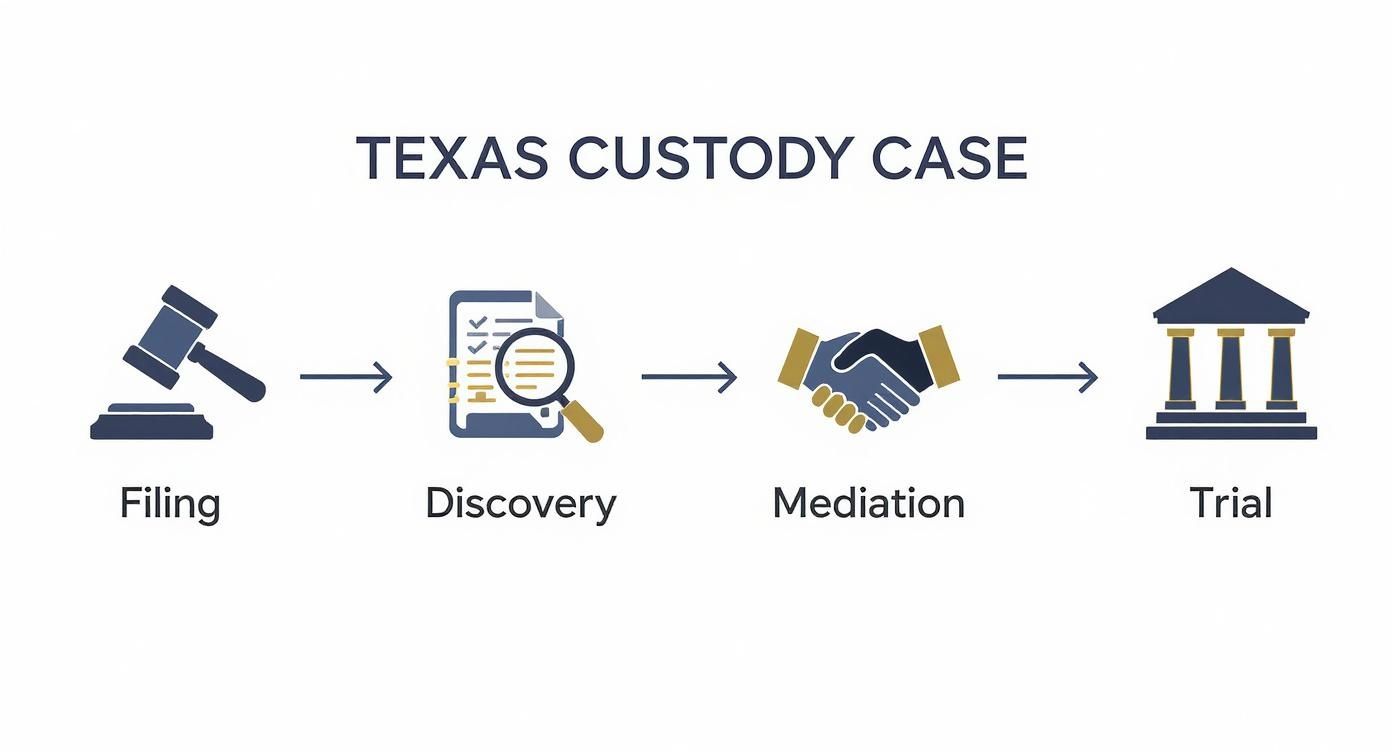
As you can see, the process really emphasizes giving parents chances to settle things on their own terms through mediation, with a trial serving as the last resort if an agreement just isn’t possible.
Let's take a closer look at how standard and custom schedules stack up.
Standard vs. Custom Possession Schedules
Deciding between the Texas Standard Possession Order (SPO) and a custom schedule is a big step. The SPO offers predictability and a court-approved framework, while a custom schedule provides flexibility tailored to your family's unique needs. This table breaks down the key differences to help you think through which approach might be better for you.
| Feature | Standard Possession Order (SPO) | Customized Possession Schedule |
|---|---|---|
| Structure & Predictability | Highly structured and predictable; follows a set formula. | Flexible; can be designed to fit work schedules, school, etc. |
| Best For | Parents with traditional 9-5 jobs who live relatively close. | Families with unique work hours, young children, or long distances. |
| Legal Presumption | Presumed by law to be in the child's best interest. | Must be proven to be in the child's best interest if not agreed upon. |
| Ease of Creation | Simple to implement, as the terms are already defined by law. | Requires more negotiation and careful drafting to cover all bases. |
| Potential for Conflict | Can reduce conflict by providing clear, non-negotiable rules. | May require more co-parenting communication and cooperation to work. |
| Examples | 1st/3rd/5th weekends, alternating holidays, 30 days in summer. | Week-on/week-off (50/50), 2-2-5-5 schedules, or irregular patterns. |
Ultimately, the best choice depends on your ability to co-parent and your family’s specific circumstances. While the SPO provides a great safety net, a thoughtfully crafted custom plan can often lead to a smoother and more cooperative co-parenting relationship in the long run.
The Parenting Plan: Your Rulebook for Co-Parenting
While the possession schedule handles the calendar, the Parenting Plan gets into the nitty-gritty of your rights and duties as parents. This is a critical document that clarifies who is responsible for what, which is absolutely essential for making joint custody in Texas work without constant arguments.
A well-drafted Parenting Plan will clearly specify things like:
- Decision-Making Power: Who gets the final say on big decisions about education, non-emergency medical care, and psychological treatment.
- Geographic Restrictions: It will almost certainly include a restriction on where the primary parent can move with the child, often keeping them within a certain county or school district to ensure the other parent has access.
- Communication Protocols: Basic rules for how you and the other parent will communicate about the child—like using a co-parenting app or agreeing to weekly phone calls.
Taking the time to be incredibly specific in this document can save you from countless headaches and disagreements down the road. If you need some guidance on what to include, you might find it helpful to review a parenting plan template designed specifically for Texas families.
A detailed Parenting Plan does more than just follow the law—it provides your child with a sense of security. When children know that their parents have a clear, cooperative plan for taking care of them, it reduces their anxiety and helps them adjust more easily to their new family structure.
At the end of the day, creating these documents is your first major act as co-parents. By working together to build a thoughtful, comprehensive plan, you are laying the foundation for a stable and supportive future for your child.
How Child Support Works in Joint Custody Cases
When parents decide to share custody, it's only natural to wonder how money fits into the new picture. One of the biggest myths we have to bust for clients is the idea that joint custody in Texas automatically means no one pays child support. It seems fair on the surface, but that's just not how the law works here.
Even when you have a Joint Managing Conservatorship, child support is almost always part of the deal. The whole point is to make sure your child has a consistent standard of living in both homes. Child support helps ensure their basic needs are met, no matter which parent’s roof they're under on any given day.
The Texas Formula for Child Support
Texas keeps things pretty straightforward with a percentage-based model for calculating child support. The math is based on the paying parent's net monthly resources. The parent who is named the primary managing conservator—the one who gets to decide where the child lives—is the one who receives the support payments.
Here’s a quick look at the standard guidelines:
- 1 Child: 20% of net monthly resources
- 2 Children: 25% of net monthly resources
- 3 Children: 30% of net monthly resources
- 4 Children: 35% of net monthly resources
- 5 or more Children: 40% of net monthly resources
Keep in mind, these numbers can change if the paying parent is already supporting other children from another relationship.
What Exactly Are "Net Monthly Resources"?
So, what does the court count as "net monthly resources"? It's a lot more than just what’s on your paycheck. The term covers nearly every source of income you have, with deductions for things like taxes and the cost of the child’s health insurance.
Most of the time, the court is looking at:
- Wages, salaries, and tips
- Overtime pay and commissions
- Self-employment income
- Rental income from properties
- Retirement benefits and pensions
A judge will add up all those income streams and then subtract Social Security taxes, federal income tax (calculated for a single person with one exemption), and whatever you pay for the child’s health and dental insurance. That final number is what they use to apply the percentage.
But What If We Have a 50/50 Schedule?
This is the big question every parent with an equal possession schedule asks. If the kids are with me exactly half the time, does that cancel out child support? The short answer is no, not automatically.
Even in a true 50/50 split, a judge will likely still order child support, especially if there's a big gap between what you and the other parent earn. The court's number one priority is always the child's best interest. If one parent makes significantly more money, the judge will probably order them to pay support to ensure the child’s quality of life is stable and similar in both homes.
In these 50/50 situations, a judge has the flexibility to move away from the standard guidelines. They might order a lower amount of child support or use a different calculation that considers both parents' incomes and the equal time split. The key thing to remember is that a 50/50 schedule doesn't give you a free pass on child support.
At the end of the day, the law sees financial stability as a critical part of a child's well-being. Understanding how child support fits into a joint custody plan helps you prepare for your child’s future and push for a financial arrangement that is fair and truly supportive.
Steps to Modify or Enforce Your Custody Order

Life rarely stands still. The custody order that felt perfect last year might not fit your family's reality today. Kids get older, parents get new jobs, and sometimes people move. The good news is that a Texas custody order isn't carved in stone; it's a living document that can—and should—adapt as your family’s needs change.
But what happens when things change, or when the other parent simply isn't following the court's rules? This is where understanding your legal options becomes critical. The two most important tools at your disposal are a modification, which changes the order, and an enforcement, which compels a parent to follow it. Knowing when to use each one is key to protecting your child’s stability.
When Can You Change Your Custody Order?
To convince a Texas court to change your existing custody, visitation, or child support order, you have to clear two specific hurdles. First, you must prove there has been a "material and substantial change in circumstances" since the judge signed the last order. Second, you must show that the change you're asking for is in the child's best interest.
This legal standard is there for a reason—it stops parents from running back to court over every minor disagreement. The change has to be a big deal, something significant enough to genuinely impact your child's life.
So, what counts as a material and substantial change? It can be a lot of things, but here are some of the most common scenarios we see:
- A Parent Relocates: One parent is planning to move a significant distance, making the current possession schedule impossible to follow.
- Lifestyle Changes: A parent develops a substance abuse problem or starts a new relationship that puts the child in an unstable or even dangerous environment.
- A Child’s Needs Evolve: As children get older, their needs and wishes change. A teenager might express a strong desire to live with the other parent, or their demanding school and activity schedule might require a totally different visitation plan.
- Major Income Shifts: A parent experiences an involuntary job loss or gets a massive promotion that changes their ability to pay child support or the child's financial needs.
No matter the reason, the court will always view these changes through one lens: what is in the "best interest of the child."
What to Do When the Other Parent Breaks the Rules
It’s incredibly frustrating—and frankly, painful—when the other parent just decides not to follow the possession order. Denying you your court-ordered visitation time isn't just unfair to you; it's harmful to your child. When this happens, you have the right to ask the court to step in and enforce the order. An enforcement action is a serious legal move designed to hold the non-compliant parent accountable.
If a judge finds that the other parent has violated the order without a good reason, they have some powerful tools to set things right:
- Order Makeup Visitation: The judge can require the non-compliant parent to give you extra time with your child to make up for the weekends or holidays you were denied.
- Impose Fines or Jail Time: For more serious or repeated violations, the court can find the parent in contempt. This can lead to hefty fines and, in some cases, even jail time.
- Order Payment of Attorney's Fees: The judge can order the parent who broke the rules to pay for your legal fees and the costs of bringing the case to court.
Taking legal action can feel confrontational, but remember this: enforcing your custody order isn't about punishing the other parent. It's about protecting your child's right to have a consistent, stable relationship with you. It’s about ensuring they get the predictability that court orders are designed to provide.
Whether you need to adapt your joint custody Texas order to new life circumstances or make sure the current rules are being followed, the law provides a clear path forward. You don't have to figure it out on your own.
Key Takeaway: Your Next Steps for a Stable Co-Parenting Future
Trying to wrap your head around joint custody in Texas can feel like a heavy weight, but understanding your rights is the single most powerful tool you have. The entire process is built around one central goal: creating a stable, predictable, and loving future for your child.
Let's quickly recap the core principles. Remember, Joint Managing Conservatorship is about sharing the big decisions, not necessarily splitting time right down the middle in a 50/50 split. Every single choice a judge makes is guided by the best interest of the child, focusing squarely on their emotional and physical well-being. A detailed parenting plan and possession schedule are your roadmaps to making co-parenting work, designed to cut down on conflict and give your kids much-needed consistency.
Beyond just the custody order, you'll also want to think about the bigger financial picture, which includes understanding how to navigate mortgage responsibilities during a divorce. After all, financial stability is a huge piece of the puzzle. Armed with this knowledge, you can build a solid foundation for cooperation and focus on what truly matters—raising a happy, secure child.
You are not just ending one chapter; you are intentionally writing the next one for your family. The choices you make now create the framework for a successful co-parenting relationship for years to come. You have the power to make that future a positive one.
Your Questions About Joint Custody in Texas, Answered
When you’re staring down a custody case, the questions can feel endless, often showing up in the middle of the night. You deserve clear, straight answers that give you a sense of control over what’s happening. Here, we’re tackling some of the most common questions our attorneys hear from parents about joint custody in Texas.
Our goal is to cut through the legal jargon and give you the practical clarity you need to move forward.
Does Joint Custody Always Mean a 50/50 Split?
This is probably one of the biggest myths in Texas family law. The short answer is no, it doesn’t. The legal term, "Joint Managing Conservatorship," is really about sharing parental rights and responsibilities—like making decisions about school and healthcare—not necessarily about splitting the child's time perfectly down the middle.
While you and the other parent are absolutely free to agree on a 50/50 possession schedule, it's not what the court defaults to. What’s far more common is the Texas Standard Possession Order. Under this setup, one parent is named the "primary" conservator with the exclusive right to decide where the child lives, and the other parent has a predictable visitation schedule.
Can a Father Get Joint Custody in Texas?
Absolutely, and they do all the time. Texas law is gender-neutral, period. The starting point for any judge is the presumption that naming both parents as Joint Managing Conservators is in the child's best interest. It doesn't matter if you're the mom or the dad.
A judge’s decision will never come down to gender. Instead, the court’s entire focus is on the "best interest of the child." This means looking at which parent can provide a stable, loving home and, just as importantly, who will support the child's relationship with the other parent. Fathers have the exact same legal footing as mothers when it comes to being named a joint managing conservator.
It's not about being a mom or a dad; it's about being a capable and committed parent. The court's only focus is on which parent can best provide for the child's emotional and physical well-being.
What Happens if We Cannot Agree on a Parenting Plan?
If you and the other parent are at a standstill and just can't find common ground on a parenting plan, the decision-making power ultimately goes to the court. This means a judge will listen to the evidence from both of you and then create an order they believe serves your child's best interest.
But courts really prefer parents to sort this out themselves. Before you ever get to a trial, you will almost certainly be ordered to attend mediation. This is where a neutral third-party professional sits down with both of you to help negotiate a compromise.
Striking an agreement in mediation is almost always the better path. It keeps you in control of your family's future and tends to set a more cooperative tone for the co-parenting years ahead—a benefit for your child that is truly priceless.
If you need help with a child custody or visitation case in Texas, our experienced attorneys can guide you every step of the way. Contact The Law Office of Bryan Fagan, PLLC today for a free consultation.