
When your child’s future is on the line, understanding your rights matters most. In Texas, the biggest difference between joint custody and sole custody boils down to one thing: decision-making power. For parents navigating a separation or divorce, grasping this concept is the first step toward building a stable, predictable future for your family.
Think of it this way: joint custody means you and the other parent are partners in making the big calls for your child. Sole custody gives one parent the exclusive right to decide on most major issues. This guide is here to offer a clear, compassionate path forward, explaining these options in plain English so you can feel empowered and informed.
How Texas Determines Custody: Understanding Conservatorship
The terms “joint custody” and “sole custody” can feel overwhelming, especially when you’re already dealing with so much. In Texas family law, we don’t actually use the word “custody” in official court orders. Instead, we use the legal term "conservatorship," which clearly defines each parent’s legal rights and responsibilities for their child. Understanding this from the start helps you focus on what truly matters: securing your child's well-being.

Here’s a quick look at the two main arrangements you'll encounter under the Texas Family Code:
| Feature | Joint Managing Conservatorship (JMC) | Sole Managing Conservatorship (SMC) |
|---|---|---|
| Decision-Making | Both parents share the right to make major decisions about the child's life. | One parent has the exclusive right to make most major decisions. |
| Legal Presumption | Texas courts start with the belief that this is in the child’s best interest. | This is only awarded in specific, serious situations, like family violence or neglect. |
| Parental Roles | Both parents are named "Joint Managing Conservators." | One parent is the "Sole Managing Conservator," and the other is the "Possessory Conservator." |
Our goal is to give you the knowledge to make confident, informed choices that protect your child. Throughout this guide, we'll provide a detailed comparison to help you see what each arrangement really means for your family. We'll always come back to the single most important standard in Texas law: the best interest of the child. We know how much weight these decisions carry. You’re not just going through a legal process; you are shaping your child’s future. We are here to provide the clarity and support you need.
Conservatorship: The Texas Approach to Custody
The entire Texas legal framework is built on a few key concepts that every parent needs to understand. These terms will be all over your court orders and will set the ground rules for your co-parenting relationship for years.
-
Joint Managing Conservatorship (JMC): This is the default arrangement in Texas courts and is presumed to be in the child's best interest. In a JMC, both parents share the rights and duties of raising their child and make major decisions together. However, one parent is usually named the "primary" conservator, which gives them the exclusive right to determine the child's residence.
-
Sole Managing Conservatorship (SMC): This is far less common. Here, one parent is given the exclusive power to make most of the big decisions for the child. A judge will only order this if there’s a serious reason—like a history of family violence, substance abuse, or extreme conflict that makes joint decision-making harmful for the child.
-
Possessory Conservator (PC): This is the legal term for the other parent in a Sole Managing Conservatorship case. When one parent is named the Sole Managing Conservator, the other is typically named the Possessory Conservator. This parent has the right to possession of and access to the child—what most people call a possession schedule or visitation—and is almost always ordered to pay child support.
The Guiding Principle: Best Interests of the Child
No matter what, every single decision a Texas judge makes comes down to one guiding standard: the “best interests of the child.” This isn’t some vague, feel-good phrase; it's a specific legal benchmark laid out in the Texas Family Code Chapter 153.
A judge's primary duty is to ensure any custody order promotes the child’s emotional and physical well-being. This principle trumps what either parent wants and is the bedrock of every decision, from possession schedules to conservatorship rights.
This means the court will look at everything—from each parent’s ability to provide a stable home to the child’s specific emotional needs. Understanding this standard is absolutely critical. Your entire case should be built to show how your requests serve your child's best interests, which is the whole point of any joint custody vs sole custody determination.
Comparing Joint and Sole Managing Conservatorship
Choosing between joint and sole conservatorship is more than just checking a box on a legal form. It’s a decision that fundamentally shapes the day-to-day reality for your child and your co-parenting relationship. To get a handle on the differences, you have to look at how these two frameworks play out in the real world.
The core distinction boils down to how parental rights and duties are divided. Think of it as the difference between running a business as a partnership versus a solo operation. In a joint setup, you and the other parent collaborate on big-picture decisions. In a sole arrangement, one parent takes the lead.
Decision-Making Power: The Core Difference
The most significant way these two paths diverge is in decision-making authority. This isn't about small, daily choices like what’s for dinner. It's about the major life decisions that will steer your child's future.
Under a Joint Managing Conservatorship (JMC), both parents typically share the right to make key decisions together, including:
- Education: Choosing a school district or agreeing to enroll in a specific school.
- Medical Care: Making non-emergency healthcare decisions.
- Psychological Treatment: Consenting to counseling or therapy for the child.
- Religious Upbringing: Guiding the child's spiritual life.
Even in a JMC, the court almost always designates one parent as the "primary" conservator, giving them the exclusive right to decide where the child lives. You can get a much deeper look into how this all works in our complete guide to Joint Managing Conservatorship.
On the flip side, a Sole Managing Conservator (SMC) holds the exclusive right to make most of these critical decisions alone. The other parent, the Possessory Conservator, still has a right to be informed about the child's life but does not have a legal say in these major choices.
This infographic shows how a court often weighs the level of parental conflict when deciding which path to take.
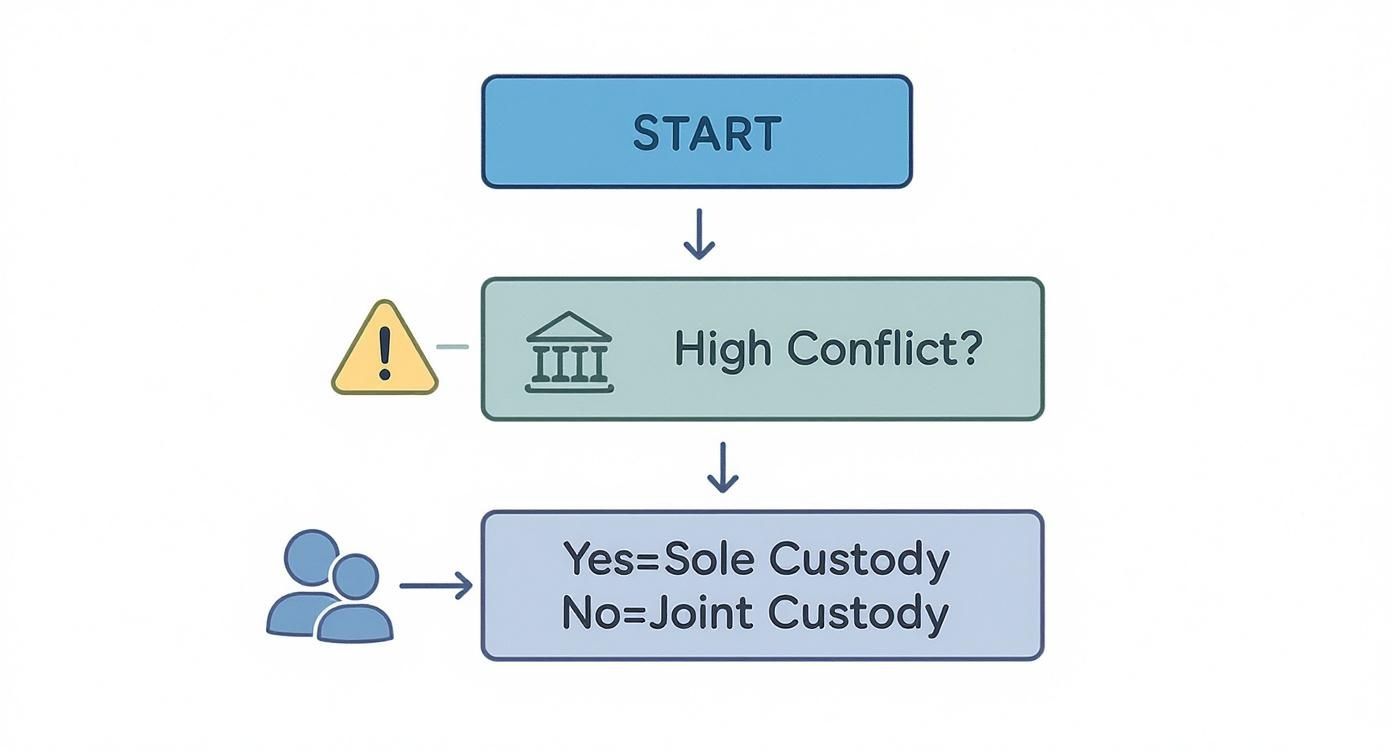
As you can see, a judge's main goal is to shield a child from conflict. That makes sole custody a tool they use in high-conflict situations where effective co-parenting is not realistic.
To make these distinctions even clearer, here's a side-by-side look at the rights involved.
Comparing Joint vs Sole Managing Conservatorship Rights
| Feature | Joint Managing Conservatorship (JMC) | Sole Managing Conservator (SMC) |
|---|---|---|
| Major Decisions (Medical, Education) | Shared between both parents, requiring agreement. | Exclusive right held by the SMC. |
| Child's Residence | One "primary" parent has the exclusive right to decide. | Exclusive right held by the SMC. |
| Child Support | Duty of both parents; one typically pays the other. | Duty of both parents; the Possessory Conservator pays the SMC. |
| Access to Records | Both parents have full access to medical and school records. | Both parents have full access to records. |
| Communication with Child | Both parents have the right to speak with the child freely. | Both parents have the right to speak with the child. |
This table highlights that while many fundamental rights remain intact for both parents, the power to make key life decisions is the central point of difference.
Possession Schedules and Financial Duties
The way you structure time with your child—what Texas law calls a possession schedule—also looks different under each model. With a JMC, a Standard Possession Order is the norm. It provides a detailed, predictable calendar for holidays, summers, and weekends that ensures both parents get regular, meaningful time with their child. It's not always a 50/50 split, but it's designed to keep both parents actively involved.
Under an SMC arrangement, the Possessory Conservator's time might be more restricted. In some cases, if the court has concerns about the child's safety, visits may even need to be supervised.
Regardless of the conservatorship title, both parents have a legal duty to financially support their child. In nearly every case, one parent will be ordered to pay child support to the other, calculated based on Texas guidelines.
Ultimately, the choice between joint and sole conservatorship comes down to your family’s unique situation. A Texas court will always make its decision based on what it believes is in the best interest of the child, focusing on which structure provides the most stable, peaceful, and nurturing environment possible.
How Texas Courts Determine Child Custody
When you’re facing a custody dispute, it can feel like your family’s entire future is in the hands of a stranger. Understanding how a Texas judge makes these life-altering decisions is key to preparing your case and advocating effectively for your child.
The process isn't random; it's guided by one single, powerful principle: the best interest of the child.
This standard, found in the Texas Family Code, requires a judge to look beyond the parents' wishes and focus entirely on what will promote the child’s physical and emotional well-being. To do this, they use a specific set of criteria to get a complete picture of the family's situation.
The Holley Factors Guiding the Court
To avoid making decisions in a vacuum, Texas courts rely on a list of factors first established in a landmark case called Holley v. Adams. These aren't just a simple checklist but a framework for evaluating what kind of environment each parent can provide.
A judge will consider things like:
- The emotional and physical needs of the child, both now and in the future.
- The parental abilities of each individual seeking custody.
- The stability of the home each parent can provide.
- Any emotional or physical danger the child may be in, now or in the future.
- The plans each parent has for the child.
During this process, courts often rely on sworn statements to establish the facts of the case, such as an Affidavit of Fact. This kind of evidence helps the judge build a clear, honest understanding of the family dynamics at play.
The court's primary duty is to create an environment of stability, safety, and support. Your case should be built around demonstrating how your proposed arrangement achieves this for your child, using the Holley factors as your guide.
The Child’s Preference and Other Considerations
For older children, their voice matters. If a child is 12 years of age or older, they can speak with the judge in private to express their preference on which parent they want to live with. While the judge is required to listen, the child's wishes are not the final word. It's just one of many factors the court weighs.
The court also examines the relationship between the parents. A history of cooperation and mutual respect can strongly support a joint custody arrangement. On the flip side, evidence of family violence, substance abuse, or extreme conflict will almost certainly lead a judge to limit one parent's rights to protect the child. You can learn more about these top considerations for determining the best interest of the child in our detailed article.
Overcoming the Joint Custody Presumption
Texas law begins with a presumption that a Joint Managing Conservatorship is in the child's best interest. This means the court starts from the belief that both parents should share the rights and responsibilities of raising their child. If you are seeking sole custody, the burden is on you to provide clear evidence that a joint arrangement would be harmful.
This legal preference for joint custody actually aligns with what we see in court outcomes. Research shows that parents who request joint custody are 1.74 times more likely to get it compared to those seeking sole custody. Even more telling, parents in states with laws favoring joint custody are 1.54 times more likely to succeed in court, which shows just how much these legal frameworks influence the final decision.
When Sole Custody Is the Necessary Choice
While Texas law always starts with the belief that shared parenting is best for a child, your family’s reality might tell a different story. Sometimes, a joint arrangement is not just unworkable—it's unsafe. In these difficult circumstances, seeking a Sole Managing Conservatorship isn't about winning a fight; it's about protecting your child from harm.

The court’s primary duty is to shield children from physical and emotional danger. When one parent’s actions threaten a child’s well-being, a judge will set aside the preference for joint custody and take decisive action. This is a significant step, and it requires clear and convincing evidence.
Grounds for Granting Sole Managing Conservatorship
A Texas court will only award sole custody if it is proven to be in the child's best interest. This typically involves serious issues that make co-parenting impossible or dangerous.
Some of the most common reasons a judge will grant sole managing conservatorship include:
- A History of Family Violence: Any credible evidence of physical, sexual, or emotional abuse directed at the child or the other parent is taken extremely seriously.
- Substance Abuse: If a parent has a current and ongoing issue with drug or alcohol abuse that impairs their ability to care for the child safely.
- Child Neglect or Abandonment: This includes failing to provide basic necessities or a prolonged, voluntary absence from the child’s life.
- Extreme Parental Conflict: When parents are so unable to communicate or cooperate that joint decision-making would expose the child to constant turmoil and stress.
A judge will not grant sole custody simply because parents disagree. The conflict must be so severe that it actively harms the child's emotional development, making one parent’s stable decision-making authority a necessity.
Proving Your Case for Sole Custody
If you believe sole custody is necessary, the responsibility falls on you to present compelling evidence to the court. The national trend has certainly moved toward shared parenting—joint physical custody arrangements rose from 13% before 1985 to 34% between 2010 and 2014—but Texas courts will prioritize safety above all else. Discover more insights about this custody trend.
To build a strong case, you will need to gather documentation that clearly demonstrates the risk to your child. This may include police reports, medical records, testimony from teachers or counselors, and photographic evidence. Understanding the specific steps and evidence required is crucial, and you can learn more about how to get full custody in Texas in our detailed guide. In these high-stakes situations, your child's safety is the only acceptable outcome.
Key Takeaways and Next Steps for Your Custody Journey
Navigating the difference between joint and sole custody is a significant emotional and legal challenge, but you now have a clearer picture of how these arrangements work in Texas. The most important thing to remember is that there is no one-size-fits-all solution. The "best" custody arrangement is the one that fits your family’s unique circumstances and, above all, serves your child’s best interests. This is a heavy weight, but you do not have to carry it alone.
Feeling in control starts with taking practical, proactive steps. Whether you are at the beginning of a separation or preparing for court, there are things you can do right now to protect your parental rights and build a strong foundation for your case.
Preparing for What's Ahead
Getting organized can make a world of difference. When you present yourself as a stable, prepared parent who is focused on your child's needs, you are already speaking the court’s language.
Your immediate focus should be on these key actions:
- Gather Important Documents: Collect copies of everything that shows your involvement as a parent. This includes school report cards, medical records, and any relevant texts or emails with the other parent.
- Communicate Carefully (If Safe): If family violence is not an issue, keep communication with the other parent respectful and focused on the children. Judges favor parents who can work together for their child's benefit.
- Document Everything: Keep a simple journal to log possession times, key decisions, and any important events. This creates a factual timeline that can be invaluable later.
Every action you take should be framed by the "best interest of the child" standard. This isn't just legal jargon; it's the lens a Texas judge will use to view your case. Your actions should demonstrate your commitment to providing your child with stability, safety, and support.
It's Time to Get Professional Legal Advice
Trying to navigate the complexities of Texas family law on your own is incredibly difficult, especially while managing emotional stress. The most important step you can take is to consult with an attorney who specializes in child custody cases. An experienced family law attorney will help you understand how the law applies to your specific situation, develop a smart legal strategy, and advocate for you in negotiations or in the courtroom. They are there to ensure your rights are protected and your voice is heard.
Texas Custody FAQs: The Questions Every Parent Asks
As you start to understand the difference between joint vs. sole custody, many practical questions will arise. Here are straightforward answers to some of the most common concerns we hear from Texas parents, both mothers and fathers.
Does "Joint Custody" Automatically Mean a 50/50 Schedule?
No, this is one of the biggest misconceptions. In Texas, Joint Managing Conservatorship is about sharing the rights and responsibilities to make major decisions for your child—like those related to education and non-emergency medical care.
While a 50/50 possession schedule is possible, it is not the default. More often, a judge will order a Standard Possession Order. This schedule designates one parent as the "primary" parent who has the exclusive right to determine the child's residence and typically has the child for a slightly greater percentage of time.
Can My Child Tell the Judge Who They Want to Live With?
Once a child reaches 12 years of age, Texas law allows them to express their wishes to the judge. The judge is required to interview the child in private to understand their preference.
However, a child's preference does not automatically determine the outcome. A judge will listen carefully and consider the child’s maturity and reasons, but the final decision must always be based on the child's overall best interest after weighing all relevant factors.
If We Share Custody, Does Anyone Still Pay Child Support?
Yes, in nearly all cases. A Joint Managing Conservatorship order does not eliminate the financial duty each parent has to support their child.
Even in a joint custody arrangement, one parent is typically designated as the "primary" conservator who receives child support payments from the other parent. The amount is calculated using the Texas child support guidelines, which are based primarily on the paying parent's net monthly income and the number of children they are supporting. This ensures the child’s needs are met consistently across both households.
If you need help with a child custody or visitation case in Texas, our experienced attorneys can guide you every step of the way. Contact The Law Office of Bryan Fagan, PLLC today for a free consultation.