
When your child’s future is on the line, understanding your rights matters most. The conversation about sole vs. joint custody can feel overwhelming, but it's one of the most important you’ll have as a parent. In Texas, the law starts with a strong preference for joint custody (called “joint managing conservatorship”), which is all about shared parental decision-making. Sole custody (“sole managing conservatorship”), on the other hand, is generally reserved for difficult situations—like family violence or substance abuse—where one parent must make all key decisions to protect the child.
Understanding Your Texas Custody Options
Deciding on a custody arrangement is one of the heaviest lifts a parent will ever face. The legal terms used in Texas, like "conservatorship," can sound cold and intimidating. But at their core, they simply define your rights and responsibilities for your child.
The court’s one and only guiding star in all of this is the “best interest of the child.” It’s a legal standard that puts their emotional and physical well-being ahead of everything else.

This guide is here to give you clarity, whether you're a mom or a dad, by breaking these critical concepts down into plain English. Knowing the real-world differences between your options is the first step toward building a stable, loving future for your family.
| Feature | Joint Managing Conservatorship (Joint Custody) | Sole Managing Conservatorship (Sole Custody) |
|---|---|---|
| Decision-Making | Both parents share the right to make key decisions. | One parent has the exclusive right to make decisions. |
| Legal Presumption | Texas law presumes this is in the child's best interest. | Awarded only in specific, often high-conflict situations. |
| Parental Rights | Rights are shared, though one parent is often the primary. | Most rights are given to one parent; the other's are limited. |
| Common Scenarios | The standard arrangement for most separated or divorced parents. | Cases involving family violence, neglect, or substance abuse. |
As you work through the complexities of Texas custody laws, you might consider different kinds of legal support to make sure everything is handled correctly. For instance, some people choose to hire a paralegal to help get their case organized and ready.
Ultimately, whether you're working toward a cooperative joint arrangement or you believe a sole conservatorship is what’s needed for your child’s safety, knowing your rights is non-negotiable. That knowledge is your foundation for advocating effectively for your child’s future.
When you're walking into a custody case, the legal jargon can feel like a foreign language. But when you boil it all down, the real-world difference between sole and joint custody comes down to one critical thing: decision-making power. Understanding how Texas law divides up these crucial rights is the first step toward fighting for the best outcome for your child. The state definitely has a preference, but knowing both options prepares you for whatever comes your way.
Texas law, specifically Chapter 153 of the Family Code, starts with the presumption that a Joint Managing Conservatorship is in a child’s best interest. This doesn't automatically mean a 50/50 possession schedule, but it does mean both parents are expected to share the rights and duties of raising their child.
On the other hand, a Sole Managing Conservatorship is an arrangement reserved for situations where sharing decisions would be damaging or simply impossible. It concentrates the primary rights and responsibilities with one parent, giving them the final say on the big-picture decisions that shape a child's life.
Parental Rights and Responsibilities
The heart of the sole vs. joint custody debate is about who gets to make the big calls for your child. In a joint setup, these rights are usually shared, split between the parents, or made by mutual agreement. Even in a joint conservatorship, one parent is typically named the "primary" parent, giving them the exclusive right to decide where the child lives (usually within a specific geographic area).
In a sole managing conservatorship, one parent holds almost all the key decision-making powers exclusively. This is a huge legal step, and it's one that Texas courts don't take lightly. For a judge to award sole custody, there has to be powerful evidence showing it’s absolutely necessary for the child's well-being.
Key Insight: Texas courts begin with the belief that keeping both parents actively involved in a child’s life is the best-case scenario. If you're asking for sole custody, the burden is on you to prove that the other parent's involvement in making decisions would endanger your child's physical or emotional health.
When Is Sole Custody Awarded?
While joint custody is the default, some situations make it inappropriate or downright unsafe. A court will seriously consider awarding sole managing conservatorship if one parent has a documented history of:
- Family Violence: Any proven abuse toward the child or another family member is a top reason.
- Child Neglect or Abuse: Evidence of physical, emotional, or sexual abuse or neglect is a major red flag for judges.
- Substance Abuse: A history of drug or alcohol abuse that puts the child in danger is a significant factor.
- Extreme Conflict: If parents are so hostile that they can't co-parent or agree on anything, a judge might give one parent the final say to stop the constant court battles.
- Parental Absence: If one parent has been missing from the child's life for a long time, the court may just make the existing reality official.
For a deeper look into the specific legal hurdles and what the role entails, you can learn more about what it means to be a sole managing conservator in Texas in our detailed guide.
Comparing Key Decision-Making Rights
To really see how these arrangements affect daily life, it helps to put the major decision-making rights side-by-side. The table below breaks down how these critical responsibilities are typically handled in both scenarios.
It provides a quick, at-a-glance comparison of the fundamental differences in parental authority under Texas law for both sole and joint custody.
Key Differences in Parental Rights Under Texas Law
| Parental Right or Responsibility | Joint Managing Conservatorship (JMC) | Sole Managing Conservatorship (SMC) |
|---|---|---|
| Determine Child's Residence | One parent is designated "primary" with the exclusive right, often restricted to a specific county or area. | The sole managing conservator has the exclusive right to determine the child's residence without geographic restriction. |
| Consent to Medical Treatment | Both parents typically have the right to consent to non-invasive medical care, but major decisions may be shared or allocated. | The sole managing conservator has the exclusive right to consent to all medical, dental, and surgical treatments. |
| Make Educational Decisions | This right is often shared, requiring mutual agreement on school choice, or one parent may be given the exclusive right. | The sole managing conservator has the exclusive right to make all decisions regarding the child's education. |
| Represent Child in Legal Actions | Both parents usually have the right to act as the child’s agent in legal matters. | The sole managing conservator has the exclusive right to represent the child in legal actions and make other legal decisions. |
| Receive Child Support | The "primary" parent typically receives child support payments from the other parent. | The sole managing conservator receives child support payments from the other parent (the possessory conservator). |
Ultimately, this breakdown shows just how much control is concentrated in one parent's hands under a Sole Managing Conservatorship, reinforcing why Texas courts reserve it for specific, often serious, circumstances.
How Texas Courts Determine Child Custody
When you walk into a Texas courtroom for a custody case, you'll find that every argument, piece of evidence, and tearful testimony boils down to one guiding principle: the best interest of the child. This isn't just a heartfelt phrase; it’s the legal compass every judge must follow to map out the future for your family. The court's job isn't to reward one parent or punish the other—it's to forge a safe, stable, and nurturing path forward for your child.
To make this monumental decision, judges don't operate on gut feelings. They work from a specific checklist established by the Texas Supreme Court in a landmark case. These are widely known as the "Holley Factors," and they serve as a detailed roadmap for figuring out what arrangement truly serves a child’s best interests.
Understanding the Holley Factors
The Holley Factors help a judge assemble a complete picture of your family's life from every angle. No single factor automatically outweighs another; instead, the court weighs them all together to decide if a sole or joint custody arrangement makes the most sense.
Some of the key Holley Factors include:
- The Child's Needs: The court looks at your child's emotional, physical, and developmental needs, both right now and for the future.
- Parental Abilities: It digs into each parent's capacity to provide a safe home, meet those needs, and—critically—encourage a positive relationship with the other parent.
- Stability of the Home: A judge will consider the consistency and security each parent's living situation offers.
- Any Danger to the Child: The court must investigate any history of family violence, neglect, substance abuse, or other behaviors from either parent that could put the child's well-being at risk.
A judge’s decision is built entirely on the evidence presented in court. This means your actions, your stability, and your proven ability to co-parent effectively carry immense weight. The court is looking for the parent who consistently puts their child’s needs above their own.
The following chart gives a quick visual breakdown of the core differences between joint and sole custody.
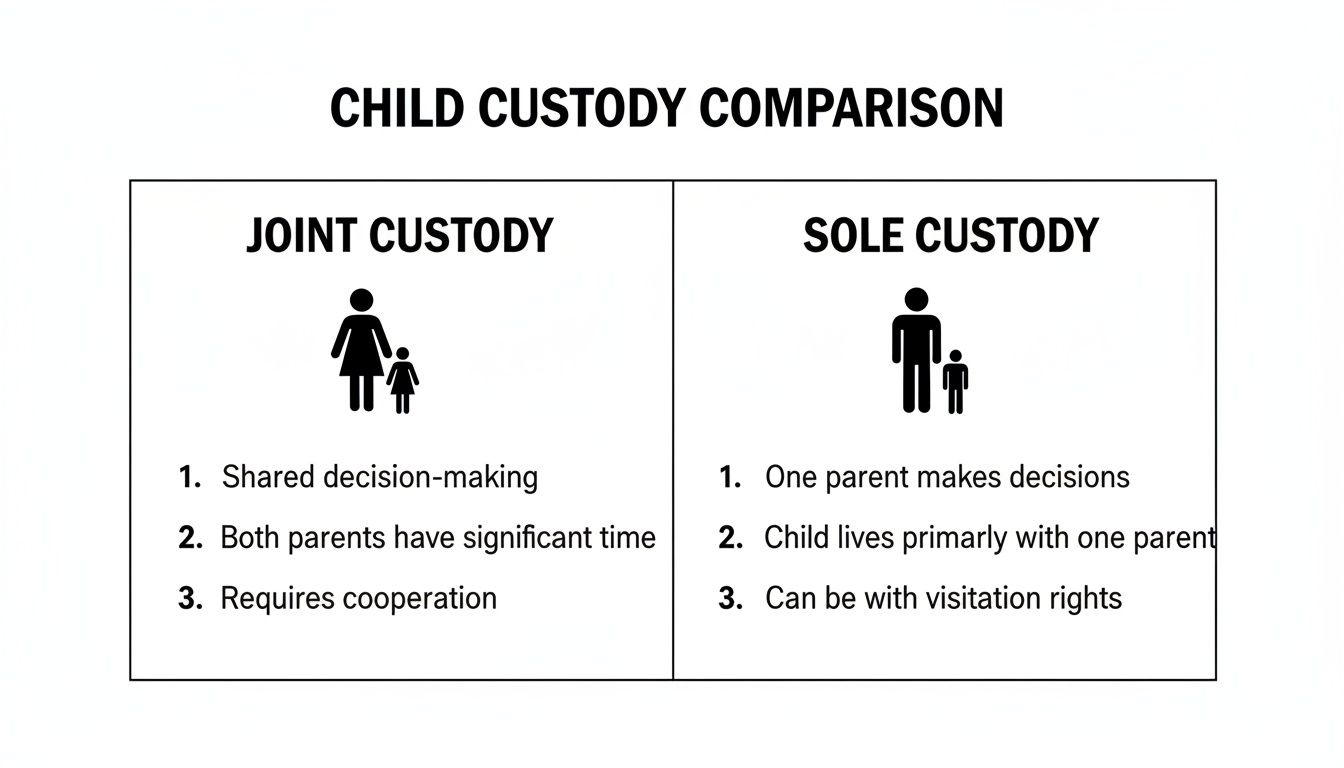
As you can see, joint custody is built on shared decision-making, while sole custody funnels those rights to one parent, usually to protect the child.
The Role of Evidence and Testimony
Proving what's in your child's best interest isn't about telling the judge you're a good parent; it's about showing them. This requires clear, compelling evidence like report cards, medical records, text messages, emails, and testimony from credible third parties like teachers, counselors, or family members. It's all about painting a picture of your consistent involvement and loving home.
In really tough cases where parents are at a complete impasse, a judge might appoint an amicus attorney. Think of this person as the child's own lawyer. Their only job is to represent the child's best interests. The amicus attorney will interview the child, both parents, and others involved, then make a recommendation to the court—a recommendation that often carries significant influence.
While Texas law leans heavily in favor of joint custody, the national picture is more complex. U.S. custody statistics from 2020 show that when sole custody is granted, mothers receive it about 85% of the time. But joint custody is on the rise, with roughly 60% of cases now resulting in a shared arrangement. You can discover more insights about custody statistics to get a better handle on these trends.
The Impact on Visitation Schedules and Child Support
When a Texas judge signs your final custody order, it does more than just assign legal titles. It creates a real-world, practical roadmap for your day-to-day life as co-parents. The difference between sole vs. joint custody directly shapes two of the most critical pieces of that map: when you see your children (possession schedules) and how their financial needs are met (child support).
Knowing how these pieces fit together is essential for setting realistic expectations for your family's future.

Possession Schedules Under Joint Custody
Because Texas law starts with the presumption that a Joint Managing Conservatorship is in a child's best interest, it also provides a default possession schedule to go with it. This is known as the Texas Standard Possession Order (SPO), and it's designed to give both parents predictable, consistent time with their child.
While parents can customize it, a typical SPO gives the non-primary parent possession of the children:
- On the first, third, and fifth weekends of a month.
- For an extended period in the summer, usually 30 days.
- In a rotation for major holidays like Thanksgiving and Christmas.
The SPO is the baseline for ensuring "frequent and continuing contact" with both parents. It's the most common arrangement you'll find in a joint custody case, especially when the parents live within 100 miles of each other.
Visitation in Sole Custody Situations
When a court orders a Sole Managing Conservatorship, the possession schedule can look dramatically different. The non-custodial parent, now called the possessory conservator, still has a right to see their child. However, the court has much more latitude to craft a schedule that protects the child's physical and emotional well-being.
A Crucial Distinction: While the Standard Possession Order is the default for joint custody, there is no "standard" schedule in sole custody cases. The judge will build an order from scratch based on the specific facts that made sole custody necessary.
This might mean the court orders:
- Supervised Visitation: All visits must happen with a neutral third party present, sometimes at a designated facility.
- Restricted Times: The court could limit visits to shorter daytime periods and forbid overnight stays.
- No Contact: In the most severe cases involving family violence or imminent danger, the court has the power to deny all possession and access.
These restrictions aren't meant to be punitive. Their sole purpose is to shield the child from potential harm.
How Child Support Works in Texas
One of the biggest misconceptions we hear is that "joint custody" means no one pays child support. That's simply not true. Child support is almost always ordered in both sole and joint custody situations.
Even when parents share decision-making, one is typically named the primary conservator—the one who receives support payments. The parent who pays support is the obligor, and the one who receives it is the obligee.
Texas uses a formula based on the obligor's net monthly resources and the number of children. The guidelines set support at:
- 20% of net resources for one child
- 25% of net resources for two children
- 30% of net resources for three children
These percentages aren't set in stone; they can be adjusted for a child's unique needs, like special medical or educational expenses. If you want to dive deeper into the numbers, you can learn more about how to calculate child support in Texas in our detailed guide.
The bottom line is clear: being named the primary conservator in a joint arrangement or the sole managing conservator almost always comes with the right to receive child support. The court's goal is to ensure the child can enjoy a reasonably similar standard of living, no matter which parent's home they are in.
When Sole Custody Becomes a Necessary Shield
Texas law starts with a deep-rooted belief that keeping both parents involved is what's best for a child. But there's one principle that overrides everything else: your child's safety. When one parent’s actions create a genuine risk of physical or emotional harm, the conversation has to shift from shared parenting to necessary protection. This is the moment a Sole Managing Conservatorship (what most people call sole custody) becomes more than just an option—it becomes an essential shield.
If you are feeling fearful or concerned, know that those feelings are valid. The law provides powerful tools to act on them. A judge will set aside the standard preference for joint custody when there's clear evidence that it would put your child in danger.
Making the Case for Sole Custody
Seeking sole custody isn't easy; it requires meeting a high legal bar. You have to present compelling, concrete evidence to the court showing that naming the other parent a joint managing conservator would not be in your child’s best interest because it would significantly impair their physical health or emotional development.
This isn't about minor disagreements over bedtime or what they eat for dinner. It's about documenting a pattern of dangerous behavior or profound instability that makes co-parenting unsafe.
Evidence that judges take seriously includes things like:
- Proof of Family Violence: This is critical. Think police reports, protective orders, medical records from injuries, and photographs that document abuse.
- A History of Substance Abuse: Evidence isn't just suspicion. It could be criminal records like a DWI conviction, failed drug tests, or credible testimony from people who have witnessed the substance abuse firsthand.
- Clear Evidence of Neglect: This can be shown through school attendance records revealing chronic absences, testimony from teachers about a child’s consistently poor condition, or official reports from Child Protective Services (CPS).
- Severe Parental Instability: This could involve documented mental health issues that prevent safe parenting, chronic unemployment that leads to an unstable home, or a transient, unpredictable lifestyle.
When a child's well-being is genuinely at risk, the court's priority shifts from encouraging co-parenting to ensuring safety. The entire legal system is designed to step in and protect a child from a parent who poses a demonstrable threat.
Legal Tools to Protect Your Child
When you're fighting for sole custody because of safety concerns, your attorney will likely use several legal instruments to provide immediate and long-term protection. These aren’t just court filings; they are legal safeguards designed to create a secure environment for your child while the case moves forward.
One of the most powerful tools is a protective order. If family violence has occurred, a Texas court can issue an order that legally prohibits the abusive parent from contacting you or your child, or from coming near your home or their school. It provides an immediate, enforceable layer of security.
Even if the other parent is eventually granted some form of visitation, the court can impose strict conditions. Supervised visitation is a common solution, requiring the parent to see the child only in the presence of a neutral third party or at a specialized, secure facility. The court can also mandate that the parent complete anger management classes, drug or alcohol counseling, or a psychological evaluation before unsupervised visits are even on the table. These measures ensure your child might maintain a relationship with the other parent, but only under circumstances that guarantee their safety. Your attorney’s job is to show the judge why these protections aren't just helpful, but absolutely necessary.
How to Modify a Custody Order in Texas
Life never stands still. The custody agreement that made perfect sense for your family last year might be completely unworkable today. While a Texas custody order is a legally binding document, it’s not carved in stone. You have every right to ask the court to modify it to fit your family’s new reality—whether that means fighting for sole custody to protect your child or shifting back to joint custody as things improve.But it’s not as simple as just asking. A judge won’t change a court order on a whim. The Texas Family Code has a clear legal standard you have to meet, which is designed to provide stability for children and prevent parents from running back to court over every little disagreement.
The Two Pillars of a Custody Modification
If you want to successfully modify a Texas custody order, you’ll need to prove two critical things to the court:
- A Material and Substantial Change in Circumstances: This is the first and most important hurdle. The change can’t be minor; it has to be a significant event that meaningfully impacts your child's day-to-day life.
- The Modification is in the Child’s Best Interest: Even if you prove a major change happened, the judge's final decision will always come down to one thing: whether your proposed new arrangement will better serve your child's physical and emotional well-being.
A "material and substantial change" is more than just an inconvenience or a minor scheduling conflict. Think of it as a major life event that fundamentally alters the situation the original order was based on, with a direct impact on the child.
What Qualifies as a Material and Substantial Change?
While judges have a lot of discretion, some situations are almost universally seen as valid reasons for a modification. These are the kinds of changes that can make the current custody order impractical, unfair, or even unsafe.
Common examples include:
- A parent is relocating for a new job, making the current possession schedule impossible.
- One parent’s work schedule changes dramatically, leaving them unable to care for the child during their designated times.
- The emergence of family violence, substance abuse, or neglect that puts the child in physical or emotional danger.
- The child, if 12 or older, expresses a strong preference to live with the other parent.
This process is absolutely vital. It ensures that as your life evolves, the legal framework guiding your child's upbringing can evolve right along with it. This move toward adaptable parenting isn’t just a Texas trend; it’s a global shift. A 2021 study across 17 European nations revealed that 20.7% of children in separated families lived in some form of joint physical custody—a figure that has nearly doubled in the last two decades.
Whether you need to secure sole custody to shield your child from a new threat or transition from sole to joint custody because a parent has turned their life around, the modification process is your legal path forward. Because these cases are so dependent on the unique facts of your situation, working with an experienced attorney is the best way to build a compelling case for the court.
Key Takeaways and Next Steps
When you're sorting through the details of sole versus joint custody, it’s easy to feel overwhelmed. The legal jargon alone can be a headache. Understanding your options is the first step toward advocating for your family’s best future.
Can a Parent with Joint Custody Just Move Out of State with the Kids?
That’s a hard no—at least, not without getting permission first from the other parent or a judge. When parents have a Joint Managing Conservatorship, the court order almost always includes a geographic restriction. This means the parent who decides where the child lives is limited to a specific area, usually the current county and those surrounding it.
If that parent wants to pack up and move out of Texas with the child, they have two options: get a signed, written agreement from the other parent, or go back to court and ask for permission. A judge will only say yes if the move is proven to be in the child’s best interest, and that is an incredibly high legal bar to clear.
Does "Joint Custody" Mean We Split Everything 50/50 and Nobody Pays Child Support?
This is probably one of the biggest myths floating around in Texas family law. Joint Managing Conservatorship is all about sharing parental rights and duties—like making decisions about school and healthcare—not necessarily about having a 50/50 possession schedule.
While perfectly equal schedules are possible, they aren't the norm. The Texas Standard Possession Order is far more common. And as for child support? It's almost always part of the equation, even in 50/50 arrangements. The court's main goal is making sure the child's needs are consistently met in both homes, so support is calculated based on what both parents earn and other key factors.
How Do I Actually Prove that Sole Custody Is What's Best for My Child?
If you want the court to award you sole custody (or Sole Managing Conservatorship), you have to come with more than just a gut feeling. You need to present powerful, undeniable evidence that giving the other parent joint decision-making rights would physically or emotionally endanger your child. The burden of proof is entirely on you.
This means you need more than your word against theirs; you need to build a case with concrete proof.
Solid evidence might include:
- Police reports that document incidents of family violence.
- Medical records that show injuries from abuse or signs of neglect.
- Credible testimony from neutral third parties like teachers, counselors, or CPS investigators.
- A documented pattern of abuse, neglect, or substance abuse shown through photos, emails, or text messages.
Because the legal standard is so tough to meet, trying to do this alone is a huge risk. Working with an experienced family law attorney is critical. A good lawyer knows how to gather the right kind of evidence and present it in a way that keeps the focus exactly where it should be: on protecting your child.
If you need help with a child custody or visitation case in Texas, our experienced attorneys can guide you every step of the way. Contact The Law Office of Bryan Fagan, PLLC today for a free consultation.