
When your child's future is on the line, the hardest part is often not knowing what happens next. Many parents come to a custody case feeling scared, tired, and worried that one wrong step could affect their relationship with their child.
A step-by-step custody case timeline in texas can make this process feel less overwhelming. You may not be able to control every move the other parent makes, but you can understand the road ahead and prepare for it with a clearer mind.
In Texas, custody is usually called conservatorship. That word refers to the legal rights and duties parents have for a child. The schedule for time with the child is often called possession and access, which many parents think of as visitation. Once you know those terms, the process starts to feel more manageable.
Your Guide Through the Texas Custody Process
It is 10:30 at night, your child is asleep, and you are searching for answers because you need to know what happens next. One parent asks, "How long is this going to take?" Another asks, "What will the judge look at?" Both questions matter, because custody cases affect your calendar, your stress level, and your daily life with your child.
Texas custody cases do not all follow the same timetable. Some move fairly quickly when parents reach agreements early. Others take much longer when there are disputes about decision-making, schedules, safety concerns, or missing information. A custody case works a lot like a road trip. You may know the destination, but the length of the drive depends on traffic, detours, and whether everyone is willing to follow the same map.

What custody means in plain English
Texas judges focus on the arrangement that supports your child's safety, stability, health, emotional development, and meaningful relationships. That may sound broad, and it is. The court is trying to answer a practical question: what plan gives this child the strongest foundation from now on?
A few terms usually cause early confusion:
- Joint managing conservatorship means both parents usually share important rights and duties related to the child. It does not automatically mean a 50/50 schedule.
- Sole managing conservatorship means one parent has more decision-making authority in certain areas.
- Possession schedule means the written schedule that says when each parent has time with the child.
Parents often carry quiet fears into this process. A mother may worry she has to prove she is doing everything perfectly. A father may fear the system assumes less of him. A grandparent or other caregiver may wonder whether the court will take their concerns seriously. Those feelings are common. In most cases, the court looks closely at the facts, the child's needs, each adult's history of care, and whether the proposed plan can be effective in practice.
One helpful way to view the case is this. The court is looking backward and forward at the same time. It considers what has happened, but it also looks for a workable parenting structure for the months and years ahead.
Why the timeline matters to parents
A custody timeline is more than a list of court dates. It is a roadmap for your home life.
If you know that temporary rules may come early, you can start gathering school records, medical information, and a parenting calendar now. If you know mediation often happens before trial, you can begin thinking about what terms matter most to you and where you may have room to compromise. If you understand that final orders can take time, you can prepare emotionally for a process instead of expecting one quick courtroom moment to decide everything.
Parents usually feel less overwhelmed when the process has names and stages. Once you can identify where your case is, you can focus on the next decision in front of you. That is far easier than carrying the whole case in your head at once.
Early temporary arrangements often shape daily life while the case is pending, so it helps to understand what happens at a temporary orders hearing in Texas custody cases.
The usual path of a Texas custody case
Most Texas custody cases follow a recognizable sequence. One parent files. The other parent receives formal notice. The court may set temporary rules for the child, the parents exchange information, settlement efforts often happen through mediation, and a judge makes the final decision only if no agreement is reached.
That path does not remove the stress. It does make the process easier to handle.
When you know the road ahead, you can prepare your documents, protect your time with your child, and make steadier decisions under pressure.
The First Moves Filing the Case and Securing Temporary Orders
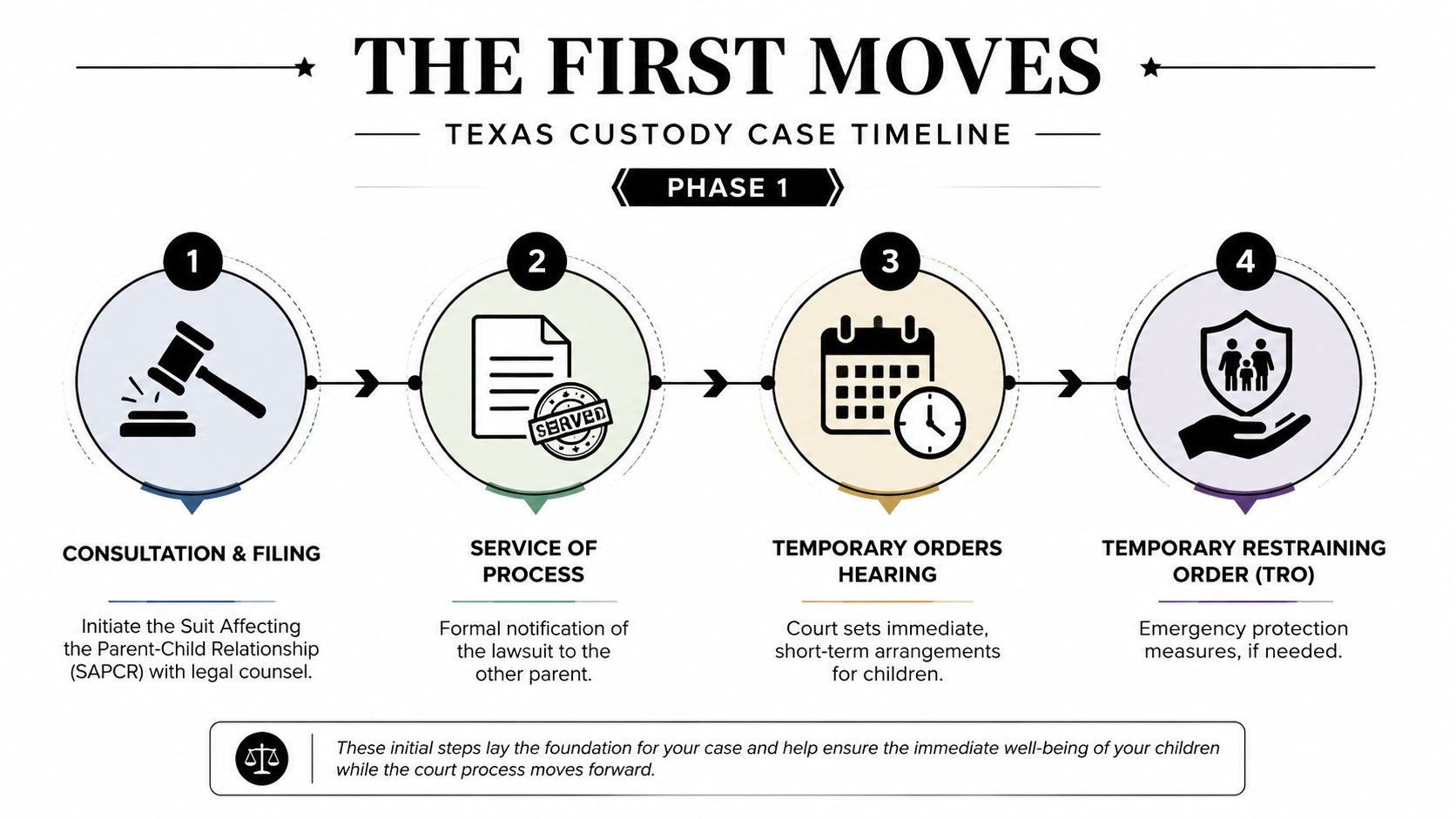
The first legal step in many Texas custody matters is filing a Suit Affecting the Parent-Child Relationship, often shortened to SAPCR. This is the lawsuit that asks the court to create or change orders involving conservatorship, possession, child support, or other child-related issues.
For many parents, filing feels intimidating. In practice, it is the formal way to ask the court to step in and create enforceable rules.
Filing the case and serving the other parent
Texas Law Help explains that the custody process starts with filing a SAPCR. Once the other parent is served, their answer is due by 10 a.m. on the Monday after 20 days have passed, and that early deadline helps set the pace of the case, as outlined in Texas Law Help's explanation of what happens after you file a custody case.
Service of process is just the legal method of making sure the other parent receives formal notice. It matters because judges want both sides to have a fair chance to participate.
A simple way to picture it is this:
| Stage | What it means for you |
|---|---|
| Filing | You ask the court for custody-related orders |
| Service | The other parent gets official notice |
| Answer deadline | The other parent must respond on time |
| Early scheduling | The court can begin moving the case forward |
Why temporary orders matter so much
Many custody cases don't reach a final order quickly. Parents still need rules in the meantime. That's where temporary orders come in.
Temporary orders often address practical questions such as:
- Where the child stays: The court may set a temporary living arrangement.
- When each parent has time: A temporary possession schedule may be created.
- Who pays support: The court may enter temporary child support orders.
- Who makes certain decisions: The judge may assign temporary decision-making rights.
These are not the final answer, but they are important. Temporary orders often create the day-to-day routine that everyone follows while the case is pending.
Practical rule: Treat a temporary orders hearing seriously. The routine created there can shape school schedules, exchanges, communication patterns, and the evidence the judge sees later.
If you're trying to understand that hearing in more detail, this guide on what happens at a temporary orders hearing in Texas custody cases can help you know what to expect.
Later in this phase, many parents also want to hear a plain-language overview before their court date. This video gives a helpful introduction:
What judges look for early on
At the temporary stage, judges often want a workable short-term plan, not a perfect life history. They want to know whether the child is safe, who has been handling daily care, what schedule fits the child's routine, and whether either parent is likely to support stability.
If you're a father seeking meaningful parenting time, or a mother trying to preserve consistency for a young child, organized facts are important. Bring calendars, school information, medical details, communication records, and a realistic proposal.
Building Your Case Discovery and Mediation
After temporary orders are in place, many parents expect the next part of the case to feel more clear. Instead, this is often the stretch where the case slows down and anxiety grows. You may be following a parenting schedule, trying to keep life normal for your child, and wondering why your lawyer is asking for documents, calendars, and detailed answers.
That is normal.
This stage is the evidence-building stage. If the early part of the case sets the ground rules, this part fills in the facts. It is the section of the road where you gather the map, mark the hazards, and decide whether a full agreement is still possible.
Discovery gives both sides the same set of facts
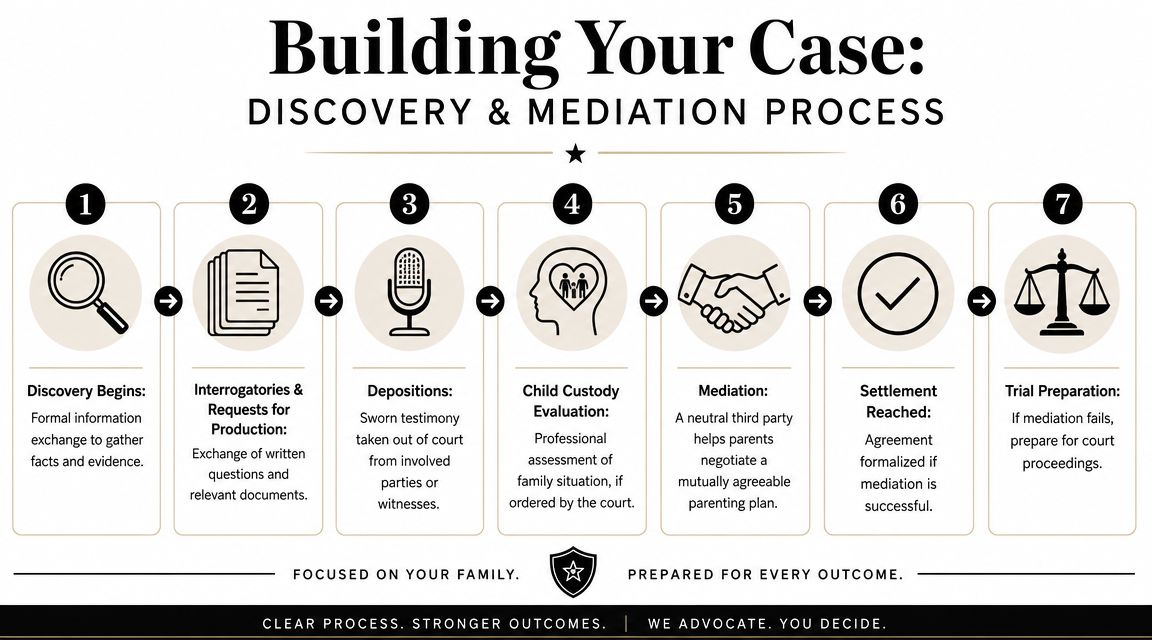
Discovery is the formal process of exchanging information. Parents often hear that word and assume the case is turning ugly. Sometimes emotions do rise here, but the legal purpose is much simpler. The court wants decisions based on records and specifics, not guesses or one-sided stories.
You may be asked for information about:
- your work schedule
- your housing and who lives in the home
- who handles school drop-off, pickup, and appointments
- texts, emails, or app messages about parenting disputes
- medical, counseling, or school records tied to the child's needs
Lawyers may call these interrogatories or requests for production. In plain language, those are written questions and requests for documents.
A good way to view discovery is this: if trial is the final exam, discovery is the part where both sides have to show their notes. Surprises become less likely. Weak claims get tested. Strong facts become easier to prove.
Some families also have real safety concerns about a new partner, caregiver, or other adult around the child. In that situation, a parent may want to learn how to verify identities online before bringing a specific concern to their lawyer. That kind of research does not replace court-approved evidence, but it can help you ask sharper, more useful questions.
What useful evidence looks like
Parents often worry that they need dramatic proof. Usually, they do not.
Judges tend to give more weight to patterns than to isolated complaints. A calm, organized set of records often does more good than an angry stack of accusations.
For example, a parent may feel frustrated and say, “My child keeps falling behind in homework during the other parent's week.” That concern may be real, but by itself it is still just a statement. Discovery helps turn it into something the court can evaluate.
Helpful records might include:
- attendance or grade reports from school
- emails or messages with teachers
- a calendar showing parenting exchanges
- messages between the parents about missed assignments or incomplete work
Those records tell a story in sequence. They show dates, context, and whether the issue is occasional or ongoing.
Keep your evidence plain, dated, and easy to follow. A simple calendar, school record, or message log is often more persuasive than a long written attack on the other parent.
Mediation lets parents build the final plan themselves
Once enough information is on the table, many Texas custody cases go to mediation. A neutral mediator works with both sides to see whether an agreement can be reached on some or all of the remaining issues.
For worried parents, mediation often feels less intimidating than court because it creates room for problem-solving. You are not sitting in a witness chair waiting for a judge to decide every detail of your child's life. You and the other parent get a chance to propose schedules, decision-making terms, holiday plans, and communication rules that fit your real life.
Parents commonly work through issues such as:
| Issue | What may be negotiated |
|---|---|
| Decision-making | Who can decide education, medical care, and activities |
| Possession schedule | Weekday, weekend, holiday, and summer time |
| Communication | Pick-up details, app use, notice rules |
| Child support details | Payment logistics and related responsibilities |
If you want a clearer picture of the process, this guide on what happens in custody mediation explains how the day usually works.
Mediation also helps with something parents do not always expect. It tests whether a proposed parenting plan can survive real-life questions. Who handles a school holiday that falls on a Monday? What happens if a child gets sick during an exchange? How much notice should each parent give before scheduling activities? A strong mediated agreement answers those questions before they become future arguments.
Settlement is not a sign that your concerns were small. In many cases, it means the parents found a workable structure without spending more time, money, and emotional energy on a courtroom fight. If no agreement is reached, the work you did here still matters. Your records, responses, and preparation become the foundation for the final stage of the case.
When You Can't Agree The Path to a Final Hearing or Trial
Some custody cases settle fully. Others settle partly. Some don't settle at all. If major issues remain, the case moves toward a final hearing or trial.
That doesn't mean you've failed. It means the court must make the final call.
Hearing versus trial
Parents often use these words interchangeably, but they are not always the same thing.
A temporary hearing usually focuses on short-term arrangements while the case is still open. A final hearing or trial decides the lasting orders that will govern conservatorship, possession, and often support.
At a final stage, the judge may hear from:
- the parents
- other witnesses
- teachers or counselors in appropriate cases
- professionals involved in evaluations, if any were ordered
If you want a fuller picture of courtroom procedure, this resource on what happens at a final custody hearing in Texas gives a useful overview.
What the judge cares about most
Texas courts use the best interests of the child standard. That phrase can sound vague, but in real life it usually comes down to common-sense parenting issues.
A judge may look closely at:
- The child's needs: school, medical care, routine, emotional support
- Each parent's stability: housing, consistency, ability to meet daily needs
- Co-parenting behavior: whether a parent encourages or damages the child's relationship with the other parent
- Safety concerns: conflict, abuse, substance issues, or dangerous conditions
- Practical ability to parent: transportation, availability, communication, follow-through
Court is not a stage for winning points against the other parent. It is a place where the judge decides what arrangement is safest, most stable, and most workable for the child.
How to present yourself well
Parents often think they need a perfect personal history. They don't. They need credibility.
That means answering questions directly, staying calm when possible, bringing organized evidence, and showing the court that you understand your child's needs. A father asking for expanded possession and a mother asking for primary conservatorship both benefit from the same approach. Focus on the child, not revenge.
Life After the Final Order Modifications and Enforcement
A final order is meant to create stability, but it isn't always the last chapter. Children grow. Parents change jobs. People move. Life rarely stands still.
That is why Texas law allows some custody orders to be modified and also allows parents to seek enforcement when orders are ignored.
When a modification may be needed
A modification asks the court to change an existing order. In many cases, the legal issue is whether there has been a material and substantial change in circumstances.
That can include situations such as:
- a parent's work schedule changing in a way that affects exchanges
- a parent relocating
- a child developing new educational or medical needs
- ongoing conflict that makes the current order unworkable
The point is not that every inconvenience justifies a new lawsuit. The point is that a custody order is supposed to fit real life well enough to serve the child.
When enforcement becomes necessary
Enforcement is different. You are not asking the court to rewrite the order. You are asking the court to require compliance with the order already in place.
Common examples include:
| Problem | Possible reason enforcement matters |
|---|---|
| Missed exchanges | The child loses predictable time with a parent |
| Repeated schedule violations | Routine and trust break down |
| Ignoring decision-making terms | Conflict increases and major issues go unresolved |
If the other parent isn't following the order, start by documenting the problem carefully. Save messages. Keep a calendar. Record dates, times, and what happened. Avoid emotional commentary in your notes. Clean facts help your lawyer assess next steps.
Why long-term planning matters
A final order should be treated like an operating manual for co-parenting. Read it closely. Follow it closely. If it no longer fits the child's reality, get legal advice before making informal changes that may later create confusion.
Checklist for Parents and Special Case Considerations
At this stage, many parents feel pulled in two directions at once. You are trying to care for your child today while also making careful choices that may matter months from now in court. That is a hard place to stand.
A custody case often works like a long road trip. You do not need to see the whole highway at once. You need a reliable map, a way to keep track of turns, and enough preparation to handle detours without panicking. Good records, calm communication, and practical planning can make the process easier to manage and easier to explain if a judge needs to step in.
A practical checklist you can start today
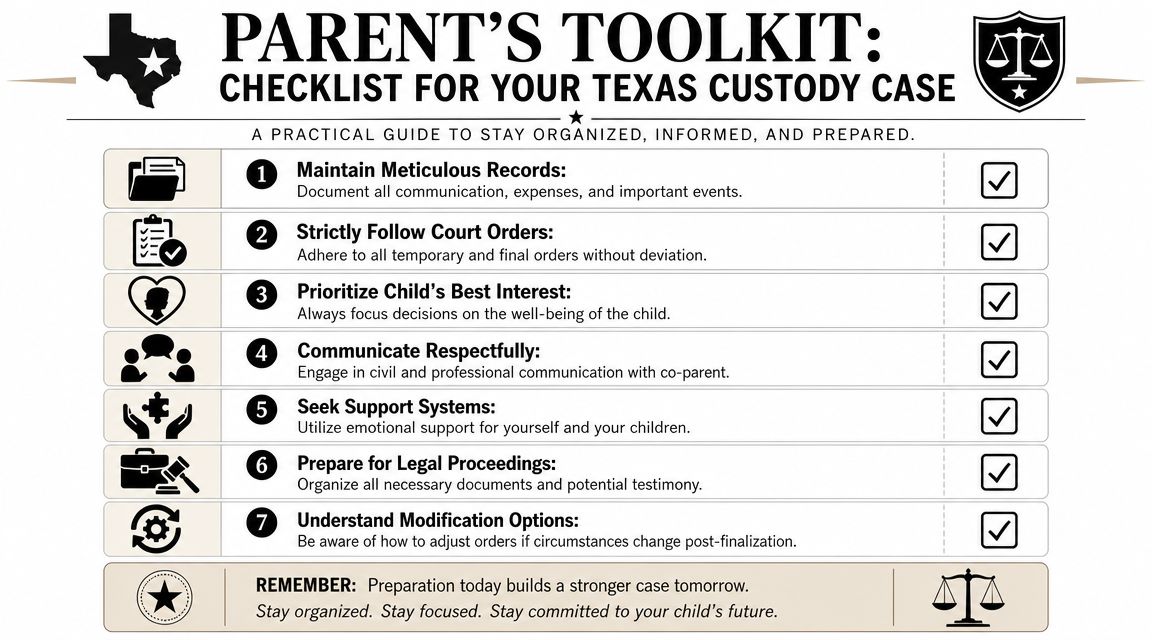
Use this list as a tool, not a test. No parent handles every part of a custody case perfectly.
- Keep a parenting calendar: Track exchanges, missed visits, school events, doctor appointments, and important conversations.
- Save written communication: Texts, emails, and app messages can matter. Keep them in their original form and do not rely on memory alone.
- Gather child-focused records: School reports, medical records, counseling information, and activity schedules can help show your child's routine and needs.
- Write down your proposed schedule: Judges and mediators respond better to a clear, workable plan than to general frustration.
- Stay respectful in communication: Write every message as if it may be read aloud in a courtroom one day.
- Follow current court orders: Even when you disagree, compliance usually protects your position better than trying to solve the issue on your own.
- Prepare questions for legal counsel: A written list of concerns often leads to clearer advice and less confusion.
Some parents also choose to work with a family law firm such as Law Office of Bryan Fagan, PLLC for help with custody, visitation, modification, enforcement, and emergency orders in Texas.
Special concerns in military custody cases
Military custody cases add another layer of planning. Deployment, training changes, and relocation can interrupt even a stable parenting schedule, sometimes with little notice.
In these cases, parents often need to prepare for questions such as who will care for the child during a deployment, how the child will stay in contact with the deployed parent, how travel will work after a move, and what routines should stay the same to reduce stress on the child. The more specific the plan, the easier it is for everyone to understand expectations.
A service member is still a parent with rights and responsibilities. The court's focus remains on what is best for the child, and clear planning usually carries real weight.
Emergency custody situations
Some custody problems cannot wait for the normal court schedule. If a child may be in immediate danger, a parent may need to ask the court for emergency relief right away.
That usually means more than ordinary conflict or frustration. Serious safety concerns, credible threats, dangerous living conditions, abuse, neglect, or behavior that puts a child at immediate risk can change the pace of a case very quickly.
If you believe your child is in immediate danger, act quickly. Get legal advice as soon as you can and start documenting specific facts. Dates, messages, photos, medical records, police reports, witness names, and clear descriptions of what happened are often more helpful than broad statements about fear.
Strong emergency requests are built on specific facts. Courts need to understand what happened, when it happened, who saw it, and why the child needs protection now.
Key takeaway
A Texas custody case becomes more manageable when you treat it as a series of steps instead of one overwhelming crisis. The legal process matters, but your daily choices matter too. The way you communicate, document, plan, and stay steady can shape both the case and your child's experience during it.
If you are a mother, father, grandparent, or caregiver, you do not need to know every rule by heart. You do need a workable system. Stay organized, keep your focus on your child, and ask for help before a temporary problem turns into a lasting one.
If you need help with a child custody or visitation case in Texas, our experienced attorneys can guide you every step of the way. Contact The Law Office of Bryan Fagan, PLLC today for a free consultation.