Skip to content
When your child’s future is on the line, understanding your rights matters most. The decision to terminate parental rights is one of the most serious actions in Texas family law, permanently severing the legal bond between a parent and child. This means every single right—to make decisions, to have visitation, and even to inheritance—is ended for good. Facing this reality can be overwhelming, but you are not alone.
What It Means to Terminate Parental Rights in Texas

Ending the legal relationship between a parent and a child is a profound step, one that Texas courts do not take lightly. It's a permanent, life-altering decision reserved only for situations where it is absolutely essential for a child’s long-term safety and well-being. Think of the parent-child relationship as a legal bridge connecting two people; termination demolishes that bridge completely and irrevocably.
Once a judge signs a termination order, the parent loses all legal standing in the child's life. This includes the right to make decisions about their education, healthcare, and religious upbringing, known as conservatorship. It also ends any rights to possession and access—what most of us call visitation—and severs the child’s right to inherit from that parent.
Two Paths to Termination
In Texas, there are two very different ways parental rights can come to an end. Understanding this distinction is critical for any parent, grandparent, or caregiver navigating this emotional journey.
- Voluntary Relinquishment: This is when a parent willingly agrees to give up their parental rights. We see this most often in adoption cases, where a biological parent consents to letting a stepparent or another loving family adopt their child.
- Involuntary Termination: This is a court-ordered process that happens against a parent's wishes. A judge must find clear and convincing evidence that the parent engaged in conduct harmful to the child and that termination is in the best interests of the child.
The Texas Family Code makes it crystal clear: the child's emotional and physical well-being is the court's primary consideration in every decision. Proving that termination is necessary means meeting an incredibly high legal standard.
This guide will walk you through this complex process with the clarity and compassion you deserve. We'll explore the specific grounds for termination, unpack what the "best interest of the child" standard really means, and outline the court process step-by-step. Our goal is to empower you with the straightforward information you need to protect your child's future.
How a Texas Court Decides to Terminate Parental Rights
In Texas, ending a parent's legal connection to their child isn't a single process. It is guided by one unwavering principle: doing what is in the best interests of the child. The journey can be voluntary, often to create a stable new family through adoption, or it can be involuntary—a court-ordered action to protect a child from harm. Understanding the difference is crucial, as the legal standards and emotional weight are worlds apart.
A common voluntary scenario is a stepparent adoption. Imagine a stepparent who has raised a child as their own for years. If the other biological parent is no longer involved, they might willingly sign an affidavit of relinquishment. This compassionate choice allows the stepparent to legally adopt the child, giving them the security of a permanent family. Even when a parent agrees, a judge must still review and approve the termination, ensuring it truly serves the child’s well-being.
When Termination is Involuntary
Involuntary termination is a much tougher legal battle. It happens against a parent's wishes and can only be ordered by a judge after a formal lawsuit. The person asking for the termination—whether it’s the other parent, a grandparent, or the Texas Department of Family and Protective Services (DFPS)—must meet an incredibly high standard of proof.
They must prove two things with clear and convincing evidence:
- The parent committed one or more of the specific harmful acts listed in the Texas Family Code.
- Ending the parent-child relationship is truly in the child’s best interest.
Clear and convincing evidence is a much higher legal bar than the "preponderance of the evidence" standard used in most family law cases. It means the proof must be so strong that it leaves the judge with a firm belief that the allegations are true.
Specific Grounds for Involuntary Termination
The Texas Family Code is very specific about the reasons a court might order involuntary termination. These are not minor parenting disagreements; they are serious actions that endanger a child's safety or well-being. Proving one of these grounds is the heart of any case to terminate parental rights in Texas. For families who need to understand what this looks like in court, our guide on how to prove a parent is unfit offers more detailed guidance.
Common grounds a court will consider include:
- Abandonment: Willfully leaving the child with no intention of returning or failing to support and stay in contact with the child for a set period.
- Endangerment: Knowingly placing the child in physical or emotional danger, such as exposure to drug abuse, domestic violence, or a hazardous living situation.
- Failure to Support: Intentionally failing to financially support the child according to your ability for a full year, within the six months before the lawsuit is filed.
- Criminal Conduct: Committing a crime that leads to conviction and imprisonment, making it impossible for the parent to care for their child.
It's also worth noting that Texas law is continually updated to better protect vulnerable children. As of September 2025, the statutes were further clarified to confirm that termination can be ordered if a parent engages in severe criminal conduct like human trafficking or prostitution involving a child, in addition to the long-standing grounds of abandonment or endangerment.
Voluntary Relinquishment vs. Involuntary Termination in Texas
To make sense of these two paths, it helps to see them side-by-side. While both end parental rights, how they get there is fundamentally different. One is a conscious choice aimed at creating a stable future, often in adoption, while the other is a last-resort court action to protect a child from harm.
| Feature | Voluntary Relinquishment | Involuntary Termination |
|---|---|---|
| Parent's Consent | Parent willingly agrees to give up rights. | Happens against the parent's wishes. |
| Legal Process | Simpler; requires signing legal documents and court approval. | A full lawsuit (trial) with a very high burden of proof. |
| Primary Goal | Often to facilitate an adoption (e.g., by a stepparent). | To protect a child from serious harm, abuse, or neglect. |
| Burden of Proof | Must prove it's in the child's best interest. | Must prove specific statutory grounds and best interest. |
| Evidence Standard | Preponderance of the Evidence. | Clear and Convincing Evidence (a much higher standard). |
| Initiated By | The parent who is relinquishing their rights. | The other parent, a family member, or DFPS. |
Ultimately, whether the process is voluntary or forced by a lawsuit, the court's final decision always comes back to one question: What will provide the safest, most stable, and nurturing future for this child?
Understanding the "Best Interest of the Child" Standard
In any Texas family court case involving a child, every decision comes down to one powerful, guiding principle: the best interest of the child. It’s not enough to prove that a parent did something wrong from the list in the Texas Family Code. For a judge to take the monumental step of terminating parental rights, they must be absolutely convinced that permanently severing that parent-child relationship is truly what’s best for that child’s future.
This legal standard is the court's compass. It ensures every choice is made with the child's long-term well-being as the one and only priority. The court’s job isn't to punish a parent; it's to protect a child. To do that, judges look past the immediate crisis and consider the child’s entire life—their emotional needs, physical safety, and chance at a stable, happy future.
How Texas Courts Determine a Child's Best Interest
So how does a judge figure out what’s truly “best” for a child? They don’t just guess. Texas courts rely on a set of guidelines known as the “Holley Factors.” These factors came from a landmark Texas Supreme Court case, Holley v. Adams, and they give judges a framework for looking at a child's situation from every possible angle.
Think of it like a doctor making a diagnosis. A good doctor wouldn't just look at one symptom. They’d run tests, review medical history, and ask about lifestyle before figuring out the right treatment. In the same way, a judge uses the Holley Factors to conduct a thorough examination of the family's life to get the full picture.
Key Holley Factors Explained
The court has a wide range of factors to consider, and no single one automatically outweighs the others. The judge looks at everything together. Some of the most significant Holley Factors include:
- The child’s emotional and physical needs, now and in the future. This covers everything from the basics like food and a safe home to the need for love, stability, and emotional support.
- Any emotional or physical danger the child faces, now or in the future. The court will look hard at any history of abuse, neglect, drug or alcohol problems, or family violence that could put the child at risk.
- The parenting abilities of the people involved. A judge assesses each person's ability to provide a safe, nurturing home and handle the day-to-day responsibilities of raising a child.
- The stability of the home being offered. Courts strongly favor stability. They’ll look at a parent's living situation, job history, and whether the child has consistent routines.
- A parent's actions (or failures to act) that suggest the parent-child relationship isn't a healthy one. This lets the court look at past behavior as a clue to what future parenting might look like.
- Any excuses the parent offers for their actions or inactions. The court will listen to a parent’s side of the story, but the focus will always be on how that behavior impacted the child.
In a termination case, the evidence must prove that ending the parent-child relationship is a better, safer, and more stable path for the child than leaving that relationship in place. The burden is on the person asking for the termination to prove this, loud and clear.
Ultimately, proving that termination is in the child's best interest is a separate and equally critical hurdle to clear, right alongside proving the legal grounds. It requires building a compelling case that shows a child will have a much better shot at a healthy, secure life if the legal ties to a parent are permanently cut.
Steps in a Texas Termination Case
Walking into a courtroom can feel overwhelming, especially when your family’s future is on the line. Knowing what to expect can provide clarity and a sense of control during an incredibly difficult time. The legal process for terminating parental rights in Texas is methodical, with every step designed to ensure the final decision is made with the child's well-being as the absolute top priority.
The First Step: Filing the Petition
The process officially begins when someone files a Petition for Termination of the Parent-Child Relationship with the court. This foundational document starts the lawsuit. It must identify the parents and the child involved and, most importantly, list the specific legal grounds for termination under the Texas Family Code.
Getting this first filing right is crucial, as it sets the stage for everything that follows. Success often depends on getting expert assistance with drafting petitions to ensure your case is presented clearly and effectively from day one.
Notifying the Other Parent and Appointing an Ad Litem
Once the petition is filed, the other parent must be formally notified that they are being sued. This is called service of process. It requires a constable, sheriff, or private process server to deliver the legal papers in person, guaranteeing that the parent whose rights are on the line has a fair chance to respond.
Because a child cannot speak for themselves in court, the judge will appoint an ad litem attorney. This is an independent lawyer whose sole job is to represent the child’s best interests. The ad litem acts as the court's eyes and ears, investigating the case by talking to the child, parents, teachers, and others before making a recommendation to the judge.
The infographic below clarifies the two-part legal standard the court must apply: first, the grounds for termination must be proven, and second, it must be proven that termination is truly in the child's best interest.
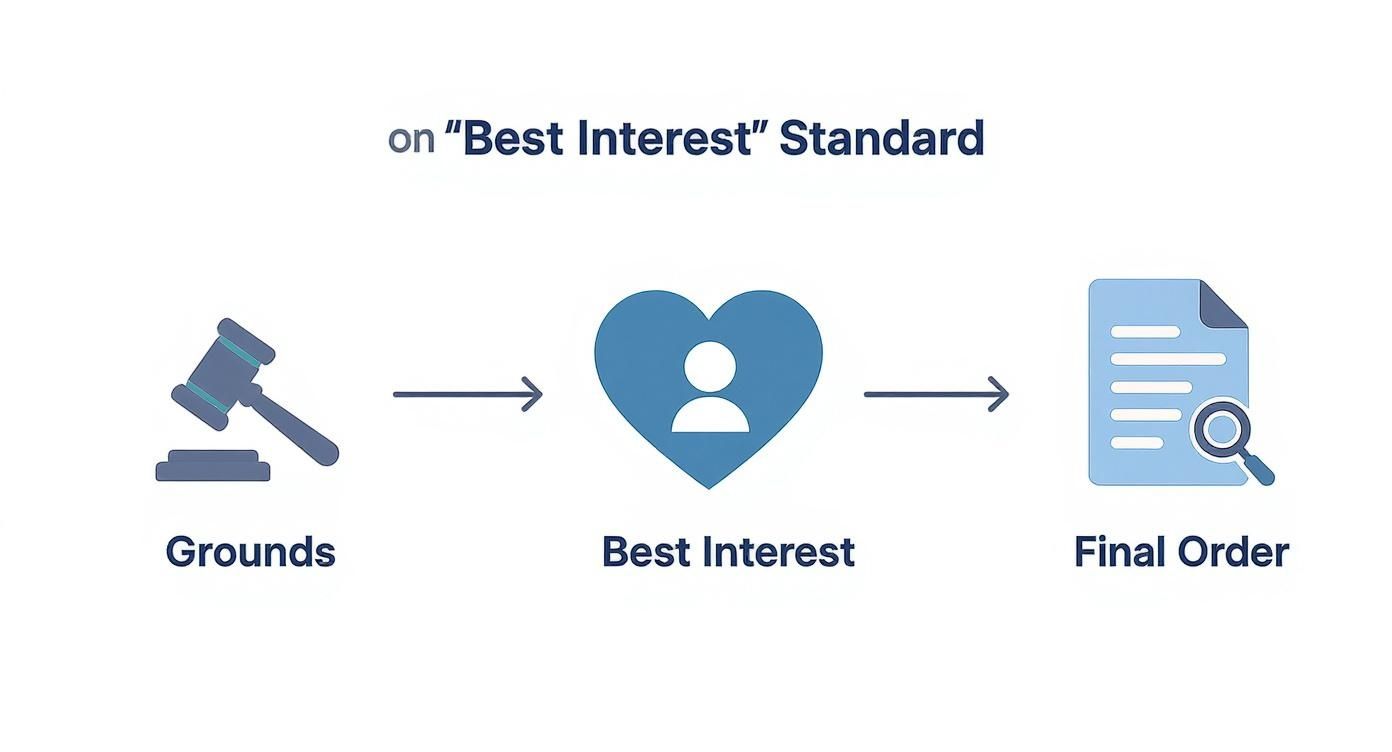
As you can see, a judge’s final decision is the result of a careful, two-step evaluation, with the child’s welfare at the very heart of the matter.
Gathering Evidence and the Role of DFPS
The next phase is what lawyers call discovery. This is a fact-finding mission where both sides gather the evidence they need to build their case. It can involve several tools:
- Written Questions (Interrogatories): Formal questions sent to the other party that they must answer under oath.
- Requests for Documents: Obtaining important records like financial statements, medical files, or school reports.
- Depositions: Questioning witnesses under oath in front of a court reporter.
This stage is critical for proving your case with clear and convincing evidence. This isn't your average legal standard. It means the proof you present has to be substantially more likely to be true than not, leaving the judge with a firm belief in its truthfulness.
In many of these cases, the Texas Department of Family and Protective Services (DFPS) is involved, especially with claims of abuse or neglect. Since 2006, Texas has terminated parental rights for an estimated 91,589 children—a figure higher than any other state, partly due to DFPS's practice of starting termination proceedings early in foster care cases.
The Final Trial and Court Order
Everything leads up to a final trial before a judge. Here, both sides present their evidence, call witnesses to testify, and make their closing legal arguments. The ad litem attorney will also present their independent findings and formal recommendation.
After hearing all the evidence, the judge will make a final decision. If the judge finds that the legal grounds have been met by clear and convincing evidence and that termination is in the child's best interest, they will sign a Final Order of Termination. This order permanently and irrevocably severs the parent-child relationship.
The timeline for this entire process can vary. To get a better feel for what to expect, you can check out our guide on the typical Texas child custody case timeline.
Life After Termination: A New Beginning Through Adoption
A court order that terminates parental rights is one of the most permanent decisions in all of family law. When the judge’s pen hits the paper, it marks the end of a painful legal road, but for the child, it’s meant to signify a new beginning.

Once a parent's rights are legally severed, that connection to their child is completely dissolved. This means they lose all legal authority and privileges—the right to visitation, the ability to make decisions about the child's upbringing, and even any rights to inheritance. The legal bridge that once connected parent and child is gone forever.
What Happens to Child Support Obligations
One of the most common questions we get is about child support. A final termination order does end the parent's obligation to make future child support payments. However—and this is a big one—it does not erase past-due support. Any unpaid child support, often called arrearages, that piled up before the termination order was signed may still be legally owed and collected by the state.
A court's goal in a termination case isn't to let a parent off the financial hook. It's about clearing a path for the child’s permanent stability and well-being. A child’s need for a safe and secure future always comes first.
The only time child support obligations are fully resolved is when the termination paves the way for an adoption. At that point, the adoptive parent assumes all financial responsibilities moving forward.
Paving the Way for a Stable Future Through Adoption
For most children, the termination of parental rights is the legal key that unlocks the door to a new, permanent home. It's almost always the necessary first step before a stepparent, grandparent, or another loving caregiver can legally adopt them. This is the ultimate goal in the vast majority of termination cases—to give a child the permanence and security they so deeply deserve.
An adoption legally forges a brand-new parent-child relationship, giving the child all the rights and stability of a biological connection. It lets a stepparent who has been a daily caregiver become a legal parent in every sense of the word. It allows grandparents who have stepped up to raise their grandchild to finally provide a forever home.
While the legal process of termination is emotionally draining, its purpose is profoundly positive: ensuring a safe and nurturing future for a child. You can learn more in our complete guide to voluntarily terminating parental rights in Texas. The final court order represents the end of one chapter and the hopeful start of another, one focused entirely on the child’s long-term happiness and security.
Alternatives and Defenses to Termination
Facing a lawsuit to terminate your parental rights can feel like the world is closing in. It’s one of the most stressful situations a parent can imagine. But it's critical to remember that in Texas, termination is a last resort. Courts would much rather find another way to protect a child while keeping family bonds intact, whenever possible.
If you are a parent fighting to keep your rights, you are not powerless. The law gives you the right to mount a vigorous defense. The person suing you has the incredibly high burden of proving their case with clear and convincing evidence. You have the right to challenge every piece of it.
Common Defenses Against Termination
One of the most direct ways to defend yourself is to challenge the petitioner's evidence head-on. Your job is to show that the allegations are either untrue, exaggerated, or simply don’t meet the strict legal standard required by the Texas Family Code. For example, if you're accused of abandonment, you can present texts, emails, photos, and witness testimony showing your consistent involvement in your child's life.
Another powerful defense is proving that termination is not in your child’s best interest. This is a huge one. Even if a judge finds that a legal ground for termination has been proven, they can still refuse to terminate your rights if doing so would hurt the child more than it would help. This is where you can bring in testimony from teachers, counselors, or family members who can speak to the strength and importance of your parent-child bond.
Less Permanent Legal Alternatives
Because termination is so final, Texas law strongly encourages less permanent solutions designed to give a child stability without completely severing the parent-child relationship. The goal is to protect the child now while leaving the door open for reunification if circumstances improve.
Common alternatives a court might consider include:
- Modifying Custody: The court can change the custody order to name the other parent or a relative as the sole managing conservator. This gives that person the exclusive right to make major decisions for the child, providing stability while you might retain supervised visitation rights.
- Appointing a Guardian: A grandparent or another trusted adult can be appointed as a legal guardian. This transfers decision-making power but doesn't permanently extinguish your parental rights.
- Enforcing a Possession Schedule: If inconsistency is the core problem, the court can enforce a clear and structured possession schedule (visitation plan). This ensures the child has predictable contact with both parents, which can sometimes resolve the issues that led to the lawsuit.
The court's ultimate goal is always to create a safe, stable, and nurturing environment for the child. Exploring these alternatives can often achieve that goal without taking the drastic and irreversible step of termination.
There's been a noticeable shift in Texas toward preserving families when it's safe to do so. Reforms in the child welfare system have led to a stunning 55% decrease in the number of children removed from their homes between 2018 and 2024. During that same time, child deaths from abuse and neglect also fell by 53%. You can learn more about these important child welfare statistics in Texas. These numbers represent a real change in philosophy, showing that the system is looking for better ways to support families and protect children without tearing them apart forever. Your most important next step is discussing every one of these paths with an attorney who knows the system inside and out.
Your Questions Answered: Terminating Parental Rights in Texas
When you’re dealing with something as heavy as ending parental rights, the questions can feel overwhelming. Families, grandparents, and caregivers across Texas come to us with many of the same worries. Let's walk through some of the most common questions we hear.
Can a Parent Give Up Their Rights Just to Avoid Paying Child Support?
This is probably the number one question we get, and the answer from a Texas court is almost always a hard no. A judge will not allow a parent to voluntarily terminate their rights as a way to dodge their financial duty to a child. The court's job is to protect the child's best interests, and that includes making sure they have the financial support they need.
The only real exception is when an adoption is on the table. If someone else—like a stepparent who has been raising the child—is ready and willing to legally adopt the child and take on full financial responsibility, a court is much more likely to approve the termination.
How Long Does It Take to Terminate Parental Rights?
The timeline to terminate parental rights in Texas can vary significantly depending on the specifics of your case. An uncontested case where everyone is on the same page, especially as part of a stepparent adoption, might be resolved in just a few months.
However, if the other parent fights the termination and the case goes to trial, you're looking at a much longer road. It could easily stretch from several months to over a year. Factors like locating the other parent, gathering evidence, and court availability all play a role.
What if We Can’t Find the Other Parent?
Texas law has a plan for this. If you cannot find the other parent, you must show the judge that you have made a diligent effort to locate them. This means you have tried every reasonable method to find them and provide notice of the lawsuit.
If those efforts fail, the court can authorize another method of notification, like "citation by publication," which involves posting a legal notice in a newspaper. This formal step allows the case to proceed while still honoring the missing parent’s right to be informed.
A court order terminating parental rights is a final, life-altering decision. It cannot be easily undone, which is why the legal process is so thorough and deliberate.
Can a Termination Order Be Appealed?
Yes, a final order to terminate parental rights can be appealed, but it’s an uphill battle. The legal standard for winning these appeals is incredibly high, and the deadlines for filing are strict and unforgiving. The difficulty of an appeal highlights just how permanent the court’s original decision is meant to be.
Next Steps: Getting the Guidance You Deserve
Navigating the complexities of terminating parental rights requires not only legal knowledge but also compassion and a deep understanding of what's at stake for your family. Whether you are seeking to provide a child with a more stable future through adoption or defending your own parental rights, you do not have to face this journey alone. The decisions made in these cases are permanent, and having a trusted advocate by your side can make all the difference.
If you need help with a child custody or visitation case in Texas, our experienced attorneys can guide you every step of the way. Contact The Law Office of Bryan Fagan, PLLC today for a free consultation.