
When your child's future is on the line, understanding your rights matters most.
A lot of parents reach the same hard moment. The court order made sense when it was signed, but your child's life doesn't look the same now. A work schedule changed. School needs changed. One parent moved. Or something more serious happened, and the current arrangement no longer feels safe or workable.
If you're asking when should you modify a custody order in texas, the answer usually isn't just “when something happened.” The better question is this: when has enough changed, and can you prove it in a way a judge will accept? That difference matters.
Texas courts don't change custody orders just because co-parenting feels frustrating or because one parent believes a different setup would be better. The court wants evidence, timing, and a clear link between the change in circumstances and your child's well-being. That's why the strongest modification cases usually start before filing. They start with careful planning, records, and a realistic look at what the court is likely to do.
Your Family's Needs Have Changed What About Your Custody Order
Parents usually don't wake up one morning eager to go back to court. Most try to make the current order work for as long as they can. Then real life keeps pushing against the old schedule until it becomes obvious that the order no longer matches the child's needs.
That might look different from family to family. A mother may now work overnight shifts and need a different possession schedule. A father may receive a job opportunity in another city and need to address geographic limits in the order. A grandparent or caregiver may be helping more often because a parent is struggling. In other homes, the concern is more urgent, such as substance abuse, unsafe supervision, or repeated instability.
What usually changes first
Some families first notice problems in the calendar. Exchanges become harder. School attendance suffers. Medical appointments are missed. The child starts showing stress because the routine no longer fits daily life.
Others notice a shift in decision-making. In Texas, joint managing conservatorship usually means both parents share certain rights and duties, even if one parent has the exclusive right to decide the child's primary residence. A possession schedule is the court-ordered plan for when each parent has time with the child. When conflict keeps disrupting either one, modification may be the right step.
Practical rule: A court order should support your child's life, not force your child to keep adjusting to an order that no longer works.
The key is not to treat every problem like a custody modification problem. Some issues call for enforcement. Some call for negotiation or mediation. Some require emergency action. But when the mismatch between the order and your child's reality keeps growing, it's time to look closely at whether modification makes sense.
The Legal Foundation for Custody Modification in Texas
Texas courts start with a simple idea. Stability matters for children. So if you want to change a custody order, you need more than a complaint. You need legal grounds and proof.
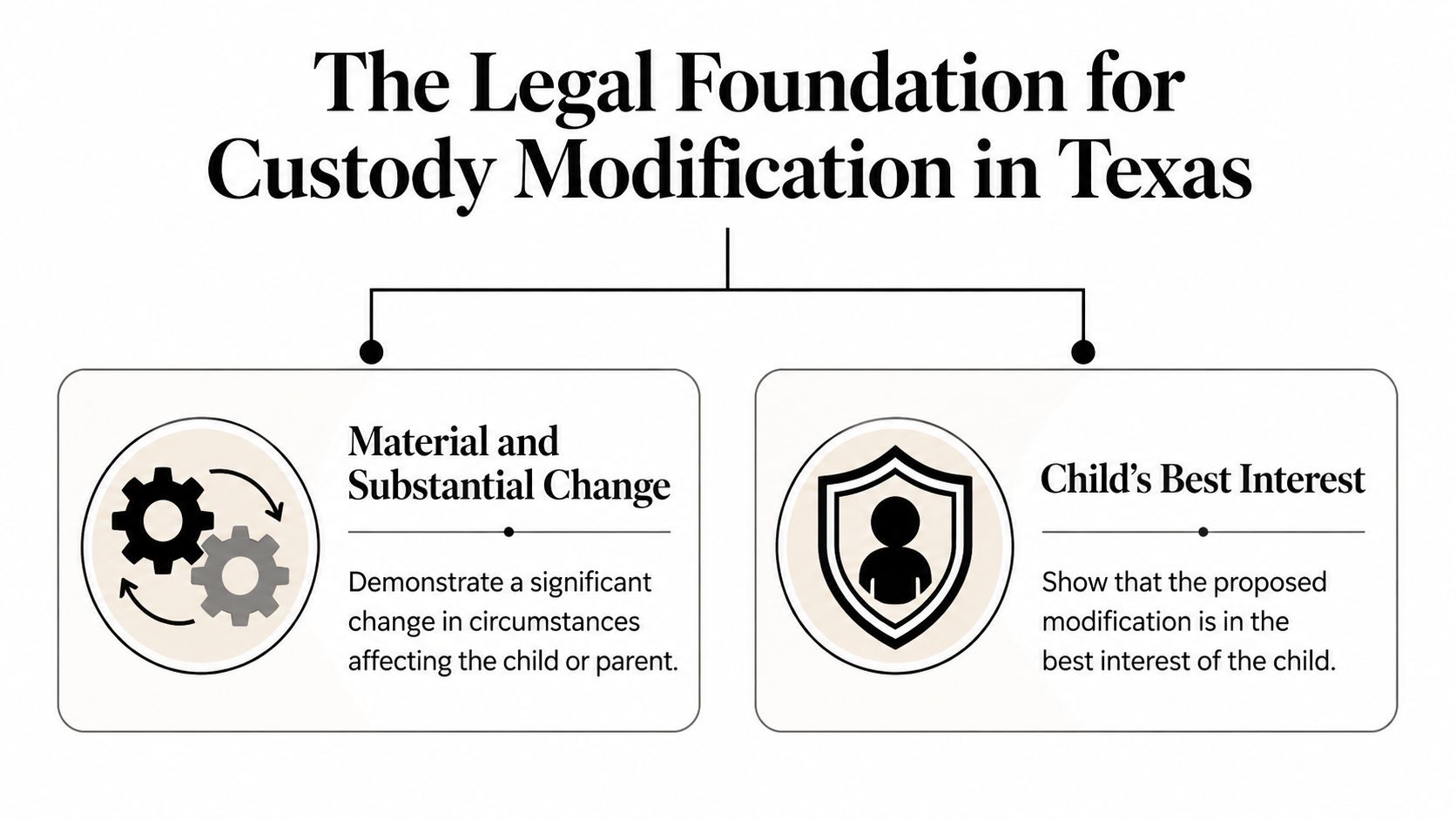
To succeed, the parent asking for the change must prove two legal elements: that the circumstances of the child or conservators have materially and substantially changed, and that the requested modification would serve the child's best interests. The burden is on the person filing, and the proof standard is a preponderance of the evidence, as explained in this discussion of Texas custody modification requirements.
What material and substantial change means
This phrase sounds technical, but the practical meaning is straightforward. The court is looking for a significant change since the last order was signed. Not ordinary co-parenting irritation. Not a short-term inconvenience. Not “I think my way is better.”
A significant move may qualify. A major shift in work schedule may qualify if it affects the child's routine. So can substance abuse, domestic violence, criminal issues, or meaningful changes in the child's physical, emotional, or educational needs. By contrast, temporary disruptions or minor disagreements usually don't carry enough weight.
If you want a fuller explanation of how Texas courts look at this issue, this overview of substantial change in circumstances in Texas custody cases is a useful starting point.
What best interests of the child means
This is the court's guiding principle. A judge wants to know whether your proposed change will improve the child's stability, safety, and daily life. That includes practical concerns such as school continuity, home environment, and the child's emotional development.
The court isn't rewarding one parent for being more persuasive. It is deciding what arrangement best supports the child. That's why a parent can prove a change happened and still lose if the proposed solution doesn't make sense for the child.
A strong case connects the facts to the child. It doesn't stop at “this happened.” It explains “this is how it affects my child, and this is why the requested change helps.”
Why timing and proof matter together
Many parents focus only on the event that triggered the case. Judges focus on evidence. If your work changed, show the work records. If the child is struggling in school, show report cards, attendance records, and communication from the school. If the issue is safety, the court will expect records, witness testimony, and a clear timeline.
Strategy matters in this context. Filing too early can weaken an otherwise valid concern if you don't yet have enough proof to show the court why the change matters.
Common Signs It Is Time to Modify Your Custody Order
The right time to ask for a modification often becomes clear in pieces, not all at once. A parent notices the child is having trouble adjusting. The schedule starts breaking down. Important decisions become harder to make. Then one event turns an ongoing problem into a legal one.

Relocation and remarriage
A parent gets married and plans to move. Another parent accepts a job in a different city or state. These cases often matter because they don't just change an address. They can affect the child's school, medical care, travel time, and contact with the other parent.
Texas courts have recognized remarriage with relocation intent as a basis that can satisfy the material and substantial change requirement, according to Texas Law Help's explanation of modification within one year. What works in these cases is showing the practical effect on the child's routine. What usually doesn't work is presenting the move as a personal preference without a child-focused plan.
Work schedules and daily logistics
Sometimes the issue isn't dramatic. It's persistent. A parent now works weekends. Another switched to night shifts. The existing pickup and drop-off structure keeps failing, and the child bears the stress.
Those cases can support a modification when the schedule change is lasting and it clearly disrupts the child's life. The court will want more than “my job changed.” It will want to see how the old order no longer fits.
Safety concerns that require fast action
Some situations should not wait. If a parent develops a substance abuse problem, becomes violent, engages in criminal behavior, or creates an unsafe home environment, modification may be necessary to protect the child.
The court takes these allegations seriously, but serious allegations need serious proof. Police reports, medical records, witness statements, school concerns, and documented incidents matter far more than broad accusations.
A short video can help frame the issue if you're trying to understand how these disputes often unfold in practice.
Your child's needs may have changed
Children grow, and custody orders don't automatically grow with them. A child may need a different school setting, more consistent medical care, therapy support, or a schedule that better fits academics and activities.
In Texas, a child who is 12 or older may file a document with the court stating a preference about who should have the exclusive right to designate the child's primary residence, and the judge must interview the child, although that preference is not binding under Texas Family Code Section 153.009. That means older children can be heard, but their wishes are only one part of the court's analysis.
Older children should be listened to, not pressured. Courts can usually tell the difference.
A quick reality check
Here are some signs that often point toward a real modification issue:
- The current order keeps failing in practice because school, transportation, or work demands no longer line up.
- The child's well-being is changing through educational struggles, medical needs, or emotional distress.
- A parent's life has changed in a lasting way through relocation, job changes, or a new household structure.
- Safety concerns are no longer isolated and are now affecting the child's daily environment.
These signs don't guarantee success. They tell you it may be time to stop asking only what happened and start asking what you can prove.
Understanding the One-Year Rule and Its Exceptions
Texas places a strong value on stability, especially when a parent wants to change who has the right to decide the child's primary residence. In most cases, there is a one-year waiting period before a parent can ask for that kind of modification. That timing rule exists to prevent constant litigation and repeated disruption in a child's life.

If you are thinking about changing primary custody, it helps to read about how often custody can be modified in Texas before you file. Timing mistakes can derail a good case.
The three main exceptions
Texas law recognizes that some situations can't wait. As summarized in this discussion of grounds for custody modification in Texas, the one-year rule has three important exceptions:
- The primary custodian consents to the modification.
- The child's present environment endangers the child's physical health or emotional well-being.
- The primary custodian voluntarily relinquished care of the child for at least six months.
These exceptions are often where strategy begins. If one applies, the courthouse door may open sooner. If none applies, filing too early can lead to dismissal.
The endangerment exception is serious
Parents sometimes assume that showing conflict, bad communication, or parenting differences will qualify as endangerment. Usually, that isn't enough. This exception is for situations where the child's physical health or emotional development is at real risk.
That can include abuse, neglect, or exposure to substance abuse. The court will expect specific facts and supporting records. Vague fear rarely works. Documented danger may.
Waiting can strengthen a normal modification case. Waiting can hurt a dangerous one. Knowing which kind of case you have is one of the most important early decisions.
Strategic timing is part of the case
The one-year rule affects more than eligibility. It affects how your facts look. Filing too soon without an exception can fail on procedural grounds. Waiting too long can create a different problem if the facts suggest the issue existed earlier and was not urgent enough to address.
For some families, the right move is to spend time gathering records and preparing a thoughtful petition. For others, especially where safety is involved, immediate legal action may be necessary. Good timing is not about patience alone. It's about matching the filing date to the legal path your facts can support.
Types of Custody Modifications You Can Request
A custody modification isn't one single request. It's more like a menu. The right option depends on what changed and what the child needs now.
Some parents need to change the calendar. Others need to change who makes major decisions. In some cases, both issues move together, and child support may also need review.

Possession schedule changes
This is the most common kind of modification. Possession means the time each parent has with the child under the order. Parents often call this visitation, but Texas courts use the term possession and access.
A possession change may involve different exchange times, revised holiday schedules, or a long-distance arrangement after a move. These cases are often practical. The court wants a schedule that people can realistically follow.
Conservatorship changes
Conservatorship refers to parental rights and duties. Texas often uses the term joint managing conservatorship, which usually means both parents share certain legal rights, even if one parent has greater authority in a specific area. A modification can ask the court to change who has the right to make decisions about schooling, medical care, or the child's primary residence.
Here is a quick comparison:
| Modification type | What it changes | When it often comes up |
|---|---|---|
| Possession | The parenting time schedule | Work changes, relocation, recurring exchange problems |
| Conservatorship | Decision-making rights and duties | Conflict over education, healthcare, or primary residence |
| Related child support update | Financial support tied to parenting changes | A major shift in time with the child |
Child support may need to be addressed too
A custody case and a child support case are not the same thing, but they often overlap. If the parenting schedule changes in a meaningful way, support may need review so the legal paperwork matches the family's actual structure.
Parents sometimes make a costly mistake in this situation. They informally change the schedule and assume support will sort itself out. It won't. If the court order is outdated, the legal obligations usually remain in place until they are formally modified.
How to Prepare Your Case for a Successful Modification
The strongest modification cases are built before the petition is filed. By the time you get to court, the judge should be able to see a pattern, not just hear your frustration.
Texas courts treat the proof requirement seriously. The material and substantial change standard is a high bar, and successful cases often rely on 6 to 12 months of documented evidence such as medical records, employment letters, or school reports that show a clear effect on the child's stability and best interests, as explained in this article on modifying custody orders in Texas. If you want to understand the practical side of building that record, this guide on how to win a custody modification case is a helpful companion.
Build a timeline, not a pile
Many parents collect screenshots and documents but never organize them. That creates work for your lawyer and confusion for the court. A better approach is to build a timeline.
Use dates. Match each important event to a supporting document. Show what changed, when it changed, and how it affected your child. The judge should be able to follow the story from beginning to end without guessing.
Focus on evidence that answers the court's real question
The court is asking whether the change affects the child and whether your requested fix serves the child's best interests. Keep your proof pointed at that issue.
Useful evidence often includes:
- School records that show attendance issues, academic changes, or communication about concerns.
- Medical or counseling records that connect the child's needs to the current arrangement.
- Work or housing records showing a lasting schedule change, relocation, or instability.
- Written communications such as texts or emails that confirm missed exchanges, refusals, or agreements.
- Witness statements from people with direct knowledge, not people repeating family gossip.
Judges are persuaded by patterns, not piles. Ten well-organized records usually help more than a messy folder of unrelated messages.
Keep your conduct steady
Parents sometimes damage a good case by reacting emotionally. Angry texts, unilateral schedule changes, and social media posts can shift attention away from the child and onto your behavior.
If possible, communicate in writing and keep it calm. Follow the current order unless your lawyer advises otherwise or an emergency requires immediate action. If safety is a concern, get legal guidance quickly.
For families looking at practical next steps, one option is to speak with a Texas family law firm that handles custody modifications, such as Law Office of Bryan Fagan, PLLC, and compare that guidance with the records you've already gathered. The point is not to rush into filing. It is to file when the case is ready.
Key Takeaways and Your Next Steps
A custody order should reflect your child's real life, not a version of family life that no longer exists. If the current order no longer fits, Texas law may give you a path to change it. But success usually depends on more than having a valid reason. It depends on filing at the right time with the right proof.
The most useful way to think about when should you modify a custody order in texas is this: modify when the change is significant, the requested solution is child-focused, and your evidence can show the court why the order needs to change now. That is what bridges the gap between a difficult situation at home and a persuasive case in court.
Next steps you can take now
- Write down the timeline of what has changed since the last order.
- Gather records early so your evidence shows more than a single bad day.
- Define the exact relief you want instead of asking the court for a vague “better” arrangement.
- Stay child-centered in your communications with the other parent.
- Get legal advice before filing if timing, safety, or proof are unclear.
A calm, prepared approach often gives parents more control than they expect. You don't need to know every legal term to start making smart decisions. You do need to understand that courts change orders based on evidence, not emotion.
If you need help with a child custody or visitation case in Texas, our experienced attorneys can guide you every step of the way. Contact The Law Office of Bryan Fagan, PLLC today for a free consultation.
If you need help with a child custody or visitation case in Texas, our experienced attorneys can guide you every step of the way. Contact The Law Office of Bryan Fagan, PLLC today for a free consultation.