Skip to content
When your child’s future is on the line, understanding your rights matters most. If you're facing a custody case, the idea of a 50/50 split can feel like the only fair outcome for you and your children. But here’s something most parents learn the hard way: Texas law doesn’t use the term “custody” in the way we do in everyday conversation.
Instead, the Texas Family Code separates what you think of as "custody" into two distinct issues: your right to make decisions for your child, and the actual time you spend with them. While Texas courts strongly believe both parents should have a say in raising their children, they do not automatically assume a 50/50 time split is what’s best for every family. Understanding this distinction is the first step toward building a strong, successful case.
What Does 50/50 Custody Really Mean in Texas?
In a Texas courtroom, the word "custody" is only half the story. The Texas Family Code uses specific legal terms that can feel intimidating at first, but breaking them down makes everything much clearer. Learning this language will empower you to navigate your case with confidence.
The two main components of any Texas custody order are:
- Conservatorship: This is a plain-English way of saying "parental rights and responsibilities." Think of it as your authority to make important decisions about your child's education, medical care, and religious upbringing.
- Possession and Access: This is the part everyone thinks of as custody—the physical time each parent has with the child, laid out on a calendar. This possession schedule determines overnights, holidays, and summer vacations.
So, when we talk about achieving 50/50 custody in Texas, we’re really talking about two different goals: securing shared decision-making rights (conservatorship) and getting an equal parenting schedule (possession and access).
Before we go deeper, let's clear up some of the legal jargon you're going to hear. This simple table breaks down the most common terms into plain English.
Texas Custody Terms Explained
| Legal Term | Plain-English Meaning | What It Covers |
|---|---|---|
| Conservatorship | Parental Rights & Duties | Making decisions about school, healthcare, and religion. |
| Possession & Access | Parenting Time/Schedule | The calendar of who has the child and when (weekends, holidays). |
| Joint Managing Conservatorship | Shared Decision-Making | The standard setup where both parents have a say in major decisions. |
| Standard Possession Order (SPO) | The Default Schedule | The "standard" Texas visitation schedule; it is not a 50/50 split. |
Knowing these terms will help you feel more confident whether you're speaking with a lawyer, a mediator, or a judge. They are the building blocks of every Texas custody order.
Joint Managing Conservatorship is the Texas Standard
Texas law begins with a powerful and family-focused assumption: it’s almost always in a child’s best interest to have both parents deeply involved in their life. Because of this core belief, courts automatically presume that a Joint Managing Conservatorship is the right fit for most families. In plain English, this means the court expects both you and the other parent to share the rights and duties of raising your child.
In a Joint Managing Conservatorship, both parents have a legal say in major decisions. It’s a framework for co-parenting, not a 50/50 division of time. One parent is typically designated as the "primary" parent who establishes the child's residence.
This setup is designed to encourage cooperation and shared responsibility—two things Texas courts believe are the foundation of a stable and loving childhood after a separation.
Possession Schedules Are a Separate Matter
While shared decision-making is the default, the actual parenting schedule—the possession order—is a whole different ballgame. There is absolutely no law in Texas that says children must split their time equally between parents.
Instead, the Texas Family Code provides a default schedule known as the Standard Possession Order (SPO). The SPO is designed to give the non-primary parent clear and consistent time with their child, but it is not an even 50/50 split.
The push for true 50/50 possession time has gained significant support in recent years. This was front and center during the debate over House Bill 803, often called the 'equal parenting bill,' which aimed to make a 50/50 schedule the starting point for Texas courts. While the bill ultimately didn't pass, it showed a huge shift in public and legislative support for more balanced parenting plans and fathers' rights. You can discover more about this legislative effort on ceborman.com.
At the end of the day, any schedule—whether it’s the standard order or a true 50/50 plan—must be proven to be in the best interest of the child. That’s the single most important factor for any Texas judge.
How Texas Determines Custody: The Best Interest of the Child
When you walk into a courtroom fighting for a 50/50 custody schedule, it’s easy to focus on what feels fair to you as a parent. But a Texas judge sees it all through one, very specific lens: the best interest of the child. This isn't just a catchphrase; it's the legal standard from Texas Family Code Chapter 153 that guides every decision about where your child will live.
This standard isn't a vague idea. It's a concrete set of factors the judge must weigh to determine what will create the safest, most stable, and most nurturing life for your child. Your job, with the help of your attorney, is to show the court exactly how your proposed 50/50 schedule achieves that goal.
The Factors that Shape Your Child's Future
To determine a child's best interest, judges rely on a list of considerations known as the "Holley Factors." Think of these less like a checklist and more like a framework for painting a complete picture of your family's life for the court.
A judge will ask practical, real-world questions, such as:
- Who can best meet the child's needs? This goes beyond just food and shelter. It includes emotional support, love, and who has historically handled day-to-day care.
- How stable is each parent's home? Judges look for consistency and a predictable environment where a child can thrive.
- Are there any dangers? The court has a duty to protect the child from any history of abuse, neglect, or substance use by either parent or anyone in their home.
- What was each parent's role before the separation? The judge will want to know who was the go-to parent for homework, doctor's visits, and bedtime stories.
Proving you're an actively involved and capable parent is everything. For both mothers and fathers, showing a track record of hands-on care can make a powerful difference in the final custody order. You can learn more about the Holley Factors and how they apply to your case in our detailed guide.
Does My Child's Opinion Matter to the Court?
Yes, especially as children get older. In Texas, if a child is 12 years of age or older, the law requires the judge to interview them privately to hear their preference about which parent they want to have the right to decide where they live.
But it’s critical to understand this: the child's wish isn't the final word. While their voice is an important piece of the puzzle, the judge still has the final say and will balance the child's preference against all the other evidence to decide what is truly in their best interest.
A child’s preference is a piece of the puzzle, not the whole picture. The court will weigh their wishes against other critical factors like home stability and each parent's ability to provide care.
Overcoming the Standard Possession Order Presumption
While a 50/50 schedule is absolutely an option, you need to know that courts start with a legal presumption: that the Standard Possession Order (SPO) is in the child’s best interest. To get a true 50/50 custody order, you must provide compelling evidence to convince the judge to move away from that starting point.
Courts are much more open to granting a 50/50 schedule when parents can show:
- They live close to each other, ideally in the same school district.
- They have a history of working together respectfully as co-parents.
- Both parents have been deeply involved in the child’s daily life all along.
- A 50/50 split won't disrupt the child's school, friendships, or activities.
Recent Texas custody statistics show that fathers, on average, receive about 33% of the parenting time, which works out to roughly 121 nights a year. This data underscores that while 50/50 is achievable, the "standard" arrangement still often gives one parent significantly more time. Successfully arguing for an equal schedule means proving it’s not just fair to you, but genuinely the best path forward for your child.
Exploring Common 50/50 Possession Schedules
When parents hear "50/50 custody," they often picture a single, rigid plan. The reality is much more flexible. Think of it less as a one-size-fits-all rule and more as a framework you can adapt to fit your family’s real life—from your work schedules to your child’s age and activities. Understanding the most common 50/50 possession schedules can help you visualize how they work day-to-day, giving you practical options to discuss with the other parent or your attorney.
Choosing the right schedule is a big deal. It often comes down to your child's age, how far apart you live, and how well you and the other parent communicate. It's also worth thinking about different co-parenting models. For example, a schedule with frequent exchanges that works for amicable co-parents might be a challenge for those who need a more parallel parenting approach with less interaction.
At the end of the day, any schedule a Texas court approves must be in the "best interest of the child." This isn't just a legal catchphrase; it's the standard by which every decision is measured.
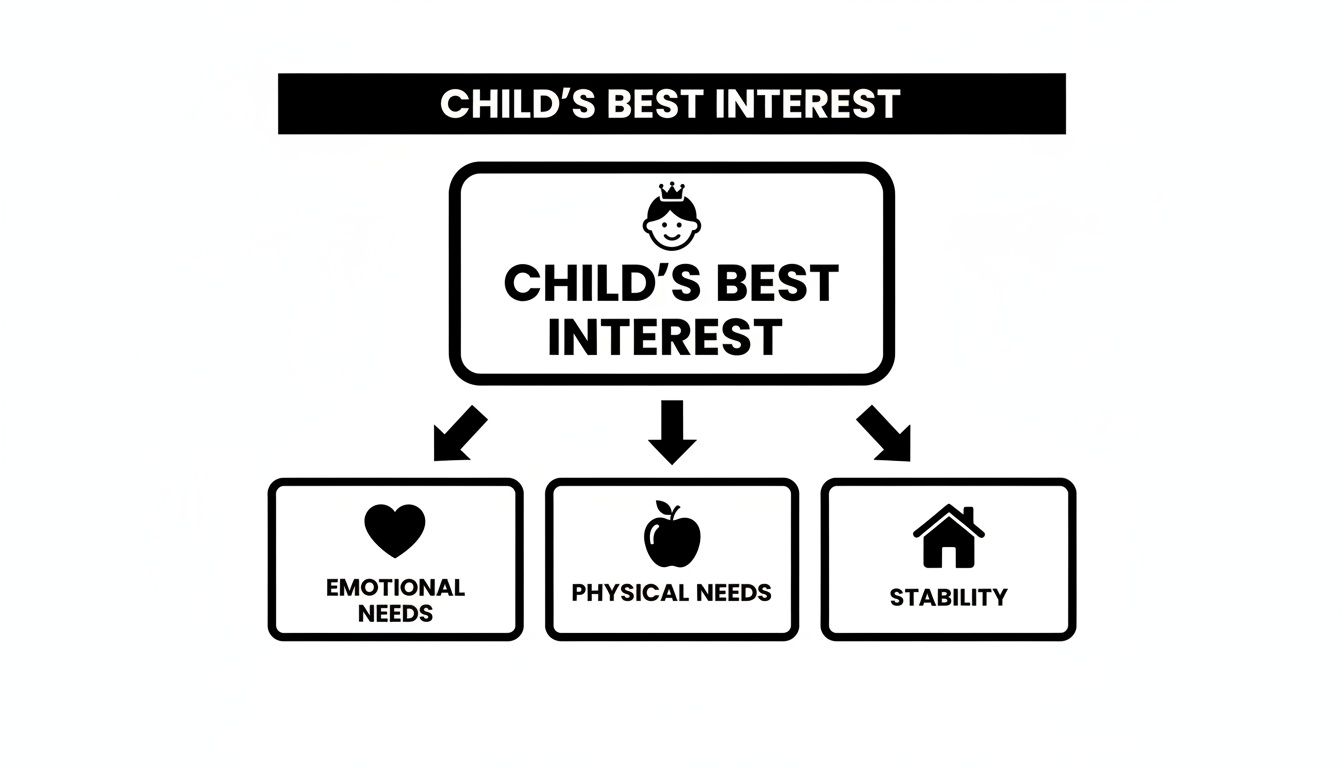
As this shows, the court is focused on ensuring the plan supports your child’s emotional and physical needs while creating as much stability as possible.
Comparing 50/50 Possession Schedules
To help you figure out what might work best, we've broken down the most popular 50/50 schedules. Each has its pros and cons, depending on your family's unique situation.
| Schedule Name | Best For | Potential Challenges |
|---|---|---|
| Week-On/Week-Off | Older kids & teens who can handle a week apart from a parent; reduces exchanges and conflict. | Can be a long time for younger children; parents need to live close to keep school routines consistent. |
| 2-2-5-5 | Families wanting frequent contact with a predictable routine; good for school-aged kids. | The rotating schedule can be confusing at first; still requires good communication. |
| 2-2-3 | Toddlers & very young children who need to see both parents often to maintain strong bonds. | The number of handoffs can be demanding and disruptive; requires excellent co-parenting. |
There's no single "best" schedule—only the one that's best for your child. Let's dig into how each one works in the real world.
The Week-On/Week-Off Schedule
The Week-On/Week-Off schedule is exactly what it sounds like and is one of the most popular 50/50 plans for a reason: it's simple. The child spends one full week with Parent A, then the next full week with Parent B. Exchanges usually happen on a Friday or Sunday afternoon.
- Best For: This setup really shines with older kids and teenagers who are independent enough to manage a full week away from one parent. It dramatically cuts down on exchanges, which means fewer opportunities for conflict and simpler logistics for busy school-age kids.
- Potential Challenges: For younger children, a full seven days can feel like an eternity away from one parent. This schedule also works best when parents live in the same school district to avoid major disruptions to school and friendships.
The 2-2-5-5 Schedule
The 2-2-5-5 schedule strikes a great balance between consistency and frequent contact. Here’s how it works: the child is with Parent A for two days (say, Monday-Tuesday), then with Parent B for two days (Wednesday-Thursday), and then back with Parent A for a long three-day weekend (Friday-Sunday). The next week, the pattern flips.
This schedule guarantees that each parent gets two weekdays and a full weekend with the child every two weeks, creating a predictable rhythm that everyone can get used to.
The biggest win here is that no parent goes more than five days without seeing their child, and weekends are split fairly over time. It’s a fantastic middle-ground option for families who find the week-on/week-off model feels too long between visits.
The 2-2-3 Schedule
The 2-2-3 schedule ramps up the number of exchanges, which can be perfect for very young children who benefit from seeing both parents as often as possible. In this plan, the child spends two days with Parent A, two days with Parent B, and then three days (usually the weekend) with Parent A. The following week, the weekend parent flips.
- Best For: This is often the go-to for toddlers and kids in early elementary school. That frequent, consistent contact is critical for maintaining strong bonds with both parents during those formative years.
- Potential Challenges: Let's be honest: the number of handoffs can be exhausting for parents and potentially disruptive for a child's routine. This schedule absolutely requires a high level of communication and cooperation to run smoothly.
Ultimately, the best 50/50 schedule is the one that gives your child the most stability and predictability. While these are common starting points, you can always work with your attorney to customize them to fit your family's unique needs. For a deeper dive into the standard possession orders used in Texas, you can learn more about the Expanded Standard Possession Order in Texas in our detailed article.
Child Support and Financials in a 50/50 Arrangement
When it comes to your child's financial well-being, getting clear on the facts is essential. One of the biggest and most common myths we see is that a 50/50 custody schedule in Texas automatically means no one pays child support.
That’s simply not true. Texas law looks at child support with one goal in mind: making sure the child’s needs are met and that they have a consistent standard of living, no matter which parent’s house they’re in. Even with a perfectly balanced possession schedule, child support is almost always still on the table. The court cares less about the number of overnights and more about each parent's financial ability to provide for the child.
How Child Support Works in a 50/50 Plan
In a standard custody case, Texas courts use a straightforward formula based on the non-primary parent’s income. But in a true 50/50 arrangement where there isn't a traditional "primary" parent, the math has to adapt.
Judges will often use what’s called an "offset" method. It’s a simple, logical approach.
- First, the court calculates what Parent A would typically pay Parent B based on the state guidelines.
- Next, it runs the numbers to see what Parent B would pay Parent A using the same formula.
- The parent who has the higher calculated obligation pays the difference to the other parent.
This method ensures the parent with greater financial resources contributes more, which helps level the playing field and maintain consistency for the child between the two homes. For a deep dive into the standard calculations, our firm has a guide on how to calculate child support in Texas.
Why the Higher Earner Often Still Pays
The purpose of child support is to uphold the child's right to be supported by both parents. When one parent earns significantly more, an offset payment prevents the child from experiencing a drastic difference in lifestyle from one house to the next. It helps ensure they have similar resources for everything—from clothes and school supplies to activities and housing—no matter whose turn it is to have them.
A 50/50 schedule addresses a child’s need for time with both parents. Child support addresses their financial needs. A Texas court will ensure both are met, independent of each other.
Even when time is split down the middle, a judge will likely order support if there's a significant income gap. The court must also account for major costs like medical needs, specialized education, or disability-related expenses. These orders aren’t set in stone; they can be modified if there is a material and substantial change in circumstances, like a job loss or a major promotion.
Other Key Financial Considerations
Your custody order needs to cover more than just the monthly support check. Thinking through these other financial details now will save you from conflict later.
- Health Insurance: The court will order one parent to provide health and dental insurance for the child. The cost of that premium is usually factored into the child support calculation.
- Child Tax Credit: Your order should be crystal clear about who gets to claim the child on their taxes. A common solution is for parents to alternate years.
- Extracurriculars and Uninsured Medical Costs: It’s wise to spell out exactly how you’ll handle expenses for sports, music lessons, tutoring, and unexpected co-pays or prescriptions. Splitting these costs 50/50 is a frequent and fair arrangement.
Sorting out these financial details upfront creates predictability for your family. It reduces arguments down the road and lets you and your co-parent focus on what really matters: raising a happy, healthy child together.
Steps to Achieve or Modify a 50/50 Custody Order
Whether you’re creating your family’s first custody plan or realizing an old order no longer fits your child's life, the first step is knowing how the process works. Getting a 50/50 custody schedule in Texas is an achievable goal, but it demands a clear strategy. The path you take will depend on one key question: can you and the other parent find common ground, or will you need a judge to make the final call?
The most effective, compassionate, and least expensive way to create or change a custody order is by working together. Texas courts always prefer when parents can reach their own solutions—after all, you know your child’s needs better than anyone.
The Path of Agreement: Negotiation and Mediation
The journey toward a fair custody plan should always start with a conversation. Simply talking openly with the other parent about what you each believe is best for your child can sometimes lead to a surprisingly quick resolution. This cooperative route saves time, money, and most importantly, shields your child from the stress of a courtroom battle.
If direct talks don't work, mediation is the next practical step. In mediation, you, the other parent, and your respective attorneys sit down with a neutral third-party professional who helps you communicate more effectively and find a middle ground.
A mediator doesn’t make decisions for you. Instead, they guide a structured conversation, helping you both explore options and build a parenting plan that you both agree is in your child's best interest.
Any agreement you reach in mediation can be drafted by your attorneys into a formal "Agreed Order." Once a judge signs it, this agreement becomes a legally binding court order—just as powerful as one decided after a trial.
The Court Process When You Can't Agree
When parents simply cannot agree, the decision-making falls to the court. This process begins when one parent files a "Petition to Modify the Parent-Child Relationship" (to change an existing order) or an original "Suit Affecting the Parent-Child Relationship" (to establish the first order). From that point on, your job is to build a compelling case showing why a 50/50 schedule truly serves your child’s best interests.
This means gathering evidence, which could include:
- Testimony from teachers, coaches, or family members who have seen you in action as a parent.
- Your own testimony detailing your involvement in your child’s daily life.
- Documents like report cards, activity calendars, and communication logs with the other parent.
Your attorney will present this evidence to the judge, who will then make a final ruling based on the factors laid out in the Texas Family Code.
Changing an Existing Custody Order
Life changes, and a custody order that was perfect for a toddler might be completely impractical for a teenager. Texas law recognizes this and allows parents to modify an existing order, but you must first meet a specific legal standard.
To change a court order, you must prove there has been a "material and substantial change" in the circumstances of the child or one of the parents. This is a critical legal hurdle. A minor disagreement or a small inconvenience isn’t enough to reopen your case.
So, what counts as a "material and substantial change"? Common examples include:
- A parent's relocation that makes the current schedule impossible to follow.
- The child's preference, if they are 12 years or older and can clearly express their wishes to the judge.
- A significant change in a parent's work schedule that affects their ability to follow the current order.
- The changing needs of the child as they get older and more involved in school or extracurricular activities.
To successfully modify an order, you must clearly show the judge how circumstances have fundamentally shifted and why a 50/50 plan is now the best solution for your child's stability and well-being.
Common Questions About 50/50 Custody in Texas
Thinking about a 50/50 custody arrangement in Texas brings a flood of questions to the surface. It’s natural to feel a mix of hope and uncertainty as you try to imagine what your family’s new life will look like. We’ve heard these questions from countless parents just like you, and we’ve put together some straightforward answers to give you the clarity you deserve.
Will a Judge Actually Listen to What My Child Wants?
Yes, but it's not the final word. The Texas Family Code requires a judge to privately interview any child who is 12 years of age or older to hear their preference on which parent they want to live with most of the time. This is a mandatory step.
However, it's important for parents to manage their expectations. While the child's wishes are an important piece of the puzzle, they are just one piece. The judge will weigh that preference against all the other evidence to decide what is truly in the child's overall best interest.
How Does Living Far Apart Affect Our Chances of Getting 50/50 Custody?
Living a long drive away from each other can make a true 50/50 schedule very difficult to implement. The frequent exchanges required for school, homework, and activities can become a logistical nightmare. A stable, predictable routine is the cornerstone of a child's well-being, and long commutes can disrupt that stability.
It's not impossible, but courts are often hesitant to order an equal possession schedule if parents don't live close by—ideally within the same school district. You would have to present a very compelling case that the benefits of a 50/50 plan outweigh the practical challenges of the distance.
Can We Just Agree to a 50/50 Schedule and Stay Out of Court?
Absolutely. In fact, this is often the best-case scenario for your family. Texas law is designed to encourage parents to work together and create their own agreements, whether through informal conversations or with the help of a mediator. After all, you and the other parent know your child and your family's rhythm better than anyone.
Crafting your own custody plan together reduces conflict, saves a significant amount of money on legal fees, and puts you—not a court—in control of your family's future. This cooperation also sets a much healthier tone for your co-parenting relationship moving forward.
Once you’ve settled on a plan, your attorneys will draft it into a formal "Agreed Order." A judge simply reviews it to make sure it serves the child's best interest. Once signed, it becomes a legally binding and enforceable court order, and you never have to step foot in a courtroom for a trial.
What Happens If the Other Parent Just Ignores the 50/50 Schedule?
A court-ordered possession schedule isn't a friendly suggestion—it's a legal mandate. If one parent consistently violates the order by returning the child late or denying your scheduled time, you have legal options.
You can file an "enforcement action" with the court. From there, a judge has the power to enforce the order. They can order make-up possession time for the days you lost, order the non-compliant parent to pay fines and your attorney's fees, or even impose other sanctions to ensure it doesn’t happen again.
If you need help with a child custody or visitation case in Texas, our experienced attorneys can guide you every step of the way. Contact The Law Office of Bryan Fagan, PLLC today for a free consultation.
Key Takeaways: Your Next Steps
Navigating the path to a stable custody arrangement can feel overwhelming, but you do not have to do it alone. The journey toward a fair 50/50 custody plan in Texas begins with understanding a few core truths. An equal possession schedule is an achievable goal, but it is never a guarantee. Every decision a court makes will be filtered through one lens: the "best interest of the child." And finally, the plan that works best is the one that’s built for your family's unique life.
Taking control of this process starts now, with a clear-eyed view of your rights and a smart, strategic approach.
As you move forward, keep these essential points in mind:
- Cooperation is Powerful: Reaching an agreement through negotiation or mediation is almost always faster, cheaper, and less stressful than a court battle.
- Evidence is Everything: To persuade a judge, you need to show a consistent history of being an active, involved parent—from homework duty to doctor’s appointments.
- The Child Comes First: Frame every request and argument around your child's need for stability, safety, and a strong relationship with both parents.
- Tools Can Help: As you plan your next steps, exploring options like the best co-parenting schedule app can reduce conflict and make daily coordination much simpler.
Your emotions are valid, but your legal strategy must be grounded in the facts and the law. A clear plan empowers you to advocate effectively for your children and protect your relationship with them for years to come.
Protecting your relationship with your child is the most important work you will ever do. Having a trusted advocate by your side can make all the difference.
If you need help with a child custody or visitation case in Texas, our experienced attorneys can guide you every step of the way. Contact The Law Office of Bryan Fagan, PLLC today for a free consultation at https://texascustodylawyer.net.