
When your child’s future is on the line, understanding your rights isn't just important—it's everything. For Texas parents navigating custody, the court's starting point is the Expanded Standard Possession Order (ESPO). This schedule is designed to give both parents significant, meaningful time with their children. If you and the other parent live within 50 miles of each other, this schedule is the presumed roadmap for your family's new chapter.
What is the Expanded Standard Possession Order?

Navigating a child custody case can feel overwhelming, but Texas law provides a clear and stable starting point designed to put your child’s well-being first. This framework is called the Expanded Standard Possession Order, or "ESPO," and it serves as the state’s presumptive, go-to schedule for parents who live relatively close to one another.
This schedule exists because Texas lawmakers—and the courts—recognize a fundamental truth: children thrive when both parents are consistently and actively involved in their lives. The ESPO moves past an outdated model of just "weekend visits" and helps create a more balanced, integrated parenting dynamic for both mothers and fathers.
Why the Expanded Order is Now the Standard
The Expanded Standard Possession Order marked a major shift in Texas family law when it became the new default on September 1, 2021, for parents living 50 miles or less apart. This wasn't a small tweak. It significantly boosted the non-primary parent's time to nearly a 50/50 split of yearly overnights.
This legislative change to Texas custody schedules was a direct response to a growing body of evidence showing that more balanced parenting time is incredibly beneficial for a child’s emotional stability and helps keep parent-child bonds strong after a separation.
The court automatically presumes this schedule is in the best interest of the child, a legal standard that guides every single custody decision. This principle isn't just jargon; it’s a plain-English way of saying the court's top priority is figuring out what will best serve a child's emotional, physical, and developmental needs.
In the eyes of the court, the "best interest of the child" means creating a safe, stable, and loving environment. The ESPO is built to support this by ensuring kids maintain strong relationships with both parents through frequent and continuous contact.
Core Goals of the ESPO
At its heart, the Expanded Standard Possession Order is trying to accomplish a few key things for Texas families. It provides a predictable, reliable framework that helps everyone—parents and kids alike—adjust to a new family structure.
The main goals are straightforward:
- Promote Stability: A consistent, predictable schedule helps children feel secure. They know what to expect, and that predictability is calming.
- Foster Strong Bonds: More frequent contact allows the non-primary parent to be part of the day-to-day routine, like helping with homework, sharing weeknight dinners, and tucking them in at night. It's about being a parent, not just a visitor.
- Reduce Conflict: By laying out a clear, court-ordered default schedule, the ESPO minimizes the "who gets the kids when" arguments that can create so much stress for everyone involved.
Think of this schedule as more than just a calendar. It's a legal tool designed to protect and support your relationship with your child. By understanding how an expanded standard possession order in Texas works, you can better advocate for the time and involvement your child deserves.
How the Expanded Order Compares to the Standard Schedule
Trying to make sense of different parenting schedules can feel like learning a new language. But when it comes to your child and your own peace of mind, understanding the nuts and bolts is absolutely critical. The key difference between the traditional Standard Possession Order (SPO) and the newer Expanded Standard Possession Order (ESPO) boils down to one thing: more meaningful parenting time for the non-primary parent.
The Expanded Order isn't just about adding days to the calendar. It was designed to weave the non-primary parent into the fabric of the child's daily life, creating more consistent and integrated parenting. It turns regular weekends into long weekends and adds an overnight visit during the week, helping that parent stay connected to school routines and everyday activities.
Weekends and Midweek Visits
The biggest shift you'll see is in how weekends are handled. The old SPO typically ran from 6 p.m. on Friday to 6 p.m. on Sunday. This often meant the non-primary parent was cut out of the school week entirely, missing homework checks, morning routines, and getting the kids ready for Monday.
The ESPO changes that dynamic completely. For parents living within 50 miles of each other, the weekend now stretches from the moment school lets out on Thursday all the way until school starts back up on Monday morning. That simple change adds two extra overnights and makes that parent a real part of the school-week rhythm. On top of that, the ESPO includes an overnight visit every Thursday during the weeks when the parent doesn't have their regular weekend possession.
Holiday and Summer Possession
When you look at major holidays like Thanksgiving and Christmas, both the SPO and ESPO schedules are nearly identical. They follow the common-sense approach of alternating these holidays between parents each year to keep things fair. So, if one parent gets the kids for the first half of Christmas break in an even-numbered year, the other parent will have them for that same time in an odd-numbered year.
Summer possession also grants the non-primary parent the same 30 days of time with the children under both schedules. The real difference isn’t the amount of time but the feel of it. Because the ESPO provides more frequent and consistent contact during the school year, the transition into a month-long summer visit often feels much more natural and less jarring for the child.
If you want to dive deeper into the basics, you can get a clearer picture by reading our detailed guide to understanding child visitation and possession orders in Texas.
A key takeaway is that the ESPO adds about 40 extra overnights per year for the non-primary parent compared to the old standard schedule. This isn't just more time—it's more meaningful time integrated into a child's real life.
Side-by-Side Comparison
To make the differences crystal clear, let's put the schedules side-by-side for parents who live 50 miles apart or less. This table really highlights how the ESPO reshapes the week.
Key Differences Between SPO and ESPO in Texas
| Possession Period | Standard Possession Order (SPO) | Expanded Standard Possession Order (ESPO) |
|---|---|---|
| Weekend Possession | 1st, 3rd, and 5th Fridays of the month, from Friday at 6 p.m. to Sunday at 6 p.m. | 1st, 3rd, and 5th weekends of the month, from Thursday school dismissal to Monday school start. |
| Midweek Possession | Thursday evenings during the school year, typically from 6 p.m. to 8 p.m. (no overnight). | Every Thursday during the school year (on non-weekend weeks) from school dismissal to Friday school start. |
| Spring Break | Alternates annually between parents, often from Friday school dismissal to the Sunday before school resumes. | Same as the SPO, alternating annually between parents for the entire week. |
| Summer Possession | 30 days for the non-primary parent, which can be exercised in one or two blocks. | Same as the SPO, providing 30 days of possession time. |
As you can see, the Expanded Standard Possession Order directly boosts the non-primary parent’s involvement in the child's school routine. This change is a cornerstone of the law's intent to keep both parents actively engaged, which is almost always in the child's best interest.
Visualizing Your Year with an Expanded Possession Calendar
Legal documents can feel pretty cold and impersonal, but a parenting schedule is about your life, your child, and your future together. To make the Expanded Standard Possession Order (ESPO) feel less like a court document and more like a real-life plan, let's walk through what a typical year actually looks like.
Thinking about the calendar in terms of the school year, holidays, and summer can bring some much-needed clarity and predictability to a process that often feels anything but.
The following infographic illustrates how Texas custody schedules have evolved, highlighting the shift towards more integrated, consistent parenting time.
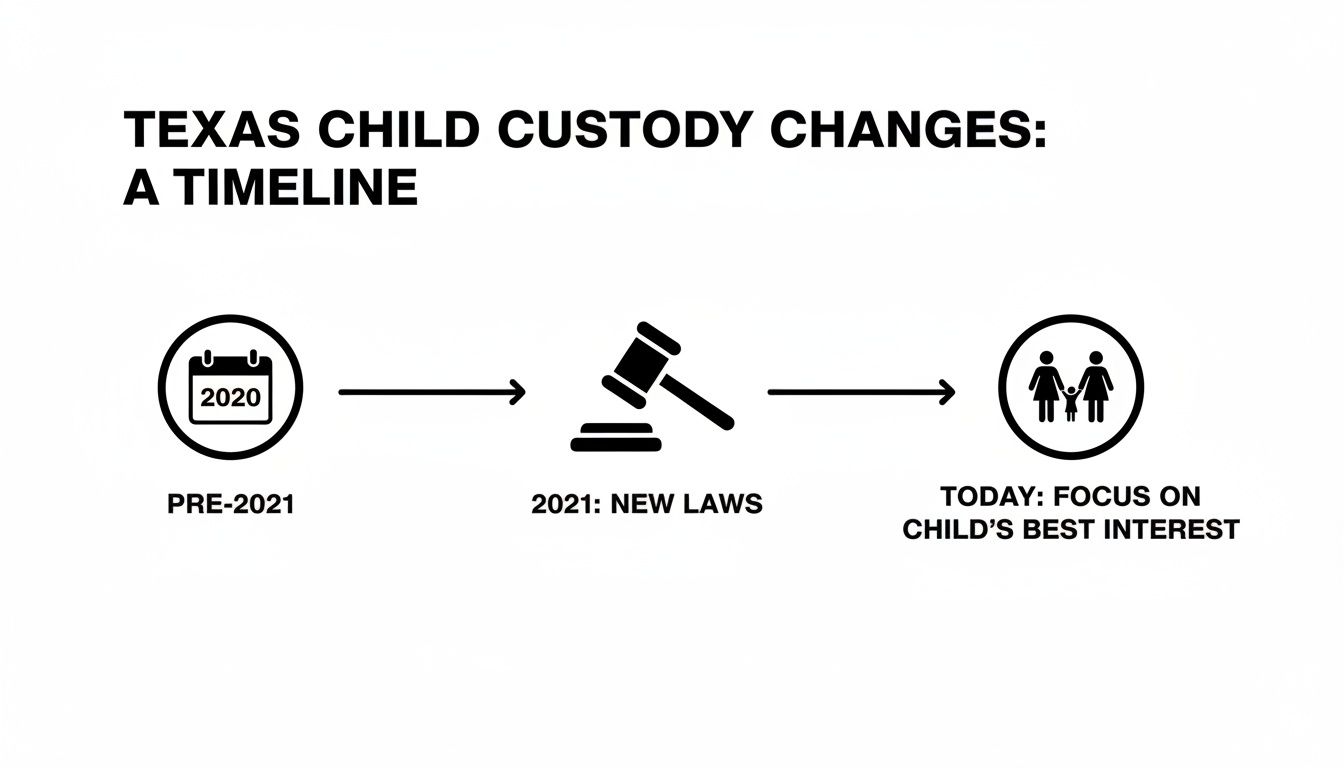
This visual journey shows how Texas law has progressed, moving away from older models and culminating in the current ESPO, which really prioritizes frequent and meaningful contact between a child and both parents.
Your Schedule During the School Year
The school year is where the ESPO truly shines, creating a rhythm that keeps both parents deeply involved. This consistency is huge for kids, helping them feel secure and connected to both homes without the constant feeling of being shuffled around.
-
First, Third, and Fifth Weekends: The non-primary parent gets the child on the first, third, and fifth weekends of a month. And here's the crucial part: this period runs from the time school is dismissed on Thursday until school resumes on Monday morning. This creates a genuine long weekend, giving you time for homework help, weekend activities, and just being present for the day-to-day routine.
-
Weekly Thursday Overnights: On the weeks the non-primary parent doesn't have their weekend time (usually the second and fourth weeks), they get the child overnight every Thursday. This visit starts when school lets out on Thursday and ends when school begins on Friday morning. That midweek connection is vital for staying plugged into school projects and what's happening in your child's social life.
This structure was a major legislative change. Since it kicked in on September 1, 2021, the Expanded Standard Possession Order has reshaped custody for countless Texas families. It transformed what used to feel like fragmented visits into substantive blocks of parenting time—a pivot made under Texas Family Code §153.3171 to address the long-standing concern that previous schedules just didn't provide enough time.
How Holidays Work Under the ESPO
Holidays are precious, and the ESPO does a solid job of dividing them fairly so both parents get to create those lasting memories. The schedule is designed to alternate each year, so what one parent has this year, the other will have next.
-
Thanksgiving: The non-primary parent has possession during odd-numbered years (like 2025, 2027), and the primary parent has possession during even-numbered years (like 2024, 2026). The holiday period typically runs from when school is dismissed for the break until the Sunday evening before school starts back.
-
Christmas/Winter Break: This longer break gets split right down the middle. In even-numbered years, the non-primary parent gets the first half, from school dismissal until noon on December 28th. In odd-numbered years, they get the second half, from noon on December 28th until school resumes.
-
Spring Break: This one simply alternates each year. The non-primary parent will have the child for the entire Spring Break in even-numbered years, and the primary parent will have them in odd-numbered years.
It’s surprisingly easy to lose track of which holiday falls in which year. Using a shared digital calendar or a helpful tool like our parenting time calculator can be a lifesaver for keeping everything organized and avoiding confusion.
Planning for Summer Possession
Summer offers a fantastic opportunity for extended time together, perfect for vacations and deeper bonding without the pressure of the school week. The ESPO gives the non-primary parent 30 days of possession.
The non-primary parent has to give written notice to the other parent by April 1st, spelling out the 30 days they want. This time can be taken all at once or broken into a couple of smaller chunks. If no notice is given by the deadline, the schedule defaults to a 30-day period in July. This notification process is key to making sure both parents can plan their summers effectively and minimize last-minute conflicts.
By visualizing the year this way, the Expanded Standard Possession Order becomes more than just a legal requirement—it becomes a predictable and stable framework for your child’s life, which is what this is all about.
How to Get or Contest an Expanded Standard Possession Order
Securing the right parenting schedule for your family is one of the most important goals in any custody case. Understanding how to advocate for—or against—the Expanded Standard Possession Order (ESPO) is a huge part of that process. Because Texas law views this specific schedule as being in a child's best interest, it has a special legal status you need to be aware of.
For parents who live 50 miles or less from each other, the Expanded Standard Possession Order is presumptive. That's a legal way of saying the court will automatically default to this schedule unless one parent actively opposes it and gives the judge a compelling reason why it’s not the right fit for their child. Knowing your rights and the correct procedures is key to making sure the final order truly serves your child’s needs.
How to Elect an Expanded Order
If you’re the non-primary parent and you want the expanded schedule, you need to formally "elect" it. This isn't a complicated process, but it has to be done correctly and in writing to be legally binding. One parent can’t just assume it’ll happen; you have to ask for it.
You can make the election in a few ways:
- In Your Initial Pleadings: When you first file your case or your response, you can include a clear statement electing the expanded schedule.
- During Mediation: If you and the other parent attend mediation, you can make the election part of your Mediated Settlement Agreement.
- In a Separate Written Document: You can file a standalone document with the court that formally states your choice.
The key is to create a clear, written record. While an oral statement in court can sometimes work, putting it in writing provides undeniable proof of your request. Once you make this election, the legal burden shifts to the other parent to prove why the ESPO would not be in the child's best interest.
How to Contest the Expanded Possession Order
Just because the ESPO is the default doesn't mean it's mandatory. A judge can—and will—order a different schedule if there are valid concerns about the child’s well-being. The court's primary duty is to protect the child, and that duty overrides any default schedule.
To successfully contest the expanded order, you have to provide solid evidence showing that this particular schedule would be harmful, disruptive, or otherwise not in your child’s best interest.
According to Texas Family Code §153.002, every decision in a custody case must be based on the "best interest of the child." This is the guiding principle that allows a judge to deviate from the standard schedule when the facts justify it.
So, what are some valid reasons a judge might deny an ESPO?
- A History of Family Violence: If there's a documented history of abuse, a judge will almost certainly limit possession to protect the child.
- Substance Abuse Issues: A parent's ongoing struggles with drugs or alcohol can be a strong reason to order a more restrictive schedule, like the standard SPO or even supervised possession.
- The Child's Well-Being: If the back-and-forth logistics of the Thursday-to-Monday schedule would cause significant disruption to the child's school, extracurriculars, or sleep, a judge might find it unworkable.
- Parental Instability: If a parent lacks a stable home or has a work schedule that makes the expanded hours impractical, the court may revert to the traditional SPO to create more consistency for the child.
It’s important to know that judges have the discretion to deny ESPO requests when these "best interest" factors are proven in court. For example, a history of abuse is a critical factor in contested cases. Many parents choose to elect the ESPO during divorce or modification proceedings to avoid lengthy court battles. To learn more about what judges consider, you can find valuable insights on fighting for balanced parenting schedules.
Ultimately, whether you are electing or contesting the expanded order, your entire argument must be framed around what is best for your child. Presenting clear, factual evidence to support your position is the only way to persuade a judge to see things your way.
Navigating Long Distance and Special Circumstances

Life doesn't always keep families in the same zip code, and Texas family law gets that. When parents live far apart, the logistics of a typical Expanded Standard Possession Order (ESPO) just fall apart. Those frequent Thursday and weekend handoffs become completely impractical—and frankly, not in a child's best interest—when there's a long drive involved.
This is exactly why the Texas Family Code provides a different game plan when parents live more than 100 miles from each other. This long-distance schedule is designed to make sure the non-primary parent can still build and keep a strong, meaningful relationship with their child, even from afar. The focus naturally shifts from frequent, short visits to fewer but longer stretches of time together.
It's an acknowledgment that while distance changes things, it shouldn't break the bond between a parent and child. So instead of feeling defeated by the miles, you can feel confident knowing there's a legal framework in place to protect your parenting time.
How Possession Works When Parents Live Over 100 Miles Apart
Once that 100-mile rule kicks in, the non-primary parent is given choices to craft a schedule that actually works. The law builds in flexibility because it recognizes that there's no one-size-fits-all solution for long-distance parenting.
For possession during the school year, the non-primary parent usually gets to pick one of these options:
- Every first, third, and fifth weekend, just like the standard order. This is a common choice for parents who are just over the 100-mile mark and can still manage the travel.
- One weekend of their choice per month. This is a really popular option. It gives that parent the power to pick a weekend that lines up with their work schedule and the child’s activities, as long as they give the other parent enough notice.
The core idea is the same: create predictable, meaningful time together. When you’re dealing with distance, the focus just shifts from quantity to quality, making sure every visit is a real opportunity to connect.
Summer and holiday possession schedules are also adjusted to make the most of that precious time. For parents living over 100 miles apart, the non-primary parent is typically awarded every Spring Break. They also get an extended summer possession of 42 days, a nice bump up from the 30 days given to parents who live closer. Our firm offers more specific guidance on creating a workable long-distance parenting plan that tackles these unique challenges head-on.
Special Considerations for Military Families
Military families have their own unique set of hurdles, from frequent relocations to unpredictable deployments. A standard possession order, even a long-distance one, often isn't flexible enough to handle the realities of military life.
Thankfully, Texas law allows military parents to create customized possession schedules. These orders can even include special provisions that let a parent designate a family member—like a grandparent or stepparent—to step in and exercise their possession time during deployment. This ensures the child keeps that vital connection to that side of the family, even while their parent is serving our country.
No matter what your family’s situation looks like—whether you’re separated by miles or by military duty—the legal system has tools to help you build a predictable and supportive schedule. An experienced attorney can help you understand all your options and fight for an order that protects your priceless relationship with your child.
Key Takeaways and Next Steps
Getting a handle on the Expanded Standard Possession Order is a crucial step in advocating for your child and protecting your rights as a parent. Think of this schedule as a tool Texas law gives you to build a close, consistent relationship with your child, making sure you stay a vital part of their everyday life.
But every family’s story is different. Your work schedule, your child's needs, and your co-parenting dynamic might not fit neatly into a one-size-fits-all court order.
Creating a Plan That Actually Works for Your Family
While the ESPO is the starting point and legal presumption in Texas, it’s definitely not your only choice. In fact, Texas courts prefer to see parents work together to create their own plan. You and the other parent are free to agree on a custom possession schedule that fits your lives, as long as it always serves the best interests of the child.
This flexibility is one of the best parts of Texas family law. It gives you the power to craft a schedule that genuinely works, whether that means tweaking exchange times or creating a totally new calendar from scratch. The goal, always, is to give your child a stable and predictable routine.
Your active and informed involvement is the single most important factor in your child's well-being during a custody case. Taking proactive steps now is the best way to secure your family's future and protect your precious relationship with your child.
Your Next Steps
Whether you’re embracing the Expanded Standard Possession Order, negotiating a custom schedule, or needing to contest the default, a clear strategy is essential. This is where a compassionate and experienced family law attorney becomes your most valuable advocate.
An attorney can help you:
- Understand every detail of the ESPO and what it means for you.
- Negotiate a fair and practical custom agreement with the other parent.
- Stand up for you in court if a conflict arises, making sure your voice is heard.
If you need help with a child custody or visitation case in Texas, our experienced attorneys can guide you every step of the way. Contact The Law Office of Bryan Fagan, PLLC today for a free consultation.
Frequently Asked Questions About the ESPO
When you’re facing custody questions, you need answers—not legal jargon, but real, straightforward information that helps you feel more in control. Let's tackle some of the most common questions we hear from parents about the Expanded Standard Possession Order (ESPO) in Texas.
Is the Expanded Standard Possession Order Mandatory in Texas?
This is a fantastic question and a common point of confusion. The simple answer is no, not strictly. In Texas, the ESPO is what's called the presumptive order for parents living 50 miles or less apart. That means the court starts with the assumption that this is the right schedule unless there's a compelling reason to do something different.
The non-primary parent can choose to "opt-out" and stick with the traditional Standard Possession Order (SPO). More importantly, a judge always has the final say and can decide against the expanded schedule if it's not in the best interest of the child—for example, in situations involving safety risks or extreme logistical problems.
A core principle of Texas family law is flexibility in service of a child’s well-being. The ESPO is the strong default, but it's not a one-size-fits-all rule. The unique needs of your family always take priority.
What Happens if the Other Parent Does Not Follow the ESPO?
A court order isn't just a suggestion; it's a legally binding document that both parents are required to follow. If the other parent is consistently ignoring the possession schedule—whether by showing up late for exchanges, cutting visits short, or just flat-out denying them—you have legal recourse.
Your first step should always be to document every single violation. Keep a log with dates, times, and specific details of what happened. This creates a clear, undeniable record of non-compliance. Armed with this evidence, you and your attorney can file an enforcement action with the court. A judge can then compel the other parent to follow the order and even issue penalties, which might include fines, ordering make-up possession time, or in cases of repeated violations, even jail time.
Can We Create a Different Schedule Instead of the ESPO?
Absolutely. In fact, Texas courts encourage parents to collaborate and design a custom possession schedule that actually works for their family's unique rhythm. After all, you know your kids, your jobs, and your lives better than anyone.
As long as you both agree on the details and the court confirms that your custom plan is in your child's best interest, you can formalize pretty much any schedule you create together. The ESPO just serves as the legal fallback—a well-designed safety net—for those times when parents can't reach an agreement on their own. The power to build a schedule that lets your children thrive is always in your hands.
If you need help with a child custody or visitation case in Texas, our experienced attorneys can guide you every step of the way. Contact The Law Office of Bryan Fagan, PLLC today for a free consultation.