Skip to content
When your child’s future is on the line, understanding your rights matters most.
You may be here because your son said he wants to live with Dad full-time. Or your daughter told you she wants to stay with Mom because that house is closer to school and friends. Maybe you’re worried the other parent is pressuring your child. Maybe you’re afraid the judge will let a child make an adult decision.
Those fears are real. So is the confusion.
In Texas, child preference in custody texas cases matters, but it never stands alone. A child’s voice can be heard, especially as they get older, yet the court still has one main job: protect the child’s well-being. That balance is where many parents get lost.
Your Child Has a Voice What Does Texas Law Say
A common moment in custody cases happens at home, not in court. A child says, in a low voice or angrily, “I want to live with you.” For many parents, that sentence brings relief, guilt, hope, and panic all at once.
You may want to act on it immediately. You may also wonder whether the court will listen.

Texas law does give some children a formal way to share their wishes with a judge. But the law doesn't treat that wish as the final answer. Courts are careful because children can feel torn, loyal to both parents, or influenced by stress around divorce.
That’s why it helps to think about your child’s voice as important, but protected. The legal process tries to hear what your child really wants without forcing them to carry the case on their shoulders. Outside of court, some families also use supportive tools to help children express feelings in healthy ways, such as Soul Shoppe's empowering activities, which can encourage age-appropriate communication without turning a child into the decision-maker.
A child can be honest about feelings and still not be responsible for the outcome. Those are two different things.
Texas judges don't ask, “Which parent wins?rdquo; They ask, “What arrangement serves this child best?rdquo; That question shapes everything that follows.
The Guiding Principle The Best Interest of the Child
The most important phrase in a Texas custody case is best interest of the child. In plain English, that means the judge looks at what arrangement is healthiest, safest, and most stable for the child, not what feels fairest to either parent.
That standard comes from Texas Family Code § 153.002 and is guided in practice by factors courts commonly weigh under Holley v. Adams. If that sounds abstract, it helps to break it into everyday parenting issues.
What judges are really asking
A judge often wants to know questions like these:
- Who meets daily needs: Who gets the child to school, handles medical care, helps with homework, and notices when something is wrong?
- Who offers stability: Is the home routine steady? Is there consistency with bedtime, school attendance, and supervision?
- Who supports the other parent relationship: Does each parent encourage contact with the other parent, or does one parent create conflict?
- Are there safety concerns: Is there family violence, substance abuse, or other conduct that could put the child at risk?
- What supports the child’s world: How will the arrangement affect school, activities, sibling relationships, and community ties?
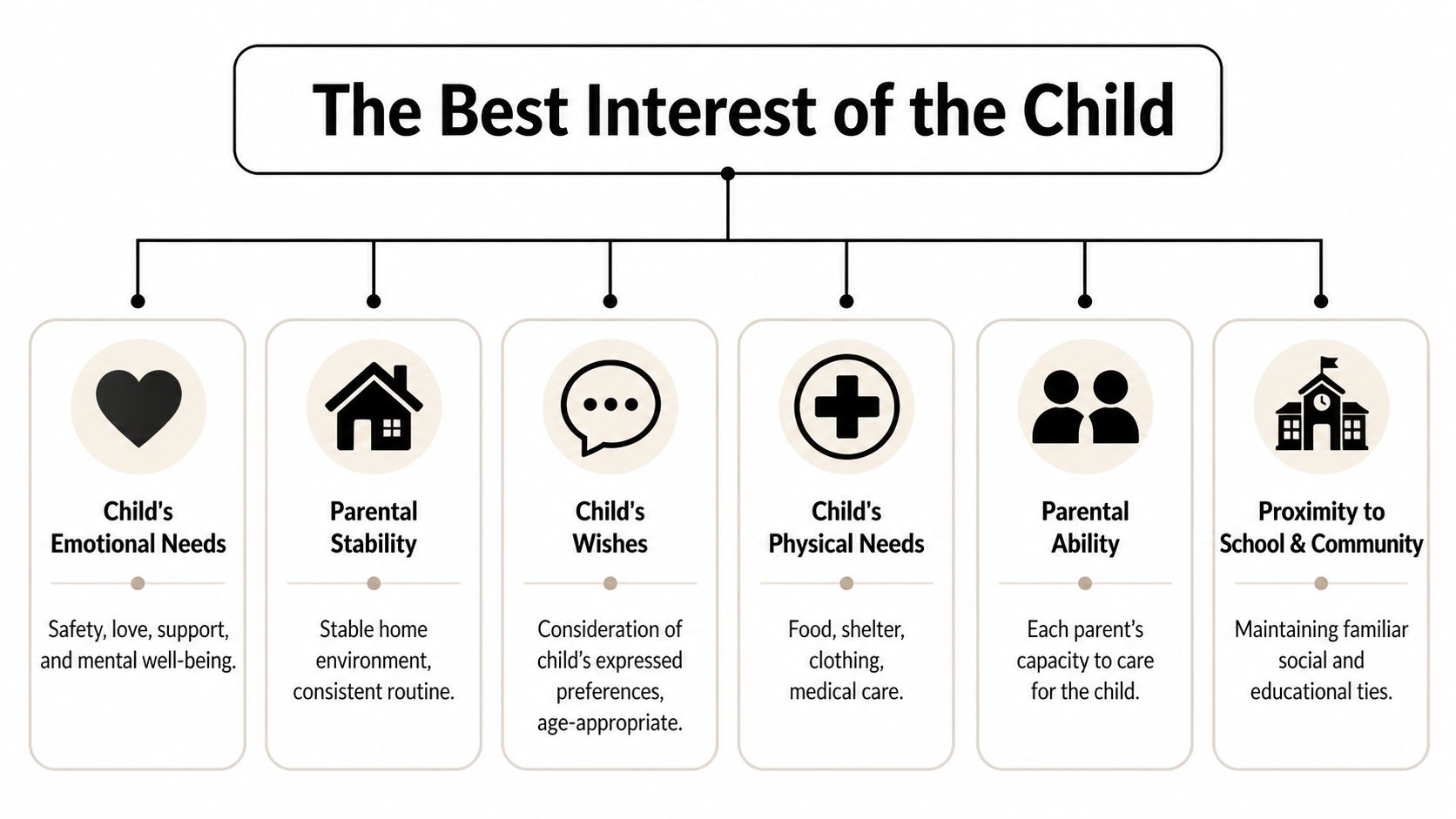
A child’s preference fits inside that bigger picture. It matters, but only as one factor among many.
If you want a deeper look at how courts apply these ideas, this guide on Texas custody and the Holley factors can help connect the legal terms to real parenting decisions.
Joint managing conservatorship in plain English
Texas uses the term conservatorship where many parents would say “custody.” The most common form is joint managing conservatorship, which usually means both parents share major decision-making rights about the child.
That does not always mean equal time. One parent may have the right to decide the child’s primary residence, while the other has a possession schedule, sometimes called visitation.
According to this discussion of Texas custody decisions, Texas courts prefer joint managing conservatorship in over 80% of cases where both parents are fit, and Texas law rejects any presumption that mothers should be favored over fathers. That point matters because many parents still walk into court believing moms automatically have an edge. Under current Texas law, they don't.
No automatic edge for mothers or fathers
This is one of the biggest myths in family law.
Texas no longer follows the old thinking that young children belong primarily with their mothers. The law is gender-neutral. Fathers can become primary conservators. Mothers can lose primary status. The deciding issue is not parent gender. It’s parenting evidence.
Practical rule: If you want the court to trust you with more parenting time, act like the parent who solves problems, keeps routines, and protects the child from conflict.
Possession schedules and daily life
Parents also get confused by the phrase possession and access. In plain English, that means when each parent has time with the child and how contact happens. A possession schedule can cover school weeks, weekends, holidays, summer break, exchanges, transportation, and communication.
A judge often prefers a schedule that a child can live with. Predictability matters. If one home is near school, near activities, and supports consistent routines, that can weigh heavily. If a parent’s work schedule makes day-to-day care difficult, that matters too.
What this means for child preference
When parents focus only on “my child wants to live with me,” they can miss what the judge is measuring. The court listens for the reason beneath the preference.
A child saying, “I want to live with Mom because she gets me to counseling, keeps me in the same school, and helps me stay close to my brother” lands differently than, “I want to live with Dad because he lets me stay up late.”
Both are preferences. Only one points clearly toward long-term stability.
The Age 12 Rule Understanding Your Child's Right to Speak
The part of Texas law most parents have heard about is the age 12 rule. The short version is this: under Texas Family Code § 153.009, a child who is 12 or older has the right to speak privately with the judge about conservatorship, possession, or access, if the interview is properly requested. The judge may consider what the child says, but the judge does not have to follow it, as explained in this overview of teen preferences in Texas custody cases.
That difference is the heart of many custody disputes.
Heard is not the same as choosing
Parents often ask, “Can my child choose where to live at 12?rdquo; The accurate answer is no. A child who is 12 or older can usually express a preference to the judge. That is a right to be heard, not a right to decide.
Consider this analogy: a recipe. Your child’s preference is one ingredient. The judge still has to look at the whole meal before serving it.
That means a mature, thoughtful preference can help. But it doesn't override evidence about safety, stability, school, health, or co-parenting.
What judges listen for
Judges don't just note which parent the child names. They listen for how the child explains it.
A preference may carry more weight when a child gives reasons like:
- School continuity: The child can stay near classes, teachers, or tutoring support.
- Community ties: The child wants to remain close to friends, sports, church, or activities.
- Household routine: One home offers steadier homework habits, transportation, and communication.
- Relationship quality: The child feels heard, supported, and emotionally safe.
A preference may carry less weight when it sounds tied to short-term perks, such as fewer chores, fewer rules, looser curfews, or more gifts.
Children often describe what feels easier. Judges are trained to ask whether “easier” also means “better for this child.”
What about children under 12
Children under 12 generally don't have the same formal right to an in-chambers interview. That doesn't mean younger children have no voice. It means their input is usually handled more carefully and less directly.
In some cases, a younger child’s maturity, consistency, and reasoning may still become part of the evidence. But courts are cautious. Younger children are often more vulnerable to pressure, confusion, and loyalty conflicts.
How a judge weighs age and maturity
The court doesn’t use a simple scorecard, but this table shows the general pattern.
| Age Group | Typical Weight Given | What Judges Look For |
|---|---|---|
| Under 12 | Usually limited formal weight | Signs of unusual maturity, consistency, and whether the child’s views can be understood without putting too much pressure on them |
| 12 and older | More direct consideration through private interview | Maturity, clear reasoning, independence of thought, and whether the preference supports long-term stability |
| Older teens | Often stronger practical influence, depending on facts | Consistency over time, realistic reasons, school and community ties, and whether the child appears coached |
For more detail on when children can speak into these decisions, this article on when a minor child can weigh in on Texas custody decisions gives useful background.
Why parents get tripped up by the age 12 rule
The biggest misunderstanding is believing age 12 creates a legal switch. It doesn't. There is no birthday at which the child becomes the judge.
Another point parents miss is that a child’s reasoning matters as much as the preference itself. A judge is trying to tell the difference between a strongly felt, mature view and a temporary reaction to conflict, discipline, or pressure from a parent.
If your child is older and has strong views, your job isn't to turn them into a witness for your side. Your job is to protect their emotional health while helping your attorney present the broader facts that support the child’s best interests.
How a Judge Gathers Your Child's Preference
Parents often picture a child testifying in open court, with lawyers asking harsh questions. That usually isn't how this works.
In many Texas cases, the judge uses a private in-chambers interview. That setting is meant to lower pressure and reduce the chance that a child feels like they must perform for either parent.

According to this explanation of child custody preference interviews, Texas Family Code § 153.009 gives children age 12 or older the statutory right to a private interview, and the current approach replaced an older written preference form that had been repealed after concerns about parental coercion and conflicting child statements. That history matters. Texas courts moved away from a process that could be too easy for adults to influence.
What happens in chambers
The interview usually takes place in the judge’s office or another private room. Parents typically aren't sitting there with the child. That separation can help the judge observe whether the child seems relaxed, guarded, rehearsed, or conflicted.
The judge may ask questions like:
- How are things going at school?
- What is each home like day to day?
- Who helps you with homework or appointments?
- How do you get along with each parent?
- Why do you want the schedule to change, if at all?
These questions often sound ordinary on purpose. A judge isn't only collecting answers. The judge is also watching how the child answers.
The judge’s mindset during the interview
A judge is often listening for several things at once:
- Maturity: Does the child understand the difference between preference and consequence?
- Reasoning: Can the child explain the wish in a way that makes sense for their age?
- Consistency: Does the story feel stable, or does it shift quickly?
- Independence: Do the words sound like the child’s own, or like an adult script?
A coached child may repeat legal-sounding phrases that don't match their age or everyday experience. A child speaking naturally may hesitate, show mixed feelings, or care profoundly about both parents at the same time. That emotional complexity can make the child seem more credible, not less.
Children who tell the truth often sound uncertain about hurting someone’s feelings. That doesn’t weaken their voice. It can show authenticity.
Other ways the court may hear the child
Not every case relies only on a judge interview. In higher-conflict or more complex matters, the court may use other professionals.
One option is an Amicus Attorney or Guardian Ad Litem. These roles are different, but both can help the court gather information about the child’s needs and perspective. If you’re trying to understand how one of these appointments works, this guide on guardian ad litem roles in a Texas custody case can help.
Another option is a custody evaluation by a mental health professional. That process may involve interviews, observations, records review, and recommendations tied to the child’s well-being. Evaluations often come up when there are concerns about coaching, alienation, mental health, relocation, or safety.
This video offers a helpful overview of child custody issues that often intersect with these questions:
Why this process is private
Parents sometimes feel uneasy that they won't hear every word their child says. That reaction is understandable. But the privacy has a purpose. It reduces pressure and makes it harder for either parent to shape the child’s answers ahead of time.
For many judges, the private setting is one of the best tools available for spotting the difference between a child’s true wishes and a child carrying an adult’s message.
When a Child's Preference Might Be Overruled
A child can strongly prefer one parent and still not get that outcome. That isn't because the court is ignoring the child. It's because the court must protect the child, even when the child wants something else.
Safety beats preference
If the preferred parent has serious problems with substance abuse, violence, neglect, or instability, a judge may give little or no weight to the child’s request. A child may love that parent very much and still not be safe in that home.
The court also looks at emotional safety. If a child’s preferred home is chaotic, unsupervised, or hostile, the judge may decide that another arrangement better serves the child, even if it disappoints the child in the short term.
Coaching and alienation are red flags
Judges pay close attention to signs that a parent has influenced the child.
That can show up when a child uses adult legal language, repeats accusations without specific examples, or seems terrified to say anything positive about the other parent. It can also appear when one parent constantly involves the child in adult disputes, court updates, financial complaints, or blame.
When a judge suspects coaching, the preference may lose force quickly.
Immature reasons often carry less weight
Some preferences make sense emotionally, but not developmentally. A child may want to live where there are fewer rules, more spending money, less homework oversight, or a later bedtime.
A judge is unlikely to treat that as a strong basis for changing custody.
Consider the difference:
- Less persuasive: “Dad lets me skip chores and stay up as late as I want.”
- More persuasive: “Mom’s house is near my school, and I’ve been missing tutoring because of long weekday drives.”
The court isn't rewarding strictness or punishing fun. It’s looking for the home that supports healthy growth.
Fluctuating wishes can weaken the request
Children under stress may change their minds. That’s normal. Divorce, remarriage, conflict, and adolescence can all affect what a child says from week to week.
If a child’s preference changes often, a judge may treat it cautiously. Courts tend to trust preferences more when they appear stable and connected to real life needs, not just the emotion of the moment.
Child Preference in Different Family Situations
The law becomes easier to understand when you place it in real family situations. Child preference in custody texas cases doesn't look the same in every home.
A father seeking primary custody
A teenage son tells the court he wants to live with his father because Dad lives near the high school, gets him to early athletic practice, and keeps him on track academically. This preference may matter because it connects to school, routine, and long-term goals.
The father still has to show more than a willing teenager. He needs evidence of stability, involvement, and a workable plan.
A mother worried about lax rules
A daughter says she wants to live with her other parent because there’s less supervision, fewer chores, and more freedom. That can be painful for the mother who has handled school forms, doctor visits, and structure for years.
In that situation, the judge may view the preference as understandable but not very persuasive. The key question stays the same: which home best supports the child’s development?
Grandparents trying to stay involved
A child may tell adults she wants to spend more time with grandparents because they’ve been a constant source of comfort. That preference can matter to the family story, especially when grandparents have played a major caregiving role.
Still, the court will tie that preference to legal rights, existing orders, and the child’s broader welfare. Wanting more contact does not automatically create a new court order, but it can support a larger argument about the child’s needs and relationships.
Military and relocation cases
A military parent may face deployment or reassignment. A child may want to remain in the same school district with the nonmoving parent, or may want to relocate with the service member because of a strong bond and past caregiving history.
Neither answer wins on preference alone. The court will look at continuity, transportation, support systems, communication plans, and whether the proposed arrangement is workable for the child.
Post-divorce modification requests
Sometimes the issue comes up years after divorce. A child gets older, routines change, and one parent asks the court to modify an existing order.
A child’s preference can be a basis for seeking modification if there has been a material and substantial change in circumstances, but this discussion of preference-based modification notes there is no specific data on what percentage of these requests are granted. In practice, that means success usually depends on corroborating evidence about maturity and the stability of the proposed new arrangement, not the preference by itself.
That point matters for both mothers and fathers. If you're considering a modification, don't build the case around one sentence from your child. Build it around the child’s life.
A Parent's Guide What to Do and What to Avoid
Your child comes home quiet after hearing that a judge may want to speak with them. At bedtime, they ask, “What am I supposed to say?rdquo; That moment can feel like a test for both of you. It is not a test of whether your child can deliver the “right” answer. It is a test of whether the adults can protect the child from carrying adult pressure.

A good way to approach this is to treat the interview like a doctor’s appointment. Your job is to get your child there calm, rested, and feeling safe. Your job is not to script the symptoms. Judges often notice the difference between a child who is speaking from lived experience and a child who sounds like they are repeating an adult argument.
What to do
- Listen without steering: If your child shares a preference, stay neutral in your tone and facial expression. A child should not feel praised for choosing one parent or guilty for loving the other.
- Use simple, safe language: You can say, “Tell the truth,” “It is okay to love both parents,” and “The judge's job is to make adult decisions.” Those short messages reduce pressure.
- Keep daily life steady: School, meals, homework, counseling, medication, and bedtime routines matter because they show what your child’s life looks like.
- Encourage honesty, not loyalty tests: A child may have mixed feelings. That is normal. Let them know they do not have to pick a parent to be heard.
- Write down facts, not speeches: Keep records of appointments, school involvement, exchanges, and caregiving tasks. Concrete details are more useful than broad claims about who is the “better” parent.
- Get legal guidance early: A parent may work with a private attorney, an amicus attorney if one is appointed, or a family law firm such as Law Office of Bryan Fagan, PLLC, which handles Texas custody, visitation, modification, and parental rights matters.
What to avoid
- Do not coach answers: Avoid practice questions like, “Tell the judge you want to live here because your mom is never home.” Coaching can make a child sound rehearsed, and it can damage your credibility.
- Do not interrogate after visits: Questions stacked one after another can feel like pressure. If your child wants to talk, listen. If not, let them settle in.
- Do not turn adult facts into a child’s burden: Financial stress, litigation strategy, and past relationship conflict belong with lawyers and adults, not with children.
- Do not badmouth the other parent: Children often hear criticism of a parent as criticism of part of themselves.
- Do not promise a result: No child should believe their words will decide where everyone lives next month.
- Do not use your child as a messenger: If a schedule, pickup time, or disagreement needs to be addressed, communicate directly with the other parent or through counsel.
One more point often gets missed. Preparation is appropriate. Coaching is not. Preparation sounds like, “If the judge asks a question, answer truthfully, and if you do not understand, say so.” Coaching sounds like, “Here are the reasons you need to give.” That line matters.
Key takeaway: The most persuasive parent is usually the one who gives the child room to be honest, keeps the child out of the conflict, and lets the court hear a real child instead of an adult script.
Next Steps Protecting Your Child’s Future
A week before a custody hearing, many parents ask the same hard question: “What do I do now that my child may speak to the judge?rdquo; At that point, the legal rules matter, but so does your posture. The judge is watching for something quieter than a scripted answer. The judge is looking for the parent who can protect the child’s peace while still presenting clear, credible facts.
Your next step is to build a record that matches the life you want the court to preserve. Keep a calm, organized timeline of school issues, medical needs, counseling, attendance, exchanges, and any changes in behavior you have personally observed. Save messages that show cooperation or ongoing problems, but do not flood the court with every unpleasant text. A strong case usually looks less like a stack of accusations and more like a well-labeled file that helps the judge see the child’s daily reality.
It also helps to prepare for the question behind the question. If your child expresses a preference, the court may ask why that preference developed now, what has changed, and whether the child sounds like a child or like an adult repeating litigation themes. Your job is not to shape the answer. Your job is to make sure your own conduct gives the court no reason to suspect pressure.
That is often the final piece parents miss. Credibility is built at home before it is tested in court.
If you need help with a child custody or visitation case in Texas, the attorneys at Law Office of Bryan Fagan, PLLC can help you understand your options, present your child’s circumstances appropriately to the court, and work toward a custody arrangement that protects your child’s best interests. Contact The Law Office of Bryan Fagan, PLLC today for a free consultation.