
When your child’s future is on the line, understanding your rights matters most.
A lot of parents sit down with a final order in their hands, find the words “possessory conservator,” and feel their stomach drop. It sounds like a lesser role. It sounds like the court reduced you to a visitor in your child’s life. If that’s where you are right now, your reaction makes sense.
But in Texas, that label often means more than parents realize.
A possessory conservator usually has important rights to time with the child, access to records, communication with schools and doctors, and authority during periods of possession. The problem is not always the law itself. The problem is that the wording in custody orders can feel cold, technical, and confusing when you’re trying to understand what it means for your real life.
This guide is for Texas parents who want to protect their relationship with their child and need clear answers about possessory conservator rights texas. You may be a father trying to establish your role after a breakup. You may be a mother trying to understand what rights the other parent has, or what your own rights are if the order changed. You may even be a grandparent or caregiver trying to make sense of a court order that affects your family.
The good news is that knowledge changes how you move through a custody case. When you know what your order says, what Texas law allows, and how to document problems, you’re in a stronger position to stay involved and take action when needed.
Your Child's Future Is at Stake Understanding Your Role Matters
The first time many parents see the term possessory conservator, they assume it means they’ve lost most of their parental rights. That assumption causes a lot of unnecessary fear.
Take a common example. A parent finishes a divorce or custody case. The other parent gets the right to decide the child’s primary residence. The order says one parent is the sole managing conservator, and the other is the possessory conservator. The possessory parent reads that phrase and thinks, “So I just get visits now?”
That’s usually not the full story.
In real life, a possessory conservator may still go to school events, talk to teachers, access records, and care for the child during their parenting time. The role may involve limits on major decision-making, but it does not automatically erase the parent-child relationship. Texas law is built around the idea that children usually benefit from continuing contact with both parents.
Many parents feel powerless because of the label. The order itself often gives them more rights than they think.
That emotional gap matters. Parents who misunderstand their role sometimes stop asking for records, stop showing up to school functions, or stop enforcing missed visitation. Over time, that can weaken the bond with the child and make later custody disputes harder.
Why this gets confusing so fast
Texas family law uses words that don’t always match everyday speech. People say “custody,” “visitation,” and “joint custody.” Texas law often uses conservatorship, possession, and access instead.
Here’s the plain-English version:
- Conservatorship means legal rights and duties regarding the child.
- Possession means when the child is physically with a parent.
- Access means contact and visitation rights.
Once you translate those terms into everyday life, the picture becomes clearer.
What matters most right now
If you’ve been named a possessory conservator, focus on three things first:
- Read your order carefully: The exact wording controls your rights and limits.
- Stay involved: Use the rights you have. Don’t assume silence is safer.
- Document issues early: If the other parent blocks access, records, or exchanges, keep a written record.
Parents who understand their orders usually make better decisions for their children and themselves. That doesn’t mean the situation stops being painful. It means you stop guessing, and that’s often the first step toward stability.
Understanding Texas Custody The Three Conservator Roles
A parent can leave court with real rights on paper and still feel unsure about where they stand. That uncertainty often starts with the labels. Texas custody orders use titles that sound formal, but each one affects ordinary decisions such as who can make major choices, who has parenting time, and what a parent should do if the other parent starts shutting them out.
Texas courts decide conservatorship based on the best interest of the child. In everyday terms, the judge is trying to build the safest and most stable arrangement for the child’s life. The goal is not to reward one parent or punish the other.
Texas often prefers shared involvement by both parents when that arrangement is safe and workable. In many cases, parents are named joint managing conservators. A parent is more likely to be named a possessory conservator when the order gives the other parent greater decision-making authority, sometimes because shared decision-making would not protect the child well.

If you want a broader overview of how these custody roles fit together, this guide to conservatorship in Texas can help.
A simple way to understand the three roles
Conservatorship works like a decision-making structure for a child’s life. The title tells you who has authority in key areas, but the court order gives the specific details.
| Role | What it usually means |
|---|---|
| Joint Managing Conservator | Both parents share many major rights and duties |
| Sole Managing Conservator | One parent has most major decision-making authority |
| Possessory Conservator | The other parent has possession, access, and important parental rights, but more limited control over big decisions |
That chart gives the outline. Your order fills in the details.
A good analogy is a school permission form. Two parents may both stay involved, attend events, and receive updates, but the order may name one parent as the person with final authority to sign off on certain major decisions. That does not erase the other parent’s role. It defines how that role works.
Joint Managing Conservator
When parents are named joint managing conservators, both usually keep a meaningful legal role in raising the child. This often includes shared rights tied to education, medical care, and access to information.
Many parents get stuck on the word “joint.” They assume it means equal time with the child. It does not. A court can name both parents joint managing conservators and still give one parent the exclusive right to decide the child’s primary residence.
That distinction matters in real life. If your title says “joint,” do not stop at the title. Read which rights are shared, which rights are independent, and which rights belong only to one parent.
Sole Managing Conservator
A sole managing conservator usually has greater authority over major long-term decisions. That can include decisions about the child’s primary residence and other major parenting issues listed in the order.
Courts often use this structure when shared decision-making would create too much risk or conflict. Cases involving abuse, family violence, serious substance misuse, or ongoing instability may lead to one parent receiving this role. Even then, the other parent may still keep important legal rights unless the court limits them.
Possessory Conservator
A possessory conservator usually has less control over major decisions, but that does not mean a minor role in the child’s life. This parent often has scheduled possession, access, and a set of continuing parental rights that exist both during and outside parenting time.
For many parents, this is the point where confusion turns into costly silence. They assume the title means they should wait to be included. That is often the wrong approach.
A better approach is to treat the order like an instruction manual. Read it closely. Mark the sections that deal with possession, school access, medical information, communication, and decision-making. If a right is listed, start using it consistently. If the language is unclear, ask a Texas family law attorney to explain exactly how it works in day-to-day life.
Practical rule: A possessory conservator should know the order well enough to use their rights, document problems, and respond quickly if those rights are ignored.
Where parents often get confused, and how to avoid that problem
These misunderstandings come up often:
- “If I’m not the managing conservator, I can’t stay involved at school.” Many orders still let a possessory conservator access records and participate in school-related matters.
- “If the other parent has primary custody, they make every decision.” The order may split rights more narrowly than parents expect.
- “If we are both joint managing conservators, our parenting time must be equal.” Conservatorship and possession are related, but they are not the same thing.
The most helpful habit is simple. Do not rely on the label alone.
Read the exact wording of your order, keep a copy where you can reach it quickly, and act on the rights it gives you. Parents who do that are in a stronger position to stay involved, correct misunderstandings early, and protect the parent-child relationship if conflict grows later.
What Rights Does a Possessory Conservator Actually Have
The phrase possessory conservator sounds restrictive. Texas law often gives this parent more authority than people expect.
Under Texas Family Code § 153.192(a), a possessory conservator keeps the parental rights found in Subchapter B unless the court specifically limits them. That includes the right to access records, consult with professionals involved in the child’s care, attend school activities, and be listed as an emergency contact, as described in Texas Family Code § 153.073.

A possessory conservator keeps parental rights unless the court takes them away or limits them in the order.
That one idea clears up a lot of confusion. Your decree may limit some powers, but the starting point is not zero. The starting point is retained rights.
Information rights that matter in daily life
Many parents worry that the other parent can shut them out of school and medical updates. Often, that is not true.
A possessory conservator may have the right to:
- Get health information: This can include medical, dental, and psychological records.
- Get school information: Report cards, attendance records, discipline records, and other school information may be available.
- Talk directly with professionals: Teachers, counselors, doctors, and other providers may speak with you.
- Attend activities: School events and extracurricular activities are often open to you as a parent.
- Stay on emergency lists: The order may support your right to be listed as an emergency contact.
These are not small rights. They affect whether you stay informed about tutoring, counseling, medication changes, school struggles, and sports schedules.
Rights during your periods of possession
Your authority grows during the time the child is with you. Texas law recognizes that a parent caring for a child needs practical decision-making power.
During possession, a possessory conservator may handle day-to-day care and may have authority tied to routine supervision and protection of the child. In emergencies, the parent may also be able to consent to medical, dental, or surgical treatment.
That means ordinary parenting still belongs to you when the child is in your home. You make dinner. You supervise homework. You enforce bedtime. You decide whether the child wears the coat you bought, goes to church with you, or attends your family gathering if it falls during your parenting time and the order allows it.
Moral and religious training
This area also confuses parents. During your possession, you may direct the child’s moral and religious training, unless the order says otherwise.
That doesn’t mean you can rewrite the child’s life in a way that creates constant conflict. It means Texas law recognizes that parenting includes values, traditions, and family culture.
For example, if your child is with you on your weekend, you may take them to your place of worship, celebrate your family traditions, or teach household expectations that fit your home. The key is that you still parent. You do not become a passive observer.
A short video can make these rights easier to picture in real life:
What can still be limited
The details demand careful scrutiny. A judge can limit rights in the order.
For example, the court may:
- Restrict contact with certain providers
- Require supervised possession
- Limit decision-making because of safety concerns
- Set special exchange terms
- Reserve major decisions to the sole managing conservator
If there has been family violence, substance abuse, or another serious concern, those limits may be extensive. That doesn’t make the rest of your role meaningless. It means your rights come from both the statute and the exact court order.
A simple way to check your real authority
When clients feel overwhelmed, it helps to separate rights into two buckets.
| Type of right | What to look for in your order |
|---|---|
| Ongoing rights | Access to records, communication with teachers or doctors, emergency contact status |
| Possession-based rights | Day-to-day care, routine control, emergency medical decisions while the child is with you |
If you want to understand your possessory conservator rights texas in practical terms, ask yourself a few direct questions:
- Can I contact the school myself?
- Can I request records on my own?
- What decisions can I make when my child is with me?
- Does my order say any of these rights are restricted?
Those answers matter more than the label alone. A parent who knows these rights can stay involved, respond faster when problems arise, and protect the bond with the child in a much more effective way.
Your Possession Schedule The Texas Standard Possession Order Explained
You open your calendar to plan a birthday dinner, a school event, or a summer trip, and one question controls everything. When do I have my child?
That question sits at the center of daily life for many possessory conservators. Your order may call you a possessory conservator, but the schedule is what turns that title into real parenting time. In many Texas cases, the court uses the Standard Possession Order, or SPO, as the starting schedule for children age three and older.
For children age three and older, Texas law generally treats the Standard Possession Order as a schedule that serves the child’s best interest. The details appear in Texas Family Code § 153.192. In practical terms, that usually means a repeating pattern of weekends, holiday periods, and extended summer time.
If you want a more visual breakdown, this guide to Texas visitation and standard possession orders can help you read the schedule the way a court expects it to be read.
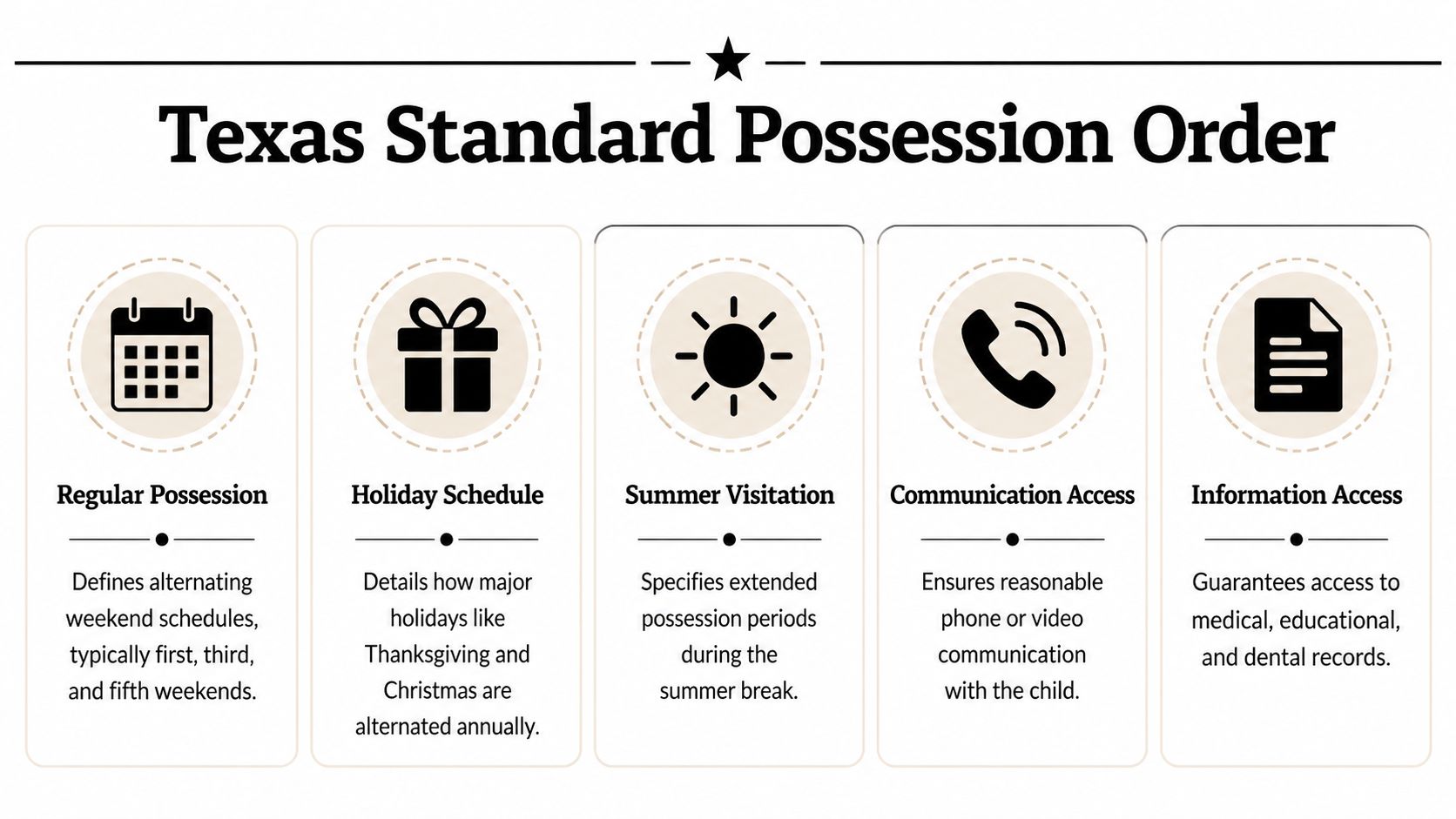
What a typical month can look like
A standard schedule often feels confusing until you place it on a real calendar.
Suppose one parent is the possessory conservator and the other parent has the right to determine the child’s primary residence. During the school year, the possessory conservator often has the first, third, and fifth weekends of the month. Some orders also include a Thursday period during the school term.
A five-Friday month may look like this:
- First weekend: possession
- Second weekend: no regular weekend possession
- Third weekend: possession
- Fourth weekend: no regular weekend possession
- Fifth weekend: possession, if the month has one
That pattern is easier to follow once you stop treating it like legal language and start treating it like a standing family routine.
Holiday time usually overrides the regular pattern
Many parents often get tripped up on this particular issue. The regular weekend schedule does not always control.
Holiday periods usually override the normal first, third, and fifth weekend pattern. So if your usual weekend falls inside the other parent’s Thanksgiving, Christmas, or spring break period for that year, the holiday schedule usually takes priority. The same is true for many school breaks.
A simple chart helps:
| Time period | General rule |
|---|---|
| Regular weekends | Follow the first, third, and fifth weekend pattern |
| Holidays | Holiday schedule usually overrides regular weekends |
| Summer | Extended summer possession follows separate rules in the order |
Do not rely on memory, especially for odd-year and even-year holiday switches. Put every holiday allocation into a digital calendar as soon as your order is signed.
Summer possession can protect your relationship
Summer is often the longest uninterrupted time a possessory conservator gets with a child. That matters more than parents sometimes realize.
Short visits are good for keeping contact steady. Longer summer time helps you build a fuller rhythm. You get mornings, errands, meals, bedtime, and the ordinary moments that strengthen a parent-child bond. Children often settle in better during a longer block too, because they have time to adjust instead of starting over every few days.
If your order requires notice to select summer dates, set a reminder well in advance. Missing a notice deadline can cost you the dates you wanted.
The 50-mile rule can change the details
Distance between households affects how possession works in real life. If you live close to the child’s primary residence, your order may include an expanded schedule with pickup and drop-off times that fit school and weekend routines better.
The key point is simple. Do not assume every Standard Possession Order is identical. Two parents may both have an SPO, but one may have expanded periods and the other may not. The exact language in your signed order controls.
That is why I tell parents to read the schedule like a map, not a label. The label says "SPO." The map shows your actual route.
The best way to protect your possession time is to plan like it matters
Parents often lose time, not because the order is unclear, but because no one set up a reliable system to track it. A good calendar is not just organizational help. It is protection.
Use tools that create a clear record:
- Google Calendar: useful for shared dates, reminders, and holiday entries
- OurFamilyWizard: helpful when you need documented communication and scheduling
- TalkingParents: useful if conflict is high and you want a message record
- A printed custody calendar: a good backup if you want something visible at home
Try these practical habits:
- Enter the full year of possession dates at one time
- Color-code regular weekends, holidays, and summer periods
- Add notice deadlines for summer elections and holiday choices
- Save screenshots of the calendar you are following
- Confirm disputed dates in writing, not by phone alone
These steps do more than keep you organized. They help you exercise your rights consistently, reduce avoidable conflict, and create a record if the other parent later claims you misunderstood the schedule.
What To Do When Your Possession and Access Are Denied
Denied visitation feels personal because it is personal. You showed up. You followed the order. Your child expected to see you. Then the door stayed closed, the messages stopped, or the other parent suddenly claimed there was a “change of plans.”
When that happens, your response matters.
The first goal is to protect your legal position. The second is to avoid making a painful moment worse by reacting in a way the court could later use against you.

Step one is to document calmly
If the other parent denies possession, stay calm and create a record.
Write down:
- The exact date and time
- Where the exchange was supposed to happen
- Who was present
- What the other parent said
- What messages, emails, or app communications exist
If you use OurFamilyWizard, TalkingParents, text messages, or email, keep everything. Take screenshots if needed. Save voicemails. If the order requires you to appear at a certain place, show up on time and be prepared to prove that you did.
Step two is to avoid self-help mistakes
Parents sometimes make things worse by trying to “even the score.” They keep the child extra time on a later visit, withhold support, or start arguing in front of the child.
Those choices usually hurt your case.
If the other parent breaks the order, don’t answer by breaking it yourself. Courts tend to respond better to the parent who stayed steady, documented facts, and asked for proper enforcement.
Step three is to send a clear written message
A short, respectful message can help. Keep it factual.
You might say that you were present for your court-ordered possession, that the child was not produced, and that you expect future compliance with the order. Don’t add threats, insults, or long emotional paragraphs. If a judge reads it later, you want it to sound measured.
Step four is to talk with a lawyer about enforcement
If denial becomes a pattern, the next step may be a Motion for Enforcement. That asks the court to enforce the existing order.
A judge may look at whether the order was clear, whether you followed it, and whether the other parent failed to comply. Strong documentation matters here. So does precision. Judges often want exact dates, exact missed periods, and exact language from the order.
For a closer look at that process, this guide on a motion to enforce custody in Texas explains the basics.
What enforcement can lead to
Every case is different, but courts can order remedies when a parent violates a possession order. Those may include make-up time or other enforcement measures allowed by law.
A good enforcement case is usually built before you ever walk into court. The winning pattern often looks simple:
- You knew the order.
- You followed the order.
- You documented the denial.
- You stayed calm.
- You asked the court for help.
That approach protects both your credibility and your relationship with your child.
How to Modify Your Custody Order in Texas
Sometimes the problem isn’t just one missed weekend. Sometimes the order no longer fits the child’s life.
Texas courts can modify custody and possession orders, but not just because one parent is unhappy. Usually, the parent asking for change must show a material and substantial change in circumstances and also show that the requested change is in the child’s best interest.
What a material and substantial change can look like
This standard sounds abstract until you put it into real life.
A child may have new medical or school needs. A parent’s work schedule may have changed so much that the current exchanges no longer work. One home may no longer be stable. In some cases, the parent with primary authority moves far enough away that the original possession plan stops making practical sense.
One especially important example is relocation. A possessory conservator’s ability to modify an order is often tied to proving a material and substantial change, and a common trigger is when the managing conservator relocates more than 100 miles, which can interfere with the existing schedule. The same source notes a 55% success rate for father-initiated modification petitions after reforms emphasizing paternity establishment, along with a 28% rise in interstate custody filings, according to Texas Family Code § 153.314 materials.
Why the facts behind the change matter
Judges don’t modify orders based on frustration alone. They look for evidence.
Helpful evidence can include calendars, school records, medical records, travel burdens, written communication between parents, and proof that the current arrangement no longer serves the child well. If substance abuse has become part of the picture, a court may also consider treatment compliance and safety concerns. Families dealing with that issue sometimes benefit from reviewing practical background on court-mandated rehab and treatment issues because those concerns often intersect with custody modifications.
A useful way to think about modification requests
| Situation | Why it may matter |
|---|---|
| Relocation | The original possession schedule may become unworkable |
| Safety concern | The child’s physical or emotional well-being may be at risk |
| Major life change | Work, school, or caregiving needs may have shifted significantly |
A modification case is strongest when the requested change connects directly to the child’s daily life. Courts want to know what has changed, why it matters now, and how your proposed order would better serve the child going forward.
Answers to Your Pressing Questions
I’m a father and I wasn’t married to the child’s mother. Do I still have rights
Yes, but you usually need legal recognition of paternity before the court can enter enforceable custody and possession orders. Until then, many fathers feel stuck because they are acting like a parent without the protection of a signed order.
The practical step is to establish paternity and then ask the court for conservatorship, possession, and support orders that define everyone’s rights clearly. Once you have an order, you’re in a much stronger position to protect your relationship with your child.
I’m a mother and the other parent keeps missing visits. What should I do
Start with documentation, not arguments. Keep a record of every missed pickup, late arrival, canceled visit, and message.
If the missed visits become a pattern, the court may want to know whether the schedule still serves the child well or whether a modification is needed. If the child is being disappointed over and over, keep the child out of the conflict and keep your notes factual. Don’t coach the child, and don’t block future visits unless your lawyer tells you there is a legal basis to do so.
Children do best when parents keep adult conflict out of the child’s emotional space, even when the other parent is being inconsistent.
I’m a grandparent. Can I become a possessory conservator or get visitation
Possibly, but grandparent rights in Texas are limited and very fact-specific. Courts place strong weight on a fit parent’s rights to make decisions about the child.
That means a grandparent usually needs unusual circumstances and strong legal grounds before the court will step in over a parent’s objection. If a child has been living with you, if both parents are unavailable, or if there are serious safety concerns, your situation may look very different from a typical grandparent visitation request.
What if the order says one thing, but we’ve been doing something else informally
Informal arrangements may work for a while, but they can create problems later. If conflict starts, the court usually looks first at the signed order.
That means the safest path is to get agreed changes put into a formal court order if the new schedule is going to last. Verbal deals and text-message side agreements often fall apart at the exact moment they matter most.
Can a possessory conservator still be an active parent
Absolutely. A possessory conservator can still be the parent who shows up to school events, keeps up with grades, attends doctor visits, and builds routines that make the child feel secure.
The role may have limits, but it does not erase your importance. In many families, the difference between a distant parent and an active parent is not the title in the decree. It’s whether the parent consistently uses the rights they still have.
Your Next Steps to Protect Your Parental Rights
If you remember nothing else, remember this. A court order is not just a label. It is a set of rights, duties, and opportunities to stay connected to your child.
Key takeaways
- Know your exact order: The title matters less than the wording.
- Use your rights consistently: Records, school contact, and involvement don’t enforce themselves.
- Document problems early: Good records help with both enforcement and modification.
- Stay child-focused: Courts respond well to parents who act steadily and put the child first.
Parents in military families often face extra pressure when deployment, relocation, or long-distance parenting enters the picture. If that sounds familiar, a real-world military family custody battle guide can offer added perspective on how fast these disputes can become high stakes.
The strongest position usually comes from a simple combination. Learn the order. Follow it carefully. Keep records. Act early when something is wrong. That approach won’t erase the stress of a custody dispute, but it gives you a clearer path forward and helps protect your relationship with your child.
If you need help with a child custody or visitation case in Texas, our experienced attorneys can guide you every step of the way. Contact The Law Office of Bryan Fagan, PLLC today for a free consultation.