
When your child’s future is on the line, understanding your rights as a father matters most. In Texas, the law doesn't use the term "visitation rights." Instead, it establishes a court-mandated schedule called a "possession order" that details exactly when you have your child. The entire system is built on the core belief that having both parents actively involved is what’s best for a child, and your rights as a father are just as important as the mother's.
How Texas Determines Custody and Visitation

As a father in Texas, the first step toward peace of mind is knowing that the family court system is designed to be gender-neutral. The law does not automatically favor mothers. Its entire focus is on creating a stable, loving environment for the child. This means you have the right to ask the court for significant time with your children and to be involved in the major decisions affecting their lives. Your relationship with your child is invaluable, and Texas law provides the tools to protect it.
Key Legal Concepts Every Parent Should Know
Navigating a custody case can feel overwhelming, but a few core concepts from the Texas Family Code provide the foundation for every decision. Understanding these terms will empower you to advocate for yourself and your child.
- Best Interest of the Child: This is the single most important standard in Texas family law. A judge will look at many factors—like each parent's ability to provide a stable home, the child's emotional and physical needs, and the history of the parent-child relationship—to decide what arrangement truly serves the child’s well-being.
- Joint Managing Conservatorship: Texas courts start with the presumption that naming both parents "joint managing conservators" is in the child's best interest. This is a plain-English way of saying both parents share the rights and responsibilities of making key decisions about their child's education, healthcare, and religious upbringing. It doesn't always mean a 50/50 split of time, but it ensures both parents remain central figures in their child's life.
- Possession Order: This is the legal term for the visitation schedule. It's a detailed, court-enforceable calendar that specifies when the child will be with each parent, covering weekends, holidays, and summer vacations.
A common misconception is that fathers have fewer rights than mothers in custody cases. The reality is that Texas law, under Chapter 153 of the Family Code, explicitly prohibits discrimination based on gender. Your case will be decided on the facts and what is best for your child.
A clear possession order brings predictability and stability, which are crucial for a child's development. It protects your rights as a father by making your time legally guaranteed, which helps prevent disagreements from turning into major disputes. This framework isn't about "winning" or "losing"—it's about building a secure and predictable future for your family.
How a Judge Decides Your Possession Schedule
Stepping into a Texas courtroom can feel intimidating. However, when you understand what a judge is looking for, the process becomes much clearer. Every decision a judge makes is guided by one principle: the best interest of the child. This is a legal standard defined by a set of guidelines known as the “Holley Factors.” These factors give judges a roadmap for creating a possession schedule that supports your child’s emotional and physical well-being.
The Holley Factors Explained
Instead of a simple checklist, a judge weighs several connected elements to decide on custody and visitation. For fathers, proving your stability and dedication through these factors is key to securing meaningful time with your child.
Some of the most critical Holley Factors include:
- The child's needs: This covers everything from their emotional and physical needs now to what they will need in the future.
- Parental abilities: The court assesses each parent's capacity to provide a safe, stable, and loving home.
- Stability of the home: A consistent, predictable environment is vital for a child's sense of security.
- Acts or omissions: The judge will consider any past behavior—positive or negative—that indicates a parent’s fitness. This includes any history of neglect or abuse.
A judge needs to see evidence of your commitment. Consistently attending parent-teacher conferences, taking your child to doctor’s appointments, and coaching their sports team are powerful actions that demonstrate your active involvement in your child's life.
Presenting Your Best Case
Your history as an involved parent is critical. Do you help with homework? Do you know your child’s friends and their parents? Have you been the one to comfort them after a scraped knee or a tough day? These moments paint a picture for the court of your essential role in your child's life.
The national conversation around parenting is shifting. With nearly 22 million children in the United States having a parent living outside their home, legal frameworks are more important than ever. You can find out more about the trends in child custody statistics as advocacy groups and legal reforms increasingly promote shared parenting, recognizing the immense value an involved father brings to a child’s life.
Ultimately, the court wants to create a possession order that allows you to continue being a dedicated, hands-on father. Your job is to provide the proof that shows you are essential to your child's happiness and stability.
Understanding the Standard Possession Order in Texas
When a Texas court needs to create a parenting schedule, it often starts with a template called the Standard Possession Order (SPO). Think of it as the default setting for visitation, built on the belief that children thrive with regular, predictable time with both parents. For fathers, the SPO is a foundational tool that legally outlines your minimum guaranteed time with your child, giving you a clear, enforceable schedule that protects your relationship.
What the Standard Schedule Looks Like
The SPO schedule depends on how far apart the parents live. The law recognizes that a schedule for parents living across town won't work for parents living hours away. The rules are different depending on whether you live under or over 100 miles from your child's other parent.
This infographic gives a visual breakdown of a typical possession schedule, making it easier to see how weekends, holidays, and summer vacation are laid out.
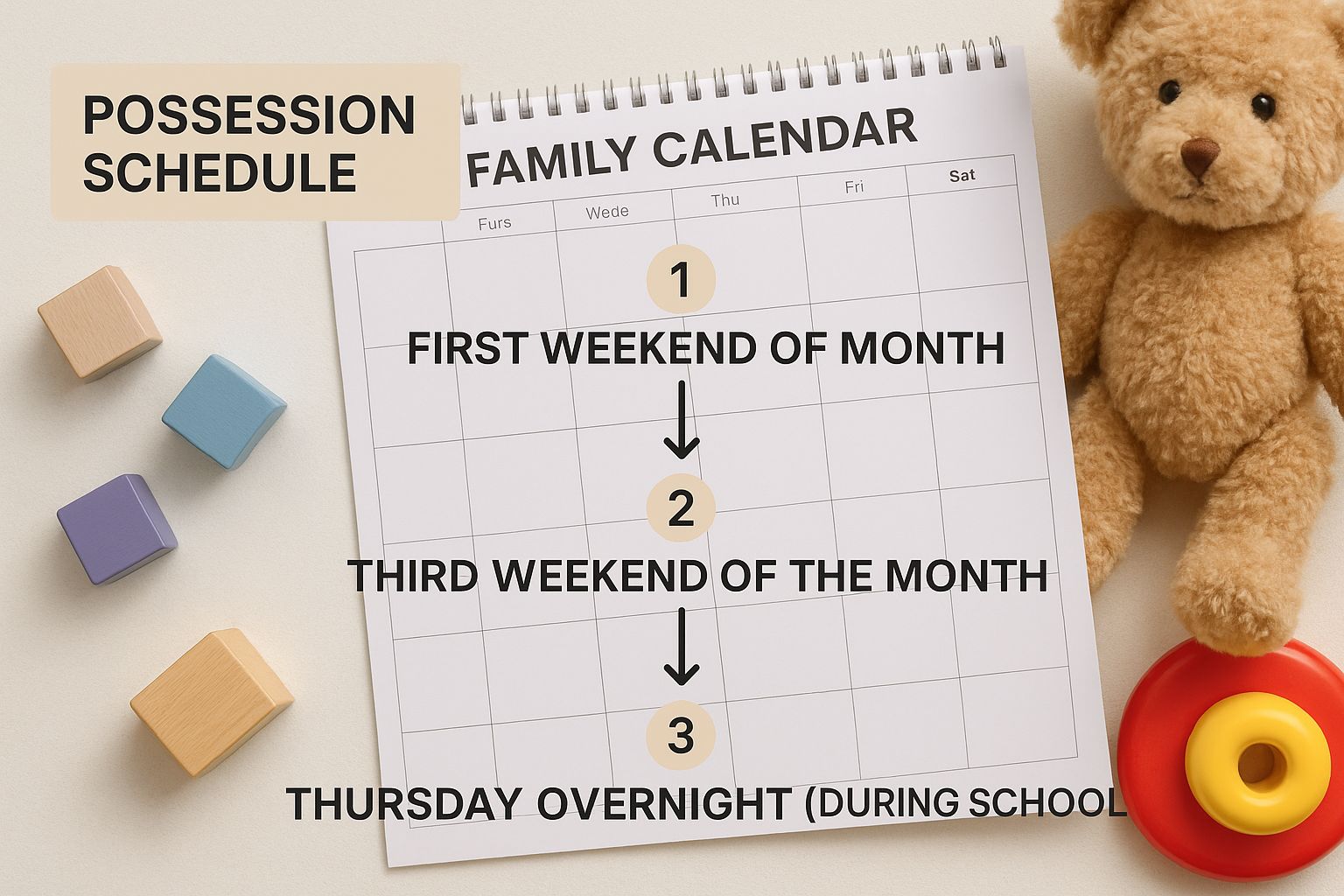
Seeing the schedule visually helps you understand how the SPO creates a predictable pattern throughout the year, which provides the stability children need.
Key Differences in the SPO
The table below gives a quick snapshot of how the schedule shifts based on that 100-mile marker.
Texas Standard Possession Order (SPO) at a Glance
| Possession Period | Parents Live Under 100 Miles Apart | Parents Live Over 100 Miles Apart |
|---|---|---|
| School Year Weekends | Typically the first, third, and fifth weekends of a month. | Can choose one weekend per month with notice. |
| Summer Vacation | 30 days of possession, usually taken in one block. | 42 days of possession, usually taken in one block. |
| Spring Break | Alternating years (e.g., you get even years, the other parent gets odd). | Always goes to the non-primary parent every year. |
| Thanksgiving & Christmas | Alternating years for both holidays. | Alternating years, but the Christmas break is often split. |
Understanding these details is the first step toward confidently exercising your rights. For a much deeper dive, you can read our detailed guide on Standard Possession Orders in Texas.
One of the most common points of confusion for parents is the holiday schedule. It’s crucial to remember that holiday possession almost always overrides the regular weekend schedule. For example, if it's your year for Thanksgiving, you will have your child for that holiday period even if it falls on a weekend that would normally belong to the other parent.
The SPO is a starting point, not the final word. It provides a solid foundation that ensures children maintain strong bonds with both parents. By understanding how it works, you are better equipped to follow the order, minimize conflict, and focus on cherishing every moment with your child.
Customizing a Schedule Beyond the Standard Order
Your family is unique, so why should your possession schedule be generic? While the Texas Standard Possession Order (SPO) offers a solid starting point, it is not set in stone. The law recognizes that a one-size-fits-all schedule can be impractical for modern families. As a father, you have the right to request a custom possession schedule that truly serves your child’s best interests.
When a Standard Schedule Isn't Enough
Some situations almost always require a schedule that looks different from the SPO. If your life matches one of these scenarios, pursuing a custom plan is often a necessity.
Common reasons for tailoring a schedule include:
- Non-Traditional Work Hours: If you are a first responder, pilot, doctor, or work any job with unpredictable shifts, the standard weekend model may be impossible. A custom schedule can be built around your work rotation to ensure you get consistent, meaningful time with your child.
- A Child’s Special Needs: A child with significant medical, developmental, or emotional needs might benefit from a schedule that prioritizes stability. This could mean shorter, more frequent visits instead of long weekends away from their primary routine.
- Very Young Children (Under Three): Texas law acknowledges that the SPO is often not appropriate for children under three. Infants and toddlers thrive on frequent contact with both parents. A judge might order a "step-up" plan that gradually increases the duration of your possession time as the child gets older.
Building a case for a custom schedule means showing the court why your proposed plan is better for your child. This isn't just about your convenience; it's about proving that the alternative schedule directly supports your child’s emotional and physical well-being.
Advocating for a Better Fit for Your Family
The world is moving toward more shared parenting, finally recognizing the vital role fathers play. In Europe, for example, joint physical custody is increasingly common. This global shift shows a wider understanding that fair child visitation rights for fathers are good for kids. You can discover more insights about these global advocacy efforts on Wikipedia.
To make a compelling case for a customized schedule in Texas, you need evidence. This could include your work schedule, letters from doctors detailing your child’s needs, or even testimony from a child development expert. Using tools like a parenting time calculator can also help you visualize and propose a schedule that maximizes your time while keeping things stable for your child. The key is to show that your plan is practical, reliable, and in your child’s best interest.
How to Enforce Your Possession Order

It’s a heartbreaking moment for any parent. You arrive on time, excited to see your child, only to be denied your scheduled time. It feels unfair and is incredibly painful for both you and your child. However, a possession order is not just a suggestion—it is a legally binding court order. When the other parent denies your court-ordered time, they are violating the law, and you have the right to hold them accountable.
What you do next is critical. Taking matters into your own hands will only backfire. It can harm your legal standing and, more importantly, puts your child in the middle of a stressful conflict. The only effective way forward is through the legal system, using the tools designed to protect your child visitation rights for fathers.
Build Your Case: Document Every Violation
In an enforcement case, evidence is everything. From the very first time a visit is denied, start keeping a detailed log. Simply telling a judge "they never let me see my kid" is too vague to be actionable.
For every missed or denied visit, your log should include:
- Date and Time: The exact day and time of the scheduled pickup.
- How It Happened: Did they refuse to answer the door? Did they send a text canceling the visit? Save every text message and email.
- The Reason Given: Write down the excuse provided, no matter how flimsy it sounds.
- Witnesses: If anyone was with you—a spouse, a parent, or a friend—note their name.
This documentation transforms your frustration into a clear pattern of behavior that a judge can act upon.
Take Action: File a Motion for Enforcement
With your evidence in hand, the next step is to file a Motion for Enforcement with the court. This legal document informs the judge that the other parent is violating the possession order and asks for the court’s intervention.
An enforcement action is a serious legal proceeding. A parent found in violation can face real consequences, including fines, payment of the other parent's attorney fees, and even jail time for repeated violations.
The court can also order make-up visitation to compensate you for the time you were wrongfully denied. This process reinforces that parental rights are not optional and are protected by law. By following the legal process, you are sending a powerful message that your relationship with your child is not negotiable.
Common Questions from Texas Parents
Once a court order is in place, real-life situations can raise practical questions. As a parent, you want to do the right thing, but it's easy to feel unsure when unexpected issues arise. Here are some clear answers to the most common concerns we hear from both mothers and fathers in Texas.
My Child is Refusing to Go—What Can I Do?
It’s heartbreaking when your child says they don’t want to go for a scheduled visit. In Texas, a child cannot legally refuse to see a parent until they turn 18. While a judge may consider the wishes of an older child (usually 12 and up), the possession order is a legal mandate that both parents must follow. If your child is pushing back, try to understand why without putting them in the middle. Talk to the other parent calmly to see if you can resolve the issue together. If it becomes a pattern, document each instance. This could be a sign of parental alienation, which Texas courts take very seriously.
What if the Other Parent Moves Away?
Most Texas custody orders include a geographic restriction, which prevents the primary parent from moving with the child outside of a specific area—often the current county and its surrounding counties. If the other parent wishes to move beyond that zone, they need either your written permission or a new court order allowing the relocation.
An unauthorized move is a direct violation of your court order. If this happens, you must act quickly. Filing an enforcement action to have your child returned is the immediate next step. Time is critical in these situations.
Do I Have to Pay Child Support if I'm Not Getting My Time?
Yes. The obligation to pay child support and the right to possession time are two separate legal issues. You must continue to pay your court-ordered child support on time, even if the other parent is wrongfully denying your possession time. Stopping payments will only create legal problems for you, including fines, wage garnishment, and even potential jail time. The proper way to handle denied visitation is to file an enforcement action with the court. This protects your legal standing while you fight to protect your time with your child.
For parents trying to understand the legal process, you'll encounter many new terms. This resource on general legal terminology can help you become familiar with the language of the court.
Key Takeaway: Your Next Steps
Knowing your rights is the first step, but taking decisive action is what protects your relationship with your child. This guide provides a solid foundation, but every family’s situation is unique. A clear legal strategy, developed with an experienced family law attorney, is the best way to ensure your child visitation rights for fathers are respected and your time together is protected for years to come.
Taking action provides a clear plan, transforming uncertainty into confidence. The road to securing your rights can feel overwhelming, but you don't have to walk it alone. To learn more about the initial court process, read our detailed article on how to get visitation rights in Texas.
If you need help with a child custody or visitation case in Texas, our experienced attorneys can guide you every step of the way. Contact The Law Office of Bryan Fagan, PLLC today for a free consultation.