
When your child’s future is on the line, understanding your rights isn't just important—it's everything. For unmarried parents in Texas, establishing paternity is the crucial legal process that officially identifies a child's father. This single step is the key that unlocks a father's right to seek custody and visitation, and just as importantly, it secures your child's access to critical benefits and a lifelong connection to both parents.
This guide is for any mother, father, or caregiver in Texas seeking clarity and confidence. We will walk you through your options, explain your rights in plain English, and empower you to take the next step for your family.
Why Establishing Paternity Matters for Your Child

Legally establishing who a child's father is goes far beyond adding a name to a birth certificate. It’s a foundational legal step that provides a child with lifelong emotional, financial, and medical security. It creates a clear legal framework that defines the rights and responsibilities for both parents, ensuring each can fully and legally participate in their child's life.
The Lifelong Benefits for Children and Parents
When paternity is legally established, it builds a bridge between a father and child that is recognized and protected by Texas law. This opens the door to a range of essential benefits that might otherwise be out of reach.
These benefits include:
- Access to Medical History: Knowing the father's family medical history can be critical for a child's health and well-being.
- Financial Support: A legal father has a duty to provide child support, ensuring the child's financial needs are met by both parents.
- Health and Life Insurance: The child can be added to the father's health and life insurance policies.
- Inheritance Rights: The child gains the legal right to inherit from their father.
- Social Security and Veterans Benefits: The child may be eligible for benefits based on the father's work history or military service.
Three Legal Paths to Establish Paternity
Texas law provides a few clear pathways for establishing paternity, ensuring every family has a way to secure these rights. For unmarried parents, the state offers three primary methods to legally determine a child's father, each suited for a different family situation.
Many men wonder why they should always request a paternity test, even when they believe they are the father. You can find more insights on this from legal experts who break down the reasoning.
Here’s a simple breakdown of the three main ways to establish paternity in Texas.
| Method | Best For | Key Action Required |
|---|---|---|
| Presumption (Birth During Marriage) | Married couples, or couples recently divorced. | No action needed; the husband is legally presumed to be the father. |
| Voluntary Acknowledgment of Paternity (AOP) | Unmarried parents who both agree on the biological father's identity. | Both parents sign a legal form, usually at the hospital after birth. |
| Court Order (Adjudication) | Unmarried parents who disagree on paternity, or when one parent is uncooperative. | Filing a "Suit to Adjudicate Parentage" with the court, which often involves DNA testing. |
Each path has its own legal requirements and implications, so it's important to choose the one that best fits your family's unique circumstances.
The Acknowledgment of Paternity: A Cooperative First Step
When unmarried parents agree on the child's biological father, Texas offers a simple, cooperative way to establish paternity without going to court. This is done through a powerful legal document called the Voluntary Acknowledgment of Paternity (AOP).
For many new parents, this is the first legal step they take together. You might be handed the AOP form in the hospital right after your child is born, which is the most common time and place for parents to sign. This creates an immediate legal link between the father and the newborn, securing rights and responsibilities from the very beginning.
How the AOP Process Works
The AOP is a sworn statement signed by both the mother and the man she identifies as the biological father. By signing, both parents are agreeing under penalty of perjury that he is the child’s genetic father. It’s a formal promise that carries the full weight of the law.
The process is designed to be straightforward. You can complete the AOP form at the hospital, through the Texas Vital Statistics Unit, or at a certified office. This streamlined approach to establishing paternity in Texas helps families act quickly to protect their child's future.
This infographic lays out the simple steps involved.
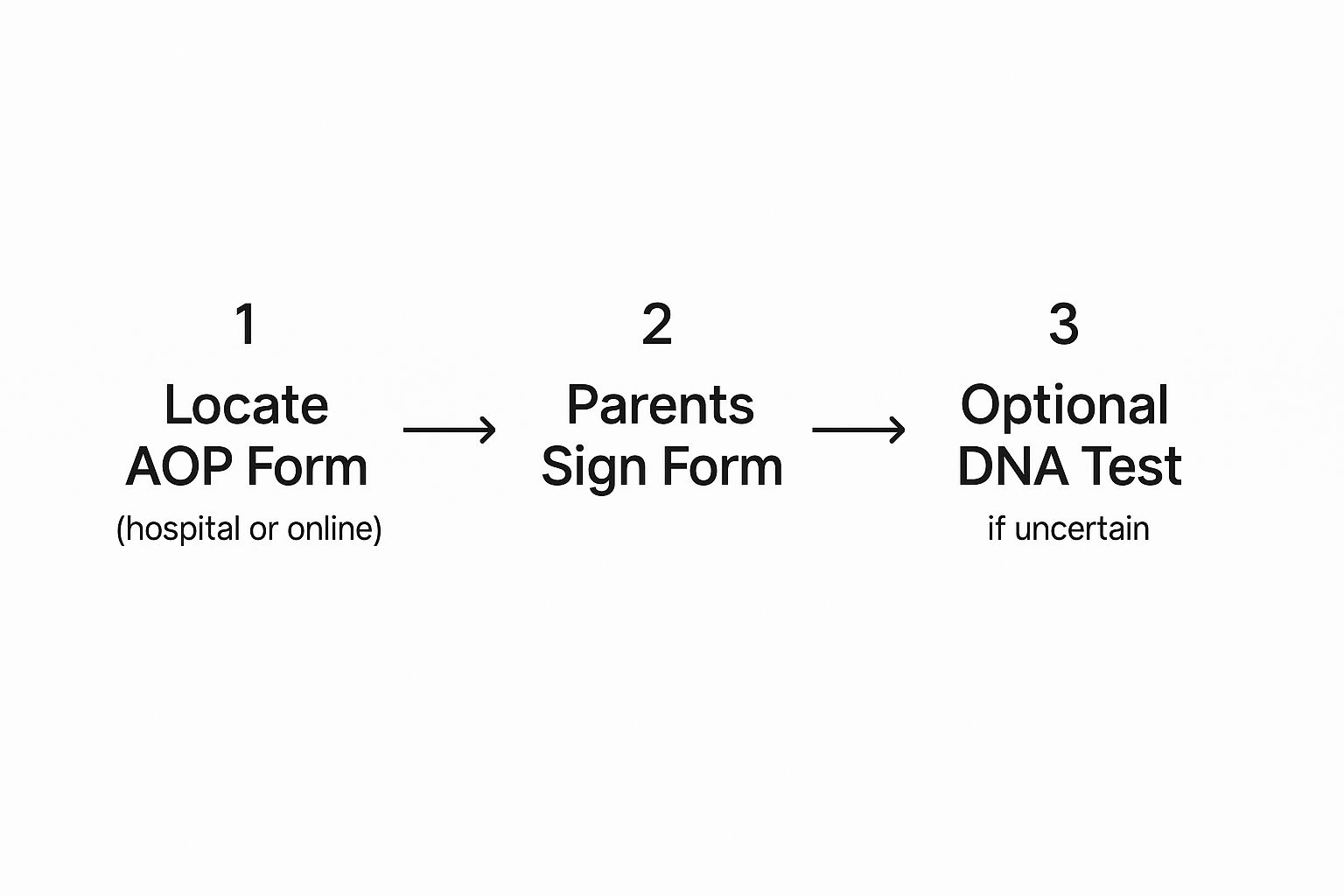
The main steps are finding the form, having both parents sign, and pausing for a DNA test if there is any uncertainty.
What Signing the AOP Legally Means
Signing an AOP is a major legal commitment. Once signed and filed, it has the same legal force as a court order. It officially makes the man the child's legal father, giving him all the parental rights and responsibilities that come with that title, including the right to seek custody and visitation and the duty to provide financial support. Even in tough situations, such as when a father passes away, it may be possible to explore acknowledging paternity on a birth certificate.
A Word of Caution: You must be 100% certain of the child's parentage before signing an AOP. If there is even a sliver of doubt, it is far wiser to request a DNA test first. Once the deadline to reverse an AOP passes, challenging it becomes incredibly difficult and expensive.
The AOP process is free, and parents under 18 can legally sign it. For the document to be valid, it must include the child’s birth information and a confirmation from both parents that no other man has been legally named the father.
When a Court Order is Necessary
If you and the other parent cannot agree on paternity, or if one parent is uncooperative, the Texas family court system provides a clear path forward. This legal process, called a Suit to Adjudicate Parentage, is designed to give your family a final, definitive answer.
While filing a lawsuit might sound intimidating, it is simply a structured way to settle the issue. The court's primary goal is always to act in the "best interest of the child." Whether you are a mother needing to secure child support or a father seeking to confirm your rights, this is the most effective way of establishing paternity in Texas when voluntary options have failed.
This screenshot from TexasLawHelp.org gives a quick overview of the first few steps in a paternity case.

A paternity case begins when one parent files a petition and has the other parent served. "Serving" is the formal legal term for giving official notice, ensuring everyone involved is aware that a court case has started.
What is a Suit to Adjudicate Parentage?
This is the official name for the lawsuit filed to legally determine a child's father. The process begins when one parent, the "petitioner," files an Original Petition in Suit to Adjudicate Parentage. This document explains why the case is being filed and what the petitioner is asking the court to do.
Once filed, the other parent, the "respondent," must be formally notified through "service." This is a critical step that ensures the other parent has a fair opportunity to respond. If you are unsure about the initial filing process, our guide on how to file for custody in Texas can walk you through the basics.
The Role of Court-Ordered Genetic Testing
At the heart of nearly every contested paternity case is the need for scientific certainty. A judge can, and almost always will, order genetic testing (a DNA test) to confirm or deny a biological link. This is not optional; if a court orders it, you must comply.
The process itself is simple and painless, usually just a cheek swab. The results are incredibly accurate, typically showing a probability of paternity of 99% or higher if the man is the biological father.
A court-ordered DNA test provides the undeniable proof a judge needs to make a final ruling. It cuts through any disagreement and allows the court to create fair orders for custody, visitation, and child support.
Understanding the 'Presumed Father' in Texas
Texas law includes a concept called a presumed father—a man who the law assumes is a child’s father under certain circumstances, even without a DNA test.
A man is considered a presumed father if:
- He was married to the child’s mother when the child was born (or within 300 days of the marriage ending).
- He married the mother after the child's birth and voluntarily put his name on the birth certificate or otherwise claimed paternity.
- He lived with the child for their first two years and presented the child to others as his own.
Being a presumed father comes with legal rights, but this status can be challenged in court. A Suit to Adjudicate Parentage is the proper way to either confirm that presumption with science or rebut it, giving your family the final, legally binding answer it needs.
Your Rights and Duties After Paternity Is Established

Successfully establishing paternity is a huge milestone, but it's also the starting line. That court order or signed Acknowledgment of Paternity (AOP) does more than put a name on paper—it creates a new legal reality for your family, complete with a clear framework of rights and responsibilities for both parents.
Knowing what comes next is key to building a stable, cooperative co-parenting relationship. The Texas Family Code lays out these duties, ensuring every child benefits from having two legally recognized parents.
Conservatorship, Possession, and Access
In Texas, we don't typically use the word "custody." Instead, our laws focus on two main concepts: conservatorship (your rights and duties) and possession and access (your time with the child). These terms define how you will share your parental role.
Conservatorship is about your right to make major decisions for your child, covering crucial choices like:
- Where they go to school
- Medical and dental care
- Psychological or psychiatric treatment
- Their religious upbringing
Texas courts strongly prefer naming parents as Joint Managing Conservators. This reflects the state's belief that it’s in a child's "best interest" for both parents to share in these critical life decisions. In this arrangement, one parent is usually named the "primary" conservator, which gives them the right to decide where the child lives and to receive child support.
The Duty of Financial Support
Along with the right to be involved in your child’s life comes the legal duty to support them financially. Once paternity is established, the court will issue orders for child support. This is not a penalty; it is a legal obligation designed to ensure the child’s needs are met by both parents.
The amount is calculated using state guidelines based primarily on the paying parent's income. You can learn more in our guide to understanding Texas child support laws.
Creating a Possession Schedule
The other major piece of a paternity order is the possession schedule, which is your official visitation calendar. This schedule clearly lays out when the child will spend time with each parent.
In most cases, courts will implement a Standard Possession Order (SPO). The SPO is a detailed, predictable schedule covering weekdays, weekends, holidays, and summer vacation. It's designed to give the child consistency and stability while ensuring both parents have regular, quality time. For legal professionals handling these vital documents, secure legal document storage for lawyers is indispensable.
Why Acting Quickly on Paternity is Crucial
When it comes to your child, time is one of your most precious resources—and in a legal sense, it’s also one of your most limited. The need to establish your parental rights feels urgent and emotional, and Texas law mirrors that urgency. Unfortunately, delaying can have permanent consequences.
Whether you're a father wanting to secure your rights or a mother needing to secure child support, waiting is rarely a good strategy. As time passes, your child forms bonds and routines that courts are often hesitant to disrupt. Acting quickly sends a strong message to the court about your commitment and protects your child's right to have a meaningful relationship with both parents.
The Statute of Limitations: A Critical Deadline
The most important deadline is the statute of limitations—the maximum amount of time you have to file a lawsuit. In Texas, the clock on paternity cases is strict, and missing that window can mean losing your chance to act forever.
Under Texas law, there is generally a four-year statute of limitations to challenge a man's presumed paternity. This means fathers who want to assert their rights—or dispute them—must move quickly. Any delay can impact their ability to get a possession order, secure visitation, or have a say in major life decisions. You can discover more about paternity timelines and parental rights from legal experts who handle these cases every day.
Real-World Consequences of Waiting
Consider this common scenario: a man has a child with his girlfriend, but they separate soon after. He stays involved informally, seeing the child occasionally and providing some money, but he never legally establishes paternity. Five years later, the mother announces she’s moving out of state with the child.
Because he waited too long and has no court order, he may have lost his legal right to stop the move or even ask a court for a visitation schedule. In the eyes of the law, he is a legal stranger. This heartbreaking situation is a powerful reminder that informal agreements offer zero legal protection.
Common Questions About Texas Paternity Law
Navigating the legal process can feel overwhelming. We understand you have questions and need straight answers to feel confident about your next steps. Here are some of the most common concerns we hear from parents in your situation.
Can I Establish Paternity if the Other Parent Is Uncooperative?
Yes, absolutely. The Texas court system is designed to handle this. If one parent is unwilling to cooperate, you can file a "Suit to Adjudicate Parentage." A judge can then order the uncooperative parent to participate, which includes compelling them to bring the child for court-ordered DNA testing. You are not at a dead end just because the other parent refuses to sign a form.
What if I Signed an AOP and Now Have Doubts?
This is extremely time-sensitive. Texas law gives you a very narrow window—usually just 60 days—to rescind (take back) a signed Acknowledgment of Paternity (AOP) without going to court. After that deadline, challenging the AOP becomes a much more difficult legal battle, requiring you to prove to a judge that it was signed due to fraud, duress, or a significant mistake. If you have second thoughts, you must act now.
An Acknowledgment of Paternity is a legally binding decision. Never sign an AOP if you have even a shadow of a doubt. It is always better to get a DNA test beforehand.
Does a Name on the Birth Certificate Establish Paternity?
This is one of the most common and dangerous myths. For unmarried parents, putting a man's name on a child’s birth certificate does not establish legal fatherhood or grant him any parental rights in Texas.
For unmarried couples, paternity can only be established in two ways:
- Both parents sign and file a valid Acknowledgment of Paternity (AOP).
- A judge issues a court order declaring a man to be the legal father, usually after DNA testing.
Without one of these, a name on a birth certificate has no legal power to grant conservatorship or possession rights.
Who Pays for a Court-Ordered DNA Test?
A judge has the final say on who pays for genetic testing. The court will consider the financial situation of both parents and may order one parent to cover the full cost, split the expense, or, in cases handled by the Texas Attorney General's office, the state may pay upfront and seek reimbursement later.
Key Takeaways and Next Steps
Understanding the process of establishing paternity in Texas is the first step toward protecting your child’s future and securing your parental rights. Whether you and the other parent are in agreement or facing a dispute, there is a clear legal path forward.
- For Agreed Parents: The Voluntary Acknowledgment of Paternity (AOP) is a simple and effective tool.
- For Disagreed Parents: A Suit to Adjudicate Parentage and court-ordered DNA testing provide a definitive resolution.
- Time is Critical: Act quickly to avoid missing legal deadlines that could permanently affect your rights.
- Legal Rights Are Not Automatic: Your parental rights must be legally established through an AOP or a court order to be enforceable.
Your relationship with your child is too important to leave to chance or rely on informal agreements. Taking decisive action now ensures your rights are protected and that your child receives the full emotional and financial support they deserve. You may find some general guidance on establishing paternity helpful for understanding the bigger picture.
If you need help with a child custody or visitation case in Texas, our experienced attorneys can guide you every step of the way. Contact The Law Office of Bryan Fagan, PLLC today for a free consultation.