
When your child's future is on the line, understanding your rights matters most.
If you're searching for a fathers rights divorce attorney in Texas, you're probably not looking for abstract legal theory. You want to know what happens to your time with your children, how Texas courts decide custody, and what you should do today so you don't make a costly mistake tomorrow.
Many fathers come into divorce carrying the same fear. They assume the mother will automatically have the advantage. Texas law doesn't work that way. But good results don't happen just because the law says parents should be treated fairly. They happen when a father shows the court that he is prepared, child-focused, credible, and serious about meeting his child's needs.
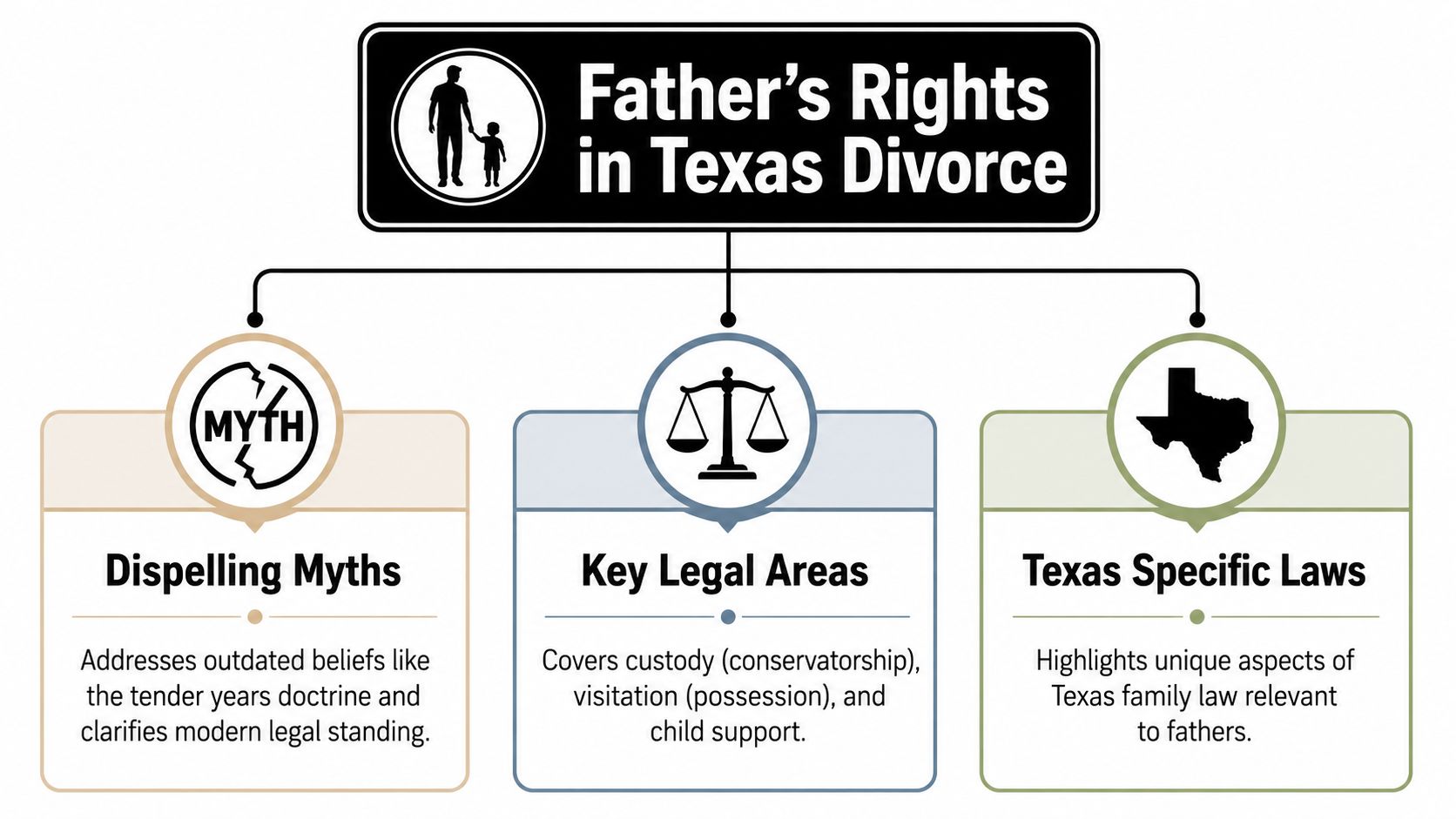
Understanding a Father's Rights in a Texas Divorce
Texas law starts from a simple principle. A father is not a second-class parent.
Under Texas law, courts must look at conservatorship without regard to the sex or marital status of the parent. Texas Family Code Section 153.003 expressly prohibits gender-based discrimination in conservatorship decisions. Texas law also treats the best interests of the child as the controlling standard, and Texas authority recognizes that both parents should have significant access to their children.
The myth fathers need to drop
A lot of fathers still worry that old ideas favor mothers automatically, especially when children are young. That concern is understandable, but it often leads to a harmful mistake. The father assumes the outcome is already decided and stops pushing for a meaningful parenting role.
That mindset can damage a case before it starts. Courts don't reward a parent for being discouraged. Courts respond to evidence, parenting history, stability, and a workable plan for the child.
Practical rule: Don't build your strategy around old myths. Build it around what you can prove.
What key custody terms mean in plain English
Texas uses terms that can feel technical at first. The meaning matters.
- Best interests of the child means the judge is focused on what arrangement helps the child most. That can include stability, involvement in school and medical care, co-parent communication, safety, and each parent's ability to meet day-to-day needs.
- Joint managing conservatorship usually means both parents share major rights and duties regarding the child. That can include decisions about education, medical care, and access to records.
- Sole managing conservatorship means one parent has a greater concentration of decision-making authority. Courts don't grant this lightly.
- Possession schedules are the calendar rules for when each parent has the child. Many parents call this visitation, but in Texas you'll often hear “possession and access.”
For a fuller discussion of father-specific custody issues, review this guide on fathers' rights to custody in Texas.
What fairness looks like in real cases
Fairness doesn't always mean equal time on a stopwatch. It means the court looks at the child's needs and the evidence in front of it. A father who wants expanded time, primary residence rights, or a custom schedule needs to show why that arrangement serves the child well.
That's why practical preparation matters so much. If you've been taking your child to school, attending medical appointments, coaching, helping with homework, or managing routines, those facts matter. If you've been shut out, that also matters, but it needs to be presented clearly and strategically.
A father's rights case is strongest when the father acts like a parent first and a litigant second.
When to Hire a Fathers' Rights Divorce Attorney
Some fathers wait too long to hire counsel because they want to keep things calm. That instinct makes sense. But waiting can hand the other side an early advantage, especially when the first proposed schedule, first court filing, or first temporary hearing sets the tone.
A fathers rights divorce attorney becomes especially important when any of these issues appear:
- Primary residence is disputed and both parents want the child to live mainly with them.
- The other parent has already hired counsel and you haven't.
- Communication has broken down and every discussion turns into a fight or silence.
- There are financial complications involving support, bonuses, contract work, business income, or irregular pay.
- Relocation is on the table and one parent may move with the child.
- Temporary parenting arrangements matter because what happens early may influence the rest of the case.
When the case is pending, Temporary Custody Orders During a Texas Case explains how custody is handled while a divorce is still moving through court.
Why representation changes the path of a case
Hiring a lawyer isn't just about preparing for trial. In many families, it helps avoid trial.
When both parents are represented, 86% of divorce cases reach a settlement, compared with 63% when only one parent has an attorney and 71% when neither parent has an attorney, according to Custody X Change divorce attorney research. That matters because a workable settlement often gives parents more control and less conflict than a courtroom fight.
There's another hard truth. Self-representation is common in family court, but it carries real risk for fathers, especially when the mother has counsel and the father does not. Family law data discussed in Clio's family law statistics overview notes that 72% of family law cases involve self-representation, and fathers who represent themselves against attorneys representing mothers often perform poorly.
A good attorney is not hired to inflame a case. He or she is hired to keep a father from walking into avoidable mistakes.
What hiring counsel actually helps you do
An attorney helps with more than courtroom speaking. The work starts with strategy.
A strong lawyer helps identify what outcome is realistic, what facts matter most, what evidence needs to be preserved, and where compromise helps rather than hurts. In many cases, that guidance is what turns an emotional dispute into a parenting plan the court will accept.
How to Prepare Your Case Before Meeting an Attorney
You don't have to wait for the first consultation to start helping your case. Fathers who prepare early usually give their lawyer better raw material to work with. That saves time, sharpens strategy, and helps separate facts from emotion.
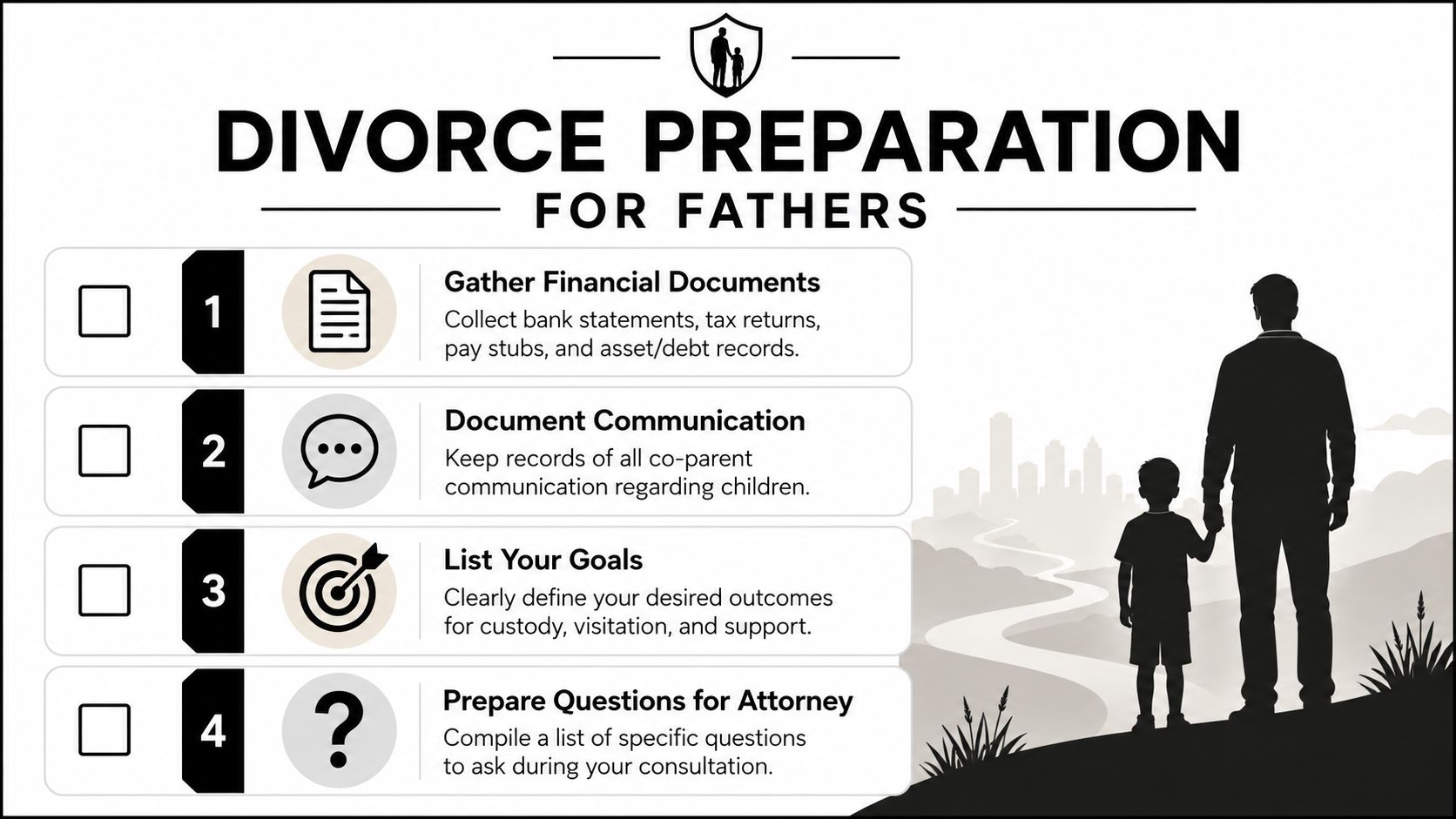
Start with the basics. Build one folder, digital or paper, and keep everything organized by topic and date.
Gather records that show how you parent
The court needs more than broad statements like “I'm a great dad.” Specific proof carries more weight.
Useful records often include:
- School involvement such as report cards, teacher emails, sign-in sheets, and notices showing you attend meetings or events.
- Medical participation including appointment summaries, prescription information, and communication with doctors or therapists.
- Daily parenting routines like pickup schedules, meal planning, homework support, bedtime routines, and extracurricular coordination.
- Photos and calendar entries that show regular involvement, not staged moments.
- Third-party confirmations from coaches, caregivers, relatives, or others who've seen your parenting firsthand.
If paternity is disputed or was never formally established, tell the attorney immediately. That issue changes the legal path and shouldn't be treated as a side detail.
A short video can help you think through the preparation process before your consultation.
Organize financial information before support becomes an argument
Child support disputes often become credibility disputes. If your paperwork is incomplete, the court may rely on rough assumptions that don't reflect reality.
Bring documents such as:
- Pay stubs and tax returns
- Bank statements
- Proof of bonuses, commissions, or overtime
- Business records if you're self-employed
- Debt and monthly expense records
- Health insurance information for the child
This matters even more if your income changes from month to month. Irregular earnings need to be documented early and clearly.
Clean up communication before it becomes evidence
Text messages, emails, and parenting apps often become exhibits. Write every message as if a judge may read it later.
Use these habits right away:
- Stick to the child. Don't revisit the marriage in parenting messages.
- Be brief. Long emotional responses usually hurt more than they help.
- Confirm logistics in writing. Pickup times, school events, and doctor visits should be easy to track.
- Don't retaliate. If the other parent sends something hostile, answer the parenting issue, not the insult.
Keep a running timeline of major parenting events. Dates matter. Judges and attorneys both need chronology, not scattered memories.
Write down your goals before the meeting
Your attorney needs to know what matters most to you. Not every goal carries the same legal value, and not every hill is worth dying on.
List your priorities in order. For example, you may care most about staying involved in school decisions, avoiding a relocation, or seeking the right to determine the child's primary residence. Clear goals help your lawyer build a better case from day one.
Evaluating and Choosing the Right Texas Attorney
You may walk out of one consultation feeling reassured, then realize later that the lawyer never asked who takes your child to school, who attends doctor visits, or whether temporary orders could set the tone for the rest of the case. That is a problem. In a Texas divorce involving children, the right attorney does more than explain the law. He or she should spot the facts that will matter early, give you a realistic plan, and tell you where your case is strong and where it needs work.
Choosing counsel is a strategy decision.

Questions worth asking in a consultation
A consultation should help you judge how the lawyer thinks under pressure, not just how well the lawyer markets the firm. Ask questions that force a specific answer.
| Question | What a useful answer sounds like |
|---|---|
| Have you handled cases involving fathers seeking substantial parenting time or primary residence rights? | The attorney gives concrete examples of strategy and explains how facts drive outcomes. |
| How do courts in this county usually approach temporary orders and parenting schedules? | The attorney shows local familiarity and does not pretend every courtroom works the same way. |
| How do you decide whether to negotiate, mediate, or prepare for trial? | The answer is balanced. Good lawyers do not threaten trial in every case, and they do not avoid it when needed. |
| What documents should I gather first? | The attorney gives a practical list and explains why each category matters. |
| How will we communicate during the case? | You should hear a clear process, not vague promises. |
Ask one more question that fathers often overlook: What facts would concern you if you represented the other side? A seasoned Texas family lawyer should be willing to answer that directly. You need candor, not comfort.
If you want a stronger screening checklist before you start calling firms, this article on how to choose a family law attorney is a useful starting point.
What to listen for beyond the words
Listen for judgment. Listen for discipline. Listen for whether the attorney keeps bringing the discussion back to the child, the evidence, and the likely decisions a judge will have to make.
Texas courts must evaluate conservatorship without regard to gender under Section 153.003. A good lawyer knows that principle and also knows fathers still need a deliberate case strategy. The issue is not whether the law says fathers matter. It does. The issue is whether your lawyer can prove, with facts and a workable plan, why your requested orders serve your child's best interest.
The lawyer should also explain legal terms in plain English. That includes Joint Managing Conservatorship, which this site covers in more detail elsewhere, and the difference between sharing rights on paper and having real authority over day-to-day and major decisions. If a lawyer hides behind jargon, expect confusion later when the case gets harder.
Office systems matter too. Delay hurts family cases. Missed documents, slow replies, and disorganized intake can cost time and credibility. Many firms use structured tools to handle communication and records. For a practical look at how law offices organize those tasks, client intake and CRM software gives helpful context.
The right attorney should leave you with a clearer plan, a realistic risk assessment, and a better sense of what the court will actually care about.
Fees, retainers, and realistic expectations
Ask direct billing questions early. You are hiring a professional, and you have every right to know how the financial side works before the case accelerates.
A retainer is money paid up front so the attorney can begin work. Family lawyers typically bill against that amount as the case moves along. Ask what work is billed, how often invoices go out, who in the office performs different tasks, and what tends to increase fees, such as emergency hearings, contested temporary orders, formal discovery, custody evaluations, or trial preparation.
Also ask what the lawyer thinks your case may require in the first 60 to 90 days. That answer often tells you whether the attorney is planning ahead or merely waiting to react.
One Texas option for custody, visitation, support, and related family law matters is The Law Office of Bryan Fagan, PLLC, which handles these categories of cases in Texas courts. Whether you speak with that office or another one, choose counsel who answers hard questions directly, respects your role as a father, and treats preparation as part of the case strategy from day one.
Key Legal Strategies in Custody Visitation and Support
At this stage, the case usually stops feeling abstract. A father is no longer asking, “Do I have rights?” He is asking harder questions. How do I protect my time with my children? What will the judge care about? What mistakes will cost me later?
The answer is strategy, backed by proof.
A good Texas family law case is built on specifics. Who handled school drop-off. Who scheduled doctor visits. Who helped with homework. Who kept the child's routine stable during conflict. Judges hear broad claims every day. They make decisions based on credible evidence, workable plans, and the child's best interest.
A fathers rights divorce attorney should be doing more than making general arguments about fairness. The lawyer should be building a record, identifying weak spots early, and making careful choices about what to ask for now versus what to prove over time.

Custody strategy starts with what you can prove every week
Texas courts focus on the child's best interest, not the parent who is most upset or most persuasive in conversation. If you want expanded parenting time or the exclusive right to determine the child's primary residence, your case needs facts that show day-to-day parenting capacity.
That usually means records.
School communications, medical records, attendance at activities, pickup logs, text messages about parenting decisions, and a clear calendar of your time with the child can all matter. Fathers often underestimate how persuasive ordinary parenting evidence can be. A calm pattern of involvement usually carries more weight than one emotional hearing.
Work schedule is another common pressure point. Long hours do not disqualify a father from meaningful custody orders, but they do force an honest conversation about logistics. A judge is more likely to trust a parent who presents a realistic plan with childcare backup, transportation details, and a schedule that fits the child's routine.
Knowing the baseline order helps you negotiate from strength
Many fathers agree to less time than they should because they do not know what Texas law already treats as a standard starting point.
For children age three and older, the Standard Possession Order is presumed to be in the child's best interest. When parents live within 100 miles, it gives the noncustodial parent possession on the 1st, 3rd, and 5th weekends, Thursday evenings during the school year, alternating holidays, and 30 days in the summer, as explained by TexasLawHelp's guide to child visitation and possession orders.
That schedule is a starting point. It is not the ceiling in every case.
Some fathers should pursue an expanded standard schedule or a custom plan that better fits school, distance, and work realities. Others are better served by locking in clear, enforceable baseline time first and avoiding a fight they are not yet prepared to win. Strategy depends on the facts. Asking for too little can hurt you. Asking for more than you can reliably exercise can also hurt you.
Vague parenting terms create problems fast. If pickup times, holiday exchanges, phone access, or transportation duties are left unclear, conflict usually follows.
Child support cases are often won or lost on documentation
Support disputes become more complicated when income is not steady. I see this often with self-employed fathers, sales professionals, oilfield workers, military families with changing pay items, contractors, and parents with seasonal earnings.
In those cases, support should not be based on a distorted snapshot of income. The better approach is to show the court the full pattern. Bring pay stubs, tax returns, contracts, profit and loss statements, military leave and earnings statements if they apply, and bank records that explain when income rises and falls. If reimbursements, overtime, bonuses, or one-time payments are involved, those details need to be identified clearly and early.
Support strategy also includes cost control. Contested custody and support issues can increase fees quickly, especially if financial records are incomplete or the other side forces formal discovery. Fathers who want a clearer sense of litigation cost should review this breakdown of child custody attorney fees in Texas cases.
Just as important, do not agree to a support figure to end the immediate pressure. Temporary numbers have a way of shaping the rest of the case.
A few issues can change the legal approach right away
Some facts require a different plan from the start:
- Children age twelve or older may be able to speak with the judge about their preference, but the court still decides based on best interest.
- Relocation disputes often turn on distance, school continuity, travel demands, and whether the move would weaken the parent-child relationship.
- Paternity questions can affect standing, conservatorship rights, and support obligations before the court ever reaches a possession schedule.
- Military service can require detailed orders for deployment, virtual contact, makeup time, and future transfers.
These are not side issues. They shape what evidence matters, what orders should be requested, and how aggressively the case should be pushed toward settlement or trial.
A strong father's case is usually steady, organized, and credible. That is how you protect parenting time, challenge unfair assumptions, and give the court a reason to trust your plan.
What to Expect After You Hire Your Divorce Attorney
Once you hire counsel, the fog usually starts to lift. You still have a difficult road ahead, but you won't be guessing your way through it anymore.
The first meetings are usually about facts, priorities, and immediate risk. Your attorney will ask for documents, identify urgent custody concerns, and help you avoid mistakes in communication and parenting exchanges. If you're worried about cost, this overview of child custody attorney fees can help you understand how these cases are commonly billed.
The first major steps in the case
The legal process often begins with filing the divorce petition and requesting any needed temporary relief. Temporary orders can establish ground rules while the case is pending, including possession, decision-making, child support, and use of property.
After filing, the case usually moves into information gathering. That can include exchanging documents, reviewing financial records, and identifying what facts are disputed. If the other side makes claims about your parenting, your attorney works to answer those claims with records, witnesses, and a clear timeline.
Why mediation matters
Many parents are surprised to learn that family cases often move toward negotiation or mediation before trial. That's usually a good thing.
Mediation gives both sides a structured setting to work toward a parenting plan and financial terms without asking a judge to decide every detail. If the preparation is strong, mediation can produce practical solutions that are harder to craft in a rushed courtroom setting.
What your role looks like after hiring counsel
Your lawyer leads the legal strategy, but your behavior still matters every day.
Keep parenting consistently. Follow temporary orders carefully. Stay civil in written communication. Keep gathering records as events happen. The fathers who help their own cases most are the ones who remain steady, responsive, and child-focused even when the process is frustrating.
Your attorney can guide the case. You still have to live it in a way that supports the outcome you want.
If you're a father facing divorce in Texas, don't assume the court will “see” your role without proof. Rights matter. Preparation matters just as much.
Key Takeaway
Texas law does not treat fathers as lesser parents. But the fathers who protect their relationships with their children are usually the ones who act early, gather proof, choose counsel carefully, and stay focused on what serves the child.
Your next steps are simple:
- Write down your custody and support goals
- Collect parenting and financial records
- Clean up your communication immediately
- Interview attorneys with specific questions
- Build a case around facts, not fear
If you need help with a child custody or visitation case in Texas, our experienced attorneys can guide you every step of the way. Contact The Law Office of Bryan Fagan, PLLC today for a free consultation.