
When your child's future is on the line, understanding your rights matters most.
If you're reading this, there's a good chance you're staring at a calendar, texting the other parent, and wondering how life got so complicated. One of the hardest parts of separation or divorce isn't just the legal paperwork. It's the fear of not knowing when you'll see your child, how holidays will work, or whether the schedule will feel fair.
In Texas, the Standard Possession Order often acts like a default calendar setting. It gives parents a starting framework when they can't agree on a custom schedule. That can feel restrictive at first, but many parents find relief in having a clear set of rules instead of constant guesswork.
A possession schedule is only one part of a custody case. Texas courts also deal with conservatorship, which means rights and duties, and possession and access, which means when each parent spends time with the child. Those two ideas work together. One addresses decision-making. The other addresses the day-to-day calendar.
For worried mothers, fathers, grandparents, and caregivers, that distinction matters. You may share important parental rights and still have a detailed schedule for possession. You may also have room to adjust that schedule if your family's needs call for something different.
Your Guide to Child Custody Schedules in Texas
One parent works late on Fridays. The other has a changing weekday schedule. School pickup turns into a point of tension. Then the month changes, and both parents realize they counted the weekends differently. That's the kind of stress many families bring into a custody case.
The Texas standard possession order exists to reduce that kind of confusion. Instead of forcing parents to invent a calendar from scratch, Texas law gives courts a ready-made framework that many families can use as a baseline. For a parent in the middle of a difficult transition, that structure can feel like a handrail.
Why a default schedule can help
A default schedule doesn't mean the court thinks every family is identical. It means the law recognizes that children usually benefit from consistency, routine, and dependable contact. A child who knows where they'll be spending weekends, school nights, and holidays often feels more secure than a child caught in constant last-minute changes.
That's especially important when emotions are high. Parents may still be hurt, angry, or exhausted. A written order can lower conflict by answering questions before they turn into arguments.
A good possession order doesn't just divide time. It creates predictability for the child.
How this fits into a larger custody case
Texas courts use words that can sound intimidating at first. Here's the simple version:
- Conservatorship means who has parental rights and duties.
- Possession and access means when the child is with each parent.
- Best interests of the child is the guiding idea behind both.
If you're a father trying to protect your parenting time, a mother trying to create stability, or a grandparent trying to understand the family dynamic, this framework matters. It gives you a practical place to start. It also reminds you that the standard possession order Texas courts use is not always the final answer. It's often the beginning of a workable plan.
What a Standard Possession Order Really Means
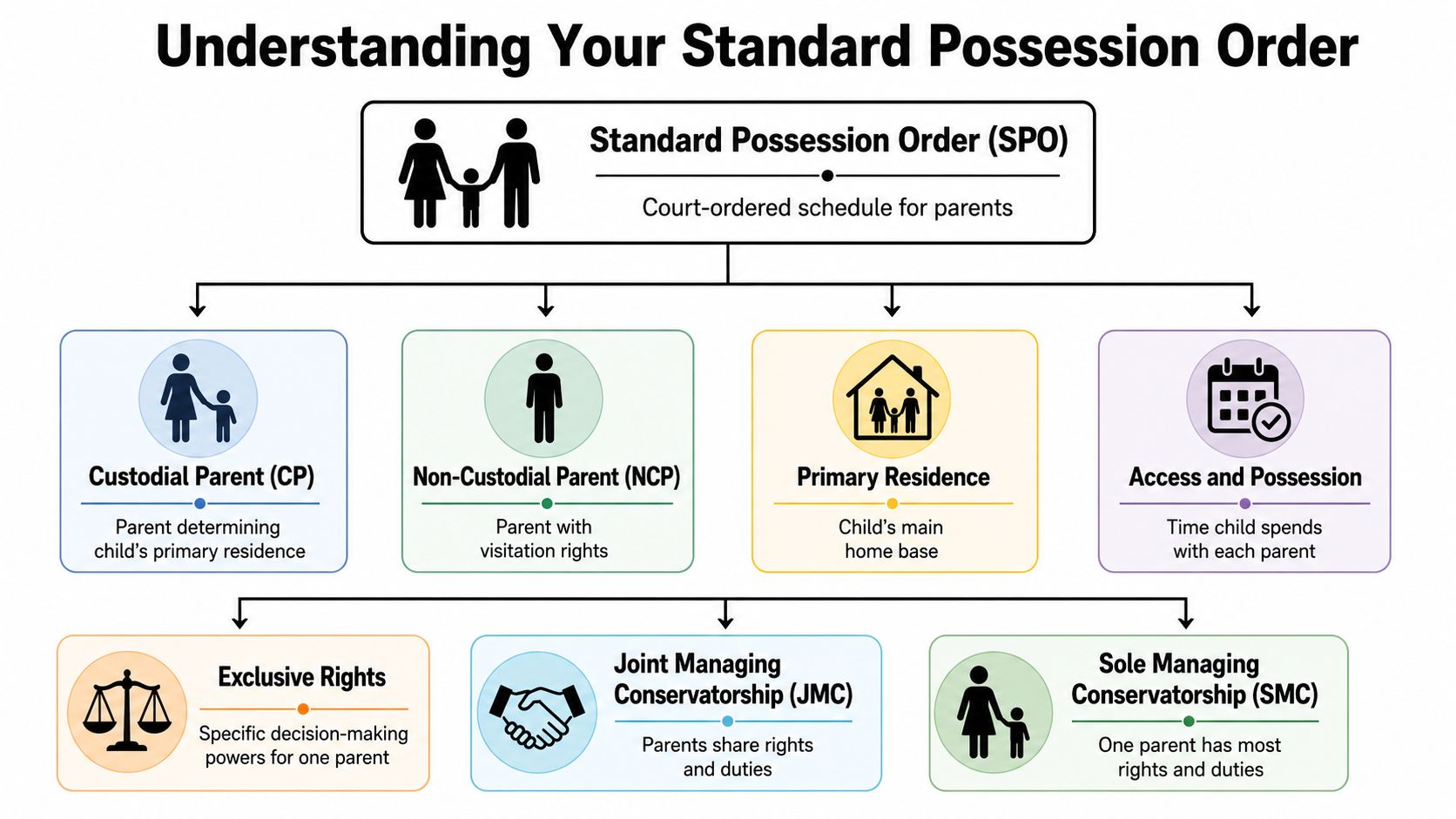
A lot of parents hear the phrase standard possession order Texas and assume it only means weekend visitation. It's broader than that. Think of it as a parenting roadmap. It helps define who makes major decisions, where the child primarily lives, and when the other parent has scheduled time.
Under Chapter 153 of the Texas Family Code, the Texas Standard Possession Order is outlined in Chapter 153 of the Texas Family Code, which presumes this schedule is in the best interest of a child aged three or older.
Joint managing conservatorship in plain English
In many Texas cases, parents are named joint managing conservators. That doesn't always mean a perfect split of time. It usually means both parents keep important rights and duties toward the child.
For example, both parents may stay involved in school, medical care, and general upbringing, even if the child lives primarily with one parent. That's why legal custody and physical time aren't the same thing.
One parent may have the right to determine the child's primary residence. People often call that parent the primary parent or custodial parent. The other parent may be called the possessory conservator, meaning the parent with court-ordered possession and access. If that term is unfamiliar, this plain-language guide on what a possessory conservator is in Texas can help.
Best interests of the child
This phrase appears often in family law because it drives nearly every custody decision. The court's focus isn't on rewarding one parent or punishing the other. The court looks for a plan that supports the child's emotional and practical needs.
That's why the standard order is often treated like a default calendar setting. Lawmakers created it as a schedule that generally supports stability and ongoing parent-child contact for many children.
An easy way to understand is this:
| Term | Plain-English meaning |
|---|---|
| Best interests of the child | What arrangement most supports the child's well-being |
| Joint managing conservatorship | Both parents share important rights and duties |
| Primary residence | The child's main home base |
| Possession schedule | The calendar for parenting time |
Practical rule: Don't assume labels tell the whole story. Read the actual order to see who has which rights, and when exchanges happen.
For both mothers and fathers, this matters because your role may be larger than the shorthand people use in everyday conversation. A parent who doesn't have the child's primary residence may still have meaningful decision-making rights and significant parenting time.
The Standard Possession Schedule Week by Week
When parents live relatively close to each other, the regular schedule often becomes the heartbeat of co-parenting life. School mornings, Thursday dinners, backpack exchanges, and weekend routines all start to follow a pattern.
The most common version many parents picture includes the first, third, and fifth weekends of each month for the non-primary parent. That's where people often get confused. “First weekend” doesn't mean the first full weekend after the first day of the month. Parents usually count by the Fridays in that month.
How to count weekends without guessing
If the first Friday of the month falls on the second day of the month, that weekend is still the first weekend for possession purposes. Then the third Friday marks the third weekend, and if there is a fifth Friday, that creates the fifth weekend.
That means some months don't have a fifth weekend at all. In those months, the schedule is just first and third weekends. In months with five Fridays, the non-primary parent may have that extra weekend.
A simple habit helps: mark every Friday on a monthly calendar, then label them in order. That avoids the “I thought this was my weekend” problem.
School-year weekday time
During the school term, many standard arrangements also include Thursday possession for the non-primary parent. For families, that often gives the child a midweek connection instead of waiting from one weekend to the next.
In daily life, that can mean dinner together, help with homework, or a few steady hours of routine. For children, these smaller points of contact can matter a lot because they make the second home feel like part of normal life, not just a place they visit.
- Use the school calendar: If your order ties exchanges to school dismissal or return, keep the district calendar handy.
- Read the exact exchange language: Some orders use school pickup and return. Others use a parent's residence.
- Plan for clothing and schoolwork: The child's backpack, medicine, uniforms, and chargers should move with them.
One helpful reference is The Texas Standard Possession Order Explained, which gives a factual overview of how the default Texas visitation schedule works.
Standard and expanded schedules
Some families use an Expanded Standard Possession Order, often called an ESPO. Parents usually prefer it when they want the non-primary parent to have more built-in time tied to the child's school schedule.
Instead of thinking in terms of short windows, an expanded schedule can better match real family life. It may allow the child to settle into a fuller weekend rhythm and more natural weekday transitions. That often reduces rushed exchanges and gives both parents more ordinary parenting moments.
If you're comparing options, ask yourself:
- Does the child handle transitions well?
- Do both parents live close enough for school-based exchanges?
- Would a broader schedule lower conflict or create more stress?
For many mothers and fathers, expanded possession feels less like “visitation” and more like shared parenting. If that sounds relevant to your situation, reviewing the firm's resource on the Expanded Standard Possession Order can help you weigh whether that structure fits your child's routine.
Navigating Holidays and Summer Vacation Under the SPO
Regular weekends matter, but holidays are where many parents feel the most anxiety. That's understandable. These are the days families remember. They're also the days when the normal weekend pattern usually gets pushed aside.
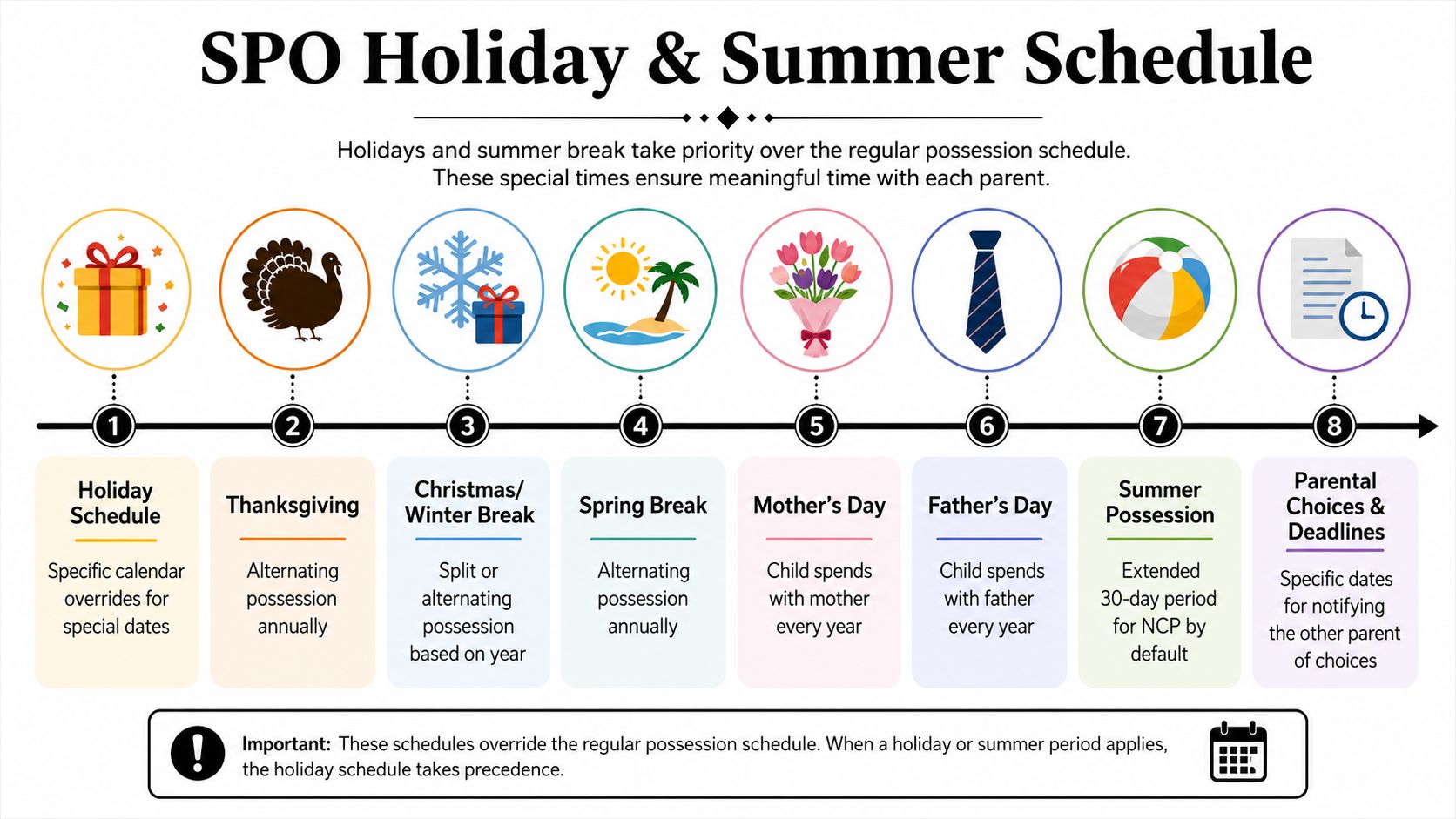
A standard holiday schedule usually works like a rotating pattern. One parent has a holiday in one year, and the other parent has it the next. That structure can feel disappointing in the moment, especially if this is your first holiday season after separation. But it also gives families something very valuable: predictability.
A simple way to think about holiday overrides
Suppose a parent is scheduled for a first weekend in November, but the holiday schedule gives Thanksgiving to the other parent that year. The holiday schedule usually takes priority. That's why many disputes happen when parents look only at the monthly weekend calendar and forget the holiday provisions.
This timeline can help you visualize how those overrides work in practice.
Texas Standard Holiday Possession Schedule (Alternating Years)
| Holiday | Possession in Even-Numbered Years | Possession in Odd-Numbered Years |
|---|---|---|
| Thanksgiving | One parent under the order's alternating pattern | The other parent under the order's alternating pattern |
| Christmas/Winter Break | One portion or designated period under the order's alternating pattern | The other portion or designated period under the order's alternating pattern |
| Spring Break | One parent under the order's alternating pattern | The other parent under the order's alternating pattern |
If you want a closer look at common holiday issues, this guide on the Texas holiday possession schedule is a useful next read.
Summer possession in real life
Summer often gives the non-primary parent an extended period of possession. In practical terms, that can mean camp drop-offs, road trips, family reunions, or several weeks of ordinary parenting that are hard to fit into the school year.
Here's where planning matters most:
- Give notice early: Many summer conflicts happen because one parent assumes dates instead of putting them in writing.
- Check overlap with vacations: Parents should compare work schedules, travel plans, and the child's activities well in advance.
- Stay child-focused: A summer schedule should still support rest, routine, and communication.
Holiday schedules usually override the regular weekend pattern. Keep a separate yearly calendar so you don't accidentally rely on the wrong rule.
For a child, alternating holidays can be emotional. One year they wake up in one home on Christmas morning. The next year they may be somewhere else. Parents can soften that transition by creating traditions that travel well, such as a special meal, a movie night, or opening one gift early. The calendar may rotate, but the child still needs a sense that both homes remain emotionally steady.
When the Standard Order Does Not Fit
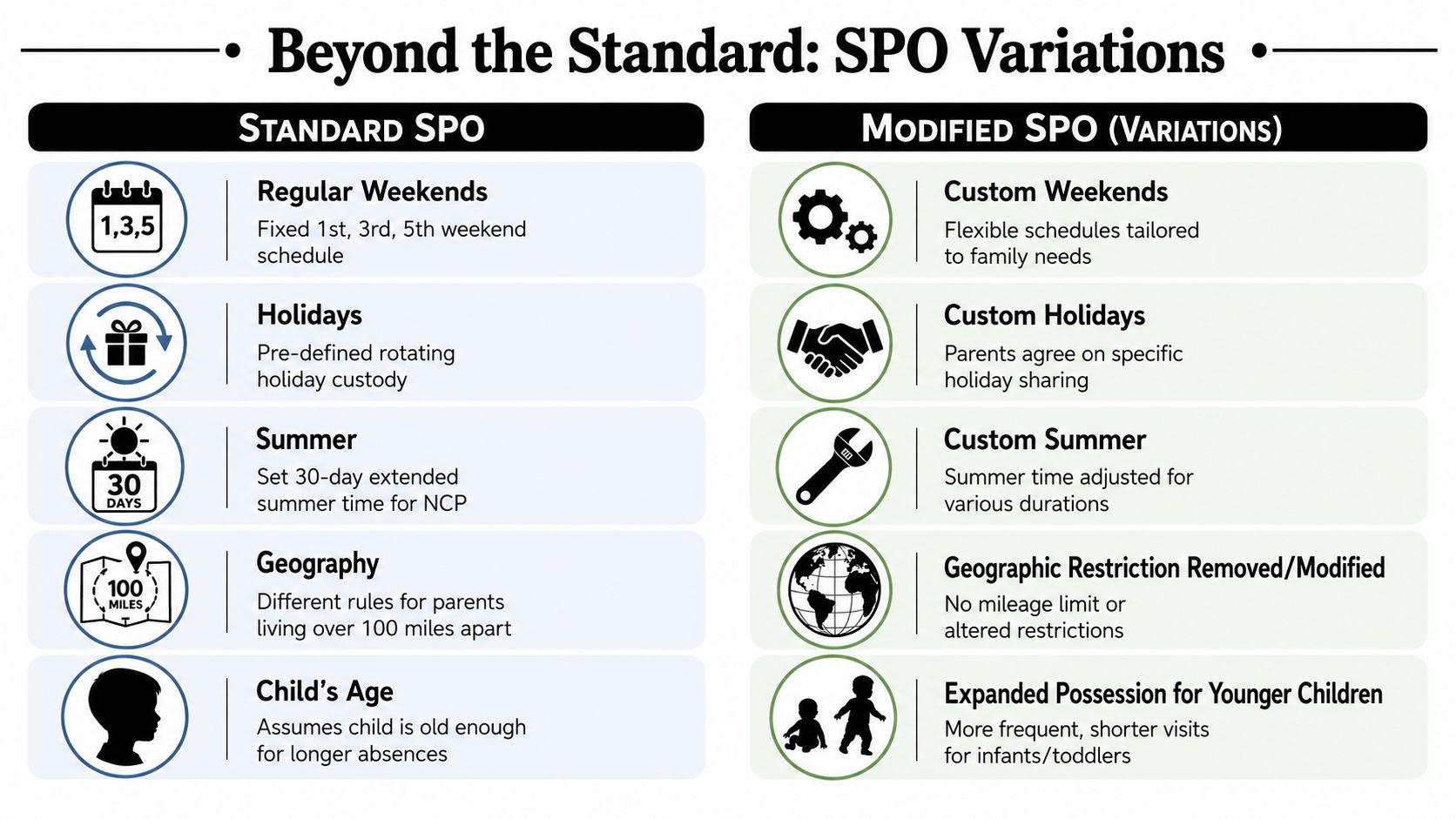
The standard order works for many families, but not all families live standard lives. Some parents live far apart. Some children are very young. Some military families deal with deployment, training, or relocation that makes a fixed routine harder to maintain.
That's where a modified order may be necessary. The goal isn't to reject structure. It's to build a structure that fits the child's real world.
Younger children and shorter visits
A toddler may not respond well to the same rhythm that works for an older child. Long stretches away from one parent can be hard when a child is still building attachment, sleeping on a delicate routine, or adjusting to daycare.
In those cases, parents sometimes need shorter, more frequent periods of possession. That can help the child maintain strong bonds without putting too much stress on the child's developmental stage.
Compare the two approaches:
| Situation | Standard approach | Modified approach |
|---|---|---|
| Older child with established routine | Longer blocks of possession may work well | Usually less need for frequent short visits |
| Infant or toddler | Standard timing may be too rigid | Shorter, more frequent contact may fit better |
| Child with special routines | General schedule may not account for those needs | Custom exchange and timing terms may help |
Parents who live far apart
Distance changes everything. A schedule that works across town may be unrealistic across cities or states. Long drives, flight schedules, missed school time, and travel fatigue all affect the child.
When parents live farther apart, possession often has to be consolidated into fewer but longer periods. That can make travel more manageable and reduce constant disruption.
- Travel burden matters: A child shouldn't spend every visit exhausted from transportation.
- School attendance matters too: The schedule should support learning, not repeatedly interrupt it.
- Communication becomes more important: Parents need clear written notice and careful planning.
Military families and flexible orders
Military parents often need orders that account for service obligations. Deployment, temporary duty assignments, and relocation can all affect possession. The law can be designed to preserve a service member's relationship with the child while also maintaining stability.
For fathers and mothers in uniform, that may mean adding detailed terms about virtual contact, makeup time, or who helps with exchanges during periods of military service. For the other parent, it can also mean creating a plan that keeps the child grounded during unavoidable changes.
The right custody order should fit the child's life, not force the child to fit an unrealistic calendar.
Grandparents and other caregivers sometimes play a practical support role in these situations too. Even when they aren't parties to the case, their help with transportation, routines, and communication can make a modified plan more workable.
Enforcing or Modifying Your Possession Order
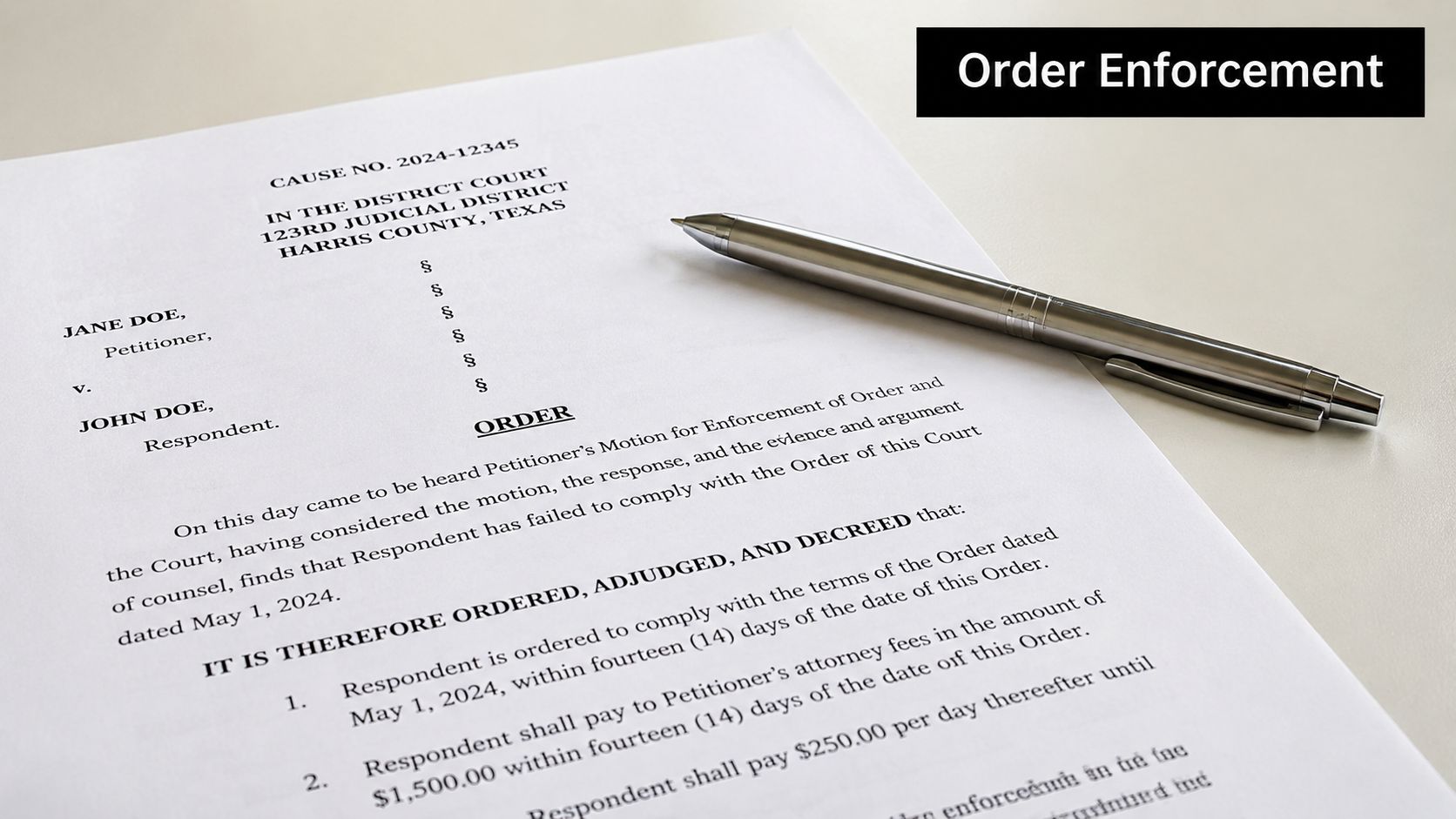
A court order only helps if both parents follow it. When one parent repeatedly refuses exchanges, returns the child late, or ignores the written schedule, the issue stops being just frustrating. It becomes a legal problem.
That doesn't mean every mistake should trigger a courtroom fight. Parents are human. Traffic happens. Illness happens. But a pattern of interference needs to be addressed clearly and calmly.
When enforcement may be necessary
If the other parent is denying your court-ordered time, start with documentation. Keep messages, note dates and times, and save anything that shows what the order required and what happened. A judge needs specifics, not general frustration.
Enforcement cases often turn on details such as exact exchange times, locations, and missed periods of possession. That's one reason clear drafting matters so much. The more precise the order, the easier it is to show whether someone followed it.
Helpful first steps often include:
- Read the order line by line: Memory is not enough. Use the actual language.
- Keep a written log: Note missed exchanges, late returns, and denied access.
- Communicate carefully: Short, respectful written messages are often better than angry calls.
Some families also explore non-court conflict-reduction tools before or alongside legal action. Resources discussing AI-guided family dispute insights can help parents think about mediation and structured communication in a lower-conflict way.
When modification makes more sense
Sometimes the problem isn't that someone is breaking the order. It's that the order no longer fits the family. A child may be older now. A parent may have changed jobs. One household may have moved. The child's school or medical needs may look very different from when the order was signed.
In those situations, modification may be more effective than repeated arguments about a schedule that has become unrealistic. Texas courts may consider changing an order when there has been a meaningful change in circumstances and the new arrangement serves the child's best interests.
One practical resource is this guide on how to modify custody in Texas.
Taking control of the situation
Parents often feel powerless when the schedule keeps breaking down. You're not powerless. You do have options, and using them doesn't make you difficult. It makes you protective of your relationship with your child.
If you need legal help evaluating whether to enforce or modify an order, Law Office of Bryan Fagan, PLLC handles Texas family law matters involving custody, visitation, possession rights, and post-order disputes.
For mothers and fathers alike, the key is to act with purpose. Don't rely on verbal side deals that keep failing. Don't wait until resentment has piled up for months. A clear legal response can protect your parenting time and reduce future conflict.
Key Takeaways and Your Next Steps
The Texas standard possession order gives many families a starting point when they need structure most. It helps create a predictable routine for the child, separates legal rights from parenting-time rules, and gives parents a framework for weekdays, weekends, holidays, and summer.
That said, a default calendar isn't the same as a perfect fit. Some families need expanded time. Some need a modified plan because of distance, a young child, or military service. Others need help because the current order isn't being followed.
A useful next-step checklist looks like this:
- Review your current order: Confirm who has the right to determine primary residence and what the possession terms say.
- Map the calendar: Put weekends, school breaks, holidays, and summer dates on one shared calendar.
- Notice recurring problems: Ask whether the issue is noncompliance, poor communication, or an order that no longer fits.
- Think about the child's daily life: Focus on school, transitions, emotional stability, and practical routines.
- Get legal advice before conflict grows: A small scheduling problem can turn into a larger custody dispute if left alone.
The strongest custody plans are the ones parents can actually follow in real life.
You don't have to figure this out alone. If you're a mother protecting stability, a father trying to preserve parenting time, or a caregiver looking for clarity, informed legal guidance can make the process less overwhelming and far more manageable.
If you need help with a child custody or visitation case in Texas, our experienced attorneys can guide you every step of the way. Contact The Law Office of Bryan Fagan, PLLC today for a free consultation.
If your current schedule feels confusing, unfair, or impossible to manage, a personalized legal review can help you understand your options. The attorneys at Law Office of Bryan Fagan, PLLC work with Texas families on custody, visitation, enforcement, and modification issues, and can help you build a plan that protects your relationship with your child.