
When your child’s future is on the line, understanding your rights as a father matters most. In Texas, the law is clear: your rights are legally equal to the mother's. Gender plays no role in custody decisions. Instead, every ruling is based on one guiding principle: the best interest of the child.
This means every dad starts on a level playing field. Facing uncertainty about your role can be one of life's most stressful experiences, but this guide is here to provide the clarity and confidence you need to protect your relationship with your child.
How Texas Law Views Your Role as a Father
It's time to bust a common myth: that Texas courts automatically favor mothers in custody cases. That's simply not true. The Texas Family Code is written to be gender-neutral, giving you the same opportunity as the mother to be a central part of your child’s life.

However, there's a difference between having rights and actively protecting them. While the law promotes equality, statistics show that fathers are often awarded only about 33% of parenting time in Texas family courts. You can read the full report on Texas court statistics for more details. This reality is exactly why you must be proactive and take the right legal steps to secure your role.
The Building Blocks of Your Parental Rights
To advocate effectively for yourself and your child, you first need to understand the core legal concepts that will shape your case. Think of these as the essential building blocks for any father navigating the Texas family court system:
- Establishing Paternity: For unmarried fathers, this is the absolute, non-negotiable first step. Without legally establishing that you are the father, you have no enforceable rights to custody or visitation. A name on a birth certificate isn’t enough.
- Conservatorship (Decision-Making): This is what Texas calls custody. It outlines your legal rights and responsibilities to make important decisions for your child—like their education, medical care, and religious upbringing.
- Possession and Access (Visitation): This refers to the actual schedule that determines when your child lives with each parent. Texas has a Standard Possession Order that lays out a default schedule for weekends, holidays, and summer breaks.
Consider this guide your roadmap. It’s designed to arm you with the knowledge you need to protect your relationship with your child and secure your legal rights from day one.
Key Legal Terms Every Texas Parent Should Know
Navigating a custody case can feel like learning a new language. This table breaks down the most common terms into plain-English explanations so you're never left guessing.
| Legal Term | Plain-English Explanation |
|---|---|
| Paternity | The legal process of identifying a child's biological father. This is the foundation of all other parental rights for unmarried fathers. |
| Conservatorship | The Texas legal term for "custody." It defines a parent's rights and duties to make decisions for the child. |
| Joint Managing Conservator | The most common arrangement, where both parents share decision-making rights and responsibilities for the child. |
| Sole Managing Conservator | An arrangement where one parent is given the exclusive right to make most major decisions for the child. |
| Possessory Conservator | A parent who has visitation rights (possession and access) but doesn't have the final say on most major decisions. |
| Possession Order | The court-ordered schedule that details when the child will be with each parent (i.e., the visitation schedule). |
| Standard Possession Order (SPO) | The default visitation schedule in Texas, which is presumed to be in the child's best interest. |
| Best Interest of the Child | The legal standard judges must use for all decisions about custody, visitation, and child support. |
| Suit Affecting the Parent-Child Relationship (SAPCR) | The official name for the lawsuit that establishes or modifies custody, visitation, and child support. |
Understanding these terms will help you follow court proceedings and communicate more effectively with your attorney. Knowledge is your best tool in this process.
Establishing Paternity: Your First and Most Critical Step
For fathers in Texas, the path to securing parental rights begins with one foundational move: establishing paternity. If you weren't married to your child's mother when they were born, the state doesn't automatically recognize you as the legal father—even if your name is on the birth certificate.
Without legal recognition, you have no enforceable rights. You can't ask a court to grant you time with your child (possession) or a say in their upbringing (conservatorship). It's the key that unlocks every other right you have as a parent.
Think of it this way: your biological connection creates a relationship, but only the legal process of establishing paternity creates your rights. Fortunately, Texas provides two clear pathways to get it done.
Two Paths to Legal Fatherhood
For an unmarried father, proving you're the child's legal parent is the cornerstone of your entire relationship under the law. Understanding your options is the first step in protecting your role in your child's life.
- Voluntary Acknowledgement of Paternity (AOP): This is a legal form, often offered at the hospital after the child is born, that both parents can sign. By signing the AOP, you and the mother agree under oath that you are the child’s biological father.
- Court Order: This route involves filing a lawsuit called a Suit to Adjudicate Parentage. This formal court process legally declares you as the father, often after DNA testing confirms the biological relationship.
While signing an AOP seems simpler, it’s critical to understand its limitations.
Why a Court Order Offers Stronger Protection
An AOP is a valid way to establish a legal parent-child relationship, and it's a good first step for many parents on good terms. However, it does not automatically grant you any custody or visitation rights.
An AOP opens the door to your rights, but a court order walks you through it and gives you a permanent seat at the table. To get a legally enforceable possession schedule and define your decision-making authority, you still need a court order.
A Suit to Adjudicate Parentage is a far more robust solution. This single legal action accomplishes several critical goals at once:
- It legally establishes you as the father.
- It creates a formal custody order (conservatorship).
- It sets a specific, court-ordered visitation schedule (possession order).
- It establishes a child support order.
Filing this suit provides the strongest possible legal shield for your rights as a dad. It resolves all key issues in one proceeding, leaving no room for doubt about your role and responsibilities. It transforms you from a biological father into a legal parent with court-backed authority. For a more detailed look at this process, you can learn more about how to establish paternity in Texas in our dedicated guide.
How Texas Determines Custody: Conservatorship and Possession
In a Texas family court, words like "custody" and "visitation" are replaced with conservatorship and possession orders. It may sound intimidating, but understanding these terms is the key to protecting your role in your child's life.
Think of it this way: conservatorship is the legal framework for your parental rights—who gets to make big decisions. A possession order is the calendar—it lays out the specific schedule of when your child is with each parent. Let's break down what this means for you as a father.
Understanding Conservatorship: Your Decision-Making Rights
Under Texas Family Code Chapter 153, the law presumes it's in a child's best interest for both parents to share in the rights and duties of raising them. This shapes the most common custody arrangements in the state.
- Joint Managing Conservatorship (JMC): This is the default arrangement in Texas. In a JMC, you and the other parent share the authority to make key decisions about your child's education, medical care, and religious upbringing. It doesn't guarantee a 50/50 split of time, but it ensures you are a co-parent with a legal voice.
- Sole Managing Conservatorship (SMC): This is far less common and is typically only granted if there is a history of family violence, substance abuse, or extreme conflict that would harm the child. The Sole Managing Conservator has the exclusive right to make most major decisions.
For most fathers, being named a Joint Managing Conservator is the goal. It solidifies your position as a central, decision-making figure in your child's life. Our attorneys can help you navigate the details of conservatorship in Texas and advocate for your rights.
This flowchart shows the critical path an unmarried father must take to become a parent with legally protected rights.
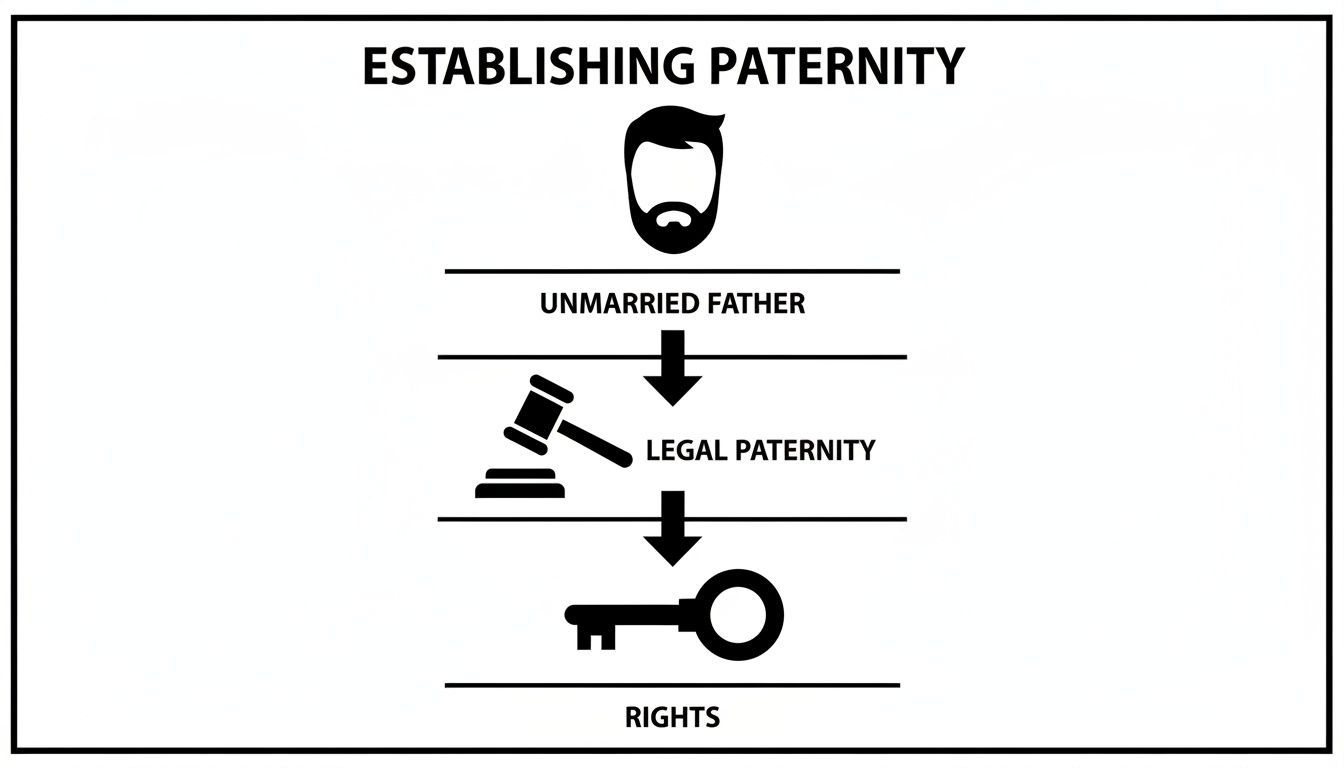
As you can see, for unmarried fathers, establishing legal paternity is the non-negotiable gateway to securing enforceable rights like conservatorship and a possession schedule.
The Standard Possession Order: Your Parenting Schedule
Once conservatorship is decided, the court creates a possession order. This is the schedule that dictates when each parent has the child. Unless both parents agree on a custom schedule, Texas courts usually implement the Standard Possession Order (SPO). The law presumes the SPO is in the child's best interest because it provides a clear, predictable routine.
The SPO works differently depending on how far apart the parents live.
Key Takeaway: The Standard Possession Order is designed to ensure both parents have frequent, meaningful, and continuous contact with their child. It is the default schedule because Texas law recognizes that children benefit when both parents are actively involved.
For parents who live under 100 miles apart, the SPO generally gives the non-primary parent possession of the child on:
- The first, third, and fifth weekends of the month.
- Alternating major holidays, like Thanksgiving and Christmas.
- At least 30 days in the summer.
If you live over 100 miles apart, the schedule adjusts to make travel less disruptive. The non-primary parent might get every spring break, a longer summer possession (often 42 days), and the choice of one weekend a month. This structure ensures that fathers who live farther away still have substantial, quality time with their kids.
Child Support: Rights and Responsibilities for Fathers
Child support can feel like a heavy topic, but it's important to see it for what it truly is: a direct way to provide for your child's daily needs. Consistently paying child support shows your commitment and strengthens your position as a responsible, involved father.
While Texas law separates visitation from child support obligations, judges notice when a father reliably meets his financial duties. Fulfilling this responsibility doesn't just support your child; it builds your credibility in court.

It’s crucial to understand both your rights and responsibilities. This is about ensuring your child has what they need while making sure the amount you pay is fair and based on your actual income.
How Texas Calculates Child Support
Texas uses a standard formula to calculate child support based on the non-primary parent's net monthly resources.
Here’s a simple look at how it works:
- Determine Gross Income: The court adds up all sources of income, including salary, wages, bonuses, overtime, and self-employment earnings.
- Calculate Net Resources: Certain deductions are made from the gross income, such as federal and state income taxes, Social Security taxes, union dues, and the cost of the child's health insurance. The remaining amount is your "net monthly resources."
- Apply Guideline Percentages: The court applies a specific percentage to your net resources based on the number of children in the support order.
The Texas Family Code provides guideline percentages that are presumed to be in the child's best interest, creating a clear and predictable starting point for everyone.
| Texas Child Support Guideline Percentages |
| :— | :— |
| Number of Children | Percentage of Net Resources |
| 1 Child | 20% |
| 2 Children | 25% |
| 3 Children | 30% |
| 4 Children | 35% |
| 5 or more Children | 40% |
These percentages may be adjusted if you are legally required to support children from another relationship. Our attorneys can walk you through the specifics and explain how to get child support orders established or modified in Texas.
Your Rights as a Paying Parent
You have a responsibility to pay, but you also have rights. As a paying parent in Texas, you should be aware of the following:
- Right to an Accounting: You can formally request a detailed report showing how child support payments are being spent.
- Right to Medical and Dental Support Details: If you provide health insurance for your child, you have a right to information about their medical care.
- Right to Modify: If your financial situation changes significantly—due to a layoff, illness, or major pay cut—you have the right to ask the court to modify the support amount. You cannot stop paying on your own; a new court order is required.
Meeting your child support obligation is one of the most powerful ways to stay involved in your child’s life, ensuring their needs are met and solidifying your role as a dedicated parent.
Steps to Modify or Enforce a Custody Order
A court order is a legally binding roadmap for your family. But life is unpredictable, and what worked for your child last year might not be what’s best today. These orders aren’t carved in stone; they can and should be changed to reflect new realities.
It's also important to remember that these orders are not suggestions. If the other parent is ignoring the rules—like denying your court-ordered time with your child—you have powerful legal tools to enforce your rights.
How to Modify a Custody or Support Order
To change an existing order in Texas, you must prove there has been a “material and substantial change” in circumstances. This means the change must be significant and lasting.
Common examples include:
- Significant Job Changes: A promotion with a new schedule or an unexpected job loss that impacts your ability to follow the current possession order.
- Relocation: One parent plans to move to another city or state, making the current visitation plan unworkable.
- Your Child's Evolving Needs: As children grow, their needs change. A court may consider a teenager's preference if they are over 12.
- Changes in the Other Parent's Home: Concerns about a new partner, substance abuse, or other issues that could put your child's well-being at risk.
If a major change has occurred, the next step is to file a Petition to Modify the Parent-Child Relationship. The court will then determine if changing the order is in your child's best interest.
Enforcing Your Right to Visitation
It is gut-wrenching when you show up to pick up your child and the other parent refuses to open the door. This is a direct violation of a court order, and you have every right to take action.
Don’t let it slide. The most powerful thing you can do is document every time you are denied a visit. Keep a detailed log with dates, times, and any excuses you were given. This evidence is crucial for building an enforcement case.
If the other parent consistently blocks your court-ordered time, you can file a Motion for Enforcement. This asks a judge to force the other parent to follow the rules. A court can enforce your rights by:
- Ordering make-up visitation time.
- Forcing the non-compliant parent to pay your attorney's fees.
- Imposing fines for violating the order.
- In cases of repeated violations, even ordering jail time.
Your rights as a father are protected by Texas law. Knowing how to modify your order when life changes and enforce it when it’s ignored is key to ensuring your relationship with your child stays strong.
Handling Special Circumstances and Emergencies
Life doesn’t always follow a predictable script. Texas law offers clear pathways for fathers facing unique challenges, from military deployments to sudden safety concerns. Knowing your options in these specialized scenarios is key to protecting your rights.
Some situations require a deeper understanding of specific rules that apply to military families, parents who need to relocate, or families facing an immediate threat. These moments can feel overwhelming, but the law provides tools to manage them.
Rights of Military Fathers
Serving your country should never mean giving up your rights as a father. The Servicemembers Civil Relief Act (SCRA) provides special protections for military parents. If you are deployed or must relocate due to military orders, these laws can prevent a court from issuing a default custody order against you just because you cannot appear in person.
While deployed, a court can grant temporary custody to a family member you designate, like a grandparent or stepparent. These orders are temporary and designed to protect your possession schedule until you return—pressing "pause" on custody matters, not erasing your rights.
Navigating Relocation and Geographic Restrictions
What happens when one parent wants to move away with the child? Most Texas custody orders include a geographic restriction, which limits the child’s primary residence to a specific area—usually a particular county and those surrounding it. This ensures both parents can maintain a strong, consistent relationship with their child.
If one parent wants to move outside this area, they need either the other parent’s written permission or a new court order. To get a judge's approval, the parent must prove:
- There has been a material and substantial change in circumstances.
- The move is in the child’s best interest.
A court will consider the reason for the move, the potential benefits for the child, and how the move would impact the non-moving parent’s relationship with the child. As a father, you have the right to object to a proposed relocation if you believe it would damage your bond with your child.
Seeking Emergency Orders
Sometimes, a child's immediate safety is at risk, and waiting for a standard hearing isn't an option. In these urgent cases, you can ask a court for an emergency order, most commonly a Temporary Restraining Order (TRO).
A TRO is a powerful, short-term court order designed to prevent immediate and irreparable harm to a child. It can be issued quickly to stop an emergency in its tracks.
A father might seek a TRO if he has evidence of:
- Physical or emotional abuse of the child.
- The other parent engaging in dangerous activities, such as substance abuse, around the child.
- A credible threat that the other parent is about to abduct the child.
A TRO typically lasts for 14 days and sets a hearing where both parents can present their case. These emergency actions are a critical safety net, ensuring the law can step in swiftly to protect a child from harm.
Common Questions About Fathers' Rights in Texas
Getting straight answers from the legal system can feel challenging. We've compiled some of the most common questions we hear from fathers in Texas to give you the practical clarity you need.
Can I Get 50/50 Custody of My Child in Texas?
Yes, a 50/50 possession schedule is achievable in Texas, but it isn't the automatic starting point. You must prove to a judge that an equal schedule is in the “best interest of the child.” This often involves showing practical factors, such as how well you and the mother co-parent, how close your homes are to each other and the child's school, and why your child's age and needs make a 50/50 split a good fit.
Does It Matter If I Was Never Married to My Child's Mother?
Yes, this is a critical distinction. If you were never married to your child's mother, you have no legal rights to your child—even with your name on the birth certificate—until paternity is formally established. This is done either through a court order or by signing an Acknowledgment of Paternity. Once paternity is legally established, you have the same rights and responsibilities as a father who was married to the child's mother.
Can My Child's Mother Move Away With Them?
Not without your permission or a court order. Most Texas custody orders include a geographic restriction that limits the child’s primary residence, usually to the county you live in and its adjoining counties. If she wants to move beyond that area, she needs your written agreement or must get a judge's permission to modify the order.
What If My Ex Denies My Court-Ordered Visitation?
If your ex prevents you from seeing your child in violation of a court order, you have legal recourse. The next step is to file an enforcement action with the court. It is critical to document every time a visit is denied, keeping a log of dates, times, and any reasons given. A judge can enforce the order and has the power to order make-up visitation time, impose fines, or, in cases of repeated violations, order jail time.
When dealing with court filings, protecting personal information is a top priority. Learning about securely redacting sensitive information in PDF documents is a smart way to keep your data safe.
Next Steps: Protecting Your Rights as a Father
Navigating a custody case can be emotionally draining, but you don't have to do it alone. The most important step you can take is to arm yourself with knowledge and secure experienced legal guidance.
Your key takeaways should be:
- Texas law is gender-neutral: Your rights as a father are equal to the mother's.
- Paternity is non-negotiable: For unmarried fathers, establishing legal paternity is the first step to securing any rights.
- Court orders are your shield: A formal custody and possession order is the only way to create legally enforceable rights to see your child and have a say in their life.
- Documentation is power: Keep detailed records of visitation denials, financial contributions, and any significant events.
If you need help with a child custody or visitation case in Texas, our experienced attorneys can guide you every step of the way. Contact The Law Office of Bryan Fagan, PLLC today for a free consultation.