
When your child’s future is on the line, understanding your rights matters most. Legal terms like 'conservatorship' can feel overwhelming and impersonal, but it’s a word you'll hear a lot in Texas family courts. So, what does it really mean for your family? Put simply, conservatorship is the legal term for child custody in Texas. It's the court-ordered framework that defines each parent's rights and responsibilities, creating a stable, loving, and predictable plan for your child's life moving forward.
This guide is here to walk you through the process with clarity and compassion, so you can understand your options and feel confident in the decisions you make for your family.
What Conservatorship Really Means for Your Child's Future

Navigating a custody case can feel like learning a new language, and "conservatorship" is one of the most important words in that vocabulary. It is the foundation of every custody order in the state. At its core, a conservatorship order outlines who gets to make the big decisions for your child—like where they go to school or what doctor they see—and establishes the possession schedule for when each parent will have the child in their care. The entire point is to protect your child’s well-being by creating a supportive and predictable environment.
The Texas Family Code always starts with the assumption that it's best for a child to have both parents actively involved in their life. This guiding principle shapes how courts approach custody arrangements.
Joint Managing Conservatorship is the Texas Standard
Here in Texas, the law starts with a very strong belief: it’s almost always in a child’s best interest for both parents to be named Joint Managing Conservators (JMC). This is by far the most common arrangement you'll see in Texas courts.
Being a JMC doesn't automatically mean a 50/50 split of time with your child. What it does mean is that you and the other parent will share the fundamental rights and duties of raising your child. Key responsibilities typically shared by Joint Managing Conservators include:
- Making joint decisions about your child's education and healthcare.
- Having the right to access your child’s school and medical records.
- The duty to support your child, both financially and emotionally.
This approach encourages parents to work together for their child's benefit, even if they're no longer a couple. It’s the court’s way of saying that both parents play a vital role in a child’s life.
A common misconception is that one parent "wins" and the other "loses" custody. Under a Joint Managing Conservatorship, the focus shifts from winning to co-parenting effectively. The court’s order provides a roadmap for how you will work together.
Of course, there are situations where a joint arrangement just isn't safe or appropriate. In cases involving family violence, neglect, or substance abuse, a court will likely decide that naming one parent as the Sole Managing Conservator is necessary to protect the child. This gives one parent the exclusive right to make most of the major decisions. Understanding this distinction is absolutely crucial, and you can learn more in our detailed guide on what it means to be a Sole Managing Conservator.
The Different Roles Parents Have in Texas Custody

When you're working through a custody case, it can feel like you're being assigned job titles for the most important role you'll ever have—being a parent. Understanding these legal roles is critical for protecting your relationship with your child. In Texas, the law outlines a few distinct roles that parents can take on, each with its own set of rights and responsibilities.
Joint Managing Conservatorship: A Co-Parenting Partnership
Think of Joint Managing Conservatorship (JMC) as a co-parenting partnership that's legally recognized by the court. It's the default arrangement because Texas law is all about keeping both parents engaged in their child's life. It's crucial to understand that JMC does not automatically mean a 50/50 split of possession time.
Instead, JMC means that you and the other parent share the rights and duties of raising your child, creating a framework for making major decisions together. Shared responsibilities under a JMC order often include:
- Jointly deciding on your child’s education.
- Making shared decisions about non-emergency medical, dental, and psychological care.
- Having the right to access your child’s school and health records.
- The duty to support your child, both emotionally and financially.
Even in a JMC setup, one parent is usually designated as the "primary" parent. This parent has the exclusive right to decide the child’s main residence (often within a specific geographic area) and is typically the one who receives child support payments.
Sole Managing Conservatorship: When One Parent Has the Final Say
While joint conservatorship is the norm, Texas courts know it isn’t always safe or practical. In some specific situations, one parent may be named the Sole Managing Conservator (SMC). This is a much less common outcome, usually reserved for cases where there's a history of family violence, child abuse or neglect, or severe substance abuse problems.
An SMC is given the exclusive authority to make most of the major decisions for the child without needing the other parent's input. This includes exclusive rights to:
- Designate the child’s primary residence.
- Consent to medical and dental treatment.
- Make all decisions about the child’s education.
A court will only order a Sole Managing Conservatorship if there is clear evidence that a joint arrangement would harm the child's physical or emotional well-being. The burden of proof is high, and the decision is always based on the best interest of the child.
When one parent is named the SMC, the other parent is almost always named the Possessory Conservator. This structure ensures they still have a right to be in their child’s life, but with more limited decision-making power.
Joint vs. Sole Managing Conservatorship at a Glance
| Feature | Joint Managing Conservatorship (JMC) | Sole Managing Conservatorship (SMC) |
|---|---|---|
| Decision-Making | Shared rights and responsibilities. Parents must consult each other on major decisions. | One parent has the exclusive right to make most major decisions without consulting the other. |
| Primary Residence | One parent is typically designated to establish the child's primary residence. | The Sole Managing Conservator exclusively establishes the child's primary residence. |
| Medical/Educational | Decisions are generally made jointly, unless a right is given exclusively to one parent. | The Sole Managing Conservator has the exclusive right to make these decisions. |
| Court Preference | Presumed to be in the child's best interest. This is the standard in Texas. | Ordered only in specific circumstances, such as family violence, abuse, or neglect. |
| Other Parent's Role | The other parent is also a Joint Managing Conservator with shared rights. | The other parent is typically named the Possessory Conservator with visitation rights. |
This table highlights the fundamental difference: JMC is about partnership, while SMC consolidates authority with one parent for safety reasons.
Understanding the Role of the Possessory Conservator
The term Possessory Conservator might sound complicated, but it simply refers to the parent who has visitation rights—what Texas law calls "possession and access." This parent has the right to spend time with their child according to a court-ordered possession schedule, like the Texas Standard Possession Order.
While a Possessory Conservator’s decision-making rights are limited, they are still a legal parent with important duties and privileges. They have the right to get information about their child's health, education, and general welfare, and they have the duty to provide financial support through child support payments.
For a deeper dive into this specific role, you can learn more about what a Possessory Conservator is in Texas in our detailed guide.
Knowing these roles helps you see how the court structures co-parenting plans. Whether you end up as a Joint Managing Conservator or a Possessory Conservator, the ultimate goal is always to create a stable and predictable routine that allows you to maintain a strong and loving relationship with your child.
How Texas Determines Custody: The "Best Interest of the Child" Standard
When you walk into a Texas family courtroom, you’ll hear one phrase over and over again: the “best interest of the child.” This isn't just a sentimental idea; it's the single, most important legal standard that guides every decision a judge makes about your family.
But what does “best interest” actually mean? It’s not about who has the nicer house or the bigger paycheck. Instead, the court uses a specific framework to build a complete picture of a child’s life and determine what arrangement will best support their physical, mental, and emotional health. This framework comes from a landmark Texas case that set the standard for decades to come.
The Holley Factors: A Judge's Guide
Years ago, the Texas Supreme Court case Holley v. Adams established a set of guidelines to help judges make fair and consistent decisions. We now know them as the Holley Factors. Think of them less as a rigid checklist and more as a roadmap a judge uses to explore a family’s situation from every angle. Getting familiar with these factors gives you a huge advantage because it shows you exactly what the court cares about.
Here are some of the key Holley Factors, explained in plain English:
- The Child’s Needs: This covers everything from their emotional and physical needs to their developmental stage. The court will look at a child's age, health, and any special requirements they might have.
- Parental Abilities: The judge examines each parent's capacity to meet the child's needs. This means looking at parenting skills, emotional stability, and the ability to provide a safe and nurturing home.
- Stability of the Home: A stable, predictable home life is crucial for a child's development. The court will consider the stability of each parent's proposed living situation.
- Parent-Child Relationship: The court wants to understand the quality of the bond that already exists between each parent and the child.
- Acts or Omissions: This allows the judge to look at past behavior—both good and bad—that might indicate a parent's fitness.
- Any Dangers: The judge has a duty to consider any potential emotional or physical danger to the child, whether it's an immediate threat or a future risk.
By understanding these criteria, you can better prepare your case to show the court how you provide a loving, safe, and stable life for your child.
How Judges Apply These Factors in Real Life
A judge doesn't just pick one or two factors. They weigh them all together to see the whole picture. There is no single factor that automatically wins or loses a conservatorship in Texas case.
For example, one parent might earn more money, but the other parent has always been the primary caregiver and shares a stronger emotional bond with the child. The court will balance these different strengths to find the best path forward.
The ultimate goal is to create an environment that fosters a child's happiness, security, and overall well-being. The Holley Factors are simply the tools a judge uses to figure out how to best achieve that goal for your specific family.
When it comes to a child's education, especially for those with unique learning needs, being familiar with resources like special education advocacy, IEPs, and 504 plans is a game-changer. It shows the court you're equipped to support their development and can heavily influence the outcome.
The Importance of a Cooperative Attitude
There's one unwritten factor that carries a surprising amount of weight: a parent’s willingness to co-parent effectively. A judge will pay close attention to how you and the other parent interact. Can you put your child’s needs ahead of your own frustrations? Are you willing to foster a positive relationship between your child and their other parent? Showing a cooperative spirit can make a huge positive difference in your case. For a complete breakdown of each factor, you can learn more by understanding Texas custody and the Holley Factors.
Your Step-by-Step Guide to the Court Process
When your child’s future is at stake, the thought of going to court can be intimidating. Our goal is to demystify this journey, giving you a clear, step-by-step roadmap of a typical conservatorship in Texas case. Knowing what to expect can replace anxiety with confidence, showing you that the legal process, while challenging, is structured and manageable.
This visual breaks down the core factors a judge will look at every single step of the way: your child's needs, the stability you can offer, and how well you and the other parent can co-parent.
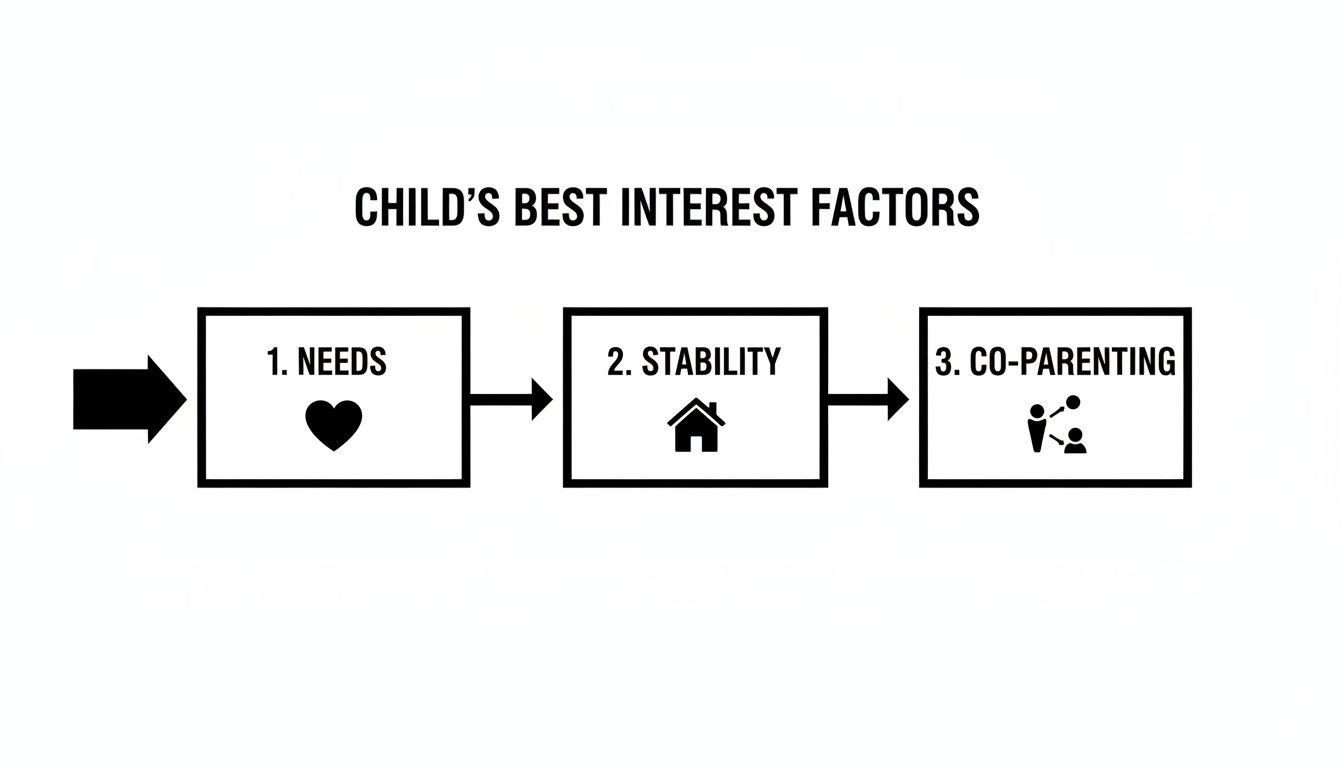
As you move through the court process, remember that every piece of evidence and testimony ultimately connects back to demonstrating your ability to meet these fundamental needs for your child.
Step 1: Filing the Petition
Every conservatorship case officially begins when one parent files an Original Petition in Suit Affecting the Parent-Child Relationship (SAPCR). This is a formal legal document filed with the court in the county where your child lives. It tells the court what you are asking for regarding custody, visitation, and support. Once filed, the other parent must be officially notified through a process called "service," which ensures both parents have a fair chance to respond.
Step 2: Setting the Ground Rules with Temporary Orders
Because a final custody decision can take months, the court will almost always hold a hearing to put temporary orders in place. Think of these as a set of ground rules that both you and the other parent must follow while the case is ongoing. These orders are designed to address immediate issues, like:
- Who the child will live with for now.
- A temporary visitation schedule.
- Temporary child support and who covers medical costs.
- Geographic restrictions to keep one parent from moving far away with the child.
This hearing is a critical early milestone, as it establishes a status quo that can influence the final outcome.
Step 3: Finding Common Ground Through Mediation
Before you go to trial, Texas courts require parents to attend mediation. This is a confidential meeting where you, the other parent, and a neutral third-party mediator try to reach an agreement on your own terms.
Mediation is a powerful opportunity for you to take back control and create a custom parenting plan that actually works for your family, instead of leaving it all up to a judge who doesn't know you.
The vast majority of Texas custody cases are settled during mediation. It’s less stressful, less expensive, and gives you a much bigger say in the final order. Your attorney will be there to advise you and help you negotiate effectively.
Step 4: Gathering Information in the Discovery Phase
If you can’t reach a full agreement in mediation, your case moves into the discovery phase. This is the formal process where both sides gather information and evidence from each other. Common discovery tools include:
- Requests for Disclosure: Standard questions asking for basic case information.
- Interrogatories: Written questions the other side must answer under oath.
- Requests for Production: Asking for documents like bank statements or emails.
- Depositions: Out-of-court testimony given under oath.
This stage is crucial for building your case and understanding the strengths and weaknesses of the other side’s position. It’s also where broader trends, like Texas's annual divorce rate of 1.9 per 1,000 residents, can inform legal strategy. You can learn more about the divorce and custody statistics that shape the Texas family law system.
What Happens When DFPS (CPS) Gets Involved?
Sometimes, when there are serious worries about a child's safety, the Texas Department of Family and Protective Services (DFPS)—also known as Child Protective Services or CPS—can step in. This is different from a private custody dispute. A DFPS case starts because the state has reason to believe a child is at risk of abuse or neglect. The goal isn't to punish parents; it's to ensure kids are safe, with the primary objective always being to reunite the family if possible.
If DFPS contacts you, a caseworker will investigate the report. You have rights during this stage, and it is a critical time to seek legal advice. If the caseworker believes there’s a danger, they can seek an emergency court order, which kicks off a formal court case where DFPS, not the other parent, is the one filing the lawsuit. The court will likely order a "service plan" for the parents, which is a roadmap of steps you need to take to resolve the issues. This might include:
- Attending parenting classes or counseling.
- Undergoing a substance abuse assessment or treatment.
- Making specific safety improvements to your home.
When a child's well-being is at risk due to substance use, DFPS involvement becomes a real possibility. For parents facing these specific challenges, resources on understanding teen substance use can offer valuable guidance.
The good news is that DFPS is making real progress in managing caseloads. As of February 2025, the statewide average was just 9.5 children per worker, well below the state's target. This means caseworkers have more time to focus on your family's reunification plan, which can lead to a quicker, better resolution. You can learn more about the DFPS caseload findings in their official reports.
Your active and consistent participation in your service plan is the most powerful way to show the court you are committed to your child's best interests. Document every class, every appointment, and every step you take toward creating a safe home.
Successfully completing your service plan is the clearest path to getting your child back home. An experienced family law attorney is your most important ally through this process, ensuring your parental rights are protected.
Common Questions About Conservatorship in Texas
When you're in the middle of a custody case, the questions can feel endless. You are not alone. We’ve put together straightforward answers to the questions we hear most often from families just like yours to bring you some clarity and peace of mind.
How Can I Modify a Custody Order?
Life changes, and what worked last year might not work today. To change a court order in Texas, you must file a Petition to Modify the Parent-Child Relationship. You have to prove to the judge that there has been a "material and substantial change" in circumstances since the last order was signed. This could be a parent's relocation, a major shift in a work schedule, or new concerns about the child's safety. Simply wanting a different schedule isn't enough; you must show that because of this big change, the current order is no longer in your child’s best interest.
What is the Standard Possession Order?
The Texas Standard Possession Order (SPO) is the state's default visitation schedule. It’s designed to ensure both parents have consistent, meaningful time with their child. For parents living within 100 miles of each other, a typical SPO looks like this:
- The non-primary parent has the children on the first, third, and fifth weekends of a month.
- Major holidays, like Thanksgiving and Christmas, are split and alternated each year.
- An extended summer visit, usually 30 days, for the non-primary parent.
The goal is predictability and routine. Kids thrive on knowing what to expect, and the SPO provides a stable foundation.
It's crucial to remember that the SPO is just a starting point. Parents can always agree to a different schedule that fits their family's unique needs. As long as it's in the child's best interest, a judge will almost always sign off on it.
Is it true that courts favor mothers over fathers?
This is one of the most stubborn myths in Texas family law, and it is 100% false. The Texas Family Code is very clear: courts cannot make decisions based on a parent's gender. The law is neutral. The only thing that matters is the best interest of the child. Judges rely on the Holley Factors to determine which parent can provide the most stable and nurturing environment. A father who has been an active, hands-on parent has just as strong a chance at being named the primary conservator as a mother does.
What if the other parent isn't following the custody order?
It is beyond frustrating when a court order is ignored. If the other parent is denying your court-ordered time, you have a legal remedy: filing a Motion for Enforcement. This asks the judge to step in and force the other parent to comply. If the judge finds they’ve intentionally violated the order, the consequences can be serious. A judge can order:
- Make-up visitation time.
- The non-compliant parent to pay for your attorney's fees.
- Fines or, in serious cases, even jail time.
Start documenting every single violation with dates, times, and specific details. This evidence is essential for protecting your relationship with your child.
If you need help with a child custody or visitation case in Texas, our experienced attorneys can guide you every step of the way. Contact The Law Office of Bryan Fagan, PLLC today for a free consultation.
Your Next Steps to Protect Your Family
Understanding your rights is one thing, but taking decisive action is what secures your child’s future. Texas law is built to support stable, loving co-parenting relationships, and the legal process gives you a clear path forward. Whether you're creating a new parenting plan or modifying an old one, your strategy should be built on clarity and solid preparation.
Key Takeaway
The single most important thing you can do is focus on documenting everything that shows your unwavering commitment to your child's best interests. This creates a powerful and honest record for the court to see. Go into mediation with a cooperative mindset, but always be ready to stand firm for what your child truly needs. Remember, you don't have to navigate the complexities of a conservatorship in Texas case on your own.
If you need help with a child custody or visitation case in Texas, our experienced attorneys can guide you every step of the way. Contact The Law Office of Bryan Fagan, PLLC today for a free consultation.