
When your child’s future is on the line, understanding your rights isn't just important—it matters most. Filing for custody in Texas can feel like a daunting journey, but it's a formal legal process designed with one primary goal: to create a stable, supportive, and loving environment for your child.
This process is officially called a “Suit Affecting the Parent-Child Relationship,” or SAPCR. Every decision a judge makes, every form you fill out, and every conversation you have will be guided by a single principle: the best interests of your child. We're here to walk you through it, step by step.
Your First Steps to Protect Your Child's Future

Making the decision to start a custody case is deeply personal. It often comes with a tangled mix of anxiety, determination, and uncertainty. Whether you’re a parent navigating a divorce, an unmarried mother or father seeking to define your rights, or a concerned grandparent stepping in to help, your feelings are completely valid. The Texas legal system may seem intimidating, but its core purpose is to protect children and provide them with stability.
The Foundation of a Texas Custody Order
A Texas custody order is built on three essential pillars that create a clear, enforceable framework for your child's life. Think of these as the building blocks for their future:
- Conservatorship (Custody): This determines who has the legal right to make important decisions for your child, such as those concerning their education, healthcare, and religious upbringing.
- Possession and Access (Visitation): This part lays out the specific calendar of when the child will spend time with each parent, covering everything from regular weekends and weekdays to holidays and summer breaks.
- Child Support: This establishes each parent's financial responsibility to provide for the child’s needs, ensuring they have consistent support no matter which home they are in.
The first document you file, called the Original Petition in a Suit Affecting the Parent-Child Relationship, is what officially begins the process. It’s the formal paper that asks a judge to create a legal framework that serves your child's best interests.
Your goal isn't to "win" against the other parent. It's to create a court order that gives your child the stability and support they need to thrive. The court will always, always prioritize what is best for the child, not what’s most convenient for the parents.
This guide is your roadmap. We’re here to translate complicated legal jargon into plain English and give you the knowledge you need to move forward with confidence. Every step you take from here is a step toward securing a predictable and loving future for your child.
Understanding Texas Custody Terms Before You File
Before you can confidently begin the process of filing for custody in Texas, it's crucial to understand the language the courts use. You might think in terms of "custody" and "visitation," but Texas law has its own vocabulary. Learning these key terms will empower you to have clearer, more productive conversations with your attorney and understand the court's orders.
The biggest shift in thinking is that Texas doesn't officially use the word "custody." The legal term is conservatorship. This concept goes beyond just where a child lives; it’s about the legal rights and responsibilities each parent holds. Navigating these terms can be tricky, and resources like those exploring how Legal AI: Empowering You and Your Family in the Digital Age can help you make sense of complex legal information.
Here’s a simple breakdown of the most common terms you'll encounter in a Texas custody case.
Key Texas Custody Terms Explained
| Texas Legal Term | What It Means for Your Family |
|---|---|
| Conservatorship | This is what Texas calls "custody." It defines each parent's legal rights and responsibilities to make decisions for the child. |
| Joint Managing Conservator | This is the most common arrangement. It means both parents share the right to make decisions on major issues like healthcare and education. It does not necessarily mean a 50/50 split of time. |
| Sole Managing Conservator | A less common outcome where one parent has the exclusive right to make most major decisions, usually due to family violence, substance abuse, or neglect by the other parent. |
| Possessory Conservator | This is the parent who has visitation rights (possession) but does not have the primary right to make decisions. This is the title often given to the non-primary parent in a joint conservatorship. |
| Possession Order | This is the official, court-ordered visitation schedule. It details exactly when the child will be with each parent, including weekends, holidays, and summer vacation. |
| Standard Possession Order (SPO) | The default visitation schedule outlined in the Texas Family Code. It's often the starting point for judges, but it can be customized to fit a family's unique needs. |
Think of this table as your guide. These are the words that will appear throughout your court documents, so getting comfortable with them now puts you a step ahead.
Joint Managing Conservatorship: The Texas Standard
In the vast majority of cases, Texas courts presume that a Joint Managing Conservatorship is in the child's best interest. This is by far the most common outcome for Texas families because it keeps both parents actively and meaningfully involved in their child's life.
When you are named joint managing conservators, you and the other parent share the rights and duties of raising your child. You will be expected to work together on major decisions, such as:
- Healthcare: Choosing doctors and dentists and consenting to medical procedures.
- Education: Making decisions about school enrollment and academic programs.
- Psychological Care: Agreeing on counseling or therapy if your child needs it.
However, "joint" doesn't automatically mean a perfect 50/50 split of every right. The court order will be very specific, outlining which rights are shared, which are exclusive to one parent (like the right to determine the child's primary residence), and which require mutual agreement. You can learn more about how conservatorship works in our detailed article.
Sole Managing Conservatorship: When Is It Necessary?
A Sole Managing Conservatorship is uncommon and typically reserved for situations where shared decision-making would be harmful or dangerous for the child. In this arrangement, one parent is given the exclusive right to make most, if not all, of the major decisions.
A court will only order this if there is a documented history of serious issues, such as:
- Family violence or neglect
- Substance abuse by a parent
- Extreme conflict that makes co-parenting impossible
- A parent being absent from the child's life for a long period
Even if one parent is named the sole managing conservator, the other parent is usually named a possessory conservator. This means they still have the right to spend time with their child, even if their say in major decisions is limited.
Possession Orders and the Standard Schedule
What you probably call a "visitation schedule," Texas law calls a possession order. This is the calendar portion of your court order that spells out exactly when the child will be with each parent. It covers everything—weekends, holidays, summer vacation, and birthdays.
To create consistency for families, the Texas Family Code outlines a Standard Possession Order (SPO). Think of it as the default schedule that judges often use as a starting point because it is presumed to be in the child's best interest. It typically gives the non-primary parent possession of the child on the first, third, and fifth weekends of a month, plus a split of major holidays and a portion of the summer break.
It's important to remember that the Standard Possession Order is a template, not a mandate. Parents can agree to a different schedule, or a judge can customize the order if the standard schedule isn't workable or in the child’s best interest.
While the law aims for fairness, the numbers tell a revealing story. Texas custody statistics show fathers typically get about 33% of parenting time, which is very close to the national average of 35%. This happens even as joint custody becomes more common and social norms push for both parents' involvement. Under Texas Family Code Section 153.002, courts must focus on the child's best interests, but mothers still secure primary custody in most cases, putting Texas at 22nd nationally for gender-equitable parenting time. This gap is a big reason so many fathers file for modifications or to establish paternity, especially in the 14,247 non-divorce parent-child cases filed in FY2023. You can explore more about these Texas divorce and custody statistics on FamilyLaw-TX.com.
How to File for Custody in Texas: The Process Explained
Thinking about the practical steps of filing for custody in Texas can feel overwhelming, but we're here to provide a clear, step-by-step guide. Knowing what to expect at each stage can help you feel more in control and prepared to advocate for your child.
The process begins when you file a specific legal document, and from that point on, a series of crucial steps must be followed to protect your rights and your child’s future. Let's walk through it together.
Step 1: Filing the Original Petition
The very first step is filing an Original Petition in a Suit Affecting the Parent-Child Relationship (SAPCR). This is the formal document that officially opens your case with the court. It's more than just a form; it's a legal request that tells the judge who is involved, what you are asking for, and why it is in your child's best interest.
The Petition lays out essential information, including:
- The names and information for both parents and the child.
- A statement confirming that the case meets Texas jurisdiction requirements.
- The specific orders you are requesting for conservatorship, possession, and child support.
Filing this document in the right courthouse is absolutely critical. You can learn more about why this matters by reading our guide on filing for custody in the correct Texas county. An experienced attorney will ensure this vital first step is handled correctly.
The legal landscape is always changing. For example, recent Texas family law reforms under Senate Bill 1936 have significantly impacted custody filings. These updates expanded possession schedules for non-primary parents, reflecting research that favors strong dual-parent bonds. The law also tightened the rules for non-parents, like grandparents, who now must show they’ve had exclusive care of the child for at least six months to have standing to file. With 47,731 divorces involving children in FY2023 alone, these changes are impacting thousands of Texas families.
Step 2: Notifying the Other Parent (Service)
Once your Petition is filed, you can't just text or email a copy to the other parent. They must be formally notified of the lawsuit through a legal process called service of process. The rules for service are strict and must be followed perfectly.
Typically, service is handled by a sheriff, constable, or private process server. They personally deliver a copy of the lawsuit documents to the other parent, ensuring they are officially aware of the case and have an opportunity to respond.
Improper service is one of the most common—and costly—mistakes people make when they try to file on their own. If the other parent isn't served correctly, the court can't move forward with your case, leading to major delays and frustration.
After being served, the other parent has a specific deadline to file a formal response, known as an "Answer," with the court. This document lets the court know they intend to participate in the case.
Step 3: Getting Temporary Orders for Stability
The time between filing a case and getting a final order can take months, or even over a year. Your child’s life can’t be put on hold during that time. This is where Temporary Orders hearings are so important.
A Temporary Orders hearing is like a mini-trial held near the beginning of your case. A judge will listen to both sides and establish temporary rules that will be in effect until the case is finalized, creating much-needed stability for your child right away.
During this hearing, a judge can issue orders on:
- Temporary Conservatorship: Deciding who makes key decisions for the child while the case is ongoing.
- Temporary Possession Schedule: Creating a temporary visitation calendar.
- Temporary Child Support: Ordering one parent to pay temporary support and provide health insurance.
- Geographic Restrictions: Prohibiting the child from being moved outside of a certain county or area.
An attorney is invaluable in helping you prepare evidence and present a clear, compelling case to the judge during this critical hearing.
This flowchart provides a simple visual of the key components a Texas custody order will address.
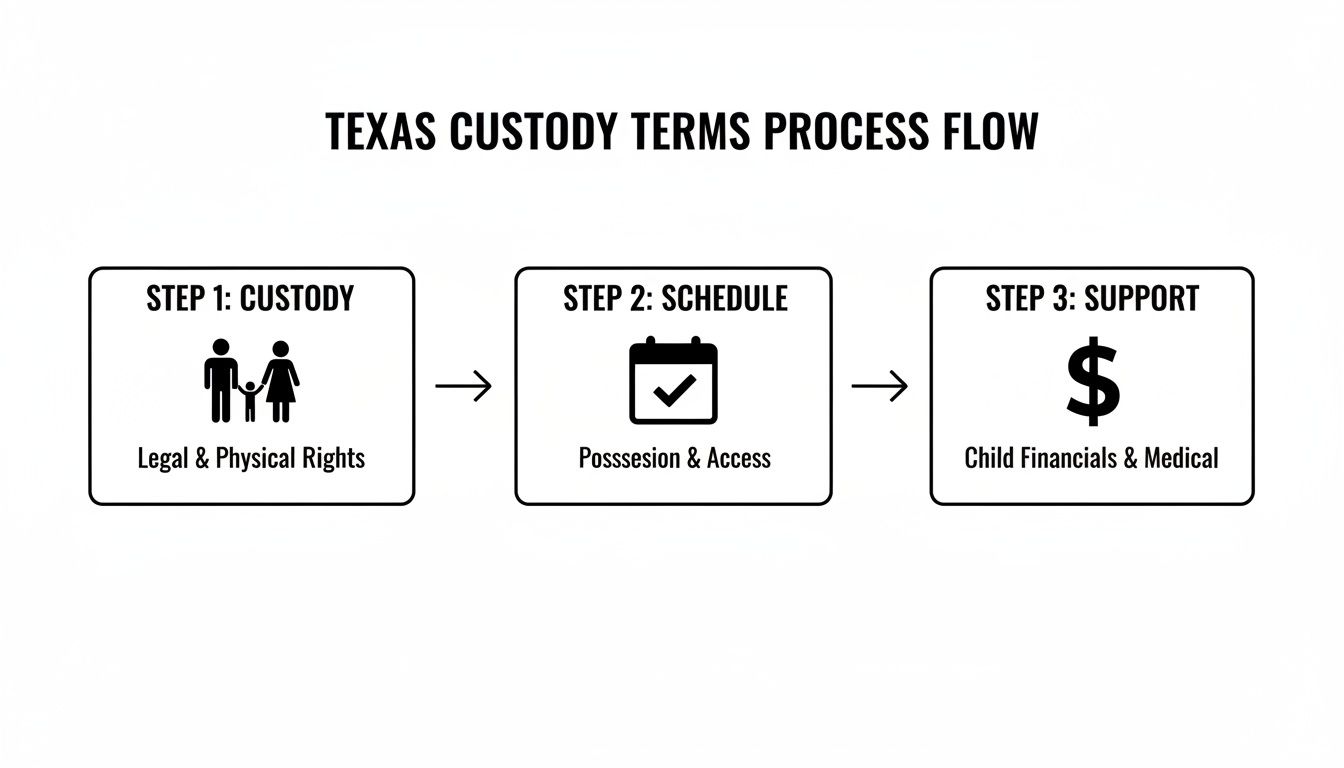
As you can see, every custody order is built on these three pillars: who has the right to make decisions (custody), when each parent sees the child (schedule), and how the child is financially supported (support).
Step 4: Mediation and Final Orders
After temporary orders are in place, your case moves into the "discovery" phase, where both sides formally exchange information. This is often followed by mediation—a required step in most Texas counties. During mediation, you, the other parent, and your attorneys will sit down with a neutral third-party mediator to try and reach an agreement.
If you can find common ground, you can finalize your case without a trial. If not, a judge will make the final decisions for you. Each step requires careful attention to detail and a true understanding of Texas law. Having a trusted advocate by your side makes all the difference.
How Texas Courts Determine a Child's Best Interest
When you're filing for custody in Texas, every single decision a judge makes comes back to one guiding principle: the best interest of the child. This phrase is the North Star of Texas family law, steering every ruling on conservatorship, possession schedules, and parental rights.
But what does that actually mean in a courtroom? It's not a vague feeling. Texas courts rely on a specific list of considerations, known as the "Holley Factors," to get a complete picture of a child’s life and what they truly need to thrive. As a parent, your most important job is to show the court how your requests align with your child’s needs.
The Holley Factors Explained
The Holley Factors come from a landmark Texas Supreme Court case and give judges a clear framework for making custody decisions. While the list isn't exhaustive, it covers the critical areas of a child's life the court will investigate.
Here’s what the court considers:
- The emotional, physical, and developmental needs of the child.
- Any emotional or physical danger the child might face, now or in the future.
- The parental abilities of each person seeking custody.
- The stability of each parent’s home and environment.
- The plans and resources each parent has in place for the child.
- Any actions or failures to act by a parent that suggest an improper parent-child relationship.
A judge weighs all these factors together—no single point automatically decides the case. You can learn more about how courts apply the Holley Factors in our in-depth article.
Putting the Factors into Practice
Let's imagine a real-world scenario. A mother works from home with a flexible schedule, allowing her to handle school pickups and doctor's visits. The father works long, unpredictable hours. A judge applying the Holley Factors won't just look at who has more free time. They'll ask: Who has historically been the primary caregiver? Who knows the child's teachers and daily routine? Which home offers more stability? The father’s willingness to adjust his schedule could also be a major point in his favor.
A parent's ability to foster a positive relationship between the child and the other parent is a huge consideration for the court. A parent who is seen as actively encouraging that bond is viewed much more favorably than one who tries to alienate the child from the other parent.
This highlights the delicate balance courts must strike. In fiscal year 2023, Texas family courts managed 47,731 divorce cases involving children. That means nearly 44% of all divorces required judges to make these life-altering decisions. While our courts are incredibly efficient—achieving a 100% clearance rate for two years straight—there's a concerning trend: a 7% surge in self-represented plaintiffs. These parents often risk unfavorable outcomes because they lack skilled legal counsel to help them present their case effectively. You can read the detailed annual report from the Texas Judicial Branch.
The Child's Preference and Its Limits
Parents often ask, "Can my child just tell the judge who they want to live with?" The answer is yes, but with important limits. In Texas, if a motion is filed, a judge must interview a child who is 12 years of age or older in private. The judge also has the discretion to interview a younger child.
However, the child’s preference is not binding. It is just one more factor for the judge to consider. A judge will try to understand the reasons behind the child's preference. Is it based on mature thought, or because one parent has fewer rules? The court's primary duty is to protect the child's long-term well-being, even if that means going against the child's stated wishes.
Navigating Special Circumstances in Custody Cases

Not every family's situation is the same, and Texas family law is built to be flexible enough to protect children in all kinds of circumstances. When you're filing for custody in Texas under unique conditions, knowing the specific legal tools available to you is empowering. Whether you are a service member, an unmarried father, or a grandparent, the law provides a path forward.
Guidance for Military Families
For military parents, the fear that a deployment could jeopardize your parental rights is very real. Thankfully, Texas law has specific protections to ensure service members are not unfairly penalized in custody cases.
A federal law called the Servicemembers Civil Relief Act (SCRA) allows you to ask for a "stay"—or pause—on your custody proceedings if military duties prevent you from appearing in court. This ensures that major decisions about your child aren't made while you’re deployed and unable to defend your rights. Additionally, the Texas Family Code prevents a judge from issuing a permanent order changing custody just because you were deployed. Instead, courts typically issue temporary orders that cover the deployment period, with the original order resuming upon your return.
Establishing Paternity for Unmarried Fathers
For an unmarried father in Texas, this is the most critical first step: you have no legal rights to custody or visitation until you have legally established paternity. Without it, you do not have the legal standing to ask a judge for a possession schedule or a say in your child's life.
There are two main ways to establish paternity:
- Acknowledgement of Paternity (AOP): A legal form signed by both parents, usually at the hospital after the child is born, voluntarily establishing you as the legal father.
- Court Order: If there is a disagreement, either parent can file a suit to adjudicate parentage. The court will likely order DNA testing and then issue a formal order establishing paternity.
Once paternity is established, you can move forward with a custody suit to define your rights and responsibilities as a father.
High-Conflict Cases and Protective Orders
When a child's safety is at risk due to conflict, abuse, or neglect, the court can step in immediately. A Temporary Restraining Order (TRO) is an emergency order that can be issued quickly to stop a parent from taking harmful actions, such as:
- Taking the child out of the county or state.
- Hiding the child from the other parent.
- Harassing or threatening the other parent or the child.
These orders create an essential buffer of protection. If you believe your child is in immediate physical or emotional danger, seeking a protective order is a critical step. When custody cases involve children with special needs, understanding available resources like ADHD support services can also be an important factor for the court to consider.
The Role of Grandparents in Custody
Grandparents are often a stabilizing force in a child's life. In certain situations, Texas law gives them the legal "standing" to file for custody or visitation. A grandparent can file a suit if they can show that the child’s current living environment presents a serious risk of physical or emotional harm. This is a high legal standard, but it provides a vital safeguard. Grandparents may also have standing if they have had "actual care, control, and possession" of the child for at least the last six months. In every case, the court's focus remains on the child's best interest.
Key Takeaways and Next Steps
Facing a custody case is one of the most challenging experiences a parent can go through. Remember these key points as you move forward:
- Focus on the "Best Interest of the Child": This is the standard the court will use for every decision. Frame your requests around your child's needs for stability, safety, and well-being.
- Understand the Terminology: Knowing the difference between conservatorship, possession, and child support will empower you throughout the process.
- Follow the Process: From filing the petition to attending mediation, each step is crucial. Missing a deadline or procedural requirement can have serious consequences.
- Seek Experienced Guidance: You do not have to navigate this alone. The law is complex, and the stakes are incredibly high. An experienced family law attorney can provide the legal strategy and emotional support you need.
Your next step is to gather your thoughts and documents and seek professional advice. A clear understanding of your legal options is the first move toward securing a positive outcome for you and your child.
If you need help with a child custody or visitation case in Texas, our experienced attorneys can guide you every step of the way. Contact The Law Office of Bryan Fagan, PLLC today for a free consultation.