
When the precious bond you share with a grandchild is threatened, the feeling of helplessness can be overwhelming. That connection, built on love, wisdom, and shared joy, is one of life's greatest gifts. If a parent is denying you access, it's natural to feel lost and uncertain about your options. The love that brought you here is valid, and we understand the emotional weight of this situation.
This guide is here to walk you through the realities of grandparents rights to visitation in Texas, offering clarity and confidence. While your rights aren't guaranteed, Texas law provides a specific path to seek court-ordered time with your grandchildren. The journey begins with understanding the single most important principle guiding every family court decision: the “best interest of the child.”
The Foundational Rule: The "Best Interest of the Child"
In every custody and visitation case, a judge’s primary focus will always be on what is best for a child’s emotional, physical, and developmental well-being—not what the parents or grandparents want. For you, this means proving that having you in your grandchild’s life is crucial for their happiness and stability.
The legal system recognizes the vital and supportive role that grandparents often play. At the same time, it operates on a strong presumption that a fit parent acts in their child’s best interest. Overcoming that presumption is the central challenge you will face.
The High Bar for Grandparent Intervention
To successfully petition the court, you must meet strict conditions laid out in state law. Under the Texas Family Code, grandparents can only file for court-ordered visitation if they can prove that denying them access would actively harm the child's emotional or physical well-being. This is a high bar to clear, and it requires compelling evidence.
This guide will break down these complex requirements into plain English, helping you understand:
- Your Legal Standing: Do you meet the strict criteria to even file a lawsuit?
- The Court Process: What are the steps involved from start to finish?
- Building Your Case: What kind of evidence is needed to have a chance of success?
You are not alone in this. While the legal road ahead can be demanding, knowing your options is the first step toward protecting that unbreakable bond.
How Texas Courts View Grandparent Visitation Cases
If you're a grandparent heading to court in Texas to ask for visitation, it's crucial to understand that you are not starting on a level playing field. The legal system begins with a powerful idea known as the “parental presumption.”
In plain English, this means the court automatically assumes that fit parents know what’s best for their children and have the right to make decisions for them. This isn't just a local Texas rule; it's a legal principle cemented by the U.S. Supreme Court.
The Legal Precedent: Troxel v. Granville
A major U.S. Supreme Court case in 2000, Troxel v. Granville, fundamentally shaped how states, including Texas, handle these sensitive family situations. The Court made it clear that fit parents are presumed to act in their children's best interests. This ruling places a very high burden on anyone trying to challenge a parent's decision about who their child sees.
Because of Troxel, Texas law is designed to protect a parent's rights. To get court-ordered visitation, you must overcome that powerful legal presumption. It’s simply not enough to tell a judge you love your grandchild or that you would be a positive influence.
In the eyes of the court, a parent's decision to limit or deny access is considered valid unless you can provide compelling evidence to the contrary. Your personal feelings, unfortunately, do not hold legal weight without proof of harm.
Proving "Significant Impairment"
So, what does it take to get past that presumption? The Texas Family Code is very specific. You must prove that denying you access to your grandchild would “significantly impair the child’s physical health or emotional well-being.” This is the heart of your entire case, and it is the most difficult part to prove.
"Significant impairment" is more than a child being sad or missing their grandparents. The court needs to see solid evidence that the child’s well-being is genuinely suffering because you are no longer in their life.
To make things clearer, let's break down the two main hurdles you'll face.
The Legal Hurdles for Grandparent Visitation
| Legal Hurdle | What It Means in Plain English | Example of Evidence Needed |
|---|---|---|
| Overcoming the Parental Presumption | You must prove that a fit parent is making a decision that is actively harming their child. The court assumes the parent is right until you prove otherwise. | Testimony from a neutral third party (like a teacher or counselor) who can speak to the parent's harmful decision-making and its impact on the child. |
| Proving Significant Impairment | You must show that your absence is causing actual, measurable damage to the child’s physical or emotional health—not just making them sad. | School records showing a sudden drop in grades, or a therapist's report linking the child's anxiety directly to the lack of contact with you. |
Successfully navigating these hurdles is tough. You must convince a judge that the parent, despite being fit, is making a choice so damaging that the court has to step in.
What Does Evidence of Harm Actually Look Like?
Proving significant impairment requires concrete, specific evidence. A judge won't grant your request based on your word alone. You have to draw a direct line between the parent denying visitation and a negative impact on the child.
Here are a few real-world examples of what courts might consider compelling evidence:
- A Steep Decline in School Performance: Are your grandchild's grades suddenly dropping? Are teachers flagging new behavioral problems that started right after you were cut out of their life?
- Documented Emotional Distress: Can a school counselor, therapist, or even a pediatrician testify that the child is showing clear signs of depression, anxiety, or other emotional issues directly tied to the separation from you?
- Loss of a Primary Caregiver: This is a significant factor. Did you previously act as a primary caregiver? If you were the one providing daily care, helping with homework, and acting as a steady, stabilizing force, your sudden absence could be proven to cause significant emotional harm.
Building a case that meets this demanding standard requires meticulous documentation and a solid understanding of what proves the best interest of the child in a legal sense. You must show the court that your relationship is so fundamental to the child's life that its absence creates a void that is genuinely harmful.
Steps to Filing a Lawsuit: Do You Have "Standing"?
Before you can step into a courtroom, you must clear the first legal hurdle: “standing.” Think of it as your ticket of admission. Without standing, a court cannot hear your case. For grandparents in Texas seeking visitation, this means your family’s situation must fit into specific categories defined by state law.
This isn't about how much you love your grandchild; it’s a strict, black-and-white legal requirement. To file a lawsuit for access—what the courts call a Suit Affecting the Parent-Child Relationship (SAPCR)—you first have to prove you’re legally allowed to ask.
This infographic breaks down the tough road ahead, from a parent denying you access all the way to proving harm in court.
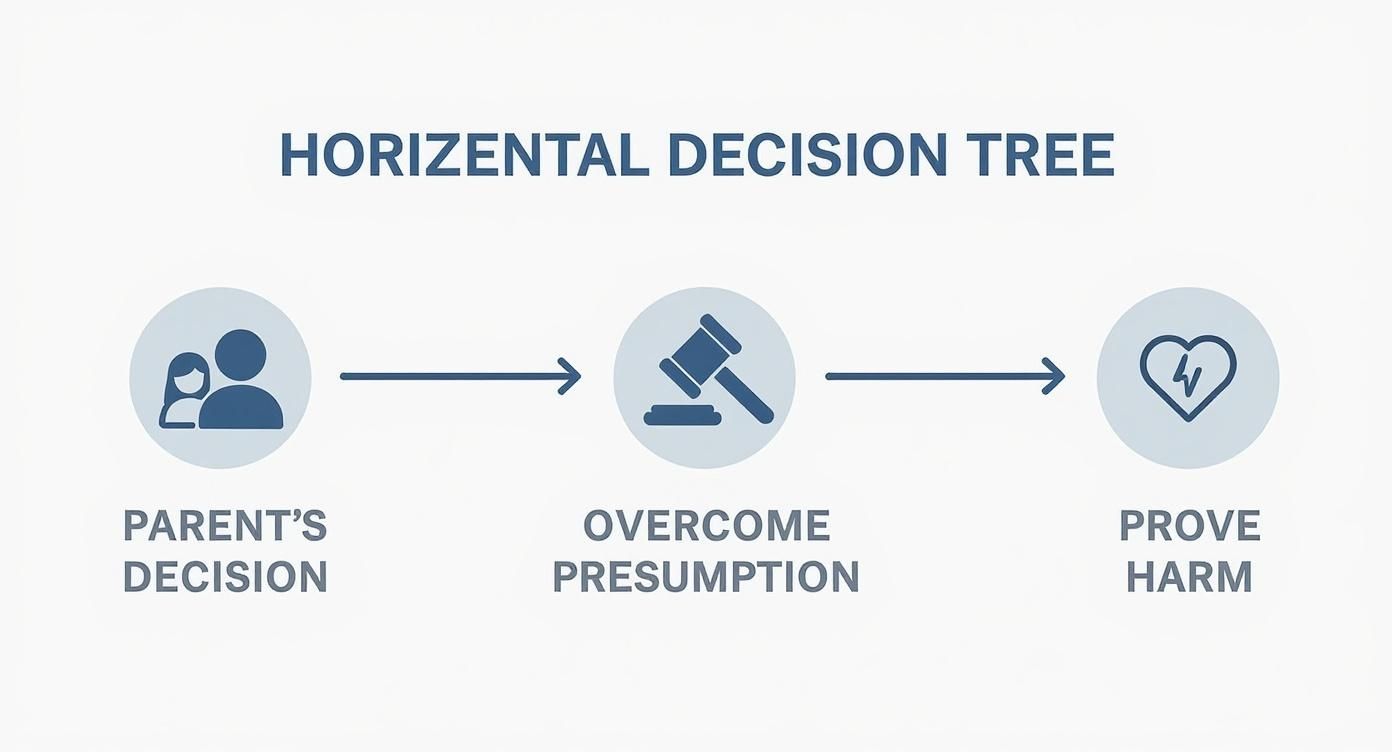
As you can see, it’s a series of high hurdles. Each one is designed to protect the parent-child relationship unless a grandparent can show that being kept away would truly hurt the child.
Who Qualifies as a Grandparent in Texas?
First, the law defines a "grandparent" as the parent of the grandchild’s parent. This covers both biological grandparents and those who are legally recognized through adoption.
However, your rights as a grandparent are directly tied to your own child's parental rights. If your child’s parental rights are terminated for any reason, your legal link to your grandchild is usually severed as well.
The Specific Scenarios That Grant You Standing
The Texas Family Code is very specific about the situations that give a grandparent the green light to file for visitation. You must be the parent of the grandchild’s parent, and at least one of these conditions must be met:
- The grandchild's parent is deceased.
- The grandchild's parent is incarcerated for at least three months.
- The grandchild's parent has been found legally incompetent by a court.
- The grandchild's parent does not have actual or court-ordered possession of or access to the grandchild.
Meeting one of these conditions only gets your foot in the courthouse door. It gives you the right to file the lawsuit, but it does not guarantee you will win. You still face the uphill battle of proving that denying you visitation would significantly harm your grandchild.
For example, let's say your son passed away, and his widow—your daughter-in-law—has cut off all contact with you and your grandchild. Because your son is deceased, you have legal standing to file a petition with the court and ask for visitation.
What if the Parents Are Divorced?
Divorce is another common scenario where grandparents find themselves sidelined. The divorce itself can create the necessary standing for you to file a request for visitation. However, the standard of proof remains just as high. You still have to overcome the parental presumption and prove that your absence would cause significant emotional or physical harm.
When Grandparent Rights Are Automatically Terminated
There is one major event that will almost always extinguish your ability to seek visitation: adoption. If your grandchild is adopted by anyone other than a stepparent, your legal rights as a grandparent are terminated. The law treats this as the creation of a brand-new family unit, severing your previous legal relationship.
Figuring out these eligibility rules is the absolute first step. For a deeper look into the nuances of these laws, you can explore more about grandparent rights in Texas in our detailed guide.
A Step-by-Step Guide to the Court Process

The idea of going to court can feel overwhelming, especially when the future of your relationship with your grandchild is at stake. The legal system can seem like a confusing maze, but it becomes much less intimidating once you have a map.
This section provides that map. We’ll walk you through each critical phase in plain English, step by step. Our goal is to demystify the process for seeking grandparents rights to visitation in Texas and empower you to move forward with confidence.
Step 1: Filing the Original Petition
The first official move is filing an Original Petition in a Suit Affecting the Parent-Child Relationship (SAPCR) with the appropriate court. This legal document is your formal request to the judge, explaining who you are, your connection to your grandchild, and why you are seeking visitation rights. It lays out the legal grounds for your case, showing how you meet the strict eligibility rules and arguing that denying you access would significantly harm your grandchild’s well-being.
Step 2: Serving the Parents
Once your petition is filed, the child's parents must be formally notified of the lawsuit. This is called "service of process," a non-negotiable step that ensures everyone has a fair chance to respond. A constable, sheriff, or private process server will deliver a copy of your petition and a legal notice known as a "citation" to each parent.
Step 3: The Discovery Phase: Gathering Evidence
After the parents have been served and have filed their response, your case enters the Discovery phase. This is where both sides gather the evidence they’ll use to build their arguments. Frankly, this is where cases are often won or lost.
During discovery, your attorney has several legal tools to collect information:
- Requests for Production: Asking the other side for relevant documents, like emails, text messages, photos, or school and medical records.
- Interrogatories: Sending written questions that the parents must answer in writing, under oath.
- Depositions: Questioning the parents or other key witnesses in person, under oath, with a court reporter transcribing every word.
This is your opportunity to collect the concrete proof needed to show the court the strength of your bond and the harm your absence is causing. To get a better sense of how this fits into the bigger picture, you can learn more about the Texas child custody case timeline in our detailed guide.
Step 4: Attending Mandatory Mediation
Before a final trial, Texas courts will almost always require you to attend mediation. This is a confidential meeting where you, the parents, and your lawyers sit down with a neutral third-party mediator. The goal is to find common ground and resolve the dispute on your own terms, which can save time, money, and emotional stress. If you reach an agreement, it becomes a legally binding court order.
Step 5: Preparing For the Final Hearing
If mediation doesn't lead to a settlement, your case will be set for a final hearing, or trial. This is your day in court, where you and your attorney will present all your evidence and witness testimony to the judge. The judge will listen to both sides and make a final ruling based on what they believe is in the "best interest of the child."
Key Stages of a Grandparent Visitation Case
| Stage | Key Action | Purpose |
|---|---|---|
| Filing Petition | Submit an Original Petition (SAPCR) with the court. | Officially starts the lawsuit and outlines your legal claims. |
| Service of Process | Have a process server formally deliver the lawsuit to the parents. | Legally notifies the parents so they can respond. |
| Discovery | Exchange evidence (documents, written questions, depositions). | Gathers the facts and proof needed to build your case. |
| Mediation | Attend a confidential settlement meeting with a neutral mediator. | Attempts to reach a mutual agreement and avoid a trial. |
| Final Hearing | Present your evidence and arguments to a judge. | Allows the judge to make a final, legally binding decision. |
Each step builds on the last, moving your case toward a final resolution with the guidance of an experienced family law attorney.
Understanding the Growing Role of Grandparents
If you’re fighting to stay connected with your grandchild, it can feel like a lonely battle. But your struggle is part of a much bigger story playing out in homes across America. The fact that laws like grandparents rights to visitation in Texas even exist shows just how much the American family has changed.
Knowing this context helps make sense of the legal hurdles you’re facing. Courts in Texas aren't just looking at your individual family; they’re trying to solve a puzzle that affects millions: how do you protect a parent’s fundamental right to raise their child while also recognizing the huge, often essential, role grandparents play?
The Changing Face of the American Family
Let's be honest, the "traditional" family isn't so traditional anymore. Over the last few decades, more and more grandparents have stepped up to the plate, providing the stability and care that kids desperately need when their parents can't. This isn't just a feeling—it’s a fact backed by hard numbers.
Recent data shows that about 2.7 million grandparents are living with their grandchildren, and 2.4 million are their primary caregivers. These aren't just temporary sleepovers; we're talking about grandparents who have become the bedrock of their grandchildren's lives. This shift is often driven by tough situations like high divorce rates or parental substance abuse. In response, all 50 states have passed laws to address this new reality. You can dig deeper into the data and its legal implications here.
Why This Matters for Your Case
This is exactly why the Texas Family Code was written the way it was. Lawmakers saw that in many families, cutting off a grandchild from their grandparent would do real, lasting harm to a child who relies on that bond for love and security.
But here’s the catch. That recognition is weighed against one of the most powerful principles in family law: a fit parent’s right to make decisions for their child. This is the legal tug-of-war at the center of every single grandparent visitation case.
The court's job is to figure out when a parent's decision stops being a reasonable choice and starts actively harming the child. Your entire case boils down to proving that your situation is the latter.
Grounding Your Fight in Legal Reality
It can be validating to know you’re not alone and that society sees the value you bring. But it's also a reality check. The law was designed for serious situations—cases where taking a grandparent away would leave a gaping hole in a child’s emotional well-being.
Understanding this bigger picture helps you frame your case correctly. This isn’t just about your desire to see your grandchild. It's about showing the court that your relationship is so vital to the child's world that losing it would cause the "significant impairment" the law demands you prove. This shifts your argument from an emotional plea to a powerful legal case focused squarely on the best interest of the child.
Next Steps: Your Action Plan for Moving Forward
Navigating this journey is emotionally exhausting. Fighting for grandparents' rights to visitation in Texas is an uphill battle, but knowing the rules of the game is your greatest asset. The entire legal process rests on a few core truths that you must keep front and center as you weigh your options.
Key Takeaways to Remember
Before you make any decisions, it’s vital to accept the legal realities of your situation. These aren't suggestions; they are the bedrock of grandparent visitation law in Texas.
- Parents Have the Right to Decide: The law always presumes that a fit parent knows what’s best. A judge will side with a parent’s decision unless you provide powerful, compelling evidence to prove otherwise.
- You Must Prove Harm: Your deep love for your grandchild, as real and important as it is, is not legal grounds to win a case. You must prove with clear evidence that being kept away would cause the child significant emotional or physical harm.
- You Must Qualify to File: You cannot file a lawsuit unless your situation meets the strict legal requirements for "standing" under the Texas Family Code, such as a parent's death, incarceration, or a court finding of incompetence.
This isn't about showing you're a good influence or that the grandkids have fun with you. It's about proving that your absence would create a harmful void in your grandchild's life. The burden of proof is 100% on you.
Your Action Plan, Starting Today
Feeling overwhelmed is normal. The best way to counteract that is to take control of what you can. Here are the practical steps you should take now.
- Document Everything: Start gathering every piece of proof you have. Collect photos, emails, text messages, and calendars that show you've been a consistent, stable presence. If you provided financial support or daily care, find bank statements or records that prove it.
- Focus on the Child's Needs: Step back and honestly consider this from your grandchild’s perspective. How will a legal fight affect them? A judge will want to know you've considered their well-being above all else.
- Seek Professional Legal Guidance: This is the most important step. No two family situations are identical. Only an experienced family law attorney can review the unique facts of your case, give you an honest assessment of your chances, and guide you through the legal maze.
Your desire to fight for your grandchild comes from a place of love. The path is challenging, but you don't have to walk it alone.
If you need help with a child custody or visitation case in Texas, our experienced attorneys can guide you every step of the way. Contact The Law Office of Bryan Fagan, PLLC today for a free consultation.
Frequently Asked Questions About Grandparent Rights
When you're fighting for time with your grandchildren, the legal landscape can feel overwhelming. The emotions are raw, and the law can seem confusing. To help you find clarity, we've answered the questions we hear most often from grandparents like you.
Can a parent legally stop me from seeing my grandchild?
Yes. This is a difficult but fundamental principle of Texas family law. The U.S. Supreme Court has affirmed that fit parents have a constitutional right to raise their children as they see fit, which includes deciding who their child spends time with.
Without a court order, a parent’s decision is legally the final word. The only way to challenge it is to file a lawsuit and convince a judge that the parent's choice is causing significant harm to your grandchild’s physical or emotional well-being.
What kind of evidence actually proves harm?
Proving that your absence is harming your grandchild requires more than your word. The court needs solid, convincing evidence showing a direct link between the lack of contact and a real decline in the child's welfare.
Strong evidence often includes:
- Testimony from Neutral Professionals: Teachers, school counselors, or therapists who can testify about a noticeable negative shift in the child's behavior, grades, or emotional state that began after contact with you ended.
- Proof of Your Caregiving Role: Documents, photos, and calendars showing you were a consistent, stabilizing presence, especially if you acted as a primary caregiver.
- Accounts from Others: Testimony from family members, neighbors, or friends who have personally witnessed the child’s distress since being separated from you.
The key isn't just showing that the child is sad. You have to paint a clear picture for the judge that your involvement is essential for the child's stability and happiness.
How long does the court process take in Texas?
There is no single answer. A grandparent visitation case can be resolved in a few months if an agreement is reached in mediation. However, if the case is heavily contested and goes to a final trial, it could easily last for a year or more. The court's schedule, the amount of evidence involved, and the level of conflict all impact the timeline.
If you need help with a child custody or visitation case in Texas, our experienced attorneys can guide you every step of the way. Contact The Law Office of Bryan Fagan, PLLC today for a free consultation.