
When your child’s future is on the line, understanding your rights as a father matters most. The decision to seek full custody often comes from a deep conviction that you can provide the stability, safety, and support your child needs to thrive. For many dads, this means learning how a dad can get full custody by showing a court that this arrangement is genuinely in their child’s best interest.
This journey starts with understanding your rights and options under the Texas Family Code.
Your First Step as a Father Seeking Full Custody

Here's something every father in Texas needs to know right from the start: the law is written to be gender-neutral. Courts are not supposed to favor mothers over fathers. Instead, every single decision must be based on one guiding principle: the best interest of the child.
The standard arrangement in Texas is called Joint Managing Conservatorship, which encourages both parents to share in the big decisions affecting their child. However, this is not the only possible outcome. In specific situations where it is in the child's best interest, a judge will grant one parent what most people call "full custody." In legal terms, this is known as being named the Sole Managing Conservator.
What Sole Managing Conservatorship Means for You
Becoming a Sole Managing Conservator gives you the exclusive right to make pivotal decisions about your child’s life without needing the other parent's consent. This is a significant level of authority that covers several critical areas:
- Primary Residence: You get the exclusive right to decide where your child lives.
- Medical and Dental Care: You can make all non-emergency healthcare decisions on your own.
- Educational Choices: You have the final say on school enrollment and other key educational matters.
- Psychological and Psychiatric Care: You can consent to mental health treatment for your child.
This legal status is about more than just having your child live with you. It’s about having the ultimate authority to guide their upbringing and ensure their stability and well-being.
A common misconception is that you must prove the other parent is "unfit" in some dramatic, movie-like fashion. While serious issues like abuse or neglect are clear grounds, Texas courts also consider chronic instability, a lack of involvement, or an unsafe environment as compelling reasons to name one parent the sole decision-maker.
For fathers who were not married to the child's mother, the first legal hurdle is often establishing legal fatherhood. Our guide on how to establish paternity in Texas explains this crucial process, which is the gateway to asserting your full parental rights in court. Understanding this foundational step is essential before you can pursue any custody arrangement.
How Texas Determines Custody
To effectively advocate for your child in a Texas custody case, you need to understand the court’s language and standards. Knowing the terms and, most importantly, what a judge is looking for when they make a decision that will change your family’s life forever is crucial.

The court’s starting point is almost always a Joint Managing Conservatorship (JMC). This is a legal framework for co-parenting where both parents share the major rights and responsibilities, designed to keep both of you deeply involved in your child’s life.
But if you are seeking full custody, you are aiming to be named the Sole Managing Conservator (SMC). This isn’t just about having your child live with you more often; it’s about having the exclusive authority to make the major decisions for them—from where they go to school to which doctor they see.
A judge will only grant this level of authority if you can prove, with solid evidence, that making you the sole decision-maker is in the best interest of the child. That phrase isn't just legal jargon; it is the single most important standard in every Texas custody case. Everything hinges on it.
The “Best Interest of the Child” Standard
So, what does "best interest of the child" actually mean in a courtroom? It’s not a vague idea. It’s a specific legal framework guided by a set of criteria known as the “Holley Factors.” These factors give the judge a roadmap to evaluate your family's situation.
A judge will consider questions like:
- What are the child's emotional and physical needs, both now and in the future?
- Is there any present or future emotional or physical danger to the child?
- What are the parenting abilities of each person seeking custody?
- Which parent can provide a more stable, positive, and safe home?
- What plans does each parent have for the child?
Your entire case, from the first filing to the final day in court, needs to be built around showing how you are the answer to these questions.
Overcoming Potential Bias
While Texas law is clear that courts cannot discriminate based on gender, many fathers feel they are starting from behind. There can be an unspoken bias that sometimes favors mothers.
The reality is that a father’s chance of securing full custody often comes down to how well he can prove he is a stable, engaged, and primary caregiver. A mother automatically has legal rights to her child. But for unmarried fathers, you must legally establish paternity before you can even ask the court for custody rights.
While the law says you get equal consideration, you need to build a case that leaves no doubt. Your goal is to show the judge that you are the parent best equipped to provide for your child's total well-being. You can get more perspective on how courts see these cases by reading the insights on fathers seeking full custody on CustodyXChange.com.
To help clarify the key differences in parental authority, the table below breaks down the rights and duties under both arrangements.
Joint vs. Sole Managing Conservatorship: A Quick Comparison
| Parental Right or Duty | Joint Managing Conservatorship (JMC) | Sole Managing Conservator (SMC) |
|---|---|---|
| Primary Residence | One parent is designated to establish the child's primary residence, often with a geographic restriction. | The SMC has the exclusive right to determine the child's primary residence without geographic restriction (unless the court orders one). |
| Major Decisions (Medical, Educational, Psychiatric) | Rights are shared. Parents must consult each other. One parent may be given "tie-breaker" authority. | The SMC has the exclusive right to make these decisions without consulting the other parent. |
| Child Support | The "non-primary" parent typically pays child support to the primary parent. | The other parent (Possessory Conservator) pays child support to the SMC. |
| Consent to Marriage & Military Enlistment | Both parents must consent. | The SMC has the exclusive right to consent. |
| Managing Child's Services & Earnings | Shared right. | Exclusive right for the SMC. |
| Access to Records (School, Medical) | Both parents have independent access. | Both parents still have independent access, unless limited by the court. |
Understanding these distinctions is crucial. It shows you exactly what you're fighting for when you ask the court to be named the Sole Managing Conservator. You're not just asking for more time; you're asking for the ultimate legal responsibility for your child's upbringing.
Proving Sole Custody Is Best for Your Child
When you are a dad fighting for your child, your mindset has to shift from simply wanting full custody to proving why it's absolutely necessary for their well-being.
A Texas judge will only take the significant step of naming you a Sole Managing Conservator if you can show compelling reasons why it’s in the child’s best interest. This means you have to build a clear, evidence-backed case showing that a joint arrangement would be detrimental to your child.
The court is looking for specific, serious situations that endanger a child's physical or emotional health. This isn’t about minor disagreements over parenting styles. It’s about real issues that create an unsafe or deeply unstable environment for your child.
Grounds That Can Justify Sole Custody
The Texas Family Code provides a clear roadmap for granting a father sole custody when a child’s safety is on the line. Some of the most powerful arguments you can make are tied to the other parent's harmful behavior or inability to provide a stable home.
A judge will give serious weight to your request if you can prove the other parent has a history of:
- Family Violence or Abuse: Any documented instance of physical, emotional, or sexual abuse against you or the child is the most direct path to sole custody. Evidence includes police reports, protective orders, and testimony from credible witnesses.
- Substance Abuse: If the other parent has a current or recent history of drug or alcohol abuse that interferes with their parenting, the court will take it very seriously. Evidence could include DUI convictions, failed drug tests, or witness accounts of endangerment.
- Child Neglect or Abandonment: This involves failing to meet a child’s basic needs—such as providing adequate food, safe shelter, supervision, or medical care. It also covers situations where a parent has been absent from the child’s life for an extended period.
- Extreme Instability: Sometimes the danger is in the chaos. A lifestyle of frequent moves, unstable housing, or exposing the child to a revolving door of new partners can be just as damaging as direct abuse.
A key thing to remember is that the court is always looking forward. Your evidence needs to show not just that a problem happened in the past, but that it poses a current or future risk to your child's physical or emotional well-being.
Parental Alienation and Toxic Environments
Sometimes, the danger isn't physical—it's emotional. Parental alienation is a destructive pattern where one parent actively tries to damage the child’s relationship with the other parent. This could involve making false accusations, interfering with your possession schedule, or constantly speaking negatively about you to the child.
When you're fighting for full custody, it's critical to spot and explain these harmful dynamics. A great resource for this is understanding patterns of toxic relationships, which can help you articulate what's happening to your child.
Courts take this very seriously, as it can cause lasting psychological damage. Proving it often requires communication logs, journals, and even testimony from counselors or teachers who have witnessed the negative effects on your child. For a deeper look at what the court needs to see, our article on how to prove the best interest of the child offers detailed guidance on building your case around this crucial legal standard.
Building a Strong and Credible Case for Custody
To convince a Texas judge that granting you sole custody is in your child's best interest, you must build a rock-solid, evidence-based case that highlights your strengths as a stable, loving, and consistent father.
Think of it like painting a detailed picture for the court. Every piece of evidence is a brushstroke, and your goal is to create a clear image of the supportive and reliable home you provide. This takes diligence, organization, and a forward-thinking approach from day one.
The Power of Documentation
Your memory isn't evidence. You need tangible proof of your deep involvement in your child's life. One of the most powerful tools is a detailed parenting journal. This isn't a diary for your feelings; it's a factual log of your actions and any important incidents.
Your journal should track:
- Parenting Time: Log every pickup and drop-off. Note exact times and any issues, like the other parent being consistently late or a child being upset.
- Communication: Keep a record of calls, texts, and emails with the other parent. Stick to the facts—what was said and when.
- Child’s Activities: Document your involvement. Note when you helped with homework, took your child to the doctor, attended parent-teacher conferences, or coached their sports team.
- Concerning Incidents: Record any missed visitations by the other parent, worrying things your child says after a visit, or situations where you felt your child’s needs weren't being met.
Over time, this journal becomes an invaluable source of evidence that proves your reliability.
Identifying Credible Witnesses
Witnesses can give the court a neutral third-party perspective on your parenting. You need credible people who can testify about specific facts that demonstrate your stable home and positive relationship with your child.
The most effective witnesses are often people who see you in action:
- Teachers or school counselors
- Coaches or daycare providers
- Family friends or neighbors who have observed your parenting
- A therapist or counselor who has worked with you or your child
These individuals can validate the stable environment you provide, a massive factor in custody decisions. While your focus should be on your strengths, sometimes you must address the other parent's shortcomings. If their actions are harmful, it's critical to learn how to prove an unfit parent with compelling evidence, not just accusations.
Understanding the Custody Evaluation
In highly contested cases, a judge might order a custody evaluation or social study. This is an in-depth investigation into your family dynamics conducted by a neutral mental health professional.
The evaluator will interview you, the other parent, and your child. They will likely conduct home visits and speak to "collateral witnesses" like teachers or doctors. It is an intense process.
The evaluator’s final report to the court will include a professional recommendation on conservatorship and possession schedules. While not legally binding, this recommendation carries immense weight with most judges. Being prepared, honest, and cooperative is absolutely critical.
Custody outcomes often hinge on which parent can better demonstrate stability. In the U.S., fathers now make up about 20% of the 13 million custodial parents. Data also shows they are more likely to be employed full-time year-round (74%) than custodial mothers. For more insights, you can explore child custody statistics at ParentClassesOnline.com.
Navigating the Texas Family Court Process
When your child’s well-being is on the line, the Texas family court system can feel intimidating. But think of it less like a maze and more like a roadmap with distinct phases, each designed to help a judge gather the information needed to make a decision in your child's best interest.
The journey begins when you file the initial lawsuit, formally called a “Suit Affecting the Parent-Child Relationship.” This is the crucial first step that officially opens your case. Once filed, you must ensure the other parent is properly notified through a process called "service."
Key Milestones in a Custody Case
From there, your case moves into the discovery phase. This is where both sides exchange evidence and information. It's a structured process that lets your attorney request documents, ask written questions (interrogatories), and gather the facts needed to build your argument for sole custody.
One of the most critical early hurdles is the temporary orders hearing. Here, a judge makes short-term decisions about where the child will live, who makes key decisions, and what the possession schedule will look like while the case is ongoing. While these orders aren't final, they often set a powerful precedent for the rest of the case.
Before trial, Texas law requires you to attend mediation. This is a confidential meeting with a neutral third-party mediator to try and reach an agreement. It’s your best opportunity to find common ground and resolve the dispute without leaving the life-altering decision up to a judge.
The infographic below breaks down the fundamental steps for building a strong case to present during these legal phases.
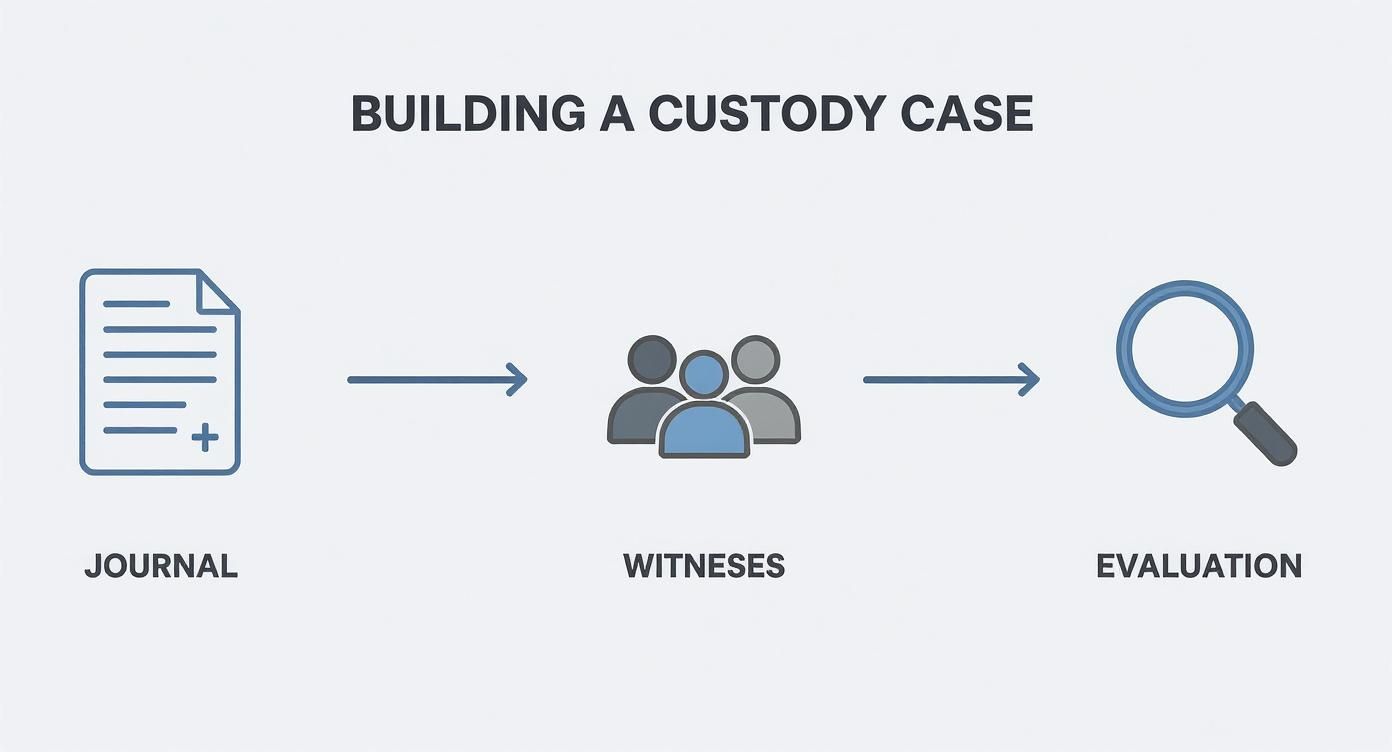
As you can see, a successful case isn't about luck; it's built on meticulous documentation, credible witnesses, and a thorough evaluation of the facts.
Preparing for the Final Hearing
If mediation doesn't lead to a resolution, your case will be set for a final trial. Both sides will present their evidence and witness testimony before a judge, who will then make a final, binding ruling on custody.
The legal landscape is slowly changing. Today, approximately 20% of custodial parents are fathers, a significant increase from 16% in 1994. While this shows progress, courts still grant fathers sole custody in only about 18.3% of cases, underscoring the importance of a meticulously prepared case. Discover more insights about these family law statistics.
Every step is an opportunity to show the court why you are the parent best suited to provide a stable, loving home. Understanding this process empowers you to present your case with clarity and confidence.
Frequently Asked Questions from Fathers
Of all the questions we get from fathers, a few come up repeatedly. When you're in the middle of a custody battle, uncertainty can be overwhelming. Let's clear up some of the most common concerns we hear from dads across Texas.
Can I get sole custody if we were never married?
Yes, absolutely. A father’s rights in Texas are not dependent on whether you were married to the child's mother.
Your first, non-negotiable step is to legally establish paternity. Once the court recognizes you as the legal father, you are on equal footing with a married father. From that point on, the judge's decision will hinge entirely on your child’s best interest, not on your past relationship status.
How much weight does my child’s opinion have?
This is a common question, especially for dads with older children. In Texas, if a child is 12 years or older, the court must interview them if a parent requests it. The judge will speak with your child privately in their chambers to hear their preference on who they want to live with.
It’s critical to understand this: while the judge must listen to what your child wants, their preference is not the final word. It is just one piece of the puzzle. The court will weigh it against all the other factors to make a decision that serves the child’s overall best interests.
If I get sole custody, will the other parent pay child support?
Generally, yes. When you are named the Sole Managing Conservator—the legal term for the parent with sole custody—you are typically the parent who receives child support payments.
The other parent would be named the Possessory Conservator and would be ordered by the court to pay you child support based on Texas guidelines. This system ensures both parents contribute financially to the costs of raising the child.
Key Takeaway: Next Steps for Fathers
Fighting for your child's future is the most important job you'll ever have. The legal road to securing sole custody in Texas can feel like a marathon, full of emotional and legal hurdles. But with the right strategy and a focus on your child, you can build a powerful case that shows the court why you are the best parent to provide a stable, loving home.
Let every decision be guided by one question: What is in my child’s best interest? Document everything. Stay deeply involved in their life, from homework to doctor’s appointments. Build a support system you can lean on. The journey is tough, but your child’s well-being is worth every effort.
If you need help with a child custody or visitation case in Texas, our experienced attorneys can guide you every step of the way. Contact The Law Office of Bryan Fagan, PLLC today for a free consultation.