
When your child’s future is on the line, understanding your rights as a father matters most. Many dads believe the legal system is stacked against them, but in Texas, the court’s only guide is the best interest of the child—not outdated stereotypes. This guide is designed to empower you with the knowledge and practical steps needed to show a judge that you are the parent best equipped to provide a stable, nurturing, and consistent home for your child.
Understanding How Texas Determines Custody

Walking into a custody dispute can be intimidating, but we're here to replace that anxiety with a clear, actionable plan. Success isn’t about attacking the other parent; it’s about methodically building an undeniable case that proves your positive involvement in every part of your child's life. With the right preparation and legal guidance, you can confidently pursue the outcome that truly protects your child.
Dispelling the "Mother-Favored" Myth
Let's clear the air on a persistent myth: the idea that Texas courts automatically favor mothers is simply untrue. The Texas Family Code is gender-neutral. This means a judge cannot legally make a custody decision based on whether a parent is a mother or a father. Period.
The court's sole focus is on what arrangement will provide the best possible environment for the child to thrive. This means a father who can demonstrate he is the primary caregiver and offers the most stable home has a genuine opportunity to be awarded what most people call "full custody."
The Reality of Custody Statistics
While the law is neutral, it's important to understand the landscape. In 2018, only 20% of the 12.9 million custodial parents in the U.S. were fathers. This statistic isn't meant to discourage you; it's meant to underscore how critical a well-documented, evidence-driven case is. You can learn more about how these family law statistics can inform your legal strategy.
Key Takeaway: Around 90% of custody arrangements are actually settled outside of a trial. This means most outcomes are shaped by negotiation, mediation, and strategic legal advocacy—not just one dramatic court hearing.
Our goal in this guide is to break down complex legal concepts into plain English and give you a step-by-step approach to building your case. We'll cover:
- Demystifying legal terms: We’ll explain the difference between “Sole Managing Conservatorship” (what most call full custody) and the standard “Joint Managing Conservatorship.”
- Building your evidence: You will learn how to document your involvement in a way that resonates with a judge and tells a powerful story.
- Navigating the process: We will walk you through the key stages of a Texas custody case, from the initial filing to the final orders.
With the right preparation, you can confidently pursue the outcome that best protects your child’s future.
What “Full Custody” Really Means In Texas

When you're fighting for your child, the legal terms can feel overwhelming. You hear people talk about "full custody," but in a Texas courtroom, the official term is Sole Managing Conservatorship. Understanding this language isn't just about legal details; it's the first step toward building a successful case.
Being named a Sole Managing Conservator means you are granted the exclusive legal authority to make the most important decisions in your child's life. This is the highest level of parental responsibility recognized under the Texas Family Code.
The Power of Exclusive Decision-Making
As a Sole Managing Conservator, you have the final say on the fundamental aspects of your child's upbringing—rights that are almost always shared between parents in typical custody arrangements.
Here are the key exclusive rights you'd hold:
- Deciding Where Your Child Lives: You have the exclusive right to determine the child's residence, without geographic restrictions unless a judge specifically orders one.
- Making All Medical Decisions: You are the only parent who can consent to medical, dental, and surgical treatments, including psychological and psychiatric care.
- Directing Their Education: You alone make the significant decisions about your child’s schooling, such as which school they attend.
- Holding Legal and Financial Authority: You can represent your child in legal matters and make other legally significant decisions on their behalf.
This is a significant concentration of authority in one parent’s hands, which is why Texas courts do not grant it lightly.
Sole vs. Joint Conservatorship: The Texas Standard
Texas law begins with the presumption that a Joint Managing Conservatorship is in a child’s best interest. This is the most common outcome, where both parents share the rights and duties of raising their child, even if one parent is the "primary" parent who establishes the child's home and receives child support.
However, as a father seeking sole custody, your goal is to present compelling evidence showing a judge why a joint arrangement would be harmful, unworkable, or simply not in your child's best interest.
A judge will only depart from the standard joint custody model if there is clear proof that naming one parent as the Sole Managing Conservator is essential to protect the child's physical or emotional well-being.
The court looks for specific, serious circumstances, such as a documented history of family violence, substance abuse, severe instability, or neglect from the other parent. The goal is always to protect the child, not to punish a parent.
To give you a clearer picture, here’s a breakdown of how the two legal structures compare.
Sole vs Joint Managing Conservatorship A Texas Comparison
This table highlights the key differences in parental rights and duties between having sole "custody" and the more common joint arrangement.
| Parental Right or Duty | Sole Managing Conservatorship (Full Custody) | Joint Managing Conservatorship (Shared Custody) |
|---|---|---|
| Primary Residence | The sole conservator has the exclusive right to determine the child's home. | One parent is typically given the exclusive right to determine the child's residence (often within a geographic area). |
| Major Decisions | The sole conservator makes all key decisions (medical, educational, legal) alone. | Both parents share the right to make major decisions, often requiring mutual agreement or consultation. |
| Child Support | The other parent (possessory conservator) is typically ordered to pay child support. | The non-primary parent is usually ordered to pay child support to the primary parent. |
| Court Presumption | Awarded only when proven to be in the child's best interest due to specific negative circumstances. | Presumed by law to be in the child's best interest unless evidence proves otherwise. |
Understanding this legal framework is your starting point. It allows you to align your strategy with what Texas law requires to achieve the stability your child deserves.
Building Your Case: Evidence is Everything
When you walk into a courtroom, your feelings about being a great dad are important, but they don't win custody cases. Evidence does. A judge needs to see a clear, documented picture of your life as a parent, and it's your responsibility to provide it.
Your goal is to prove, with tangible proof, that making you the sole managing conservator is without a doubt in your child’s best interest. This isn’t about starting a fight; it’s about meticulously showing the court your stability, your involvement, and your unwavering dedication. Vague claims won't cut it. You need specifics, and that requires an organized approach to gathering proof that will tell your story.
The Power of a Parenting Journal
One of the most effective tools you can have is a simple parenting journal. Think of it as a detailed log that builds a timeline of your involvement in your child's life. Consistency is key.
Start documenting everything, every single day. Over time, this creates a pattern of evidence that is incredibly difficult to dispute.
- Daily Routines: Who gets the kids up? Who makes breakfast, packs lunches, helps with homework, and handles the bedtime story? Write it down.
- Appointments and Activities: Log every doctor's visit, parent-teacher conference, and soccer practice you take them to or help manage.
- Positive Interactions: Make notes about the good moments—the conversations you have, the milestones they hit, and the special times you share. These details matter.
- Legitimate Concerns: If the other parent misses visitations, is consistently late, or your child says something concerning, document it factually. Stick to dates, times, and what was said or done, without adding emotional commentary.
This journal becomes a goldmine for your attorney, transforming general statements like "I'm the primary caregiver" into a concrete, undeniable record of your commitment.
Identifying Credible Witnesses
While you are the star witness in your case, compelling testimony from third parties can be incredibly persuasive. The right witnesses give the judge an objective look at your parenting. Think beyond close family members, whose testimony might be viewed as biased.
You want people who have firsthand knowledge of your relationship with your child but no personal stake in the outcome.
- Teachers and School Staff: They can speak to your involvement in your child's education and your presence at school events.
- Coaches and Activity Leaders: They see you interacting with your child in a community setting and can vouch for your support.
- Neighbors or Friends: A long-time neighbor who has seen your daily routines can offer powerful testimony about your stability.
- Childcare Providers: A nanny or daycare worker has a front-row seat to which parent handles the day-to-day logistics.
It's crucial to talk with potential witnesses beforehand to understand what they've observed and what they’d be comfortable testifying to in court. Their unbiased accounts can be key to backing up your story.
A judge once told me that the testimony of a child’s teacher can be worth more than hours of a parent’s own testimony. It provides an impartial window into the child’s world and the parent’s role in it.
Organizing Digital Communication
Text messages, emails, and social media posts are often center stage in custody battles. The key is to be strategic and organized.
Your goal is twofold: showcase your cooperative, child-focused communication, and, if necessary, present legitimate concerns about the other parent's conduct.
- Highlight Positive Co-Parenting: Save messages where you are being flexible, informative, and keeping the focus on the kids' needs.
- Document Uncooperative Behavior: If the other parent is consistently hostile, unresponsive, or makes unreasonable demands, organize these messages chronologically.
- Capture Important Admissions: If a parent admits to something relevant in a text—like neglecting a responsibility—save it.
This evidence isn't about "getting" the other parent. It's about giving the court a clear, factual basis to make its decision. For a dad fighting for full custody, this documentation is essential. To learn more, check out our guide on how to prove the best interest of the child in a Texas court. Each piece of evidence strengthens your position as the parent best suited to provide a secure home.
Navigating the Texas Legal Process
Knowing what to expect can turn a stressful process into a manageable one. A Texas custody case follows a structured path designed to gather facts and give both parents a fair hearing. Your journey begins the moment you file the first legal document.
The first step is filing an Original Petition in a Suit Affecting the Parent-Child Relationship (SAPCR). This is the official document that starts your case. It clearly states what you are asking the court to do—in this situation, to name you the Sole Managing Conservator.
Once filed, the petition must be legally delivered to the other parent. This formal delivery is known as service, and it’s critical to get right. Proper service ensures the other parent is officially aware of the lawsuit and has an opportunity to respond.
The Importance of Temporary Orders
Soon after your case is filed, your attorney will likely request a Temporary Orders hearing. This hearing is one of the most pivotal moments in your case. A judge will make initial, temporary rulings about where the child will live, who makes key decisions, and what the visitation schedule will be while the case moves forward.
These orders aren't permanent, but they set a powerful precedent. A judge who sees a child thriving under a temporary arrangement with their dad is more likely to make that arrangement permanent. This is your first real opportunity to present your evidence and prove to the court that you provide a stable, loving environment.
Key Takeaway: The outcome of the Temporary Orders hearing often shapes the final outcome of the case. It establishes a "status quo" that judges are often hesitant to disrupt later without a very compelling reason.
Preparing for this hearing is non-negotiable. You and your lawyer will need to have your evidence organized to make a concise and powerful argument for why you should have primary responsibility for your child from day one.
Mediation and Social Studies
Before a final trial, Texas courts almost always require parents to attend mediation. This is a confidential meeting where you, the other parent, and a neutral third-party mediator try to reach an agreement. The goal is to create your own parenting plan instead of leaving the decision in a judge's hands.
If you and the other parent cannot agree, a judge might order a custody evaluation or social study. This is an in-depth investigation by a mental health professional or social worker. The expert will interview you, the other parent, your child, and others like teachers or doctors. They'll also conduct home visits.
The expert then writes a detailed report for the judge with a professional recommendation for the custody arrangement they believe is in the child's best interest. While not legally binding, this recommendation carries significant weight.
The infographic below shows how different types of evidence come together to build your case.
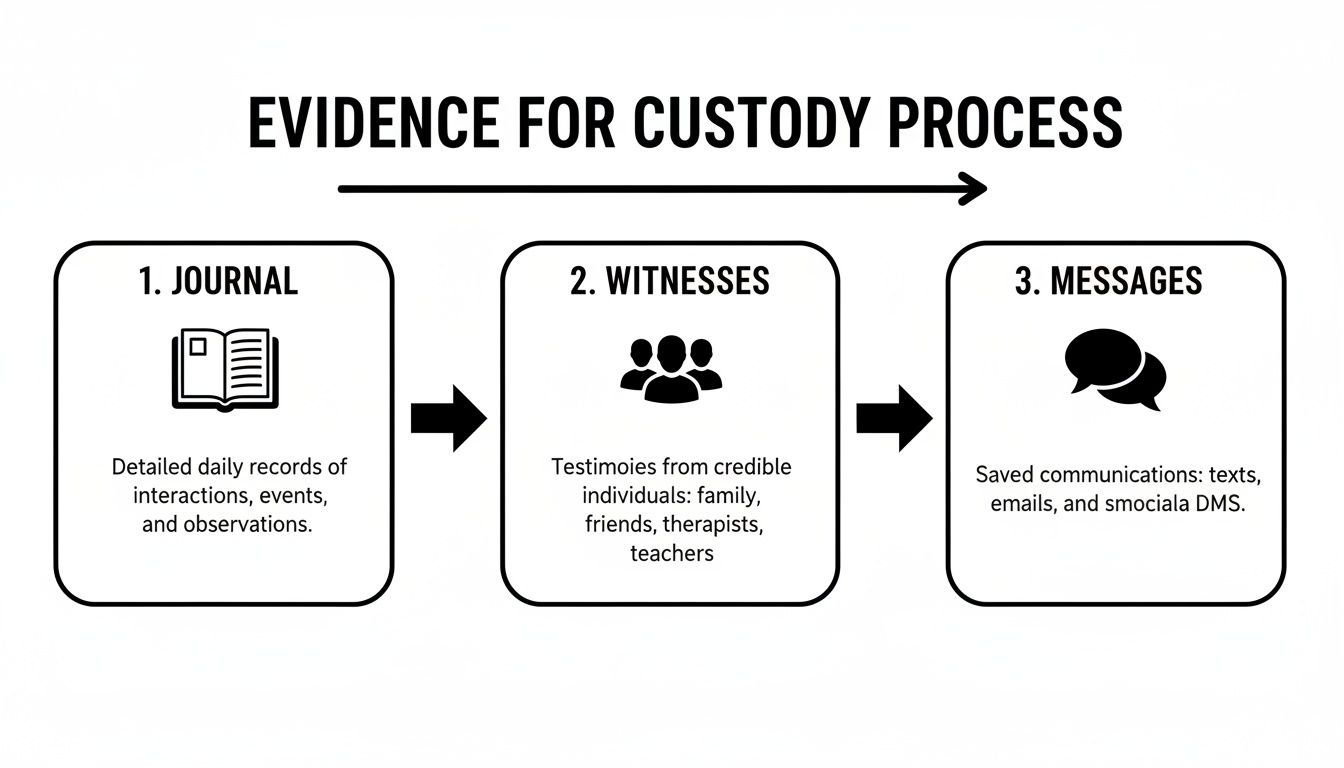
This visual shows how consistent documentation, credible third-party accounts, and clear communication records all work together to tell a compelling story to the court.
Every step is an opportunity to build your case. Being prepared and keeping your child's best interests at the forefront is how a dedicated dad can succeed. For a more detailed look at what to expect, you can review a typical Texas child custody case timeline in our comprehensive guide.
Proving You Are the Child's Primary Caregiver

To win sole custody in Texas, you must prove you are the child’s primary caregiver. This isn't about love or biology; it's about demonstrating with hard evidence that you're the parent who handles the countless day-to-day tasks that keep your child's life on track.
Every decision a judge makes comes down to the best interests of the child. This isn’t a vague idea; it’s a legal standard guided by a specific set of criteria known as the "Holley Factors." Your job is to build a case that connects your evidence directly to these factors, painting a clear picture of your essential role.
The Holley Factors: What Texas Judges Look For
Think of the Holley Factors as the judge's roadmap for determining a child's best interest. It’s a framework for evaluating which parent provides the most stable, nurturing, and consistent environment.
A judge will look at several key areas, including:
- The child's emotional and physical needs, both now and in the future.
- Any emotional or physical danger the child might be in.
- The parental abilities of each parent.
- The stability of the home each parent provides.
- The plans and resources each parent has for the child.
Your evidence has to speak directly to these points. For example, don’t just say you provide a stable home. Show it with school attendance records, organized medical files, and a documented daily routine that you manage.
Documenting Your Day-to-Day Involvement
Winning full custody is about proving you are the anchor in your child's life. This is where meticulous documentation becomes your most powerful weapon. You need to show the court, not just tell them, that you’re the one managing all the small but critical details.
This means gathering evidence of your hands-on involvement in things like:
- Meal Preparation: Who plans the grocery list, cooks the meals, and makes sure your child eats nutritious food?
- Bedtime Routines: Who is there for bath time, story time, and tucking them in at night?
- School and Homework: Who emails the teacher, helps with the science project, and goes to parent-teacher conferences?
- Medical Care: Who schedules the dentist appointments and takes your child to the pediatrician when they're sick?
- Emotional Support: Who is the go-to parent for comfort after a nightmare or help navigating a tough day at school?
A huge part of this is showing you have an intimate knowledge of where your child is developmentally. A great resource for this is understanding childhood development milestones.
Beyond a Weekend Dad: The Importance of Consistent Care
In a custody fight, actions always speak louder than words. A judge cares far less about what you promise to do and far more about what you have already been doing. This is your chance to show you are the primary parent.
The parent who can demonstrate a consistent history of attending to the child’s daily needs—from packing lunches to scheduling playdates—presents a compelling case that they are indispensable to the child's well-being. This pattern of behavior is often more persuasive than any other single piece of evidence.
The court wants to see who provides the structure and stability that makes a child feel safe. The little things are everything here. Knowing your child’s shoe size, their best friend’s name, their favorite snack, and their biggest fear isn’t just good parenting—it’s powerful evidence. We get into more detail about what being the primary parent means in our dedicated blog post.
A request for sole custody must be backed by overwhelming proof that it's truly what's best for your child, often due to the other parent's instability or neglect. This makes proving your primary caregiver status more critical than ever.
Key Takeaways and Next Steps
Winning sole custody as a father in Texas isn't about luck; it's about strategy, evidence, and keeping your child’s well-being as your absolute focus. The road ahead can be challenging, but you have the power to build a case that shows a judge that you are the parent best equipped to give your child a stable, nurturing home.
Success starts now. Not next week, not when you get a court date. Today.
Your Immediate Action Plan
- Start Your Parenting Journal. Now. Get a notebook or open a document and start logging everything. School drop-offs, doctor visits, homework sessions, bedtime stories—every single detail. This journal will become one of the most powerful tools in your arsenal.
- Organize Your Records. Start a folder for financial statements, your child's report cards, and any communications that show you're a stable, cooperative parent. Organization is key.
- Identify Your Witnesses. Think about credible people who've seen your parenting up close—teachers, coaches, even a trusted neighbor. Their firsthand accounts can speak volumes.
These steps are non-negotiable. But the single most important decision you can make right now is to team up with an experienced family law attorney. Trying to navigate the Texas legal system on your own is a huge gamble when your child's future is on the line.
An attorney who knows the local courts can take your dedication and turn it into a legal argument that a judge can't ignore. They ensure your voice is heard.
Common Questions from Fathers Seeking Custody
Navigating a custody case brings up a whirlwind of questions and fears. Getting clear, straightforward answers is the first step toward feeling confident and prepared.
Do Texas Courts Favor Mothers in Custody Cases?
Absolutely not. The Texas Family Code is explicitly gender-neutral, meaning the law forbids a judge from making a decision based on a parent's gender. The court's only focus is the “best interest of the child.” A father who can prove he is the more stable, involved, and capable parent has an equal opportunity to be named the primary parent. Your case will be decided on evidence, not stereotypes.
Can My Child Decide Who They Want to Live With?
Once a child is 12 years of age or older, they have the right to speak with the judge in private and express a preference about which parent they want to live with. However, the child’s wish is not the final word. The judge is required to listen but will base their final decision on all factors affecting the child's best interest, including the child's maturity and reasons for their preference.
What Should I Do About False Allegations?
Facing false allegations is terrifying. The most important thing is to stay calm and work methodically with your attorney to disprove the claims with evidence. Panicking or retaliating will only hurt your case.
The key to overcoming false allegations is a methodical, evidence-based response. Credibility is everything in a courtroom, and a parent who is proven to have lied to the judge can permanently damage their own case.
Your strategy will involve gathering hard proof to counter the lies, such as:
- Text messages or emails that directly contradict the accusations.
- Testimony from credible, neutral witnesses (like teachers or coaches).
- Your own detailed parenting journal documenting your activities and interactions.
Judges take false claims very seriously. Proving that the allegations are untrue not only clears your name but can also massively strengthen your position.
If you need help with a child custody or visitation case in Texas, our experienced attorneys can guide you every step of the way. Contact The Law Office of Bryan Fagan, PLLC today for a free consultation.