
When your child’s future is on the line, understanding your rights isn’t just important—it’s everything. If you and your child's other parent aren't married, navigating the Texas legal system can feel overwhelming. The entire world of custody for unmarried parents pivots on one critical step: establishing legal paternity for the father. Until that happens, the law gives the mother sole legal and physical custody by default.
This guide is here to turn on the lights. We will walk you through what the law says, what your options are, and how you can protect your precious relationship with your child. The feelings you're experiencing—the anxiety, the hope, the deep-down need to do what's best for your kid—are all completely normal. Our goal is to replace that uncertainty with confidence by breaking down Texas custody laws for unmarried parents into simple, straightforward terms. This isn't just about rules; it’s about securing your role in your child's life.
Key Concepts We Will Cover
Think of this guide as your trusted resource, here to help you understand the basics of Texas family law as it applies to your unique situation. We’ll walk through:
- Establishing Paternity: The non-negotiable first step for a father to gain any legal rights to custody or visitation.
- Conservatorship: What Texas calls "custody." This defines who has the legal authority to make important decisions for your child.
- Possession and Access: The legal terms for the visitation schedule—the "when" and "where" of your time with your child.
- The Child's Best Interest: The single most important standard a judge uses to make every decision about your child.
By the time you finish this guide, you’ll have a much clearer picture of your rights and the legal road ahead. Remember, knowing what to expect is the first step toward protecting your family’s future and building the stable, loving home your child deserves.
How Texas Determines Custody: The First Step is Paternity
For an unmarried father in Texas, every legal right you have to your child—from visitation to making decisions about their schooling—hinges on establishing paternity. Until the law officially recognizes you as the child's father, you have no enforceable rights to custody or possession. It doesn't matter how involved you are or how much you love that child.
Think of it this way: Legal paternity is the key that unlocks the courthouse doors. It puts you on equal legal footing with the mother and gives you the ability to ask a judge for a formal custody order that protects your relationship with your child.

Here’s a hard truth: when a child is born to an unmarried woman in Texas, she is automatically granted sole legal custody. This gives her the exclusive power to make all major decisions for the child. While having your name on the birth certificate is a good start, it is not enough to grant you any custody or visitation rights on its own. To secure those, you must take formal legal action.
The Two Paths to Establishing Legal Paternity
So, how do you get those rights? Texas law provides two main routes to establish legal paternity. The one you take depends on whether you and the mother are in agreement.
| Method | Plain-English Explanation | When It's Used | Key Outcome |
|---|---|---|---|
| Voluntary Acknowledgment of Paternity (AOP) | A simple legal form signed by both parents, usually at the hospital right after birth. It's a sworn statement that you are the child's biological parents. | When both parents are in complete agreement about who the biological father is. | Establishes the man as the legal father, making him responsible for child support and eligible for custody and visitation rights. |
| Suit to Adjudicate Parentage | A formal lawsuit filed with the court to determine fatherhood. | When parents disagree on paternity, or if one parent is uncooperative or unavailable to sign an AOP. | A judge issues a court order declaring the father, often after court-ordered DNA testing. This is a binding legal decision. |
Choosing the right path is crucial, as the outcome fundamentally changes your legal standing as a father. For a deeper look into the specifics of each method, you can learn more about how to establish paternity in our detailed guide.
Why a Court Order Is So Important
Even if you and the mother are on great terms and sign an AOP, you're not done yet. An AOP makes you the legal father, but it doesn't create a custody, visitation, or child support order. You still need to file a lawsuit (often called a Suit Affecting the Parent-Child Relationship, or SAPCR) to get a court order that clearly defines each parent’s rights and duties.
"For an unmarried father, obtaining a court order is everything. It transforms your role from a biological connection to a legally protected relationship, giving you the power to enforce your time with your child and participate in their life decisions."
Under Texas Family Code §160.204, a man is sometimes presumed to be the father, such as if he lived with the child for the first two years and acted as the father. But a presumption isn't a guarantee of rights; you still need that court order. Without it, you have no inherent right to see your child, no matter how much you’ve been a part of their life.
Understanding Texas Custody Terms: Conservatorship and Possession
When you start digging into Texas custody laws, you'll quickly run into unfamiliar words. The terms you expect to see—like “custody” and “visitation”—are rarely used in official court documents. Instead, Texas has its own legal vocabulary. Don't let it intimidate you. Understanding these terms is the key to understanding your rights.
Let’s break down the two most important concepts in plain English: Conservatorship and Possession and Access. Once these click, you'll have the confidence to know what you’re asking for in court and what a final order really means for your family.

What is “Conservatorship”? (Legal Custody)
In plain English, Conservatorship is about who has the legal right and responsibility to make the big-picture decisions for your child. It's not about where the child lives day-to-day. It’s about who gets a say in the major life choices that shape your child's health, education, and well-being.
Common conservatorship rights include the power to:
- Decide where the child goes to school.
- Consent to medical, dental, and psychological treatment.
- Make decisions about the child's religious upbringing.
- Access the child's school and medical records.
Texas law starts with a strong preference that both parents share these duties. This arrangement is called Joint Managing Conservatorship (JMC). It means you and the other parent act as co-pilots in your child's life. For a deeper dive, our complete guide on conservatorship in Texas explains these roles in much greater detail.
Under a Joint Managing Conservatorship, one parent is typically named the "primary" conservator. This parent has the exclusive right to determine the child's main residence, usually within a specific geographic area.
This is a critical point. Even when parents share decision-making, one parent's home becomes the child’s legal home base for things like school enrollment. The other parent, often called the non-primary parent, is granted a clear visitation schedule (possession order) and is typically ordered to pay child support.
What are “Possession and Access”? (Visitation Schedules)
If conservatorship is about making decisions, Possession and Access is about the calendar. This is the legal term for the visitation schedule—the detailed plan that lays out exactly when the child will be with each parent. This replaces guesswork with a clear, enforceable schedule.
In most cases where parents live within 100 miles of each other, Texas courts will order a Standard Possession Order (SPO). The SPO is a default schedule created by the Texas Family Code, designed to be predictable and ensure children have consistent time with both parents.
A typical Standard Possession Order includes:
- During the School Year: The non-primary parent usually has the child on the first, third, and fifth weekends of a month.
- Holidays: Major holidays like Thanksgiving and Christmas are divided and alternated each year, so both parents get to create special memories.
- Summer Vacation: The non-primary parent gets an extended period of time with the child, usually 30 days.
This schedule is the backbone of most Texas custody orders. While parents can always agree to a custom schedule that works for their family, the SPO is the reliable framework that judges rely on to ensure children maintain a strong relationship with both parents.
How Courts Decide: The “Best Interest of the Child” Standard
When unmarried parents can't agree, a judge must decide. In Texas, every single custody decision is guided by one powerful principle: the best interest of the child. This standard, found in Chapter 153 of the Texas Family Code, is the North Star for every ruling the court makes.
It’s not about which parent is "better" or who "deserves" custody more. It is about what environment will allow your child to thrive—physically, mentally, and emotionally. A judge’s job is to look at the entire picture of your child’s life and create an order that supports their long-term well-being.
The Holley Factors: A Judge's Guidebook
To ensure decisions are fair and thorough, Texas judges use a set of guidelines known as the “Holley Factors.” These come from a landmark Texas Supreme Court case and provide a framework for determining a child's best interest. Understanding these factors helps you see your situation from the court’s point of view.
Here’s a plain-English look at what the court considers:
- The Child’s Needs: What does this specific child need to flourish, emotionally and physically, now and in the future? (e.g., age, developmental stage, special needs).
- Parental Abilities: Which parent has demonstrated they can meet those needs? This includes providing daily care, guidance, and emotional support.
- Stability of the Home: The court looks for a stable, secure, and predictable home environment.
- Emotional and Physical Dangers: The court will consider any potential harm to the child in either parent’s care, such as from substance abuse, neglect, or family violence.
- The Parent-Child Relationship: The judge will look closely at the emotional bond each parent has with the child.
Knowing these are the key questions allows you to focus on showing the court how you provide a stable and positive home for your child.
"The 'best interest' standard is intentionally broad to give judges the flexibility to look at every unique detail of a family's life. It allows them to craft an order that gives the child the best possible shot at a happy, healthy future."
The Child's Preference and Co-Parenting
In Texas, if a child is 12 years of age or older, the judge is required to interview them privately to hear their wishes about where they want to live. However, the child's preference is just one factor among many and is not the final word.
Perhaps most importantly, judges pay very close attention to how well parents can co-parent. A parent who encourages a strong, healthy relationship between their child and the other parent will always be viewed more favorably than one who tries to undermine that bond.
The Legal Process: Your Path to a Custody Order
The thought of a lawsuit can be intimidating, but the process is structured and predictable. In Texas, a custody case is called a Suit Affecting the Parent-Child Relationship (SAPCR). This is the legal process for asking a judge to make formal, enforceable orders about conservatorship (custody), possession (visitation), and child support.
Getting the Case Started
The process begins when one parent files an Original Petition with the court. This document identifies the parents and child and states what the parent is asking the court to do. The other parent must then be formally notified through a process called service. After being served, the other parent has an opportunity to file a formal response, known as an Answer. If you need help with this first step, our guide on how to file for custody in Texas breaks down the initial paperwork in more detail.
Setting Ground Rules with Temporary Orders
A full custody case can take months. To create stability for your child in the meantime, either parent can ask the court for Temporary Orders. These are short-term rules that establish a temporary possession schedule, child support, and other guidelines while the case is ongoing. Temporary orders are critical for creating a predictable routine for your child and preventing conflict from escalating.
This flowchart shows the core factors a judge will weigh when making decisions about your child's well-being.
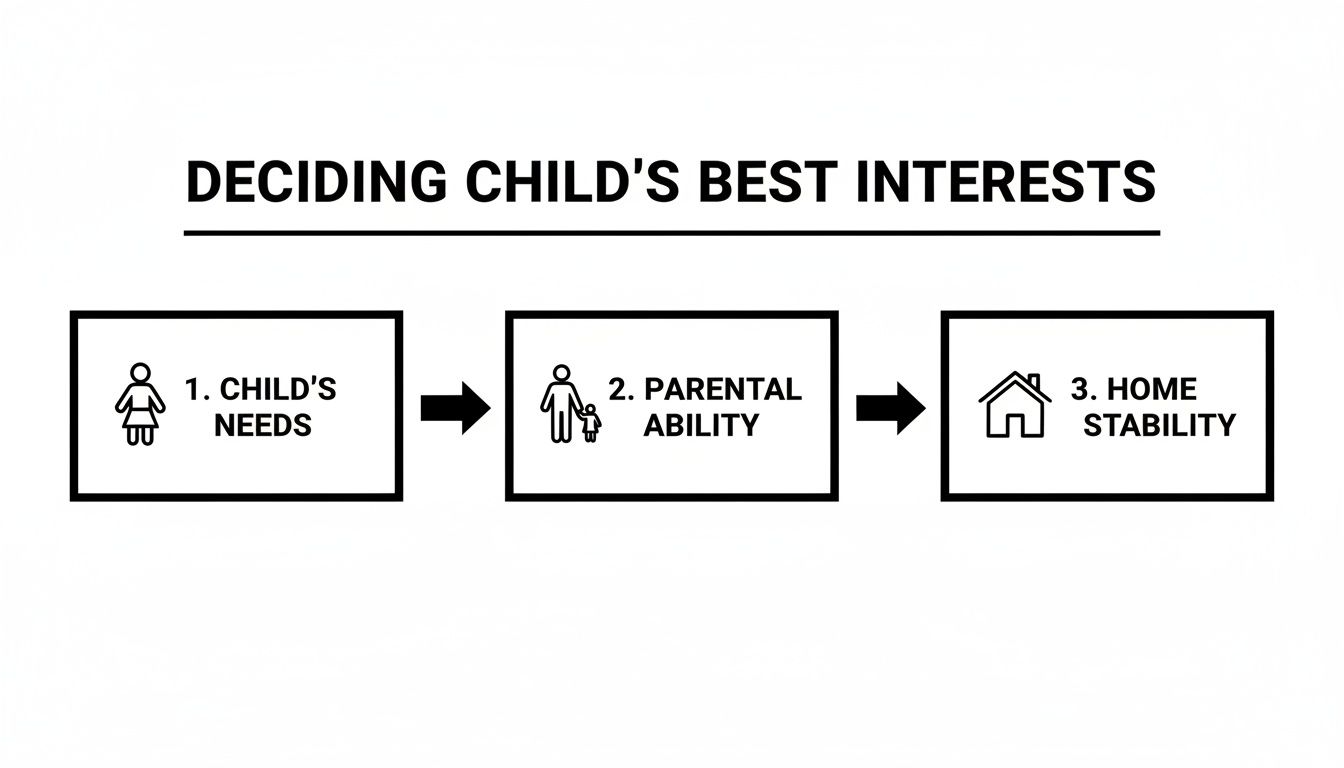
From the child’s emotional and physical needs to each parent's ability to provide a stable home, these elements are the foundation of every single custody decision a court makes.
Discovery and Mediation: Finding a Resolution
After temporary orders are in place, the case moves into discovery, where both sides formally exchange information and gather evidence. Before a final trial, most Texas courts require parents to attend mediation. This is a confidential meeting with a neutral third-party mediator whose job is to help you find common ground and reach an agreement. Mediation provides a powerful opportunity to create a parenting plan tailored to your family's needs, rather than leaving the decision to a judge. The vast majority of custody cases are resolved in mediation.
Key Takeaways and Your Next Steps
Understanding Texas custody laws when you aren’t married is a significant first step. Now, it’s about turning that knowledge into action to protect your role in your child’s life.
Remember, the legal system has a clear path:
- For unmarried fathers, establishing paternity is the non-negotiable first step to gaining any legal rights.
- For both parents, every court decision will be based on the best interest of the child.
Practical Guidance for Both Mothers and Fathers
Feeling overwhelmed is normal, but you can take control by taking small, focused actions today.
- Gather Documents: Create a file with your child’s birth certificate, any Acknowledgment of Paternity forms, and proof of your involvement in your child's life (photos, receipts, school records).
- Keep a Journal: Document the time you spend with your child, the activities you do, and your contributions to their care. This creates a powerful record of your commitment.
- Focus on Co-Parenting: To the best of your ability, communicate respectfully with the other parent. Showing a judge that you can put your child's needs above your own disagreements is incredibly powerful.
This journey is not one you have to walk alone. Seeking professional guidance is a strategic move to ensure your rights and your child’s future are protected by an advocate who knows the system inside and out.
Frequently Asked Questions
If we aren't married, who has custody in Texas?
By default, when a child is born to unmarried parents in Texas, the mother has sole legal and physical custody. A father has no legal rights to custody or visitation until he legally establishes paternity and gets a court order.
What if the father's name is on the birth certificate?
This is a common source of confusion. While important, having a father's name on the birth certificate is not enough to grant him any enforceable custody or visitation rights in Texas. You must still get a court order that defines your specific rights and possession schedule.
Can an unmarried mother move out of state with the child?
If there is no court order in place, the mother, as the sole legal custodian, generally has the right to move. However, once a father establishes paternity and files a custody case, he can ask the court to prevent the child from being moved. Nearly all final custody orders include a geographic restriction that limits where the primary parent can live with the child.
How is child support handled for unmarried parents?
Child support is handled the same way for unmarried and married parents. Once paternity is established, the court will issue a child support order based on the Texas Child Support Guidelines, which uses a percentage of the non-primary parent's net monthly income.
What if we agree on everything?
Even if you and the other parent have a perfect verbal agreement, it is crucial to get it formalized in a court order. A verbal agreement is not legally enforceable. If one parent changes their mind, the other has no legal recourse. A court order protects both parents and gives your child the stability they deserve.
If you need help with a child custody or visitation case in Texas, our experienced attorneys can guide you every step of the way. Contact The Law Office of Bryan Fagan, PLLC today for a free consultation.