
When your child’s future is on the line, understanding your rights matters most. As a father, you may be asking a critical question: can a dad actually get full custody in Texas?
Let me be clear: Yes. Absolutely.
The Texas Family Code is gender-neutral; it doesn’t favor mothers over fathers. A court’s decision is based on one guiding principle: proving that awarding you primary custody is in the best interest of the child. This is the foundation of every custody case in Texas, and it's where your journey begins.
A Father's Path to Full Custody in Texas

The instinct to protect and provide for your child is powerful. If you believe your child’s well-being is best served primarily in your care, it's natural to feel a mix of determination and anxiety. The good news is that Texas law provides a clear pathway for fathers to secure their parental rights and pursue the primary role in their child's life.
Let’s set the record straight—any outdated stereotype that mothers are the default caregivers holds zero legal weight in a modern Texas courtroom. Your role as a father is valued, and your rights are equal to the mother's.
Understanding Texas Custody Language
Before we dive deeper, it’s helpful to understand the specific terms Texas courts use. You’ll hear lawyers and judges talk about "conservatorship" and "possession and access" more often than "custody" and "visitation." Knowing these terms will help you navigate your case with confidence.
Here’s a plain-English explanation of what these terms mean for you.
Texas Custody Terms at a Glance
| Texas Legal Term | Plain-English Explanation | What It Means for You |
|---|---|---|
| Conservatorship | The legal rights and responsibilities of a parent, like making decisions about school or healthcare. | This is the official term for custody. It defines who gets to make the big decisions for your child. |
| Sole Managing Conservator | The parent with the exclusive right to make major decisions and determine the child's residence. | This is what most people mean by "full custody." You would have the final say on all major life choices for your child. |
| Possession and Access | The schedule outlining when each parent has physical time with the child. | This is the court's term for the visitation schedule. It dictates when you and the other parent will physically have the child. |
The reality is that a growing number of fathers are stepping into the role of primary caregiver. Over the past few decades, the number of single fathers has risen dramatically, with over 2.5 million now acting as custodial parents in the U.S.
However, the statistics also show a tough road ahead. Courts still award fathers sole custody in only about 18.3% of cases, which underscores just how critical it is to build a rock-solid case from the very beginning.
This journey is about securing your child's future, not just winning a fight. For more specifics on parenting time, our guide on child visitation rights for fathers can provide additional context.
What 'Best Interest of the Child' Really Means

Every decision a Texas judge makes in a custody case is guided by one powerful legal standard: the best interest of the child. While that phrase might sound broad, it is the absolute bedrock of Texas family law under Chapter 153 of the Texas Family Code.
It’s not about which parent is "better" or who "deserves" the children more. It’s a detailed, fact-based analysis of which parent is best equipped to provide a safe, stable, and nurturing life for the child moving forward.
For any father seeking to be the primary parent, understanding this standard isn't just important—it's everything. Your entire case must be built around demonstrating, with solid evidence, that you can meet your child's needs most effectively. This shifts the focus from a dispute between parents to a solution centered on the child.
The Holley Factors: The Judge's Checklist
So, how does a judge make this determination? To ensure rulings are consistent and fair, Texas courts rely on a specific set of guidelines known as the "Holley Factors." These factors originated from a landmark Texas Supreme Court case and give judges a framework for evaluating a child's entire situation.
Think of it as the judge's checklist. Your job is to provide clear and convincing answers for every item on that list that applies to your family.
Some of the most critical Holley Factors include:
- The child's emotional and physical needs, both now and in the future. This covers everything from providing a safe home and nutritious meals to offering love, comfort, and emotional support.
- The parenting skills of each person seeking custody. A judge will look at who has historically been the primary caregiver and who demonstrates stronger parenting abilities.
- The stability of the home you are providing. This is a huge factor for fathers. A stable home, a consistent routine, and a supportive community can heavily influence a judge's decision.
- Any actions or failures to act by a parent that might suggest the current parent-child relationship is not a healthy one. This could include neglect, exposing the child to unsafe situations, or failing to meet basic needs.
- Any emotional or physical danger to the child, now or in the future. Evidence of family violence, substance abuse, or serious mental health issues on one parent's part can be a determining factor.
Proving Your Case Beyond Words
Simply telling a judge you're a good dad is not enough. The court needs to see it through your actions and your evidence. This is where preparation becomes your greatest asset.
For example, instead of just saying you're involved in your child's education, provide report cards, emails exchanged with teachers, and a log of every parent-teacher conference you attended.
Don't just claim you provide a stable home. Present photos of your child's bedroom, a proposed daily schedule, and testimony from neighbors or friends who have witnessed your consistent, positive parenting. The goal is to paint a vivid picture for the judge—one that clearly shows your home is where the child will thrive. For a deeper dive, our detailed guide explains how to prove the best interest of the child in a Texas courtroom.
A judge wants to see what parents do for their children, not just what they say. Your actions, documented and presented clearly, will always speak louder than arguments.
Ultimately, winning primary custody as a father means proving that you are the parent best positioned to guarantee your child's long-term health, happiness, and success. By focusing your case on the Holley Factors and backing up your claims with solid proof, you align your goals directly with the court's legal duty.
Establishing Paternity: Your Non-Negotiable First Step
Before you can make a case for custody, Texas law has a critical, non-negotiable requirement: you must be the child's legal father. For unmarried fathers, this is the single most important step. Without it, you have no legally enforceable rights to custody or even visitation.
Think of it as laying the foundation for a house. Your entire custody case must be built on the solid legal ground of established paternity.
Why Paternity Matters
When a child is born to a married couple in Texas, the law automatically presumes the husband is the legal father. But for unmarried parents, that legal link doesn't exist automatically. You could be the most loving and involved dad in the world, but until the law recognizes you, your rights aren't protected.
Establishing paternity is what gives you the legal standing to walk into a courtroom and ask for conservatorship (custody), possession and access (visitation), and the right to make decisions for your child. It transforms you from a biological father into a legal parent with a protected voice.
Two Paths to Establishing Legal Fatherhood
In Texas, there are two primary ways for an unmarried father to secure his legal rights. The path you choose often depends on your relationship with the child's mother.
-
Voluntary Acknowledgement of Paternity (AOP): This is the most straightforward route. The AOP is a legal form that both the mother and father sign, usually at the hospital after the child is born. By signing it, you are legally declaring you are the child's father. It is a simple and effective way to establish your rights from day one.
-
Suit to Adjudicate Parentage: This is the formal court process. You file a petition asking a judge to legally declare you as the father. This often involves DNA testing to confirm biology, leaving no room for doubt. Once a judge signs an Order Adjudicating Parentage, it is legally binding and provides the strongest possible foundation for your parental rights.
It's crucial to understand that simply being named on the birth certificate is not enough. While it’s a good step, it doesn’t grant you the same enforceable rights as an AOP or a court order. A court order is the gold standard for protecting your relationship with your child.
For a comprehensive breakdown of the legal process, you can learn more about how to establish paternity in Texas in our detailed guide. This initial step ensures the courthouse doors are open to you and that your voice will be heard.
How to Build Your Case for Sole Custody
Winning sole managing conservatorship in Texas isn’t about who is the better parent in a general sense. It’s about who can prove, with clear and compelling evidence, that putting the child primarily in their care is undeniably in that child’s best interest. This is where strategy meets action. Think of it less as a fight and more as telling a powerful, fact-based story about why your child will thrive with you.
You have to move beyond telling the judge you’re a good father. You have to show them with organized, credible proof. Every piece of evidence you gather must serve one purpose: to demonstrate your unwavering commitment to your child's well-being and stability.
Documenting Your Deep Involvement
The bedrock of a strong custody case is proving you are the more engaged and hands-on parent. A judge needs to see a consistent pattern of active participation in all the small and large parts of your child’s life. Your goal is to create such a detailed record that it leaves no room for doubt about your central role.
Start by meticulously documenting everything. This isn't about keeping a diary of grievances; it's about building a factual timeline of your parenting.
Consider gathering items like these:
- School and Daycare Records: Collect attendance records, email chains with teachers, and notes from every parent-teacher conference you attended. Did you volunteer for a field trip? Document it.
- Medical Appointment Logs: Keep a calendar of every doctor, dentist, and therapy appointment you took your child to. Note the dates, providers, and the reason for the visit. This demonstrates responsibility for their health and wellness.
- Extracurricular Involvement: Create a detailed list of the sports teams, music lessons, or other activities you manage. Note the games you coached, the practices you never missed, and the recitals you attended.
This level of detail paints a vivid picture for the court. It shows you are a fully engaged parent who handles the day-to-day responsibilities of raising a child.
Demonstrating a Stable and Nurturing Home
A judge’s primary concern is ensuring the child is in a safe, stable environment. You must prove that your home isn't just adequate but is the best possible option for your child's physical and emotional security. As a father seeking custody, this is where you can directly challenge and overcome any outdated stereotypes.
Your evidence should showcase the stability you provide:
- Financial Records: Proof of steady employment, like recent pay stubs or tax returns, shows the court you can provide for your child's needs.
- Home Environment: Take clear photos of your home, focusing on your child’s bedroom, play areas, and the general living space. A clean, organized, and child-friendly home speaks volumes.
- Detailed Childcare Plans: If you work, have a rock-solid plan for who will care for your child. Provide names, contact information, and details for babysitters, daycare centers, or family members who are part of that plan.
- Your Support System: Show the court you have support. Letters or testimony from grandparents, trusted friends, or neighbors who have witnessed your excellent parenting can be incredibly persuasive.
Addressing Concerns About the Other Parent’s Fitness
Sometimes, seeking sole custody is a protective measure because the other parent’s behavior genuinely puts the child at risk. This is a delicate area that must be handled with facts and evidence, not just emotional accusations. The court is only interested in evidence that directly impacts that parent's ability to safely care for the child.
If there are legitimate concerns, you must present them carefully. A strong case may involve showing how the other parent's actions are detrimental to the child's well-being. For instance, being able to identify and present the signs of parental alienation can be a critical component in court.
Evidence in these situations might include:
- Police Reports or Court Records: Official documentation of domestic violence, arrests, or protective orders are hard to dispute.
- Witness Testimony: Credible statements from teachers, counselors, or family members who have personally witnessed neglect, substance abuse, or unstable behavior.
- Communication Records: Text messages or emails from the other parent that reveal instability, threats, or a refusal to co-parent can be powerful.
It's vital to present this information factually, without exaggeration. The goal is to protect your child, not to punish the other parent.
When it comes to the odds, fathers must be ready for the court's scrutiny. While less than 4% of fathers contest custody in court, research shows that among those who do, fathers were awarded sole or joint custody in over 90% of cases. You can read more about these father custody findings on CustodyXchange.com.
Building this mountain of evidence takes time and effort, but it's the most important work you will do to secure your child’s future. An experienced family law attorney can guide you, helping identify what evidence will be most effective and how to present it to the court.
Navigating the Texas Custody Court Process
The idea of walking into a courtroom can be intimidating, but knowing what to expect is the best way to feel prepared. Understanding the stages of a Texas custody lawsuit demystifies the process, allowing you to focus on your child’s best interest. This is about being strategic and confident from start to finish.
The process begins when one parent files an Original Petition in Suit Affecting the Parent-Child Relationship. This formal document officially starts the case. Once it’s filed and served on the other parent, the legal clock starts ticking.
The Role of Mediation and Temporary Orders
Shortly after the case begins, the court will likely schedule a hearing for temporary orders. These are important because they set the ground rules for custody, visitation, and support that will remain in place while the case moves forward. This first hearing often sets the tone for the entire case, so making a strong impression is critical.
Before that hearing, most Texas counties require parents to try mediation. This is a guided negotiation where a neutral professional—the mediator—helps you and the other parent try to reach an agreement on your own terms.
Mediation is a powerful opportunity to take control of your family’s future. An agreement you create together is almost always better and longer-lasting than one a judge imposes on you. This step can save everyone significant time, money, and emotional stress.
Preparing for a Final Trial
If mediation doesn’t lead to a full agreement, your case will proceed toward a final trial. This is the formal hearing where you and your lawyer present all the evidence you’ve gathered to the judge. The judge will hear testimony, review your documents, and then make a final, legally binding decision.
How you present yourself in court matters. Courtroom etiquette—dressing professionally, speaking respectfully, and staying calm—shows the judge you are a serious and stable parent.
Financial stability also plays a part in how a judge sees your case. While the "best interest of the child" is the main focus, your ability to provide a secure home is a key piece of that puzzle. Research shows that about 74% of custodial fathers in the U.S. are employed full-time year-round, compared to 51% of custodial mothers, and they are generally less likely to live in poverty. You can learn more from these child support and custody statistics on aecf.org.
The graphic below breaks down the high-level flow for building your case.
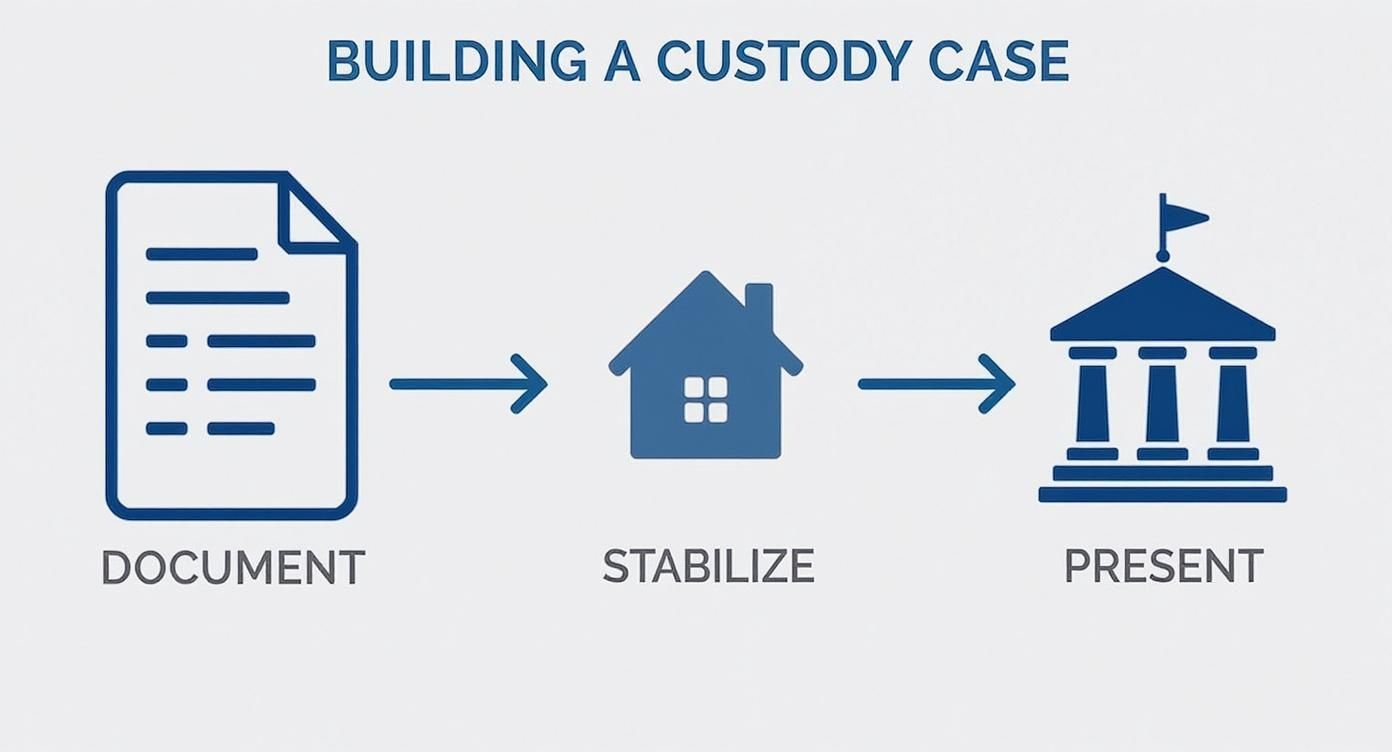
A winning case is built on a solid foundation of detailed documentation and a stable home life, all brought together in a compelling presentation to the court.
Key Stages of a Texas Custody Case
| Stage | What Happens | How to Prepare |
|---|---|---|
| Initial Filing | One parent files a petition with the court, officially starting the lawsuit. The other parent is served with legal papers. | Gather all essential documents (birth certificates, proof of paternity, financial records) and consult with an attorney. |
| Temporary Orders Hearing | A short hearing where a judge sets temporary rules for custody, visitation, and child support while the case proceeds. | Document your day-to-day involvement with your child. Prepare a proposed schedule and budget to show the judge. |
| Discovery | Both sides exchange information and evidence, such as financial documents, emails, and text messages. Depositions may be taken. | Stay organized. Respond to requests from your attorney promptly and be completely honest about all information. |
| Mediation | A mandatory settlement conference with a neutral mediator to try to reach an agreement without going to trial. | Come with an open mind, a clear list of priorities, and a willingness to negotiate for your child's best interest. |
| Final Trial | If no settlement is reached, the case goes before a judge who hears testimony, reviews evidence, and makes a final ruling. | Work closely with your attorney to prepare your testimony, gather witness lists, and organize all your evidence. |
Understanding these milestones helps you anticipate what's next and stay focused on your goals. An experienced family law attorney can be your guide, strategist, and advocate through one of the most important challenges of your life.
Key Takeaway: Your Next Steps as a Father
Let's pull everything together into a clear, actionable game plan. This journey requires focus and an unwavering commitment to your child's future. Remember that Texas law sides with the child's best interest, not a parent's gender. Your goal is to show the court that you are the parent best equipped to provide a safe, stable, and nurturing home.
This can feel like a mountain to climb, but you can start making progress today. The consistent actions you take now will build the foundation for a strong case.
A Clear Path Forward
Your immediate priorities should be direct and purposeful. By concentrating on these key actions, you can build the legal standing and evidence needed to pursue primary custody.
Here's what to focus on right away:
- Formally Establish Paternity: If you haven't done this, make it your top priority. An Acknowledgement of Paternity (AOP) or a court order is the only way to secure your legal rights as a father. It is non-negotiable.
- Document Everything: Start a detailed log of everything you do as a parent. Track school meetings, doctor's appointments, daily routines, text messages, and expenses related to your child. Evidence is your most powerful tool in court.
- Maintain a Stable Environment: Consistency is key. Focus on creating a positive, predictable, and supportive home life for your child. Judges look for stability above almost all else.
The single most important step you can take right now is to get guidance from a legal expert who understands what you're facing. You do not have to figure this out alone.
If you need help with a child custody or visitation case in Texas, our experienced attorneys can guide you every step of the way. Contact The Law Office of Bryan Fagan, PLLC today for a free consultation.
Questions We Hear from Fathers Seeking Custody
When you're facing a custody case, the questions can feel overwhelming. As a dad, you just want straight answers so you can focus on what matters—your child. These are some of the most common questions we hear from fathers at the beginning of this process.
Can I Get Full Custody If We Were Never Married?
Yes, absolutely. Your marital status has no impact on your right to seek custody in Texas. The law views married and unmarried fathers as equals—once paternity is legally established.
This is the one non-negotiable step. If you haven't already, you must legally establish that you are the child's father, either through an Acknowledgement of Paternity (AOP) or a court order. Once that legal tie is in place, your custody case will be judged by the same standard as any other parent's: what is in the best interest of the child.
What's the Difference Between Sole and Joint Custody?
The standard in Texas is Joint Managing Conservatorship. This is where both parents share the rights and responsibilities of raising their child. Even in a joint arrangement, the court usually names a "primary" parent who has the exclusive right to decide where the child lives.
Sole Managing Conservatorship—what most people call "full custody"—is different. It gives one parent the exclusive power to make major decisions about a child's life, such as their residence, school enrollment, and non-emergency medical care. To achieve this, you must prove to a judge that giving the other parent joint rights would be harmful or damaging to your child. This is a high legal standard and usually involves proving serious issues like family violence, neglect, or substance abuse.
How Much Is a Full Custody Case Going to Cost?
The honest answer is: it varies. There is no single price tag because every family's situation is unique.
A case where parents can reach an agreement in mediation will be far less expensive than a contested case that goes to trial. The final cost will depend on factors like the level of conflict, the need for expert witnesses like a child psychologist, and the amount of evidence that needs to be gathered. The best way to understand potential costs is to sit down with an attorney and discuss the specifics of your case.
If you need help with a child custody or visitation case in Texas, our experienced attorneys can guide you every step of the way. Contact The Law Office of Bryan Fagan, PLLC today for a free consultation.