
When your family’s future is on the line, the legal system can feel overwhelming. The decision to divorce is deeply personal, often coming at the end of a long, emotional road. But breaking the process down into clear, manageable steps can help you feel more in control as you work toward a stable future for you and your children.
Think of this guide as your roadmap. It's designed to walk you through the process, helping you move forward with clarity and confidence.
Your First Steps in the Texas Divorce Process
Taking the first step is often the hardest part. Remember, filing for divorce is not about ending a family but restructuring it in a way that allows everyone, especially your children, to thrive in a more stable environment. Each step, from confirming residency to filing that first document, is a move toward resolution and peace.
Confirming Your Texas Residency
The very first step isn't about emotions—it's about jurisdiction. Before a Texas court can even hear your case, you have to meet specific residency rules. This isn't optional; it's the legal starting line.
To file for divorce in Texas, one of you must have lived in the state for at least six months. On top of that, one spouse must have been a resident of the county where you plan to file for at least the last 90 days. These rules, laid out in the Texas Family Code, ensure the court has the proper authority to handle your case. You can find more details about Texas divorce laws from various family law resources.
Understanding the Key Players
Once you've confirmed your residency, the next piece of the puzzle is understanding who's who. The spouse who files the first round of paperwork is called the Petitioner. The other spouse, who will be officially notified of the divorce filing, is the Respondent.
Don't read too much into these titles. They are neutral legal terms that simply define each person's role in the court case. They don't imply fault or blame on either side.
Texas Divorce Key Requirements and Timeline
| Requirement or Milestone | What You Need to Know |
|---|---|
| Residency | One spouse must live in Texas for 6 months and the filing county for 90 days. |
| Filing the Petition | The Petitioner files the Original Petition for Divorce to start the case. |
| Serving Papers | The Respondent must be formally notified of the lawsuit. |
| Waiting Period | Texas has a mandatory 60-day waiting period after filing before a divorce can be finalized. |
| Temporary Orders | These orders can be set up early to address custody, support, and property issues while the case is pending. |
| Final Decree | This is the final, signed court order that officially dissolves the marriage and details all terms. |
This infographic breaks down the foundational elements of starting a divorce in Texas, from residency to the roles of each spouse.
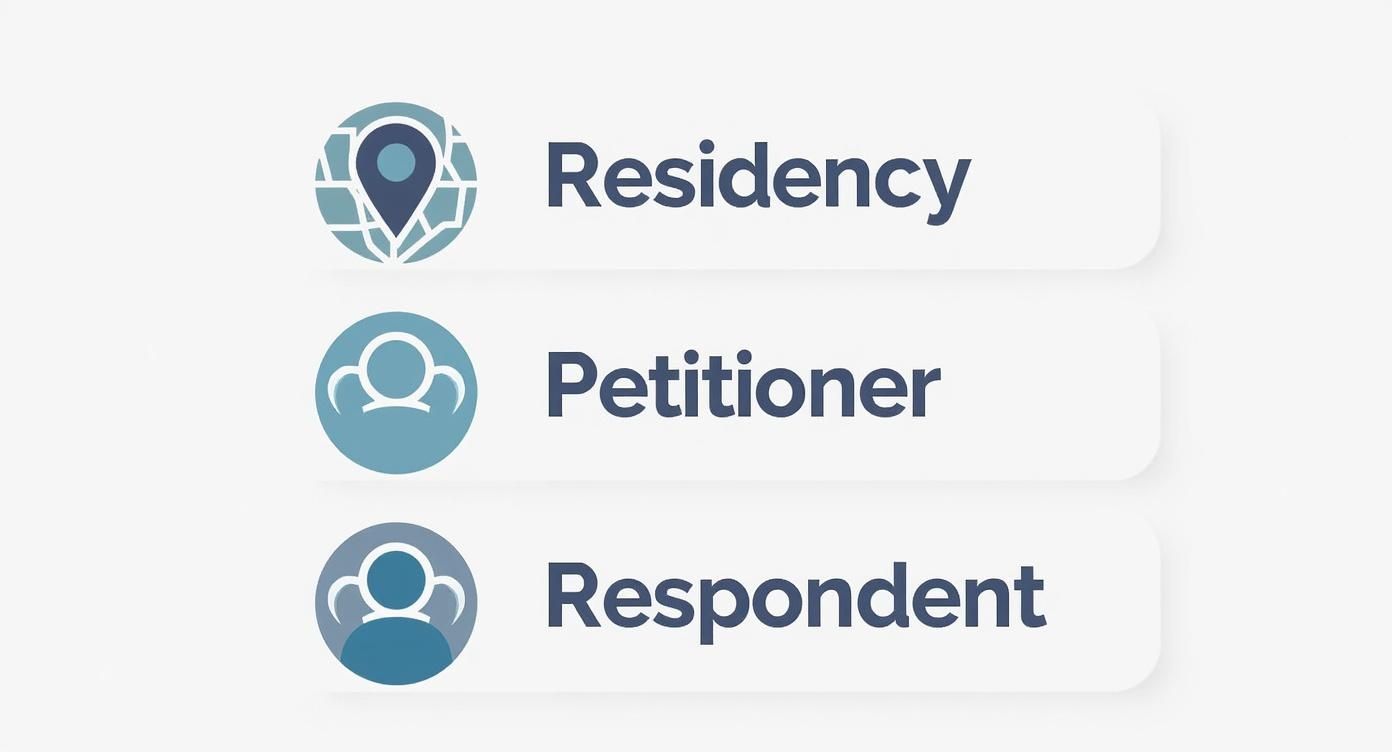
Visualizing these initial requirements helps clarify that the process begins with clear, defined legal steps before you tackle the more complex issues.
Filing the Original Petition for Divorce

Once you’ve confirmed you meet the Texas residency requirements, it’s time to take the first official step: filing the Original Petition for Divorce. While the name sounds intimidating, think of it as the document that introduces your case to the court and lays out what you're asking for.
This isn’t just another form. It’s the legal starting line for your divorce journey. It gives the court the essential facts about your marriage, your family, and what you need to move forward. Getting this part right sets a clear, organized tone for the rest of your case.
Understanding Grounds for Divorce in Texas
One of the first questions the petition will ask is for the grounds, or legal reason, for the divorce. In Texas, you can choose between "no-fault" and "fault" grounds. This decision can seriously shape the entire mood and complexity of your divorce.
-
No-Fault Divorce (Insupportability): This is by far the most common path. Insupportability simply means the marriage has broken down due to conflict and there’s no reasonable chance of getting back together. It doesn’t point fingers, which usually leads to a more cooperative and less stressful process.
-
Fault-Based Grounds: Sometimes, one spouse’s behavior is the direct reason the marriage ended. Texas law recognizes several fault grounds, like cruelty, adultery, or abandonment. Proving fault can sometimes influence how community property is divided, but it also means you have to present evidence. This can make the divorce much more adversarial and expensive.
For most families, especially those with kids, sticking with the no-fault ground of insupportability is the way to go. It keeps the focus on finding solutions for the future, not fighting about the past.
What Information Goes into the Petition
The Original Petition for Divorce is a detailed document, so being prepared with the right information will make things go much smoother. You’ll need to provide a clear snapshot of your marriage and family for the court.
The goal of the petition is clarity. It's your first opportunity to tell the court, "Here is my family's situation, and here is the help we need to move forward." A well-prepared petition creates a solid starting point for negotiations or court decisions.
Here's what you'll typically need to include:
- Full names and addresses for you and your spouse.
- The date and place you were married.
- The names and birthdates of any minor children from the marriage.
- A statement confirming you meet Texas residency requirements.
- The legal grounds for the divorce (as we just discussed).
- A section asking the court for specific orders, known as a prayer for relief.
If you have children, the petition gets a bit more involved. It must also include what’s called a Suit Affecting the Parent-Child Relationship (SAPCR). This section is where you’ll state your requests for conservatorship (custody), possession and access (visitation), and child support. It’s critical to understand your options here, and our detailed guide on how to file for custody in Texas is a great place to start.
The Logistics of Filing Your Paperwork
After you or your attorney drafts the Original Petition for Divorce, the next move is to file it with the right court. This has to be done in the District Court or a County Court at Law in the county where either you or your spouse has lived for the past 90 days.
When you file, you’ll have to pay a filing fee. It varies by county but usually lands somewhere between $250 to $350. If that fee is a hardship, you can file a "Statement of Inability to Afford Payment of Court Costs," which asks the judge to waive the expense.
Once the court clerk accepts your petition and gives it a case number, your divorce is officially filed. This action turns a private family matter into a public legal case and, importantly, starts the clock on the state’s mandatory 60-day waiting period before a divorce can be finalized. This initial filing is a huge, empowering step toward building a new, stable future for you and your kids.
Notifying Your Spouse and Their Response

Once your Original Petition for Divorce is filed with the court, the next step is a non-negotiable legal requirement called service of process. This is just the formal way of saying your spouse must be officially notified that you’ve started the divorce. It’s all about fairness and due process, giving them a clear opportunity to participate in the case.
The thought of having papers served on your spouse can feel incredibly stressful or confrontational. But it doesn't have to be. Texas law actually provides a few different ways to handle this, so you can choose an approach that fits your family's dynamic—whether it's cooperative or a bit more complicated.
The Amicable Path: Waiver of Service
If you and your spouse are on decent terms and have already talked about the divorce, the most peaceful and efficient route is the Waiver of Service. This is a straightforward legal document where your spouse simply acknowledges they've received a copy of the divorce petition.
By signing the waiver, they agree to the court’s authority without needing to be formally served by a stranger. This move saves time, money, and spares you both the awkwardness of formal service. One critical detail: the waiver is only valid if it's signed after the Original Petition for Divorce has been officially filed with the court. Once signed, it's filed with the court clerk, and your case moves on.
Formal Service of Process Explained
When a Waiver of Service just isn't in the cards, you'll need to use formal service. This creates an official, undeniable record that your spouse received the divorce papers. You can't just hand the documents to them yourself; it has to be done by a neutral third party.
Here are your main options for formal service:
- A Private Process Server: These are certified professionals who deliver legal documents for a living. They're often fast, flexible with their hours, and really good at finding people who might be hard to locate.
- A Sheriff or Constable: You can also have a deputy from the local sheriff's or constable's office deliver the papers. This is a common and reliable method, though sometimes not as quick or flexible as a private server.
The server will personally hand a copy of the citation (an official notice from the court) and your divorce petition to your spouse. After they've done that, they will file a "Return of Service" with the court. This is the official proof of when, where, and how your spouse was served.
How you choose to notify your spouse is one of your first opportunities to set the tone for the entire divorce. If cooperation is possible, the Waiver of Service is a powerful tool for starting the process with mutual respect.
What Happens After Service? The Respondent's Answer
Once your spouse is served or signs a waiver, they officially become the Respondent in the case. From that moment, a clock starts ticking for them to file a formal response with the court.
That response is called the Respondent’s Original Answer. Filing an Answer is a crucial step for the Respondent. It’s how they tell the court, "I'm here, and I'm participating." It also prevents you, the Petitioner, from getting a "default judgment" against them. A default judgment could happen if the Respondent fails to answer, potentially letting the judge finalize the divorce entirely on your terms.
The deadline for filing an Answer is very specific. It must be filed by 10:00 a.m. on the Monday that follows the expiration of 20 days from the date they were served. For example, if your spouse was served on a Tuesday, they count 20 days out from that date, and their Answer is due by 10:00 a.m. on the very next Monday. Because this timeline can be tricky, it's a smart move for any Respondent to get legal advice to make sure they respond correctly and on time, protecting their rights from the get-go.
How Texas Determines Custody and Visitation
Once the Original Petition for Divorce hits the courthouse, a legal clock starts ticking. In Texas, the law mandates a 60-day waiting period before a judge can legally finalize your divorce. While it might feel like a frustrating delay, this time is actually a golden opportunity to tackle the urgent questions that pop up when a family is restructuring—especially regarding your children.
Life doesn't just hit pause during this 60-day wait. You still have to figure out who’s staying in the house, how the mortgage gets paid, and—most importantly—where the kids will be sleeping from one night to the next. That uncertainty can easily become one of the most stressful parts of the entire divorce.
The “Best Interest of the Child” Standard
In every Texas custody case, the judge’s decision is guided by one single principle: the “best interest of the child.” This is the North Star for all family law courts, meaning every order for custody, visitation, and support must be designed to promote the child’s physical and emotional well-being and development.
This standard gives judges the flexibility to look at each family's unique situation. They will consider factors like the child’s emotional and physical needs, the stability of each parent's home, and the parents' ability to work together for their child's benefit.
Creating Stability with Temporary Orders
This is exactly where Temporary Orders become a lifeline. These are real, legally binding court orders that set up temporary rules for your family to live by while the divorce is pending. They’re designed to bring stability and predictability back into the picture for everyone, especially the children.
Temporary Orders can solve a whole host of immediate problems, including:
- Child Custody (Conservatorship): They establish a temporary possession schedule, clearly defining when each parent will have the kids. In Texas, it's presumed that Joint Managing Conservatorship is in the child's best interest, meaning both parents share decision-making rights.
- Child Support: They can set up temporary child support payments to make sure the children’s financial needs are covered right away.
- Spousal Support: If one spouse doesn’t have the resources to cover their basic needs, a judge can order temporary spousal support.
- Property Use: These orders can decide who gets to live in the family home and who has the right to use certain cars or other property.
- Bill Payments: They spell out who is responsible for paying the mortgage, car notes, and other joint debts until the divorce is final.
Your temporary orders hearing is your first real chance to show the judge that you are focused on your children's stability. Come prepared with a clear, responsible plan for your family’s immediate future.
Reaching an Agreement and Finalizing the Divorce

You’ve filed the initial paperwork and made it through the mandatory 60-day waiting period. Now you’re entering the final phase: creating a Final Decree of Divorce.
Think of this document as the official rulebook for your post-divorce life. It’s the comprehensive legal document that formally dissolves your marriage and spells out every detail you and your spouse will need to follow moving forward—from who gets the house to when each parent sees the kids. The path you take to create this decree will have a massive impact on your family’s future.
The Power of Mediation in Texas Divorce
The overwhelming majority of Texas divorces don’t end in a dramatic courtroom trial. Instead, they’re settled through mediation.
Mediation is a guided negotiation where you, your spouse, and your lawyers sit down with a neutral third-party mediator to find common ground. They don't make decisions for you; they help you make the decisions.
Mediation puts you in control. Instead of letting a judge who doesn't know your family make life-altering decisions, you and your spouse have the power to craft a solution that truly works for your unique circumstances. It is an empowering process focused on resolution, not conflict.
It's also far less stressful and expensive than a trial. It allows for creative solutions and keeps your family’s private business out of the public record.
Crafting the Final Decree of Divorce
Once you've reached an agreement, your attorney will draft the Final Decree of Divorce. A solid Final Decree will clearly spell out everything:
- Property Division: A detailed list of all community property and debt, specifying exactly who gets what.
- Conservatorship: This section will name you and your ex-spouse as Joint Managing Conservators and define the specific rights and responsibilities each of you will have.
- Possession Schedules: This is where the visitation schedule, or Possession Order, lives. A possession schedule details the specific days and times each parent will have the children, covering regular weekends, all holidays, school breaks, and summer vacation. A detailed possession schedule prevents future conflict.
- Child Support: The decree locks in the monthly child support amount, designates who is responsible for the child's health insurance, and outlines how out-of-pocket medical expenses will be split.
This is also where your parenting plan becomes a legally binding court order. A well-thought-out parenting plan is crucial for giving your kids the consistency they need. For more guidance on what to include, you can check out our detailed parenting plan template for Texas families.
When an Agreement Isn't Possible: The Path to Trial
Sometimes, even with the best intentions, you and your spouse just can't see eye to eye. When you're at a complete impasse, the only option left is to let a judge decide the outcome at a final trial. At trial, both sides will present evidence and arguments, and the judge will make a binding ruling based strictly on the "best interest of the child" standard. A trial is public, expensive, and emotionally exhausting, which is why Texas courts push so hard for settlement.
Key Takeaways and Next Steps
Navigating a divorce is a marathon, not a sprint. Remember these key points as you move forward:
- Understand the Legal Framework: Know the residency requirements, the 60-day waiting period, and the difference between no-fault and fault grounds.
- Focus on Your Children's Best Interests: This is the standard the court will use for every decision related to your kids. A stable, cooperative approach will always serve them best.
- Seek Amicable Solutions First: Mediation and negotiation put you in control of the outcome, save money, and reduce stress for your entire family.
- Temporary Orders Provide Stability: Use them to create a predictable routine for your children and manage finances while the divorce is pending.
- Get Professional Guidance: An experienced family law attorney can protect your rights and help you build a secure future for your family.
The choices you make today will shape your family's tomorrow. By approaching this process with knowledge and a commitment to your children's well-being, you can lay the groundwork for a positive new beginning.
If you need help with a child custody or visitation case in Texas, our experienced attorneys can guide you every step of the way. Contact The Law Office of Bryan Fagan, PLLC today for a free consultation.