
Life doesn't stand still after a judge signs a custody order. A new job, a child's changing needs, or a parent's decision to move can quickly make an old arrangement unworkable. When your child’s future is on the line, understanding your rights isn't just important—it's everything.
The good news is that Texas law understands that families evolve. The legal system provides a clear path for parents to ask a court to modify an order when circumstances change, ensuring the arrangement continues to serve your child's best interests.

How Texas Determines if a Custody Order Can Be Changed
So, how do you officially change your custody, visitation, or child support order? In Texas, the process is guided by a specific two-part test laid out in the Texas Family Code. To succeed, you must prove two things to the court:
- There has been a material and substantial change in the circumstances of the child or one of the parents.
- The modification you are requesting is in the best interest of the child.
This isn't just legal jargon; it's the framework a judge uses to balance a child’s need for stability with the reality that life moves forward. A court needs to see that something significant has happened that makes the current order impractical or no longer beneficial for your child.
What Is a “Material and Substantial Change”?
A "material and substantial change" is much more than a minor inconvenience or a simple disagreement with your co-parent. It must be a significant life event that directly and meaningfully impacts your child’s world.
A common misconception we see is that any change is enough to modify an order. In reality, Texas courts look for major shifts that affect a child’s physical or emotional well-being, making the current possession schedule or conservatorship arrangement genuinely unsuitable.
Here are a few examples of situations that courts often consider significant enough to warrant a modification:
- A parent is relocating, making the current visitation schedule impossible to maintain.
- A major, long-term shift in a parent's work schedule that conflicts with the existing possession order.
- The changing needs of a child as they grow older—such as new school demands, serious extracurricular commitments, or evolving emotional needs.
- A parent's remarriage, which introduces a new stepparent and changes the family dynamic.
- Serious concerns about a child's safety due to a parent's substance abuse, neglect, or exposure to a dangerous environment.
- A child expressing a strong preference to live with the other parent, especially if they are 12 years of age or older.
The “Best Interest of the Child” Standard
Even if you can prove a massive change has occurred, a judge will only approve a modification if it serves the best interest of the child. This is the single most important principle in all Texas custody matters. The court will analyze a range of factors to determine what arrangement will best support your child's emotional, physical, and developmental well-being. This is where you can learn more about how to prove the best interest of the child.
Understanding these legal grounds is key. The standard for modifying custody often mirrors the requirements for other related changes, like the criteria for modifying child support, which also requires proving a substantial and material change in circumstances.
Navigating this process is more common than you might think. National court data shows that roughly 20% of custody orders are modified within the first three years. This tells us that Texas courts are accustomed to these requests but will always require a strong case built on that “material and substantial change” foundation.
Steps to Modify a Custody Order
The foundation of any custody modification case is proving that a material and substantial change has taken place. This legal standard is the key that unlocks the courtroom door. Without it, a judge is legally unable to alter your existing order.
So, what does this mean for you? It means you must demonstrate to the court that a significant life event has occurred since your last order was signed—something that renders the old arrangement unworkable or, more importantly, no longer in your child's best interest. This isn't about small disagreements. The court is looking for game-changing events. Your job, with the help of an experienced attorney, is to connect the dots for the judge, showing exactly how this change impacts your child’s well-being.
What Courts Consider a Valid Change
Judges in Texas have seen a wide range of family situations. While every case is unique, certain circumstances frequently meet the "material and substantial" threshold. Knowing them can help you assess your own situation.
Common examples that often justify a modification include:
- A Parent's Relocation: One parent moving to another city or state for a job, making the current possession schedule impossible.
- Changes in a Parent’s Lifestyle: A parent developing a substance abuse problem, being convicted of a crime, or exposing the child to an unsafe or unstable living environment.
- A Child’s Evolving Needs: A child being diagnosed with a medical condition requiring specialized care, or a teenager’s demanding schedule no longer fitting an outdated visitation plan.
- The Child's Preference (if 12 or older): While not the deciding factor, a child aged 12 or older can speak with the judge in private about which parent they want to designate their primary home.
- A Parent's Remarriage: Introducing a stepparent and possibly stepsiblings into the home is a significant shift in a child's world that the court will consider.
To help you understand if your situation might qualify, here is a breakdown of common scenarios and why they matter to a judge.
Examples of Material and Substantial Changes
| Type of Change | Common Examples | Why It Matters to the Court |
|---|---|---|
| Parental Relocation | Moving out of the county, state, or country for a new job or to be closer to family. | A significant move makes the current possession schedule impractical, directly impacting the child's access to both parents. |
| Lifestyle & Safety | A parent develops a drug or alcohol problem, engages in criminal activity, or exposes the child to an unsafe home environment. | The court's primary duty is to protect the child. A dangerous environment is a clear and compelling reason for a change. |
| Child's Needs | A new medical diagnosis, changing educational needs, or a teenager's desire for more stability during the school week. | Custody orders must adapt as a child grows. An old plan may no longer serve the child's current developmental or emotional needs. |
| Parent's Remarriage | A parent marries someone new, introducing a stepparent and possibly stepsiblings into the child's life. | This changes the family dynamic and home environment. The court will want to ensure the new situation is stable and positive for the child. |
| Financial Changes | A significant, involuntary, and long-term loss of income for one parent, or a major increase in the child's expenses (e.g., medical costs). | This is more often tied to child support modifications but can impact custody if it affects a parent's ability to provide a stable home. |
This isn't an exhaustive list, but it covers the most common grounds. If your family's situation is reflected here, you may have a strong basis for modification.
Why Informal Agreements Are a Costly Mistake
Many parents try to avoid court by making informal, verbal agreements. While a cooperative spirit is commendable, this path is risky. Unwritten deals are not legally enforceable in Texas. If the other parent suddenly decides to ignore your handshake agreement, you have no legal recourse to make them comply.
This is a critical point. Parents who try to “work it out informally” often discover that these verbal understandings can't be modified by a court, because judges modify orders, not conversations. National statistics show about 39% of parents without a legal support order believed a formal agreement wasn't necessary. When those informal deals fall apart, those parents are left completely unprotected. You can discover more insights about these child custody stats and see for yourself why getting it in writing is so vital.
The only way to truly protect your child and ensure your new arrangement is permanent and enforceable is to have it signed by a judge and filed as a new court order. Anything less leaves your family vulnerable.
Gathering the Evidence to Build Your Case
To convince a judge that a change is necessary, you need more than just your word—you need proof. Evidence is what transforms your claim from an opinion into a fact the court can act upon. Begin gathering and organizing any documentation that supports your case now.
Your evidence should paint a clear "before" and "after" picture of the substantial change. Crucially, it must also show why your proposed new arrangement is in your child's best interest. A strong case requires various types of proof.
- Communication Records: Save relevant texts, emails, and social media messages between you and the other parent. These can show agreements, disagreements, or concerning behavior.
- School and Medical Records: Report cards, attendance records, and teacher notes can demonstrate how a child is faring under the current arrangement. Medical or therapy records can highlight new health or emotional challenges.
- Financial Documents: Pay stubs or employment letters can prove a change in income or a new work schedule that makes the old order unworkable.
- Photos and Videos: Visual evidence can be powerful for showing a child's living conditions or documenting concerning activities.
Organizing this information thoughtfully from the start will make your case stronger and more persuasive in front of a judge.
Filing a Petition to Modify Your Custody Order
After gathering your evidence and confirming that a "material and substantial change" has occurred, it's time to put your preparation into action. This is when you officially ask the Texas court system to intervene. The legal process begins with one critical document: the Petition to Modify the Parent-Child Relationship.
This petition is your formal request to the court. It explains who the parties are, what has changed, and why the current custody order is no longer working for your child. Think of it as the official starting point for your modification case.
Starting the Legal Process Correctly
Filing the Petition is the first domino. It must be drafted carefully because it frames your entire argument. In it, you'll outline the specific changes you’re requesting—perhaps a new possession schedule, a change in which parent has the right to designate the child's primary residence (what's often called "primary custody"), or an adjustment to decision-making rights.
This document is the foundation of your case, and mistakes can cause delays or weaken your position. This is why having an attorney ensure it’s drafted correctly and filed in the proper court is so critical. For a closer look at these filings, our guide on how to write a court motion offers additional insight.
Notifying the Other Parent The Right Way
Once your petition is filed with the court clerk, the other parent must be formally notified. This is called "service of process," and it’s a constitutional requirement ensuring everyone has a fair opportunity to respond to a lawsuit.
You cannot simply email or text a copy of the paperwork. The law requires a neutral third party, like a sheriff's deputy or a private process server, to personally deliver a copy of the petition and a legal notice called a "citation" to the other parent. This official step proves to the court that the other parent is aware of the case.
The path from gathering evidence to getting a new court order involves a few key legal steps, and it all starts with turning your proof into a formal request.
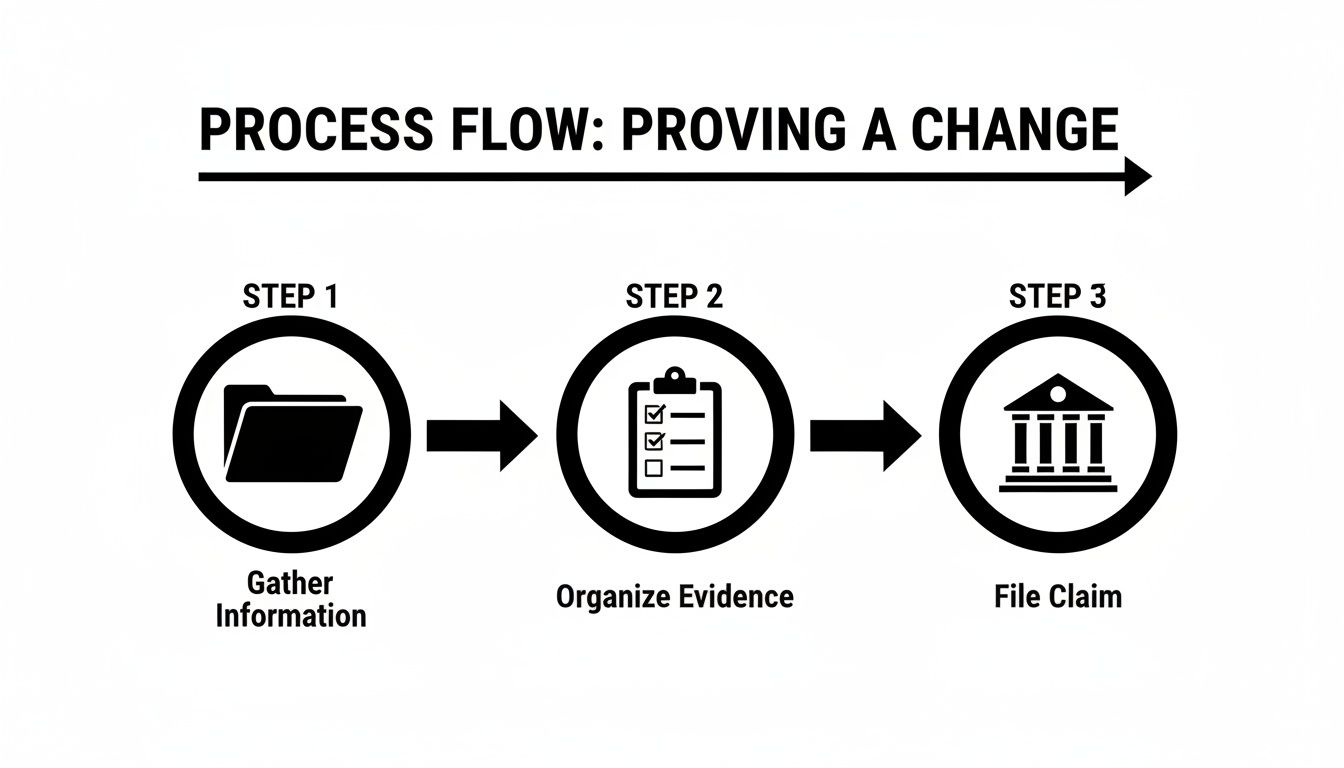
As you can see, filing the petition is the crucial action that bridges your preparation and the formal legal process.
Seeking Immediate Relief with Temporary Orders
Modification cases don't resolve overnight; they can take months. So, what do you do if you have an urgent issue that can't wait? This is where Temporary Orders come in.
When you file your petition, you can also ask the court for a temporary orders hearing. This is a mini-hearing that happens relatively quickly, where a judge can establish temporary rules to provide stability while the case is ongoing.
For example, a judge might issue temporary orders to:
- Implement a temporary possession schedule that reflects the new reality.
- Prevent one parent from moving out of the county with the child.
- Order a parent to undergo a drug test if there are legitimate safety concerns.
These orders create stability and protect your child while you and the other parent work toward a final, permanent solution.
Temporary orders are a powerful tool for protecting your child’s well-being right away. They bridge the gap between filing your case and the final resolution, ensuring your child isn't stuck in an unworkable or unsafe situation for months on end.
Finally, after the case is underway, most Texas courts will require you and the other parent to attend mediation. This is a required and often valuable step where a neutral third party helps you and the other parent negotiate your own agreement, putting you in control of the outcome.
Resolving Your Case Through Mediation or Court
Once you've filed your petition and handled any urgent issues with temporary orders, your case moves toward a final resolution. At this stage, you have two primary paths: reaching an agreement with the other parent or presenting your case to a judge in a courtroom. Most courts in Texas will require you to try the first path—mediation—before they will consider the second.
This is a critical fork in the road. One direction keeps you and your co-parent in control, while the other hands that control over to a judge. Understanding what to expect from both mediation and a court hearing is key to preparing for what comes next.
The Power of Agreement in Mediation
Mediation is a private, confidential process where you, the other parent, your attorneys, and a neutral mediator sit down to negotiate a solution. The mediator doesn’t take sides or issue rulings; their role is to facilitate productive conversation and help you find common ground.
For many families, mediation is the best way to handle a custody modification. Here's why:
- You Control the Outcome: You and the other parent create the new terms of your order, not a judge who only knows your family from a stack of paperwork. This allows for creative solutions that fit your unique lives.
- It’s Confidential: What is said in mediation, stays in mediation. This privacy allows for honest conversations without fear that your words will be used against you in court.
- It's Often Faster and Less Expensive: A successful mediation can resolve your entire case in a single day, saving significant time, stress, and money compared to a lengthy court battle.
The most powerful aspect of mediation is that it preserves the co-parenting relationship. By working together to find a solution, you set a positive tone for the future, which is always in the best interest of the child.
Getting the most out of this process comes down to preparation. You can review our child custody mediation tips to learn more about what to expect and how to prepare.
What Happens If You Go to Court
If you cannot reach a full agreement in mediation, your case will be set for a final hearing before a judge. A courtroom is a formal, structured environment. It is an adversarial process where each side presents their case.
Your attorney will introduce evidence, question witnesses (including you and the other parent), and make legal arguments on your behalf. The other parent’s lawyer will do the same. The judge’s decision will be based only on the evidence presented and whether you have successfully proven both a material and substantial change in circumstances and that your requested modification is in your child's best interest. When preparing for court, meticulous documentation is crucial. To ensure accuracy for depositions and testimony, you might consider professional legal transcription services.
Sometimes, court is unavoidable, especially when parents are too far apart to agree or when a child's safety is at risk. It’s also important for Texas parents to know that legal standards have evolved. Since over 85% of jurisdictions now apply a “best interests of the child” standard, judges are often more open to arrangements that expand a non-primary parent's time, especially with solid evidence of good co-parenting. While settling is often preferred, our firm is always prepared to advocate powerfully for you in court to protect your child.
Handling Complex Custody Modification Issues
Not every custody modification is straightforward. Life can present complex challenges that require specific legal strategies, and it’s important to understand how Texas law addresses these situations so you are prepared to protect your child, no matter what comes your way.

Some of the most emotionally charged modifications involve a parent wanting to relocate, the unique demands of military service, or one parent refusing to follow court orders. Each scenario has its own set of legal standards and practical hurdles.
When a Parent Wants to Relocate
One of the most common reasons for a modification is a parent's desire to move. Whether for a new job, to be closer to family, or for a fresh start, a relocation can dramatically impact a child’s life and their relationship with both parents.
Most Texas custody orders include a geographic restriction. This provision defines the specific area—often a county and its surrounding counties—where the child’s primary residence must be located. If you are the parent with the right to establish the child's residence and you want to move outside this restricted area, you must get the court's permission first.
To get approval from a judge, you must prove two key things:
- The move is genuinely in the child’s best interest.
- You can create a new, workable possession schedule that still allows for a frequent and meaningful relationship with the other parent.
A judge will not approve a move just because it’s a great opportunity for the parent. The entire focus will be on the child’s stability, their community ties, and how the move will affect their bond with the parent who is not moving.
Unique Rules for Military Families
Military service adds a layer of complexity to custody cases. The realities of deployment, active duty, and frequent relocations don’t always align with standard possession schedules. Fortunately, Texas law and federal protections like the Servicemembers Civil Relief Act (SCRA) provide specific safeguards for military parents.
For instance, a parent's deployment cannot, by itself, be the sole reason to permanently change a custody order against them. Courts can issue temporary orders to manage custody during a deployment, often allowing a designated family member—like a stepparent or grandparent—to exercise the military parent’s visitation time. When the servicemember returns, the pre-deployment order typically resumes.
These cases require a deep understanding of how state and federal laws interact to protect both the child’s stability and the servicemember’s parental rights.
Enforcing a Modified Custody Order
Getting a new custody order is a major achievement. But what happens if the other parent refuses to follow it? A court order is not a suggestion; it's the law. If the other parent is denying you your court-ordered possession time, you have the right to take legal action.
The next step is to file a Petition for Enforcement. This document asks the court to compel the other parent to comply with the order. To be successful, you must clearly state which parts of the order were violated, including the specific dates and times you were denied possession of your child.
If a judge finds the other parent intentionally violated the order, the consequences can be serious. A court can order:
- Make-up parenting time to compensate for the time you lost.
- Fines or monetary judgments to cover your attorney’s fees.
- In severe or repeated cases, a judge can even sentence the non-compliant parent to jail time.
You fought hard for a modification that serves your child's best interests. You have every right to ensure that hard-won order is respected.
Key Takeaway: Taking the Next Step to Protect Your Child
We've covered a lot of ground—from understanding what a material and substantial change means in a Texas court to gathering evidence and navigating the legal process. But at the end of the day, this isn't just about legal steps; it's about your family's future.
Deciding to modify a custody order is a significant decision, one you are likely considering because you are deeply committed to your child’s well-being. You’ve taken in the information, and now you’re probably asking, "What’s my next move?"
Your Path Forward
While this guide provides a solid foundation, every family's situation is unique. The specific changes you're facing, your relationship with the other parent, and your child's needs will all shape the best path forward. Nothing can replace advice from an attorney who has guided hundreds of Texas families through this process.
Your child's future is too important to leave to guesswork. The most powerful step you can take today is to get professional guidance from someone who lives and breathes Texas family law.
This isn't a journey you have to take alone. We invite you to take the most important step today by scheduling a free, confidential consultation with one of our compassionate attorneys. We will listen to your story, answer your questions, and help you map out your legal options. Let us help you build a strategy that protects your child and gives you the peace of mind you deserve.
If you need help with a child custody or visitation case in Texas, our experienced attorneys can guide you every step of the way. Contact The Law Office of Bryan Fagan, PLLC today for a free consultation.
Your Top Questions About Modifying Custody in Texas
When you start thinking about changing your custody agreement, it's normal to have a lot of questions. The process can feel overwhelming, but getting clear answers is the first step toward feeling in control. Let's tackle some of the most common questions we hear from parents in your situation.
How Long Does It Take to Modify a Custody Agreement?
There's no single answer, as every family's case is different. If you and the other parent agree on the changes, you have an agreed modification. These can often be finalized in just a few months.
However, if you disagree, it becomes a contested case. These require a judge to make the final decision and can stretch the timeline to a year or longer. The main factors are your local court's schedule, the level of conflict between you and the other parent, and the complexity of your case.
Can My Child Decide Who They Want to Live With?
This is a very common question, especially for parents of teenagers. Under the Texas Family Code, a judge is required to interview any child who is 12 years of age or older in private to hear their wishes.
However, the child's preference is not the deciding factor. It is just one piece of the puzzle. The judge weighs it against many other factors, all under the "best interest of the child" standard. The court will consider the child's maturity and their reasons, but the ultimate decision rests with the judge.
How Much Does It Cost to Modify a Custody Order?
The cost of a modification can vary significantly. An uncontested case where both parents are in agreement is the most affordable route. In that scenario, your costs primarily consist of court filing fees and attorney's fees to draft and finalize the paperwork.
A contested case will be a larger investment. Costs can increase with higher attorney's fees for court appearances and trial preparation, mediation costs, and sometimes fees for expert witnesses. The best way to get a clear picture of potential costs is to schedule a free consultation, where we can provide a personalized estimate based on your unique situation.
Disagreements are a normal part of the process, and the legal system is built to resolve them. If you and the other parent cannot agree, your case is considered “contested,” and a judge will make the final decision after hearing all the evidence. This is the moment when having a skilled, strategic attorney is absolutely critical to protecting your child’s future.
If you need help with a child custody or visitation case in Texas, our experienced attorneys can guide you every step of the way. Contact The Law Office of Bryan Fagan, PLLC today for a free consultation.