
When your child’s future is on the line, understanding your rights matters most. In Texas, the law starts with a powerful belief: keeping both parents actively involved is almost always what's best for a child. This is why joint custody is the standard, not the exception. For parents, grandparents, and caregivers navigating this path, know that the system is designed to support shared parenting and encourage cooperation.
Legally, this arrangement is called a Joint Managing Conservatorship—a formal term for a plan that allows both parents to remain central figures in their child's life.
What Joint Custody Really Means for Texas Parents
Navigating a custody case can feel overwhelming, filled with unfamiliar legal terms. But once you grasp the core concepts, you'll be empowered to advocate for your family with confidence. The Texas legal system's goal is to create a stable, predictable environment where your child can thrive, even after a separation.
The term you'll hear most often is Joint Managing Conservatorship (JMC). In simple terms, think of "conservatorship" as the Texas word for "custody." A JMC is a court order that names both you and the other parent as legal decision-makers for your child. It’s the default arrangement because Texas law, specifically Chapter 153 of the Texas Family Code, presumes that having two engaged parents is in a child’s best interest.
This doesn't automatically mean a 50/50 split of time, but it does mean that both parents share the rights and responsibilities of raising their child. Here’s a plain-English breakdown of what these terms mean for your day-to-day life.
Joint Managing Conservatorship at a Glance
| Key Concept | What It Means for Your Family |
|---|---|
| Joint Managing Conservators | Both you and the other parent are named as legal decision-makers for your child. |
| Rights and Duties | You both share the responsibility for major decisions like education, medical care, and religious upbringing. |
| Possession Schedule | This is the calendar that outlines when the child lives with each parent. It's often a Standard Possession Order but can be customized. |
| Child Support | One parent typically pays child support to the other, even in a JMC, to ensure the child's needs are met in both homes. |
| Geographic Restriction | The court often designates a specific geographic area (like a county or school district) where the child's primary home must be located. |
Understanding these components helps you see the bigger picture—it's not just about dividing time, but about building a cooperative framework for your child's future.
The Best Interest of the Child Standard
Every single decision a Texas judge makes about custody is filtered through one guiding principle: the best interest of the child. This standard is the cornerstone of Texas family law, laid out in the Texas Family Code Chapter 153. It legally requires the court to prioritize a child's physical and emotional well-being above all else.
When a judge determines what’s in a child’s best interest, they consider a wide range of factors, including:
- The child’s emotional and physical needs, now and in the future.
- The stability of each parent’s home environment.
- Each parent’s ability to provide a safe, nurturing home.
- Any history of family violence or substance abuse.
This standard ensures the focus remains exactly where it should be—on creating a positive and stable future for your child.
Sharing Rights and Responsibilities
Under a Joint Managing Conservatorship, you and the other parent are legally expected to work together on the big decisions. This shared responsibility is the heart of joint custody in Texas. It’s a framework for co-parenting that encourages communication and cooperation long after the court order is finalized.
A common misconception is that joint custody is only about dividing the calendar. In reality, it’s about sharing the fundamental duties of parenthood—from medical decisions and educational choices to moral and religious upbringing.
While some specific rights may be given exclusively to one parent (like the right to determine the child's primary residence), the core idea is that both of you have a legal say in your child’s life. Your final custody order will spell out these rights and duties, giving you a clear roadmap to follow. This structure is designed to minimize conflict and keep both parents focused on supporting their child together.
How Texas Courts Decide on Joint Custody

When parents can't agree on a custody plan, a judge must make the decision. For many mothers and fathers, this is the most daunting part of the process—it can feel like you're handing over control of your family's future to a stranger.
However, Texas courts don't make these decisions lightly. They follow a specific and predictable framework designed with one goal: protecting your child’s physical and emotional well-being. The legal system isn’t designed to pick a “winner” and a “loser.” It’s there to determine the arrangement that will best support your child's happiness, stability, and growth.
The Holley Factors: The Judge’s Guidebook
So, how does a judge actually determine what’s in a child’s “best interest”? They use a set of guidelines known as the “Holley Factors.” These aren't just suggestions; they come from a landmark Texas Supreme Court case and act as a checklist to ensure every critical aspect of a child’s life is weighed carefully.
A judge will look at evidence related to each of these points:
- The child’s needs: This covers their emotional, physical, and developmental needs, considering their age and unique circumstances.
- Each parent’s abilities: The court will assess each parent's capacity to provide a stable, loving, and safe home.
- The stability of the home: A judge looks for consistency in a child’s routine, school life, and community connections.
- The child’s wishes: If a child is 12 or older, the judge may interview them privately to hear their preference. While important, it’s just one factor among many.
- Any immediate or future danger: The court will investigate any history of family violence, neglect, or substance abuse, which will weigh heavily on the final decision.
These factors give the judge a comprehensive view of the family, helping them make a thoughtful, well-rounded decision.
The Presumption of Joint Custody
It is crucial for every parent to know that Texas law starts with a legal "presumption" that naming both parents as Joint Managing Conservators is what’s best for the child. The court’s starting point is that keeping both parents actively and meaningfully involved is the right thing to do.
A judge will only move away from this joint custody standard if there's compelling evidence that doing so would harm the child, such as in cases involving family violence, substance abuse, or extreme instability.
But "joint" doesn't automatically mean a 50/50 split of time. A Joint Managing Conservatorship is about sharing rights and duties, not necessarily splitting the calendar down the middle. The actual possession schedule can look very different depending on the family's unique situation.
Evidence That Matters in Court
When preparing for a custody hearing, your actions and the proof you bring tell a story about your role as a parent. The judge needs to see your commitment and involvement.
Here's the kind of practical evidence that can make a real impact:
- Proof of your involvement: Keep a log of your attendance at parent-teacher conferences, doctor's appointments, and extracurricular activities.
- A stable living environment: Show the court you can provide a safe and consistent home for your child.
- Cooperative co-parenting: Demonstrate your willingness to communicate respectfully with the other parent. A history of hostile texts or emails can damage your case.
- Witness testimony: Teachers, counselors, or trusted family friends can offer powerful insight into your parenting and your bond with your child.
The court is looking for a parent who is stable, engaged, and puts their child's needs first. By focusing on these elements, you can build a strong case that truly reflects your child’s best interests.
Navigating Your Rights and Responsibilities as a Joint Conservator
Once a judge names you and the other parent as Joint Managing Conservators, the court order becomes the blueprint for how you’ll raise your child together. Understanding your specific rights and responsibilities is the single best way to reduce conflict and provide your child with a stable routine.
Think of it as a partnership where the "business" is your child's well-being. Both partners get a say in major decisions, but the court order will clearly define who handles what, creating a predictable framework for everyone.
Shared Rights vs. Exclusive Rights
In a Joint Managing Conservatorship, most parental rights and duties are shared. This means you and your co-parent are legally expected to confer in good faith before making major decisions. The goal is to keep both parents actively involved in the big-picture aspects of raising your child.
However, to avoid constant gridlock, the court will grant certain exclusive rights to one parent. This parent is usually named the primary conservator—the one who has the right to determine the child's residence.
Here’s how those rights are typically divided:
- Shared Rights (Held by Both Parents): This almost always includes the right to make joint decisions about your child’s education and any non-emergency medical, dental, or psychological care.
- Exclusive Rights (Often Given to the Primary Parent): This parent usually gets the sole right to designate the child's residence (within a specific geographic area) and the right to receive child support payments.
This structure strikes a balance, encouraging you to work together on major issues while giving one parent the final say on things that create day-to-day stability. For a deeper look at these legal roles, see our detailed guide on conservatorship in Texas.
The Role of the Primary Conservator
The parent with the exclusive right to decide the child's residence is often called the "primary" parent. This establishes the child's main home and, by extension, their school district. This parent is also the one who receives child support from the other parent (the obligor).
It's a common myth that being the primary parent gives you more "power." The truth is, this role comes with significant responsibilities. The court expects this parent to actively encourage and support a strong, loving relationship between the child and the other parent.
Custody arrangements have evolved. While mothers were historically favored for the primary role, Texas now reflects a cultural shift toward shared parenting. Fathers now receive approximately 33% of parenting time, nearly on par with the U.S. average of 35%. You can discover more insights about these custody statistics to see how modern family dynamics are changing.
A Parent's Standard Rights and Duties
The Texas Family Code outlines a standard set of rights and duties that apply to every parent in a custody order unless a judge specifically states otherwise. These are the ground rules for your co-parenting relationship.
Every parent conservator typically has the right to:
- Receive information from the other parent about the child's health, education, and general welfare.
- Access the child's medical, dental, psychological, and school records directly.
- Consult with school officials and doctors about the child.
- Be listed as an emergency contact for the child.
- Consent to medical treatment during an emergency.
Knowing these rights is empowering. It means you can stay informed and involved, no matter whose home the child is in. These rules ensure that both parents remain central figures in their child’s life, equipped to protect their best interests.
Understanding Texas Possession Schedules and Orders
The possession schedule is the calendar that dictates when your child is with you and when they are with their other parent. This is what shapes your family’s daily routine and is often where the most practical and emotional discussions occur. Getting this schedule right is key to creating the stability every child needs.
In Texas, the default calendar is the Standard Possession Order (SPO). It is designed to be in a child’s best interest by providing a consistent routine and ensuring both parents get regular, meaningful time.
The timeline below shows the typical journey of a custody case, from the initial filing to the final orders that put a possession schedule in place.
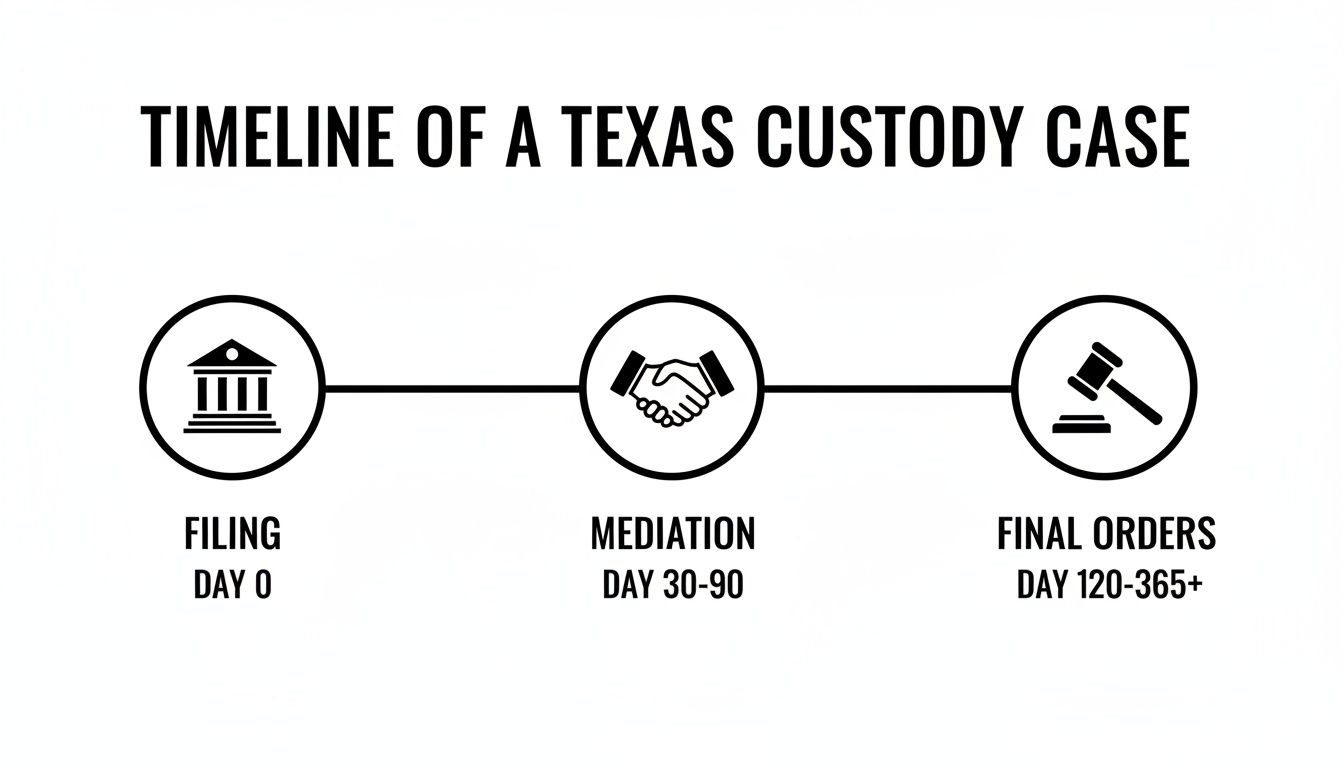
As you can see, getting to a final order is a process that often involves negotiation and mediation before a judge makes a final ruling.
The Texas Standard Possession Order Explained
So what does the SPO actually look like? For parents who live within 100 miles of each other, it gives the non-primary parent possession of the children on the first, third, and fifth weekends of the month. It also divides major holidays and gives that parent a substantial block of summer vacation time, usually 30 days.
However, the SPO is not set in stone. It’s the default. You and the other parent can agree on a completely different schedule that better fits your family’s needs. If you both agree that a custom schedule is in your child's best interest, a judge will almost always approve it.
The "standard" order is just a starting point. Your family is unique, and your possession schedule can be too. The goal is to find a routine that works best for your child, not just to fit a legal template.
If parents live more than 100 miles apart, the SPO is modified to give the non-primary parent fewer, but longer, periods of possession, such as every spring break and the entire summer vacation, to reduce the travel burden on the child.
Custom Schedules Tailored to Your Family
While the SPO provides a solid foundation, many families find it doesn't fit their lives. By working together, parents can design a custom plan that offers more flexibility and can even create a true 50/50 split. These arrangements require good communication, but the benefit to the children is often immeasurable.
Here are a few popular alternatives:
- Week-On/Week-Off: The child spends one full week with Parent A, then the next full week with Parent B. It’s simple and minimizes exchanges.
- The 2-2-5-5 Schedule: The child is with Parent A for two days, Parent B for two days, then Parent A for five days, and Parent B for five days. This ensures both parents get a mix of weekday and weekend time.
- Expanded Standard Possession Order: A common modification to the SPO that gives the non-primary parent more time, often by adding Thursday overnights during the school year. You can learn more about the Expanded Standard Possession Order in Texas in our detailed article.
When deciding between a standard and custom plan, it's helpful to see the differences.
Standard vs. Customized Possession Schedules
| Feature | Standard Possession Order (SPO) | Customized Schedule |
|---|---|---|
| Structure | Predetermined by Texas law; predictable but can be rigid. | Flexible; designed by parents to fit their specific needs and their child's activities. |
| Parental Agreement | No agreement needed; it's the default order the court will impose if parents can't agree. | Requires both parents to agree on the terms. High cooperation is necessary. |
| Time Split | Generally results in a non-equal time split. | Can be designed for any split, including a true 50/50 arrangement. |
| Best For | High-conflict situations or when parents are unable to agree on a schedule. | Cooperative co-parents who can communicate effectively and prioritize their child's needs. |
| Modification | Can be difficult to change without showing a major change in circumstances. | Can include built-in flexibility or be easier to adjust if both parents agree. |
The best schedule is the one that puts your child’s stability first and encourages a strong, healthy relationship with both parents. Thinking through these options is a huge step toward building a successful co-parenting future.
When and How You Can Modify a Custody Order
Life changes, and so do the needs of your children. The custody order that worked perfectly for a toddler might be unworkable for a teenager juggling school, sports, and a social life.
Texas law understands this. Your joint custody order can be changed—or "modified"—but only when specific, significant life changes occur. This process allows your parenting plan to evolve with your child, but the law sets a high bar to ensure stability.
The Legal Standard for Modification
To modify a Texas custody order, you must prove two things:
- There has been a material and substantial change in the circumstances of the child or one of the parents.
- Changing the existing order is in the best interest of the child.
The phrase "material and substantial change" is key. It means the change must be a major shift that significantly impacts your child's life. This standard prevents constant litigation over minor disagreements and protects a child's stable environment.
What Qualifies as a Material and Substantial Change?
While every situation is unique, modifications are often granted in these common scenarios:
- A Parent Relocates: One parent moves a significant distance, making the current possession schedule impractical.
- The Child's Needs and Wishes Evolve: In Texas, a child aged 12 or older can speak to the judge in chambers about their preference. While not the only factor, their wishes are given serious consideration.
- A Parent's Lifestyle Changes Significantly: This could be a parent's remarriage, a new work schedule, or the development of substance abuse or other stability issues.
- One Parent Consistently Ignores the Order: If one parent intentionally and repeatedly violates the possession schedule, a judge may see that as a reason to modify it.
Proving these changes is your responsibility. Document everything—keep a log of events, save relevant communications, and gather evidence showing how circumstances have shifted. To learn more, read our guide on how to win a custody modification case.
"The court's primary focus in a modification case is stability. The parent requesting the change must show not only that circumstances have changed, but that the proposed new arrangement will better serve the child’s well-being than the current one."
Families often need to adjust their orders as life happens. The best first step is always to try to reach an agreement with the other parent. If you can present an agreed modification to the court, a judge will almost certainly approve it. If not, you must file a formal Petition to Modify the Parent-Child Relationship and prepare to make your case.
Key Takeaway: Your Next Steps for Protecting Your Family's Future
Navigating joint custody in Texas is a journey of shared responsibility with your child’s well-being at the center of every decision. By understanding your rights, the court process, and the importance of cooperative co-parenting, you can build a stable, loving future for your family. This process is about creating a new normal where your child can flourish with the support of both parents.
An Actionable Checklist for Parents
As you move forward, use these steps as your roadmap to protect your rights and prepare for what’s ahead:
- Document Everything: Keep a detailed calendar logging your parenting time and all significant communications with your co-parent. Clear records are invaluable.
- Gather Key Records: Collect essential documents like your child’s report cards, medical records, and anything that shows your deep involvement in their life.
- Prioritize Your Child’s Routine: When proposing a possession schedule, focus on your child’s daily rhythm, friendships, and activities. Consistency is key to their stability.
- Stay Informed on Legal Changes: Texas family law evolves. Recent reforms have brought changes to custody dynamics, especially concerning visitation interference. You can learn about these transformative new Texas family laws to understand your current rights.
Supporting your children’s emotional health is also vital. Consider using resources for social emotional learning for children to help them process these changes in a healthy way.
Making informed decisions now sets the foundation for a successful co-parenting relationship and a happy, secure future for your child.
Your Top Questions About Joint Custody in Texas, Answered
It's completely normal to have questions when you're sorting through the details of joint custody. You're not just dealing with legal terms; you're trying to map out your family's future. Below, we’ve provided plain-English answers to the questions we hear most often from parents, so you can move forward with clarity and confidence.
Does Joint Custody Mean a 50/50 Schedule?
This is the most common misconception about joint custody in Texas. When a court names parents as Joint Managing Conservators, it’s primarily about sharing the rights and responsibilities of raising a child—not automatically splitting time 50/50.
While a 50/50 possession schedule is an option and is growing in popularity, the default is the Standard Possession Order, which typically results in a non-equal time split. To get a 50/50 schedule, you and the other parent usually need to agree to it, or you must prove to a judge that it is specifically in your child’s best interest.
Who Pays Child Support in a Joint Custody Arrangement?
Even with shared custody, one parent is almost always ordered to pay child support. The court will designate one parent as the "primary conservator"—the one who determines the child's residence. The other parent, often called the "non-primary" or "obligor," is then typically ordered to pay child support.
Under the Texas Family Code, child support is calculated using a formula based on the paying parent's net monthly income and the number of children they are supporting. A Standard Possession Order does not automatically reduce this amount.
However, if you have a 50/50 schedule and similar incomes, you and the other parent can agree to a different support amount—or none at all—and ask the court to approve it if you can show it’s in the child's best interest.
What Happens if We Can't Agree on a Decision?
Disagreements are a natural part of co-parenting. Your custody order is your rulebook for resolving them. For most major decisions, like education or non-emergency medical care, the order requires you to confer first.
If you still can’t agree, the order will usually give one parent the exclusive right to make the final decision. This tie-breaking authority often goes to the primary conservator. If you are constantly at odds and it's impacting your child, it may be time to consider mediation or, in serious cases, a modification of your order.
Can My Child Decide Who They Want to Live With?
A child's wishes are important but not the final word. In Texas, a child who is 12 years of age or older can speak privately with the judge about their preference if a custody modification has been filed.
The judge will listen carefully and give the child's preference significant weight. However, the judge’s ultimate decision must be based on the child's overall best interest, considering their maturity, their reasons, and all other relevant factors.
If you need help with a child custody or visitation case in Texas, our experienced attorneys can guide you every step of the way. Contact The Law Office of Bryan Fagan, PLLC today for a free consultation.