Skip to content
When your child's future is on the line, showing up prepared matters.
Most parents walk into a first custody consultation carrying stress, not strategy. They have screenshots, school papers, a few dates in their phone, and a lot of fear about what the other parent might say. That's normal. It's also fixable.
In Texas, custody cases turn on one central question: what arrangement serves the best interests of the child. Your first meeting with a lawyer should help answer that question clearly and directly. If you prepare the right way, that consultation becomes more than a fact dump. It becomes the start of a case narrative that shows who you are as a parent, how you meet your child's needs, and what outcome makes sense under Texas law.
This guide on how to prepare for a custody consultation in texas is built for real families. Mothers, fathers, grandparents, and caregivers all face different pressures, but the preparation process follows the same core principle. Bring facts that are organized, credible, and tied to your child's daily life.
Your Custody Consultation Binder What to Bring
A good consultation binder does one thing well. It helps your lawyer see your case fast.
Bringing a grocery bag full of loose papers usually slows the meeting down. Bringing a binder, folder set, or labeled digital files helps your attorney identify strengths, weaknesses, and missing proof right away. In practice, attorneys spend about 40 to 60% of an initial consultation organizing evidence into tiers, and courts tend to give Tier 1 and Tier 3 records about 3 to 4 times more weight than self-generated records like personal timelines or even communication logs, according to guidance on preparing for a Texas custody evaluation.
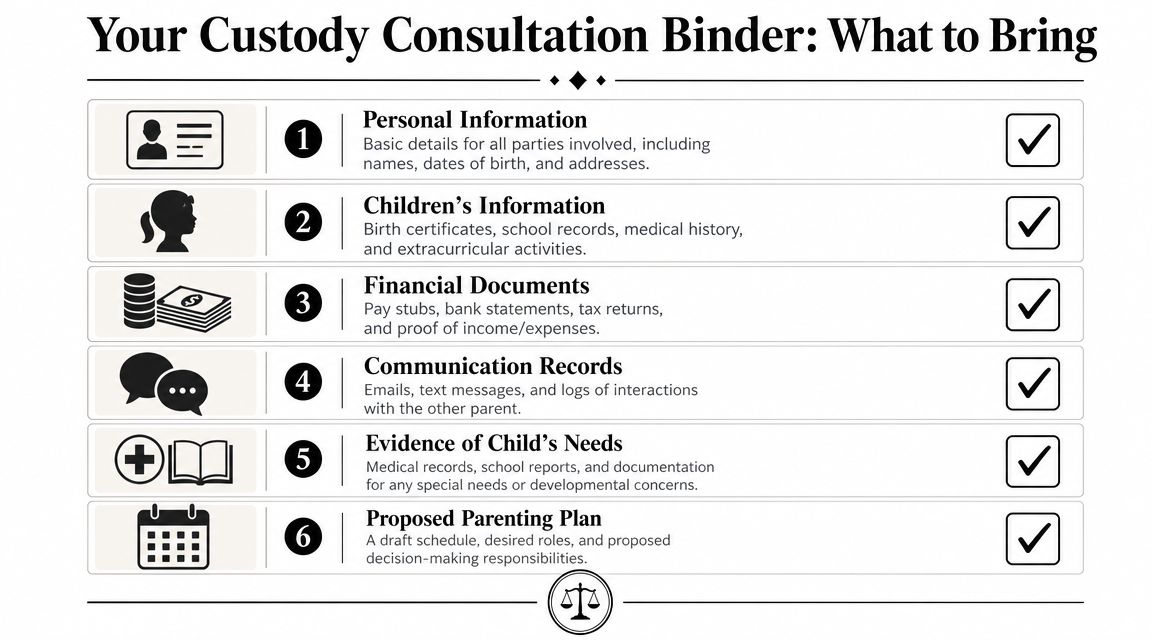
Start with the six basic categories
Before you sort by legal value, gather the basics in one place.
Personal information
Names, addresses, phone numbers, dates of birth, and contact details for both parents and any other important adults involved in the child's life.Children's information
Birth certificates, school information, medical history, therapy information if relevant, and activity schedules.Financial documents
Pay stubs, bank statements, tax returns, proof of major child-related expenses, and housing records.Communication records
Emails, text messages, parenting app messages, and logs of schedule discussions.Evidence of the child's needs
Medical records, report cards, attendance records, behavior notes, and documentation of special needs or developmental concerns.Proposed parenting plan
A practical schedule showing where the child will be, who handles school pickup, how holidays would work, and how major decisions should be made.
Use the three-tier system
Not every document carries the same weight. Thinking like a lawyer means knowing the difference.
| Tier | What it includes | Why it matters |
|---|---|---|
| Tier 1 | Medical attendance records, school report cards with dated entries, extracurricular schedules showing you as attending guardian, timestamped photos or videos | These are contemporaneous records created outside the lawsuit. They often carry the most credibility. |
| Tier 2 | Text messages, emails, calendar logs, parenting app messages | These can show patterns of involvement, but they need context and careful review. |
| Tier 3 | Receipts, proof of employment, housing records, references from teachers, coaches, or pediatricians | These support your overall parenting picture and can help verify stability and follow-through. |
Practical rule: Bring fewer documents that prove more. A clean set of school records and appointment logs often helps more than hundreds of angry text messages.
What works and what doesn't
Parents often assume the most dramatic evidence will matter most. Usually, the opposite is true.
What works:
- Dated school and medical records that show you attended, signed, transported, or followed up
- A clear calendar showing overnights, pickups, and routine care
- Third-party records from professionals who know your child
- Housing and income records that show stability in a child-focused way
What doesn't work as well:
- Long written speeches about how unfair the other parent is
- Screenshots without dates or context
- Social media printouts unless they directly relate to a serious issue
- Messy stacks of duplicate papers
Organize financial documents with purpose
A common mistake is treating finances as if they only matter for child support. They also matter because they help show whether you can provide a stable home, cover the child's needs, and plan responsibly. The better question isn't “Do I make enough?” It's “How do these records support my parenting story?”
Bring records that help explain housing, child-related spending, health coverage, school costs, and dependable routine. If medical paperwork is scattered across portals, clinics, and old emails, it helps to build a medical record command center before your consultation so you're not scrambling to piece together appointment histories.
If your case may involve a Suit Affecting the Parent-Child Relationship, reviewing this guide to the SAPCR form in Texas custody cases can also help you understand what information tends to matter early.
Choose paper, digital, or both
You don't need a fancy system. You need a usable one.
Try this simple setup:
- One master binder or folder
- Three labeled sections for the evidence tiers
- One short summary sheet with the top issues in the case
- One list of questions for the attorney
- One proposed schedule that's realistic, not idealized
If you prefer digital files, label them clearly. “School attendance Jan to May” is useful. “Scan00047” is not.
Organizing Your Story The Custody Timeline
Documents prove facts. A timeline explains why those facts matter.
A parent might bring school records, doctor visit summaries, text messages, and photos. Useful, yes. But until those records are placed in order, your lawyer still has to figure out the shape of your case. A timeline turns a pile of evidence into a story about stability, involvement, and the child's lived experience.

Build a timeline around the child, not the conflict
Start with major dates in the child's life. Birth, school enrollment, medical diagnoses, counseling, moves, schedule changes, and important transitions between homes. Then add your role in those events.
A strong timeline might include things like who handled school registration, who attended parent conferences, who scheduled medical appointments, and when the parenting arrangement started changing. It can also include missed exchanges, communication breakdowns, or safety concerns, but those should be described briefly and factually.
Keep your timeline chronological, dated if possible, and focused on care. Judges and lawyers need facts they can follow, not a running argument.
A simple example of how this helps
Consider two parents bringing the same records to a consultation.
The first says, “I've always been the more involved parent,” then hands over mixed papers. The second hands over a two-page timeline that shows the child's school year, medical needs, extracurricular schedule, and the parent's regular role in transportation, appointments, homework, and overnight care. The records back up the timeline.
The second version is easier to assess, easier to use, and easier to present.
Use brief entries such as:
School support
“August: completed enrollment paperwork, attended orientation, and handled first-week pickup.”Medical care
“October: took child to pediatric appointment, filled prescription, followed up with school nurse.”Schedule changes
“January: other parent stopped midweek exchanges. Began keeping a dated log.”
If you want a broader sense of how these facts fit into a case from filing through final orders, this overview of the Texas child custody case timeline and what to expect can help you place your consultation in context.
Understanding the Language of Texas Custody
Many parents come into a consultation using the word “custody.” Texas law often uses different terms. Learning the language helps you ask better questions and understand what your lawyer is recommending.

Conservatorship means parental rights and duties
In Texas, conservatorship refers to the rights and responsibilities of a parent. That includes things like making educational decisions, consenting to medical care, and receiving information about the child.
The two most common forms are:
Joint Managing Conservatorship
Both parents share certain rights and duties. This doesn't always mean equal time. It means both parents usually remain active legal decision-makers in important parts of the child's life.Sole Managing Conservatorship
One parent has the exclusive right to make certain major decisions. This may come up in cases involving serious conflict, safety concerns, or a history that makes shared decision-making unrealistic.
Possession and access means the schedule
Texas often uses possession and access instead of “visitation.”
Plain English version: this is the parenting schedule. It covers where the child stays, when exchanges happen, how weekends and holidays are divided, and what each parent's time looks like. A Standard Possession Order is a common schedule framework in Texas, but it isn't automatic in every case and isn't always the best fit for every child.
Best interests of the child is the core standard
This is the legal lens applied to almost every custody decision.
The phrase sounds broad because it is broad. It asks what arrangement supports the child's physical, emotional, developmental, and practical needs. In a consultation, your lawyer is trying to match your facts to that standard. That's why records about school attendance, medical care, routine, housing, and co-parenting behavior matter so much.
A useful way to think about it is this: the court is less interested in who feels more wronged, and more interested in who can show a stable, child-centered plan.
For parents who may face an evaluation, another important point is who performs that work. Under Texas Family Code § 107.104, custody evaluators must meet strict professional requirements, including advanced education, professional licensure, relevant experience, and specialized family violence dynamics training, as described in this explanation of Texas custody evaluation requirements.
A few more terms worth knowing
| Term | Plain-English meaning |
|---|---|
| SAPCR | A lawsuit involving child custody, support, or visitation |
| Temporary orders | Short-term rules put in place while the case is pending |
| Modification | A request to change an existing custody or visitation order |
| Enforcement | Asking the court to address violations of an existing order |
| Paternity | Legal determination of fatherhood, which can affect rights and duties |
This short video can also help make some of these terms easier to follow before your meeting.
The more precisely you can describe your goal, the more useful your consultation becomes. “I want to protect school stability” is usually more productive than “I want full custody.”
Questions Every Parent Should Ask a Custody Lawyer
A consultation is not only about whether a lawyer will take your case. It's also about whether that lawyer is the right fit for your family, your urgency level, and your goals.
Some parents ask only about price. That's understandable, but it's incomplete. You also need to know how the attorney thinks, how they communicate, and how they plan to prove your case.
Ask questions that reveal strategy
These questions tend to produce useful answers:
- How do you see the main strengths and weaknesses in my case right now?
- What evidence would you want first if you were building this case for court or mediation?
- What facts matter most under the best-interests standard in my situation?
- Do you expect negotiation, mediation, temporary orders, or a contested hearing to come first?
- How do you prefer clients organize documents and updates?
Listen for practical answers. A strong consultation usually includes a plan for evidence, not just a general statement about fighting hard.
Ask how financial records fit the custody case
A common gap is failing to organize financial records in a way that supports parental fitness, not just support calculations. Parents should ask how documents like pay stubs, budgets showing child-related spending, and housing records can help support the best-interests standard under Texas law, as discussed in this preparation guide for a first family law consultation.
That question matters because financial records can help show more than income. They can help show reliable housing, routine payment of child expenses, planning for education or activities, and overall stability.
Ask about communication and fit
Not every good lawyer is the right lawyer for every client.
Consider asking:
- Who will be my main contact after I hire the firm?
- How quickly do you usually respond to urgent custody questions?
- How do you prepare clients for hearings, mediation, or evaluations?
- When do you push for settlement, and when do you recommend litigation?
One practical option for parents comparing firms is to look at what services are offered. For example, The Law Office of Bryan Fagan, PLLC provides information on family law consultations and custody-related representation, which can help you frame your own questions before you decide whether to hire counsel.
A useful consultation should leave you with more clarity than fear. If you leave confused about the plan, ask more questions before signing anything.
Special Custody Situations in Texas
Some custody consultations involve the usual questions about schedules and decision-making. Others involve issues that can change the legal path right away. That's especially true for fathers, grandparents, military families, and parents dealing with urgent risk.

Fathers and paternity issues
For fathers, one early question is whether paternity is legally established. Being a biological father and being recognized as a legal father are not always the same thing. If paternity hasn't been established, your consultation should address that first because rights related to conservatorship and possession often depend on it.
Fathers should also prepare to show daily involvement, not just desire for more time. Courts respond better to records of actual parenting than promises about future parenting.
Grandparents and other caregivers
Grandparents often have a strong emotional bond with a child, but the legal standard can be demanding. A consultation should focus on your current role, the child's needs, any prior caretaking history, and what legal avenue may apply. The key issue is usually not whether you love the child. It's whether Texas law gives the court a basis to grant the relief you're seeking.
If you are a caregiver who has stepped in during instability, your records matter. School contact logs, medical involvement, and proof of day-to-day care can become central.
Military families and relocation concerns
Military service can affect schedules, communication, travel, and long-term planning. A custody consultation should address deployment risk, temporary caregiving arrangements, and how to preserve stability for the child when service obligations change quickly.
Relocation cases raise similar concerns. If one parent wants to move with the child, the legal issue usually turns on how that move affects the child's routine, school, support network, and relationship with the other parent. A realistic long-distance parenting proposal matters more than broad statements about opportunity.
Emergency concerns and safety issues
Some cases can't wait for the normal pace of family litigation. If there are serious safety concerns, threats of concealment, family violence, or immediate risk to the child's well-being, tell the attorney at the start of the meeting.
Bring direct, recent, organized proof when possible:
Protective records
Police reports, protective orders, or relevant court paperworkMedical or school concerns
Records showing injuries, alarming behavior, or urgent disruptionsSpecific incident logs
Dates, what happened, who witnessed it, and what action you took
Urgent cases need clean facts fast. If your situation is severe, don't wait to raise it until the end of the consultation.
After the Meeting What Are Your Next Steps
After the consultation, pause and review what you learned while it's still fresh.
Write down the lawyer's view of your case, the evidence they said matters most, the immediate risks, and the next legal step. That might be filing a petition, responding to one, seeking temporary orders, gathering more records, or trying to resolve the case through negotiation or mediation.
Use this short decision check
Ask yourself:
- Did the attorney explain my options in plain English?
- Did they connect my facts to my child's best interests?
- Do I understand what documents I still need?
- Do I trust this person to handle a difficult family dispute?
If you decide to move forward, stay organized. Keep adding records, follow existing court orders, avoid unnecessary conflict with the other parent, and communicate in ways you'd be comfortable showing a judge.
Key takeaway
The best custody consultation is not the one where you say the most. It's the one where you present the clearest, most credible picture of your child's life and your role in it.
Preparation gives your lawyer something solid to work with. It also gives you something many parents lose in the early stages of a custody dispute: a sense of control.
If you need help with a child custody or visitation case in Texas, our experienced attorneys can guide you every step of the way. Contact The Law Office of Bryan Fagan, PLLC today for a free consultation.