
When your child's future is on the line, confusion can make you feel stuck. Most parents who start looking up what to do before filing for custody in texas aren't looking for theory. They want to know what matters, what mistakes to avoid, and how to protect their child without making a hard situation worse.
The good news is that preparation changes everything. Before you file anything, you can get organized, think strategically, and put yourself in a stronger position. That doesn't mean turning your home into a courtroom. It means showing that you understand your child's needs, your rights, and the practical realities of life after separation.
Understanding the Landscape of Texas Custody
You may be sitting at your kitchen table, reading terms like “conservatorship” and “possession,” wondering whether Texas is asking you to learn a new language before you can protect your child. That reaction is normal. The legal words matter, but the practical question is simpler: what kind of order will give your child stability, and what facts will a judge care about when you ask for it?
Texas usually handles custody, visitation, and support through a Suit Affecting the Parent-Child Relationship, or SAPCR. If you expect the court to set enforceable rules about your child, this is generally the case that gets you there. The Texas child custody and support guide explains that SAPCR cases address conservatorship, possession and access, and child support. If you are still sorting out the paperwork, this overview of the SAPCR form process in Texas can help you understand what you will be filing and why accuracy matters. For any document you plan to submit, basic formality matters too. This guide to ensuring legal document validity is a useful primer on making sure paperwork holds up the way you expect.
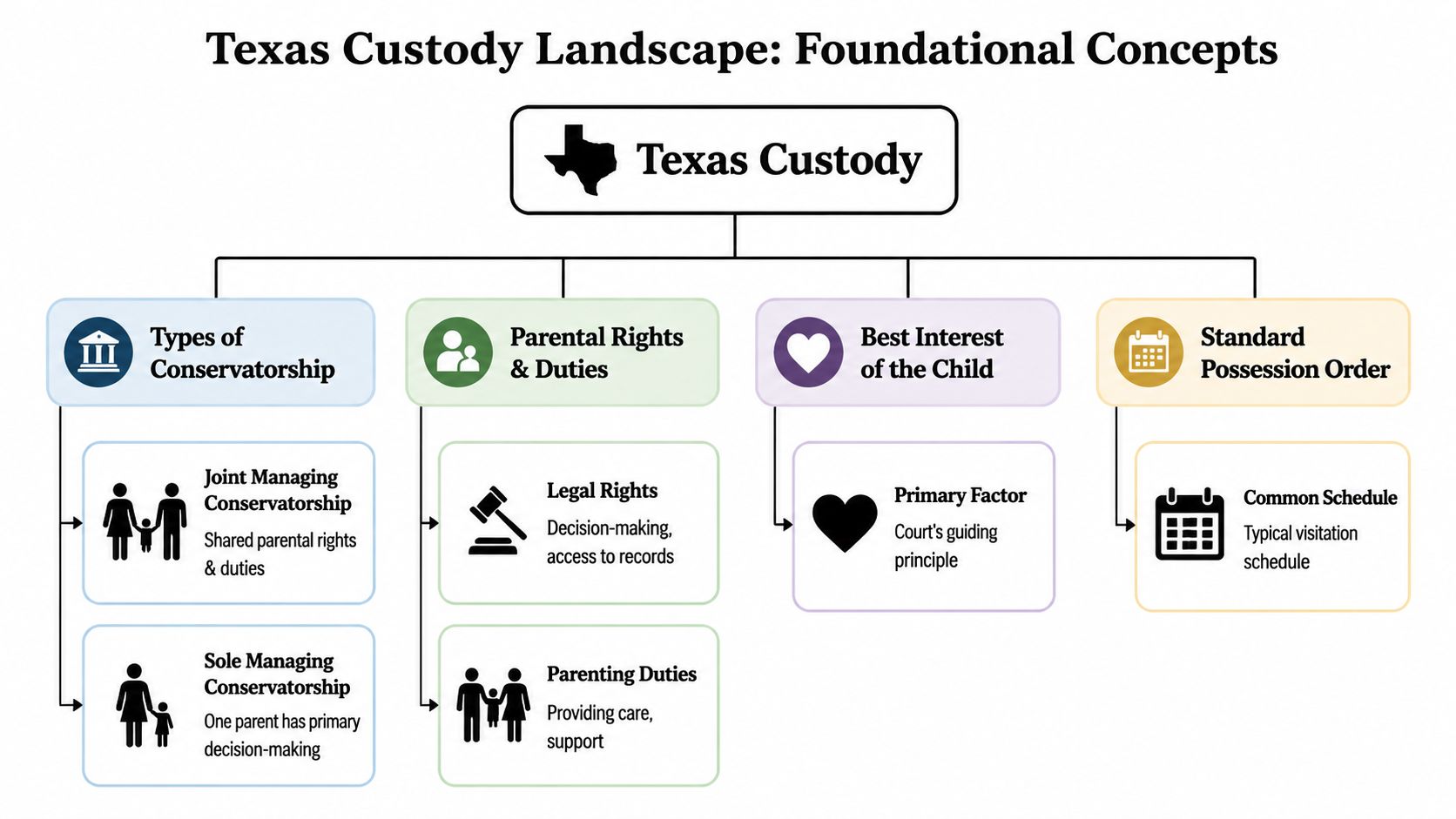
What conservatorship means in plain English
In Texas, conservatorship refers to a parent's legal rights and duties toward a child. These are the decision-making rights that cover issues like schooling, medical care, and mental health treatment. Parents often use the word “custody,” but Texas courts and statutes usually speak in terms of conservatorship because they are separating legal authority from parenting time.
A joint managing conservatorship often means both parents keep many important rights and duties. A sole managing conservatorship gives one parent broader authority over major decisions. That distinction matters, but it does not answer a different question, which is how the child's time will be divided.
Many parents find themselves confused at this stage.
A mother who has handled every doctor visit may assume she should automatically have sole rights. A father who has always been involved may assume “joint” means a 50/50 schedule. A grandparent stepping in after months of caregiving may not realize the court will first ask about legal standing before it ever reaches the child's schedule. A military parent may worry that deployment history will be used unfairly. Those are different problems, and Texas law does not solve them with one label.
What possession and access mean
Texas uses possession and access for the time each parent spends with the child. Many families still call this visitation. The court may apply a Standard Possession Order, or approve a different schedule if that better fits the child's age, school needs, distance between homes, work demands, or safety concerns.
Two parents can be joint managing conservators and still have a schedule that is not equal. One parent can be a sole managing conservator and the other can still have regular, meaningful time with the child. Judges separate decision-making power from time-sharing because family life is rarely one-size-fits-all.
What judges actually focus on
Texas courts decide custody issues based on the best interest of the child. Texas law also starts from the presumption that appointing parents as joint managing conservators is generally in the child's best interest, unless the facts show otherwise. Courts may also consider the Holley v. Adams factors, which include the child's needs, the parenting abilities of the adults involved, the stability of each proposed home, and any acts or omissions that affect the child's welfare. If a child is 12 or older, the court may interview the child in chambers about the child's wishes, but the child does not get to make the final decision.
Judges look for patterns. Who gets the child to school on time. Who notices a medication refill before it becomes a problem. Who communicates without turning every exchange into a fight. Who can support the child's relationship with the other parent when that relationship is safe.
That practical focus is why readiness before filing matters so much. Legal preparation is only one part of it.
A parent who is legally prepared but financially disorganized may struggle to explain how the child's needs will be met. A parent with a solid schedule but reckless social media posts may create avoidable credibility problems. A grandparent may have years of caregiving history but need a careful review of standing and proof. A military parent may need a plan that addresses training, deployment, and communication across distance. Emotional readiness matters too. Judges notice when a parent is child-focused and when a parent is using the case to punish the other side.
Use the terms below as a working guide:
| Term | Plain-English meaning | Why it matters |
|---|---|---|
| SAPCR | The case used to ask a Texas court for orders about a child | It is the legal vehicle for enforceable custody, visitation, and support orders |
| Joint managing conservatorship | Both parents usually share major rights and duties | Common starting point, but it does not guarantee equal parenting time |
| Sole managing conservatorship | One parent has broader authority over major decisions | Usually requires facts showing why broader authority is needed |
| Possession and access | The schedule for time with the child | It shapes the child's routine, transportation, school week, and holidays |
| Best interest of the child | The standard the judge uses to decide disputed issues | Every argument should connect back to the child's welfare, not the parent's frustration |
Once these terms are clear, parents usually make better decisions before filing. They stop arguing over labels and start preparing for what the court will evaluate.
Building Your Case with Strong Documentation
Custody cases are often won or lost long before a hearing. They're built through records, routines, and credible details. Parents who prepare well usually don't just show love for their child. They show how that love appears in daily life.

Build a file that reflects real parenting
Start with the basics, then go deeper. Gather records that show your involvement and your knowledge of your child's life.
- Identity records. Birth certificate, Social Security information if available, and any existing court orders.
- School information. Report cards, attendance records, teacher names, conference notes, special education plans if any, and activity schedules.
- Medical records. Names of doctors, immunization records, prescriptions, allergies, therapy information, and appointment history.
- Daily-life proof. Calendars, pickup logs, receipts for child-related expenses, childcare records, and notes showing who handled the routine tasks.
- Communication records. Messages with teachers, coaches, doctors, and the other parent that show your involvement and tone.
Texas custody preparation often requires detailed information about the child's life. Parents who can clearly explain school, medical needs, routines, and activities tend to present better in court because they sound like what they are, an actively involved parent.
Do a digital audit before the other side does
Digital evidence has become a serious issue in custody cases. The Texas custody preparation article on digital evidence notes that judges increasingly examine social media activity, text message tone, and co-parenting app communication. It also warns that deleting messages or showing disrespectful communication can damage a custody claim before trial.
That means your phone matters. Your posts matter. Your group chats may matter.
Don't post as if your friends are your audience. Post as if a judge may read it later.
Review your Facebook, Instagram, TikTok, X, and text history. Look for posts that suggest instability, reckless behavior, or hostility toward the other parent. If you use a co-parenting app such as OurFamilyWizard, keep messages brief, factual, and child-focused.
Preserve, don't tamper
A common mistake is trying to “clean things up” by deleting messages or scrubbing accounts. That can create more trouble than the original content. Preserve records instead. Take screenshots where appropriate, save messages, and keep documents in dated folders.
If you're organizing agreements, written confirmations, or signed parenting documents, it also helps to understand what makes paperwork enforceable. This guide to ensuring legal document validity offers a helpful overview of the basics.
For parents handling early filing paperwork, reviewing a practical resource on the Texas SAPCR form process can help you understand what information the court expects.
A working checklist you can use today
Create one folder, digital or paper, with these sections:
- Child profile. School, health, schedule, activities.
- Parenting history. Who did pickups, homework, appointments, bedtime, and discipline.
- Communications. Child-focused messages only.
- Concerns. Any safety issues, missed visits, or troubling incidents documented calmly.
- Proposed future plan. Your ideas for schedule, decision-making, and support.
A strong file doesn't need drama. It needs consistency.
Crafting a Detailed and Realistic Parenting Plan
Many parents wait for the court to tell them what life will look like after filing. That gives up too much control. A better approach is to come in with a thoughtful proposal that fits your child's actual life.

What belongs in a parenting plan
The Texas custody planning article explains that before filing, parents should draft a detailed parenting plan covering conservatorship, a possession schedule such as the Standard Possession Order, decision-making rights, and child support calculations. It also notes that mediation is mandatory in 80% of Texas counties and resolves 70% to 85% of cases pre-trial, which makes preparation especially important.
Your parenting plan should answer practical questions, not just legal ones.
Consider including:
- Decision-making about school, medical care, counseling, and extracurricular activities
- Weekly schedule for school days, weekends, and exchanges
- Holiday schedule so birthdays and major holidays don't become annual fights
- Transportation details including pickup times, locations, and who drives
- Communication rules for calls, texts, and school notifications
- Support issues including child support and health insurance responsibilities
The difference between a legal plan and a usable plan
A usable plan matches real life. If one parent starts work very early, a school-morning exchange may be unrealistic. If a child has therapies, tutoring, or sports several days a week, the plan needs to account for that. If parents live far apart, driving time matters.
Here's where parents get into trouble. They ask for a schedule that sounds ideal on paper but doesn't match work, school, or the child's temperament. Courts notice when a plan feels performative rather than practical.
A good parenting plan should survive Monday morning, not just mediation day.
A simple comparison
| Approach | What usually happens |
|---|---|
| Vague plan | Parents argue later over pickups, holidays, and decisions |
| Overly aggressive plan | The other side resists, and conflict gets worse |
| Detailed realistic plan | It gives the court a workable starting point and often helps settlement |
Think through real-life scenarios
Suppose your child is in elementary school and thrives on routine. A schedule with consistent school-night expectations may serve that child better than a constantly rotating arrangement. If your child is older and heavily involved in activities, flexibility may matter more.
If you want expanded rights, be ready to explain why your proposal helps your child, not why it feels fair to you. Texas courts care about fairness, but they care more about function. The strongest plans show how the child will get to school on time, get medical care without confusion, and maintain healthy relationships with both parents when appropriate.
For fathers and mothers alike, this matters. A detailed plan shows maturity. It tells the court you're not just reacting to a breakup. You're planning for your child's future.
Addressing Special Family Circumstances
Not every family walks into court from the same starting point. A mother with automatic possession of the child after birth, an unmarried father trying to establish rights, a grandparent who has been doing the day-to-day parenting, and a deployed service member all face different legal and practical issues.
For unmarried fathers
A father may feel involved in a child's life and still lack the legal footing to ask the court for custody or visitation until paternity is addressed. That gap surprises many dads. They assume biology alone gives them enforceable rights. It doesn't always work that way in court.
If you're an unmarried father, make paternity one of your first legal questions. This resource on establishing paternity for custody in Texas is a useful place to start. Once paternity is legally established, the court can address conservatorship, possession, and support in a meaningful way.
A practical example: a father may have cared for the child every weekend for years, paid expenses informally, and attended school events. If there's no court order and no legal establishment of paternity, that history may not protect him the way he expects.
For grandparents and other caregivers
Grandparents often step in to help. They handle school drop-offs, doctor visits, meals, and bedtime because the family needs help. Then a crisis hits, and they realize love and labor are not the same as legal authority.
If you're a grandparent, start documenting your role carefully. Keep records showing how often the child is with you, what responsibilities you handle, and what concerns exist if you believe the child needs protection. Courts don't award rights based on affection alone. They look at legal standing and the child's welfare.
For military families
Military service adds timing and distance problems that civilian families don't face. Deployment, transfer orders, and changing residence can disrupt even a well-intended parenting arrangement. These cases often require careful planning before filing so that a parent doesn't unintentionally create avoidable jurisdiction or scheduling issues.
A service member might need a parenting proposal that addresses long-distance contact, temporary delegation issues, and a clear plan for transitions before and after deployment. Precision matters here. So does acting early.
The best military parenting plans don't ignore uncertainty. They plan for it.
For mothers facing instability or conflict
Some mothers come into the process carrying most of the daily parenting load while also worrying about money, housing, or harassment from the other parent. Others are trying to protect a child while keeping conflict from escalating.
In that situation, preparation should focus on safety, documentation, and stability. Keep records. Limit emotional texting. Gather proof of caregiving. Don't assume the court “will just know” what has happened in your home unless you can show it clearly.
Navigating Legal Hurdles and Costs Before You File
A parent files quickly after a bad weekend exchange, only to learn the case was started in the wrong county and the first hearing is still weeks away. Meanwhile, money is tight, texts are getting worse, and no one has pulled together the records the judge will want to see. I see this problem often. The legal issue is real, but the bigger problem is filing before the family is ready.

File in the right county
Venue can decide whether your case starts cleanly or stalls at the outset. In many Texas custody cases, the child's county of residence controls where the case should be filed. If you guess wrong, you may lose time, spend more money, and hand the other side an avoidable procedural argument.
This matters even more in families with unusual living arrangements. Military parents may be dealing with temporary assignments. Grandparents may have stepped in across county lines. Mothers and fathers who recently left a shared home may assume the old county still applies when it does not. A practical guide on filing for custody in the correct Texas county can help you sort out the starting point before you pay a filing fee and commit to a strategy.
Get your money and records in order
Many parents budget for the first court filing and overlook everything that can follow. Service fees, mediation, contested hearings, record gathering, missed work, and expert involvement can change the cost of a case fast. The more conflict there is, the more expensive poor preparation becomes.
For support issues, judges and lawyers need clear numbers, not rough estimates. If your income is irregular, if you are self-employed, if you receive cash payments, or if you work overtime seasonally, organize that now. Do the same if you are a grandparent covering day-to-day expenses for a child or a military parent whose pay includes housing or other allowances.
Start with these records:
- Income documents. Pay stubs, 1099s, business records, benefit statements, bonus information, and proof of side income
- Tax records. Recent returns, schedules, and documents that explain deductions or business expenses
- Child-related expenses. Health insurance, daycare, school costs, tutoring, therapy, medications, and extracurricular activities
- Monthly budget. Housing, utilities, food, transportation, debt, and anything else that affects your ability to support a workable parenting plan
Good records do two things. They help your lawyer give you honest advice, and they reduce the chance that the other side defines your finances for you.
Cost usually follows conflict
A straightforward agreed case costs less than a fight over possession, decision-making, relocation, or safety concerns. That trade-off is worth facing before you file. If you already know the other parent is likely to contest everything, prepare for temporary hearings and a longer timeline instead of hoping the case will calm down on its own.
This is also part of complete readiness. Your home, schedule, and digital life may all come under scrutiny. If your child is very young and overnights or expanded visitation are likely, practical safety issues matter. A simple guide on how to childproof your home can help you address obvious concerns before they become courtroom talking points.
Here is where pre-filing mistakes usually hurt parents most:
| Issue | Why it matters before filing |
|---|---|
| Wrong county | Delays the case and can trigger transfer or dismissal problems |
| Disorganized finances | Makes support and reimbursement disputes harder to prove |
| No realistic budget | Increases pressure to agree to terms you may not be able to sustain |
| No plan for temporary orders | Leaves possession, support, and decision-making unresolved at the start |
Parents often benefit from hearing the process explained visually before making decisions. This video gives a useful overview of custody-related concerns in Texas:
Temporary orders can shape the whole case
Temporary orders often set the tone early. They can affect where the child stays, who pays support, how exchanges happen, and who makes important decisions while the case is pending. Once those routines are in place, they tend to influence settlement talks and courtroom expectations.
That is why filing without a plan is risky. Before you start the case, know your county, organize your money, prepare for temporary orders, and be honest about the level of conflict. Parents who do that are usually in a stronger position, whether they are mothers trying to protect stability, fathers trying to establish a fair schedule, grandparents stepping into a caregiving role, or military families dealing with distance and changing orders.
Your Next Steps and When to Seek Legal Counsel
At this point, the path should be clearer. Before filing, you want to know the legal framework, gather records, clean up your digital life, draft a parenting plan, and get financially ready. Those steps don't guarantee a perfect outcome, but they put you in a much stronger position.
A short pre-filing checklist
Use this as a final gut-check before you move forward:
- Confirm the right court. Make sure you're filing in the proper county.
- Organize your parenting proof. School, medical, schedule, and communication records should be easy to access.
- Review your digital footprint. Social media, texts, and app messages should reflect calm, responsible parenting.
- Draft a realistic parenting plan. Make it detailed enough to work in ordinary life.
- Prepare your financial records. Especially if your income varies.
- Identify special issues early. Paternity, deployment, grandparent caregiving, safety concerns, or relocation can change strategy.
When legal help becomes more than a good idea
Some parents can handle a straightforward agreed case with limited help. But there are situations where legal guidance becomes a strategic necessity. That includes family violence, substance abuse concerns, one parent trying to move away with the child, serious disputes over decision-making, contested paternity, or a co-parent who is already collecting evidence against you.
It also becomes important when the facts are emotionally loaded. In those cases, parents often know too much and explain too little. They assume the court will understand the history without a clean legal presentation. A lawyer helps turn emotion into usable evidence and a workable plan.
Good legal advice doesn't create conflict. It helps you avoid preventable mistakes while protecting your child and your rights.
Key takeaway
The best time to strengthen your custody case is before you file it. Calm preparation beats rushed reaction. If you're unsure where your case fits, that uncertainty itself is a reason to get advice early rather than later.
If you need help with a child custody or visitation case in Texas, our experienced attorneys can guide you every step of the way. Contact The Law Office of Bryan Fagan, PLLC today for a free consultation.