
When your child’s future is on the line, the thought of a custody hearing can feel overwhelming. It’s natural to feel anxious, but your most important task is to channel that energy into a focused, thoughtful plan. Success in court doesn't just happen; it begins with understanding the legal landscape, knowing your rights, and clearly defining what is best for your child. This preparation is the foundation of your entire case.
Your First Steps in Custody Hearing Preparation
When you're worried about your children, it's easy to feel lost, but taking control starts with understanding the process. The Texas family court system operates under specific rules, and learning them is your most powerful first move. You don't need to become a lawyer overnight, but you do need to understand the goals of the court to prepare effectively. The judge’s only mission is to create a safe, stable, and nurturing world for your child.
The guiding principle for every decision a judge makes is the "best interest of the child." This isn't just a vague legal phrase. Under Texas Family Code Chapter 153, it is a specific legal standard that requires the court to prioritize the child’s well-being above all else. A judge will weigh many factors, from your child's immediate physical and emotional needs to the stability of each parent's home and how well you can co-parent. Every piece of your preparation must demonstrate how your requests serve those best interests.
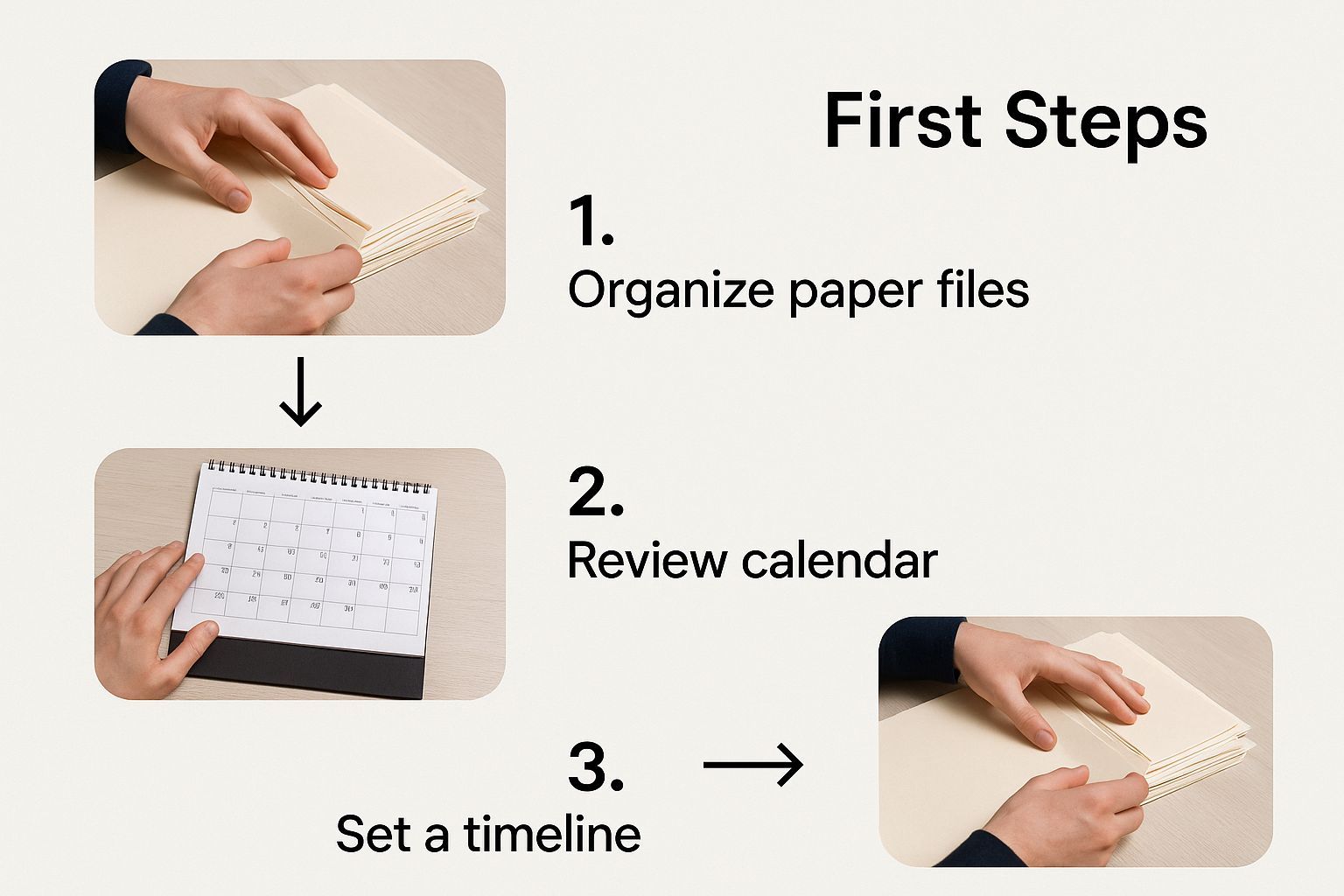
This process is about methodical organization. Gathering your documents and creating a timeline of key events might seem tedious, but these are the tasks that bring order to a chaotic situation. By structuring your preparation this way, you turn a stressful, emotional challenge into a manageable project, ensuring no critical detail gets missed.
Understanding Texas Custody Language
Before you get too far, it's important to speak the language of the court. You will hear specific legal terms that define your rights and responsibilities as a parent. Understanding these concepts early will help you and your attorney set realistic, achievable goals for your family.
Here is a plain-English breakdown of the terms you'll encounter most often.
Understanding Key Texas Custody Terms
| Legal Term | Plain-English Explanation | What It Means for Your Case |
|---|---|---|
| Conservatorship | This is what Texas calls "custody." It outlines a parent’s rights and duties, like making decisions about your child's school and healthcare. | This is the core of your case—determining who has the legal authority to make key life decisions for your child. |
| Joint Managing Conservatorship (JMC) | This is the standard arrangement in Texas. It means both parents share in the rights and responsibilities of raising the child. | Most cases end in JMC. It doesn't automatically mean a 50/50 time split, but it presumes that both parents are fit and should be actively involved. |
| Sole Managing Conservatorship (SMC) | This grants one parent the exclusive right to make most decisions for the child. | This is uncommon and typically only ordered when there is a history of family violence, substance abuse, or extreme conflict that makes joint decision-making impossible. |
| Possession Schedule | This is the calendar that details exactly when the child will be with each parent, including holidays and vacations. | This determines the day-to-day reality for your child. While a Standard Possession Order is common, your schedule can be customized to fit your family's needs. |
Getting familiar with these terms helps you understand what you're asking the court for and what the judge is considering.
A judge’s goal is to create a post-divorce environment that feels as stable and predictable as possible for the child. Proposing a clear, thoughtful, and child-focused plan is far more persuasive than simply criticizing the other parent.
Creating Your Initial Action Plan
With those concepts in mind, you can begin building your case. This isn't about drowning in paperwork just yet. First, you need to build a factual narrative. Here are the core tasks to tackle right away:
-
Define Your Ideal Outcome: What possession schedule are you asking for? What decision-making rights do you believe are best for your child? You can't reach a goal you haven't defined. For more on the first official steps, our guide on how to file for custody in Texas is a great place to start.
-
Create a Detailed Timeline: Start documenting. Note key events in your child’s life and in your co-parenting relationship. Include the date of separation, major disagreements, but also positive parenting moments and times you've been the primary caregiver. Specific dates are crucial.
-
Identify Potential Witnesses: Who has seen you be a great parent? Think about teachers, coaches, neighbors, or family friends who can speak to your stability, character, and deep involvement in your child’s life.
It's also a huge advantage to sharpen your own thinking. Developing strong analytical abilities is invaluable for sorting through evidence, seeing legal arguments clearly, and making smart decisions. Learning how to improve your critical thinking skills can give you a real edge as you organize your case and anticipate the other parent's arguments.
Taking these first steps gives you and your attorney the solid framework needed to build a compelling case that truly reflects your child's best interests.
Gathering Evidence That Matters to a Judge
When you walk into a custody hearing, a judge isn’t there to decide who they like more or who tells a better story. Their decision comes down to one thing: evidence. In a Texas family court, your claims about being a good parent are only as strong as the documents, photos, and records you have to back them up.
Think of it this way: you’re not just making statements, you’re proving them with facts. The goal is to paint a clear picture for the court, showing how you consistently contribute to your child's stability and well-being. This isn't about attacking the other parent; it’s about building a compelling case that showcases your positive involvement in every aspect of your child's life.
Proving Your Parental Involvement
Judges want to see a consistent pattern of responsible and engaged parenting. Your evidence needs to tell the story of your daily commitment to your child’s needs. It goes beyond just saying you're a good parent—it’s about showing it.
Here are the types of documents that carry real weight in court:
- Academic Records: Gather everything from report cards and attendance records to notes and emails from teachers. These documents prove you’re involved in your child’s education.
- Medical and Health Records: Keep a dedicated file of doctor's visit summaries, vaccination records, and notes from any specialists. This demonstrates your hands-on role in managing your child’s health.
- Proof of Engagement: Collect photos of you and your child at school plays, soccer games, and parent-teacher conferences. A simple calendar detailing your involvement can be a powerful visual.
These items directly speak to the factors a judge considers when determining the best interest of the child—the single most important standard in every Texas custody case.
Documenting Communication and Stability
How you interact with the other parent is just as important as how you interact with your child. A judge is looking for the parent who can co-parent effectively, even when it’s difficult. Clear, respectful communication is non-negotiable.
Co-parenting apps like OurFamilyWizard or AppClose can be invaluable. They create an official, unalterable record of all conversations, calendar requests, and shared expenses. This impartial log can be presented in court to show your efforts to cooperate.
Beyond communication, your evidence must establish that you provide a stable, secure home. This includes:
- Financial Records: Pay stubs, bank statements, and proof of on-time bill payments show you can provide for your child's needs.
- Proof of Residence: A lease agreement or mortgage statement, along with photos of your child’s bedroom and your home, helps the judge visualize the stable environment you offer.
A judge is far more impressed by a consistent record of calm, child-focused communication than by a folder of angry text messages. Your goal is to present yourself as the parent who prioritizes stability over conflict.
Organizing Your Evidence for Maximum Impact
Simply having a mountain of paperwork isn't enough. How you present it matters. A disorganized pile of documents can frustrate a judge and weaken your argument. Organize everything chronologically and by category in a binder with clear, easy-to-read labels.
For digital evidence like photos or social media posts, authenticity is critical. A judge needs to be certain that what they’re seeing is real. When digital photos are part of your case, their authenticity can make or break your credibility; learning how to verify the authenticity of photos can strengthen your position.
Finally, consider getting character reference letters from credible sources—teachers, coaches, or a family pastor. These letters must be specific. A letter that says, "John consistently volunteers in the classroom and helped organize the fall festival," is far more effective than one that just says, "John is a great father." This level of detail helps the judge see your commitment through the eyes of other respected community members.
Using Negotiation and Mediation to Your Advantage
The thought of a courtroom battle can be nerve-wracking, but here’s something many parents are relieved to learn: the vast majority of Texas custody cases are resolved without a final trial. Instead, many families find a better path forward through less adversarial approaches like negotiation and mediation.
Treating these processes with the same seriousness as a court hearing is a strategic move. It can lead to a more sustainable, tailor-made outcome for your family—especially your child.
There’s a good reason Texas courts strongly encourage (and often require) parents to try mediation before a judge will hear their case. It’s simple: a solution that both parents create together is far more likely to last than one imposed by a judge. This cooperative approach reduces conflict and gives you a direct say in your child’s future, rather than leaving it entirely in the hands of the court.
Understanding the Mediation Process
So, what exactly is mediation? Think of it as a structured, confidential meeting where a neutral third party—the mediator—helps you and the other parent communicate and find common ground. The mediator is not a judge; they don't take sides or make decisions. Their only job is to guide a productive conversation and help you work toward an agreement you can both support.
Your attorney will be right there with you, offering legal advice and ensuring any agreement protects your rights and truly serves your child’s best interests. This is your chance to build a custom possession schedule and decision-making framework that fits your family’s unique life—something a one-size-fits-all court order rarely accomplishes.
The data backs this up. A staggering 90% of custody cases are settled outside the courtroom, proving just how powerful good-faith negotiation can be. It also helps to understand the changing face of families in Texas. For example, demographic trends show that from 2004 to 2023, the percentage of Hispanic custodial parents climbed from 14% to 25%, while White custodial parents dropped from 56% to 45%. Being aware of these cultural and demographic shifts can build empathy and open the door to more creative solutions during your discussions. You can discover more insights about custody trends on clio.com to learn more.
How to Prepare for a Successful Mediation
Success in mediation isn’t about luck; it’s about preparation. Walking in with a clear strategy is every bit as important as it is for a court hearing.
Here’s where to start your prep work:
- Define Your Goals: Before you walk in the door, know what you want. This means your ideal possession schedule, who gets to make key decisions about school and healthcare (joint managing conservatorship rights), and how you want to handle holidays and vacations.
- Identify Your Non-Negotiables: What are the absolute must-haves for your child's well-being? Maybe it’s ensuring they stay in their current school district or that they have consistent time with their grandparents. Know your bottom line.
- Pinpoint Areas for Compromise: Where can you be flexible? Perhaps you’re willing to trade a holiday weekend for more time during the summer. Knowing where you can bend ahead of time keeps you from making emotional, in-the-moment decisions you might regret.
The most effective negotiators in a custody case are not the most aggressive; they are the most prepared. They come to the table understanding that the goal isn't to 'win,' but to build a stable, workable co-parenting future for their child.
One of the most powerful tools you can bring to mediation is a well-drafted proposed parenting plan. It shows you’ve put serious thought into the details and are focused on solutions, not just problems. Our parenting plan template can give you a solid starting point. When you present a concrete plan, you immediately shift the conversation from conflict to constructive problem-solving.
By leaning into negotiation and mediation, you seize control of the outcome. You also dramatically reduce the emotional and financial costs of a drawn-out court battle and, most importantly, you model cooperative behavior for your kids. It’s a strategic move that aligns perfectly with the court’s ultimate goal: securing the best interest of your child.
Partnering With Your Attorney for a Stronger Case
Hiring an experienced family law attorney is the single most important decision you can make in your custody case. But it's important to remember that your lawyer is your advocate, not a mind reader. A powerful case strategy isn’t something that’s built for you; it’s built with you. This partnership requires your active, honest, and organized participation.
Think of your attorney as the coach and you as the star player. The coach knows the rulebook and calls the plays, but you have the intimate knowledge of your family's history. Your job is to provide the raw materials—the facts, the documents, the context. Your attorney’s job is to shape those materials into a persuasive legal argument that tells a clear story to the judge. The better you work together, the stronger that story will be.
How to Be an Effective Partner in Your Own Case
Productive meetings are the backbone of a strong legal strategy. Before you meet with your attorney, jot down a concise list of your questions and any new updates. This simple step keeps your conversations focused and makes the most of your time.
Most importantly, you have to be an open book. Share everything, even the details you think are insignificant or embarrassing. The last thing you want is for your attorney to be surprised by something in court. They need to know the good, the bad, and the ugly to prepare for potential attacks and build a solid defense.
Here are a few practical ways you can become the MVP of your own case:
- Be the Fact-Checker: You lived these events. Review every document your attorney prepares—petitions, motions, declarations—and check them for accuracy. Dates, names, and key events are details you know best.
- Organize Your Evidence: Don't hand your lawyer a shoebox full of crumpled receipts and screenshots. When you present an organized evidence binder, they can instantly identify the strongest pieces of proof to build your case around.
- Stay Responsive: Legal cases can move quickly. When your attorney calls or emails, respond as promptly as you can. Delays in communication can create serious bottlenecks and impact your hearing preparation.
Why Proposing Joint Custody Can Be a Smart Move
Your protective instincts might be urging you to seek "sole custody," but it is crucial to understand how a Texas judge views the situation. The court’s starting point—its legal presumption—is that a child benefits most from having a meaningful relationship with both fit parents. Because of this, showing you’re willing to co-parent is often far more persuasive than demanding exclusive control.
This is supported by family law trends. Courts increasingly favor shared parenting arrangements where children spend significant time with each parent. When you propose a thoughtful Joint Managing Conservatorship (JMC) with a clear, practical possession schedule, you send a powerful message to the judge. It says you are reasonable, child-focused, and willing to set aside conflict for the sake of stability. It instantly positions you as the parent who is prioritizing the child, not the fight.
Your willingness to foster your child’s relationship with their other parent can be one of the most powerful pieces of evidence you present. It tells the judge you truly have your child’s best interests at heart.
Bringing in the Experts
In more complex cases, an expert witness—such as a child psychologist, a custody evaluator, or a financial expert—can provide impartial insight. These professionals aren't on "your side" or the other parent's side; their role is to give an objective assessment directly to the court.
If an expert becomes involved in your case, your preparation is key. You'll need to meet with them, provide any documents they request, and be completely honest during their interviews. Your attorney will guide you on how to interact with these experts to ensure your perspective is heard and understood.
Navigating the Courtroom on Hearing Day
After months of preparation, hearing day is finally here. It’s the culmination of all your hard work, and it's completely normal to feel a mix of anxiety and determination. Knowing what to expect inside the courtroom can help ground you, reduce stress, and allow you to present yourself as the calm, capable parent you are.
Your presence and conduct speak volumes to the judge long before you ever say a word. From the moment you walk into the courthouse, you are being observed. When you present yourself with respect and seriousness, it shows you understand the gravity of the decisions being made about your child's future.

Making a Credible First Impression
Your appearance and behavior set the tone. While a judge won’t decide your case based on your outfit, a professional appearance signals that you respect the court and the process.
- What to Wear: Business-casual is always a safe choice. Think of it like dressing for an important job interview. Avoid anything flashy, too casual (like t-shirts or shorts), or clothing with distracting slogans.
- Courtroom Etiquette: Arrive early. This gives you time to find the right courtroom and connect with your attorney without rushing. Power your cell phone completely off—not just on silent. When the judge enters or leaves the room, everyone will be asked to rise.
- How to Address the Judge: Always address the judge as "Your Honor." Never interrupt when they are speaking, and only speak when you are asked a question or it is your turn.
These simple acts of respect go a long way in creating a positive impression.
Testifying with Confidence and Clarity
When it's your turn to testify, this is your moment to speak directly to the court. The key is to stay focused, honest, and calm, even when the questions get tough. Your attorney will have prepared you for this, but keeping a few core principles in mind can make all the difference.
First, your focus must always be on the best interests of the child. Frame your answers around your child's needs, stability, and well-being—not your personal grievances with the other parent.
Second, listen carefully to every question before you answer. Take a breath. Answer only the question that was asked, and then stop talking. It’s easy to get nervous and start rambling, but short, direct answers are far more powerful.
Remember, your testimony is a conversation with the court, not a confrontation with the other side. Your credibility hinges on your ability to remain truthful, composed, and child-focused, especially under the pressure of cross-examination.
The stakes get even higher in complex international cases. For instance, disputes involving the Hague Child Abduction Convention demand extreme preparedness. This international treaty, designed for the swift return of children wrongfully removed across borders, can involve tight timelines that show exactly why your concise, clear presentation in court is so critical.
Staying Composed During Cross-Examination
Cross-examination is when the other parent’s attorney questions you. Their job is to test your credibility and find inconsistencies in your testimony. This can feel intimidating, but it doesn't have to throw you off your game.
The most important thing to remember is not to get defensive or emotional. Stick to the facts. If you don't know the answer to a question, it is perfectly acceptable to say, "I don't know" or "I don't recall." Never guess or make something up. Your attorney is right there to protect you and can object if a question is improper. Trust them to do their job while you focus on yours: telling the truth calmly and clearly.
Key Takeaways for Your Custody Hearing
As you prepare for court, remember that your goal is to build a stable, loving future for your child. Every document you gather, every conversation you have with your attorney, and every action you take should tell a story—a story that shows you are the dedicated, capable parent your child needs.
Your greatest assets in this process are solid preparation and a calm, composed attitude. Always put your child’s needs ahead of any personal feelings toward the other parent.
The most convincing case you can make in a Texas family court isn’t about “winning” against the other parent. It’s about proving your unshakable commitment to your child’s well-being. Stick to the facts, stay calm, and let your actions speak louder than words.
Keep these fundamentals at the forefront of your mind:
- Solid Documentation: Hard evidence is always more powerful than just your word.
- Teamwork with Your Attorney: You and your lawyer are a strategic team, and open communication is essential.
- A Child-First Approach: Every single thing you present must circle back to the best interests of the child.
- Courtroom Poise: How you handle yourself under pressure demonstrates your ability to parent through difficult times.
You have the insight and the tools to walk into this process with confidence.
Common Questions in Texas Custody Hearings
When you're preparing for a custody hearing, a million questions can race through your mind. Feeling uncertain is normal, but getting clear, straightforward answers is the best way to build confidence. Let's tackle some of the most common questions Texas parents ask.
How Does a Judge Decide What’s in My Child’s Best Interest?
This is the most important question in any custody case. Texas courts do not rely on a gut feeling; they use a specific set of guidelines called the “Holley Factors” to determine a child's best interests. Your job is to build your case around these factors with real-world evidence.
A judge will look at things like:
- The child’s physical and emotional needs.
- The stability of each parent's home environment.
- Each parent's past caregiving skills and involvement.
- Any history of family violence, neglect, or substance abuse.
- The child's own wishes, if they are 12 years of age or older.
Can I Use Text Messages as Evidence in Court?
Yes, absolutely. Text messages, emails, and social media posts can be powerful evidence, but they must be authenticated. Authentication means you have to prove who sent the message, when it was sent, and that it has not been altered.
Simply showing a screenshot on your phone is often not enough. Talk to your attorney about the proper way to preserve and present digital evidence so the judge will consider it. Never delete or alter messages, as that can destroy your credibility.
What if the Other Parent Lies on the Stand?
It is incredibly frustrating to listen to the other parent say something that is untrue. However, how you react in that moment is critical. Lying under oath is perjury, a serious offense.
The best response to a lie isn't an emotional outburst—it's cold, hard evidence. Your calm demeanor keeps your credibility intact, while your organized proof does the work of showing the judge the truth.
If the other parent lies, stay quiet. Do not interrupt or react visibly. Your attorney will address the falsehood during cross-examination, using the documents, texts, or other evidence you've gathered to expose the inconsistency. Trust your lawyer to handle it; your only job is to remain composed.
Will I Have to Speak Directly to the Judge?
It is very likely, yes. At some point, you will probably be called to the witness stand to testify. This involves answering questions from your own lawyer (direct examination) and then answering questions from the other parent's lawyer (cross-examination).
The judge may also ask questions to get more clarity. A large part of preparing for your hearing is practicing how to answer these questions honestly and clearly without getting defensive. The goal is not to win an argument, but to provide truthful, child-focused answers that support your case.
If you need help with a child custody or visitation case in Texas, our experienced attorneys can guide you every step of the way. Contact The Law Office of Bryan Fagan, PLLC today for a free consultation.