
Life rarely stays the same, and when your family's circumstances change, an old court order might no longer fit your reality. If your child support arrangement feels unfair or unsustainable, it’s important to know that you have options. The Texas Family Code provides a clear path for parents to ask for a change, ensuring that the support amount always reflects what your child needs and what both parents can realistically provide.
This guide is designed to walk you through how to modify child support in Texas, explaining the legal requirements in plain English and empowering you with the knowledge to protect your family's future.
When Can You Change a Texas Child Support Order?
When your family’s financial situation takes a sharp turn, it’s easy to feel stuck. Maybe you lost your job, got a big promotion, or your child developed new medical needs. Whatever the reason, the old child support order just doesn't fit anymore. It’s important to remember that asking for a modification isn’t about causing trouble; it’s a responsible step to protect your child’s well-being.
Thankfully, you're not locked into an outdated order forever. The Texas Family Code lays out a clear path for parents to request these changes. The law actually gives you two main ways to ask for a modification, all centered on making sure the support arrangement is fair and serves the best interest of the child. This legal principle guides every court decision, ensuring that your child's needs and well-being are always the top priority.
The Two Legal Grounds for Modification
In Texas, you generally have two tickets to get your child support amount reviewed by a judge:
- A Material and Substantial Change: This is the most common reason for modifications. It means something significant and ongoing has changed for either parent or the child since the day the judge signed the last order.
- The Three-Year Rule: This is your other option. If it's been at least three years since your order was set, and a new calculation based on current incomes would be different from the ordered amount by either 20% or $100, you can ask for a review.
Figuring out which of these grounds fits your situation is the first step in building your case. This dual-path system lets parents make adjustments when a big life event hits or when the numbers just don't add up anymore after a few years.
Here's an important heads-up: As of September 1, 2025, the maximum net resources used for child support guidelines will jump from $9,200 to $11,700 a month. For a parent earning above the old cap, their guideline support could go up, creating a valid reason to file for a modification. To learn more, check out our guide on evidence in Texas child support modification proceedings.
Here’s a critical piece of advice I give all my clients: A handshake deal or a text message with the other parent isn't enough. You must get a new, signed court order to legally change your child support. Without it, the old order is still 100% enforceable, and that can land you in serious legal and financial trouble down the road.
Before we move on, let's break down some of the most common reasons a court will agree to modify a child support order.
Valid Reasons to Modify Child Support in Texas
This table outlines common scenarios that may qualify you to request a change to your current child support order.
| Reason for Modification | What This Means for Parents | Real-World Example |
|---|---|---|
| Significant Change in Income | One parent's income has increased or decreased substantially, making the current order unfair. | Sarah was laid off from her engineering job and now works part-time, earning 40% less. She can file to have her child support obligation lowered. |
| Change in Child's Needs | The child develops new medical, educational, or other needs that require more financial support. | Mark's son is diagnosed with a learning disability and needs expensive tutoring and therapy not covered by insurance. Mark can request an increase in support. |
| Change in Possession Schedule | The parent paying support now has the child for significantly more time than the original order planned for. | The original order gave Tom standard possession, but his teen now lives with him 50% of the time. This change could be grounds to adjust his support payment. |
| New Child Added to the Family | The paying parent has a new biological or adopted child, which can affect the percentage of income available for support. | David, who pays support for one child, has a new baby with his current wife. He may be able to slightly reduce his first child support obligation. |
| Change in Health Insurance | The cost or availability of health insurance for the child has changed dramatically. | The parent providing insurance loses their job, and the child must be moved to a more expensive private plan. The court can re-allocate this cost. |
Remember, any one of these scenarios could be the "material and substantial change" you need to get your order updated. The key is to act quickly and follow the proper legal steps.
Understanding the Legal Grounds for Modification
When you're thinking about changing your child support order in Texas, it helps to see your situation through the eyes of the court. A judge needs more than just a feeling that things are different; they need solid, legal grounds to make a change. Let's break down what these legal standards actually mean for your family in the real world.
The court’s guiding principle is always the best interest of the child. This idea steers every single decision, ensuring any new support amount serves the child's well-being first. It means the modified payment must be fair, based on today's circumstances, and enough to meet the child's needs.
What Is a Material and Substantial Change
This is the most common reason to modify a child support order, but what does it actually mean? Think of it as a significant, ongoing life event that directly impacts either a parent's ability to pay or the child's financial needs. It can't be a temporary setback or a small dip in income.
Here are some real-world scenarios we see all the time that often qualify:
- Involuntary Job Loss: A parent gets laid off from a stable, long-term job and is now either unemployed or forced into a much lower-paying position. This is a classic example of a material change.
- Significant Promotion or Raise: The paying parent lands a major promotion that substantially increases their income. The old support amount is suddenly no longer in line with their new financial reality.
- Change in Health Insurance Costs: The parent providing the child's health insurance either loses that coverage or sees the premiums skyrocket, creating a new financial burden that needs to be factored into the support order.
- Shift in Possession Schedule: The original order was based on a standard visitation schedule, but now the child spends a lot more time with the paying parent. This increased parenting time comes with higher direct costs that can justify a support adjustment.
- New Medical or Educational Needs: The child is diagnosed with a condition requiring expensive treatments, or they need special educational resources that weren't a factor when the last order was signed.
Big financial shifts, like those from a divorce settlement, can also be grounds for a modification. For parents navigating this, resources on selling a house during divorce can offer some helpful guidance on managing those assets.
The Three-Year Review Rule Explained
The second path for a modification is much more straightforward and mathematical. Texas law gives parents a convenient option if it has been at least three years since your last child support order was finalized.
If three years have passed, you can ask for a review if the current child support guidelines would result in a new monthly payment that is either 20% or $100 different from what you're currently ordered to pay. This rule exists because life moves on—incomes and the cost of living naturally change. It provides a way to update your order without having to prove a single, dramatic life event.
This visual guide shows the main qualifiers a Texas court will consider when you seek a modification.
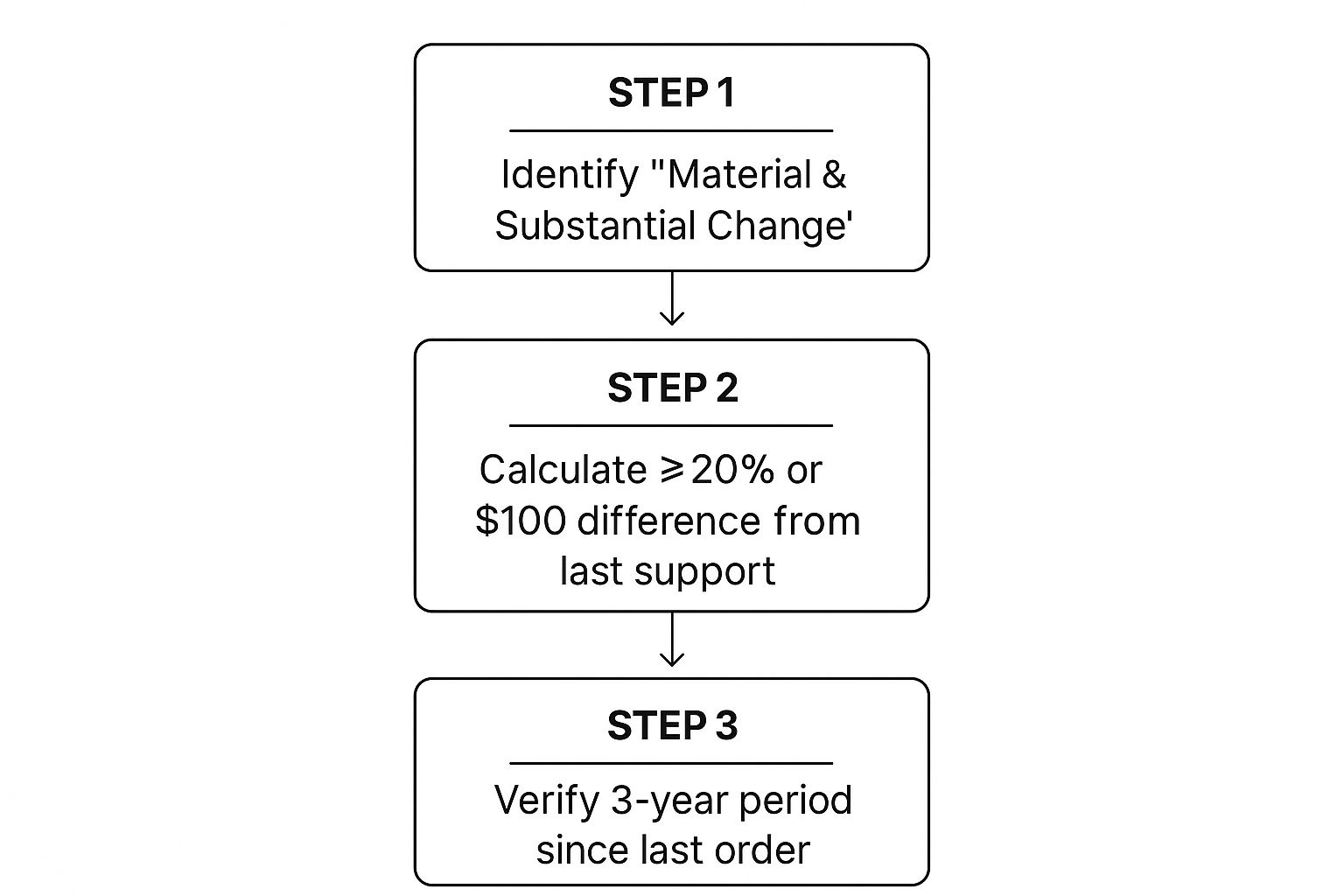
This process flow helps you quickly size up whether your situation meets the legal standards for a change before you dive into filing paperwork.
It's also important to know a unique aspect of Texas law. Our child support guidelines primarily look at the paying parent's (the obligor's) income. There isn't a set formula that automatically factors in the receiving parent's income or parenting time. While judges can deviate from the guidelines, this single-income model—which has been around since 1989—makes the modification process a critical tool for keeping things fair as family circumstances evolve.
We often see parents hesitate, wondering if their situation is "significant enough." If you are facing a real financial shift that impacts your ability to support your child, it is always better to explore your legal options than to struggle in silence or fall behind on payments.
Ultimately, whether you're using the "material and substantial change" argument or the "three-year rule," the goal is the same: to make sure the child support order is realistic, current, and fair for everyone involved. To better understand how these rules might apply to your case, we encourage you to learn more about our firm's approach to child support cases.
Steps to Modify a Child Support Order in Texas
Okay, you've figured out why you need a child support modification. Now it’s time to tackle the how. Making that change official isn't just a casual conversation; it's a formal legal journey. But don't let that intimidate you. Think of this as your roadmap—a step-by-step guide to navigating the process with confidence.

Kicking Things Off: The Petition and Your Paperwork
The whole process officially begins when you file a Petition to Modify the Parent-Child Relationship. This is the legal document you file with the same court that issued your original child support order. It’s your formal request to the judge, laying out exactly why you believe the current order is no longer working and needs to be changed.
At the same time, it’s time to get your financial ducks in a row. This isn't just busywork; you're building the factual foundation for your request. The court needs to see the numbers behind your story.
Start gathering these essential documents:
- Recent pay stubs to prove your current income (or lack thereof).
- Your tax returns from the last couple of years.
- Proof of what you're paying for your child's health insurance.
- Documentation of the big change, like a termination letter from your job, medical bills for new health issues, or receipts showing increased childcare costs.
Having all this organized from the get-go makes everything smoother. It shows the court you’re serious and that your request is based on solid facts, not just feelings.
Choosing Your Path: OAG vs. Private Attorney
When you start a modification, you have two main routes to consider: going through the Texas Office of the Attorney General (OAG) or hiring a private family law attorney. They are very different, and knowing which is right for you is a crucial first step.
The Office of the Attorney General (OAG) offers child support services for free. For some parents with very straightforward cases, this can be a great resource. But here's the catch: the OAG represents the State of Texas. They don’t represent you, and they don’t represent the other parent. Their job is to make sure a child support order is in place that serves the child's best interests according to state guidelines.
Hiring a private attorney, on the other hand, means you have someone in your corner, and only your corner. An attorney from our firm provides you with personalized legal advice, helps negotiate with the other parent on your behalf, and represents your interests in court. This path gives you far more control and is often the best choice for complex or high-conflict situations.
Notifying the Other Parent and What Comes Next
Once your petition is filed, you can't just text the other parent to let them know. They must be formally notified through a legal process called "service of process." This is a non-negotiable step that ensures both parents are aware of the case and have a fair chance to respond.
After being served, the other parent files their own response. From there, your case will likely head to mediation. This is a confidential meeting where a neutral third party helps you and the other parent try to hash out an agreement without needing a judge to decide for you. In many Texas courts, mediation is a required step, and frankly, it’s often the most effective way to resolve things.
If you can't reach an agreement in mediation, your case gets scheduled for a court hearing. A judge will listen to both sides, review the evidence, and make the final call.
Here's something I can't stress enough: informal "handshake" agreements are not legally binding. A verbal promise or a text message changing the support amount is completely unenforceable. If you rely on that and stop paying what the court ordered, you can land in serious legal trouble for unpaid back support.
The only way to legally change your child support obligation is to get a new court order signed by a judge. This protects everyone and leaves no room for confusion. For a much deeper dive, you can download our free Child Support Modification eBook, which walks you through every detail.
The state’s focus on enforcement is exactly why you must follow the formal process. In fiscal year 2020 alone, the Texas Child Support Division collected a record $4.8 billion for over 1.6 million children. The system is robust—for every dollar spent on administration, $11.68 is collected for Texas families. You can find out more about these efforts on the official Attorney General website. These numbers prove the state takes compliance seriously, which is why only a judge can legally change that financial duty through a formal modification.
How to Build a Strong Case for Modification
When you walk into a courtroom to ask a judge to change a child support order, you’re essentially asking them to tear up a legal contract and write a new one. To get them to do that, you need a lot more than just a good story—you need cold, hard proof.
Building a strong case for a modification is all about gathering clear, compelling evidence that shows your family’s circumstances have fundamentally changed. This isn't about pointing fingers or blaming the other parent; it’s about presenting the facts in a way that’s organized, credible, and easy for a judge to understand.
Being prepared does more than just strengthen your legal position. It gives you a powerful sense of control during what can be a really stressful time. A well-documented case is your single best tool for getting a fair outcome that truly serves your child’s best interests.
Documenting the Change in Circumstances
The bedrock of any successful modification is your paperwork. The judge needs to see the numbers behind your request, whether you're the parent paying support (the obligor) or the one receiving it (the obligee).
Your first step? Create a file and start gathering everything that supports your claim of a material and substantial change.
This documentation tells the story of exactly what has changed since your last court order was signed. It transforms your argument from a vague "things are different now" to a powerful "here is precisely how things are different, and here's the proof."
A common mistake we see is parents waiting until the last minute to get their documents together. Start collecting proof the moment you realize a modification might be necessary. A detailed, organized file makes the entire process smoother and shows the court you're taking this seriously.
This level of preparation is vital, whether you end up in a heated courtroom battle or a calm mediation session. Your credibility is everything, and it starts with having your facts straight and the evidence to back them up.
Your Essential Evidence Checklist
Think of this as your game plan for building a persuasive case. The specific items you'll need will obviously depend on your unique situation, but this checklist covers the most common—and most critical—pieces of evidence for both parents.
For the Parent Requesting a Decrease in Payments (Obligor):
- Proof of Income Change: This is your cornerstone. Gather recent pay stubs, a termination letter from your previous employer, or detailed records of your job search to show you're actively seeking new work.
- Financial Information Statement: This is a formal court document where you'll lay out all your monthly income and expenses. It’s designed to give the judge a complete, honest snapshot of your financial reality.
- Tax Returns: You'll typically need your last two years of tax returns to show a clear history of your earnings.
- Proof of New Obligations: If you have a new child to support, you will need that child's birth certificate and a court order that legally establishes you as the parent.
For the Parent Requesting an Increase in Payments (Obligee):
- Evidence of Increased Child-Related Costs: This is where receipts become your best friend. Collect invoices and bank statements showing new or increased expenses, like medical bills, therapy costs, private tutoring fees, or higher health insurance premiums.
- Proof of the Other Parent’s Income Increase: This can be tricky to get without a formal legal process called "discovery," but you might have other evidence. Think about public social media posts celebrating a big promotion or other information you're aware of.
- Your Own Financial Information: You aren't exempt from disclosure. You’ll also need to provide your own pay stubs, tax returns, and a completed Financial Information Statement to give the court the full picture.
By meticulously gathering this evidence, you aren't just checking off boxes on a list. You are building a powerful, fact-based argument that respects the court's time and proves your commitment to a fair and just outcome for your child.
Common Mistakes to Avoid During a Modification

Knowing how to file for a child support modification in Texas is only half the battle. Just as important is knowing what not to do. The path to a new child support order is littered with potential missteps that can delay your case, tank your credibility, or worse, lead to an outcome that doesn't actually help your child.
I've seen it all in my years of practice. Good parents with valid reasons for a modification end up in a legal mess because of a few avoidable errors. Think of this section as a field guide to those common pitfalls. By steering clear of them, you’re not just protecting your legal rights—you’re protecting your family’s future.
Relying on Informal Agreements
This is, without a doubt, the biggest and most dangerous mistake parents make. You have a quick phone call or exchange a few texts, and you both agree on a new monthly amount. The paying parent starts sending the new amount, and everything seems fine. Until it’s not.
Scenario: David lost his job and texted his ex-wife, Sarah, that he could only afford $500 a month instead of the court-ordered $900. She texted back, "OK, that's fine for now." Six months later, things went south between them. Sarah filed an enforcement action for $2,400 in unpaid back support. Because their text agreement wasn't a court order, the judge ruled David was legally in arrears and owed every penny.
Let me be crystal clear: verbal promises and text message agreements are not legally binding in Texas family court. The only thing that officially changes your child support obligation is a new order signed by a judge. Until that paper is signed, the old order is in full effect.
Stopping Payments Before an Order Is Signed
When you lose your job or get hit with a financial crisis, the instinct to immediately stop or reduce child support payments is strong. Fight that instinct. It's a critical error.
Even if you’ve filed a Petition to Modify, you are legally required to keep paying the amount in your current order until a judge officially changes it. Failing to do so can trigger a cascade of serious consequences:
- You'll start racking up back support (arrears), often with interest.
- You could face an enforcement lawsuit from the other parent or the Office of the Attorney General.
- Penalties can get severe, including wage garnishment or even jail time for contempt of court.
My advice is always the same: continue to pay what you can, even if it’s not the full amount. And keep a meticulous record of every single payment you make while your modification case is pending.
Failing to Disclose All Financial Information
When it comes to a modification case, honesty isn't just the best policy—it's a legal requirement. When you complete your Financial Information Statement, you are swearing to provide a complete and truthful picture of your income, assets, and expenses.
It can be tempting to hide a side gig or inflate your expenses to try and sway the outcome. This almost never works, and when it fails, it fails spectacularly. The moment the other attorney or the judge catches you being dishonest, your credibility is shot. This can sink your entire case and may even result in the judge ordering you to pay the other side’s attorney fees.
Being transparent, even when your financial situation is messy, builds trust with the court. The modification process is designed to adapt to real-life changes, so let the facts speak for themselves.
Next Steps: Taking Control of Your Child Support Situation
Thinking about changing your family's financial future can feel like a heavy weight, but it’s important to remember the Texas legal system created this process for a reason. Life happens. Jobs change, kids get older, and what worked last year might not work today. Modifying child support is the formal, legal way to make sure your court order reflects the reality of your life now, ensuring your child’s needs are met fairly.
Key Takeaways
As you figure out what to do next, keep a few core truths in mind:
- A Court Order is Everything: A handshake deal or a quick text message agreement won't hold up in court. Only a new order signed by a judge can legally change your child support obligation. Anything less is just an informal promise that can’t be enforced.
- Proof is Your Best Friend: You can't just tell a judge things have changed; you have to show them. You'll need to prove either a material and substantial change in circumstances or that it's been three years since your last order was set. Solid documentation is the bedrock of a successful modification case.
- You Don't Have to Figure This Out Alone: The process for modifying child support in Texas is complicated. Having a trusted legal guide in your corner can make an incredible difference, cutting through the confusion and giving you confidence in your decisions.
At the end of the day, your child's well-being is what matters most. Making sure their financial support is realistic, fair, and legally sound is a huge part of that. Taking the proper legal steps protects everyone—you and your children—from future arguments and uncertainty.
If you’re ready to move forward or just need someone to help you understand your options, our experienced family law attorneys are here. We can provide the clear, personalized guidance your family deserves.
Got Questions About Modifying Support? We've Got Answers.
Even with a roadmap in hand, it’s completely normal to have a few more questions pop up. When you’re dealing with your child’s future and your family’s finances, you deserve straightforward answers. Here, we’re tackling some of the most common concerns we hear from parents in Texas who are thinking about a child support modification.
Think of this as a quick-fire round to clear up any lingering uncertainties and help you feel more prepared for the road ahead.
How Long Does a Modification Case Usually Take?
This is the million-dollar question for most parents, and the honest answer is: it really depends. If you and the other parent are on the same page, agree to the new terms, and sign the paperwork without a fuss, a simple, uncontested modification can be wrapped up in just a couple of months.
But what happens if you don’t agree? That’s when things can slow down. If a case is contested, the timeline can stretch out considerably. Delays often come from:
- Trouble tracking down and legally serving the other parent with the lawsuit.
- Needing to go through the formal discovery process to gather financial records.
- Juggling schedules to find a time for mediation or a court hearing that works for everyone.
A more complicated, contested case could easily take anywhere from six months to over a year to see through to the end.
Can We Just Agree on a New Amount Without Going to Court?
It’s tempting, isn’t it? Just making a "handshake deal" to change the support amount seems so much easier than dealing with courts and lawyers. But in Texas, this is a huge legal mistake. Informal, verbal agreements are completely unenforceable.
The only way to legally change your child support obligation is with a new court order signed by a judge. Without that official document, the old order is still in full effect. The paying parent could end up on the hook for thousands in back support—even if they have texts or emails where the other parent agreed to less.
Don't take that risk. Always go through the formal court process. It’s the only way to protect yourself and ensure your child gets the support they’re entitled to.
What if I Don't Know the Other Parent's Income?
This is an incredibly common problem, especially if communication with your ex is strained or nonexistent. How can you modify support if you’re just guessing what they make? Fortunately, the legal system has a powerful tool for this exact situation: discovery.
Discovery is the formal legal process where each side can request specific information and documents from the other. It’s not optional. Through your attorney, you can legally require the other parent to provide critical financial documents, such as:
- Recent pay stubs
- Tax returns for the last few years
- Bank statements
- A sworn Financial Information Statement
If they try to hide the ball or refuse to hand over the information, the court can step in and compel them to cooperate. This process ensures that the new support amount is based on real numbers, not just a hunch.
If you need help with a child custody or visitation case in Texas, our experienced attorneys can guide you every step of the way. Contact The Law Office of Bryan Fagan, PLLC today for a free consultation.