
When your child’s future is on the line, understanding your rights and how to present your case matters most. In a Texas courtroom, how do you actually show what's best for them? It’s not enough to simply say you’re a good parent; you have to demonstrate it with clear, organized proof that aligns with the specific legal standards judges use.
How Texas Determines Custody: The "Best Interest of the Child" Standard
The guiding principle for every Texas custody decision is a legal standard known as the "best interest of the child." This isn't about scoring points against the other parent or "winning." It’s about giving the judge a complete and honest picture of the stable, loving, and supportive life you provide for your child every single day.
To do this, Texas courts rely on a set of guidelines from a landmark case, now commonly known as the "Holley Factors."
Understanding the Holley Factors
Think of the Holley Factors as a checklist the court uses to look beyond the emotion of a custody dispute and see the practical realities of a child's life. These factors help a judge evaluate each parent’s ability to foster a healthy, safe, and nurturing upbringing. For both mothers and fathers, understanding these factors is the first step in building a strong case.
While the list isn't exhaustive, it covers the most critical areas of a child's world, including:
- Emotional and Physical Needs: Who ensures the child is fed, clothed, safe, and feels emotionally supported day-to-day?
- Parental Abilities: Which parent has the proven skills, dedication, and track record of raising the child?
- Home Stability: Which home provides more consistency and a predictable, safe environment?
- Parent-Child Relationship: What is the real nature and quality of the bond each parent shares with the child?
Getting familiar with these factors is crucial. It’s about connecting what you do as a parent to what the law cares about, and then backing it up with evidence.
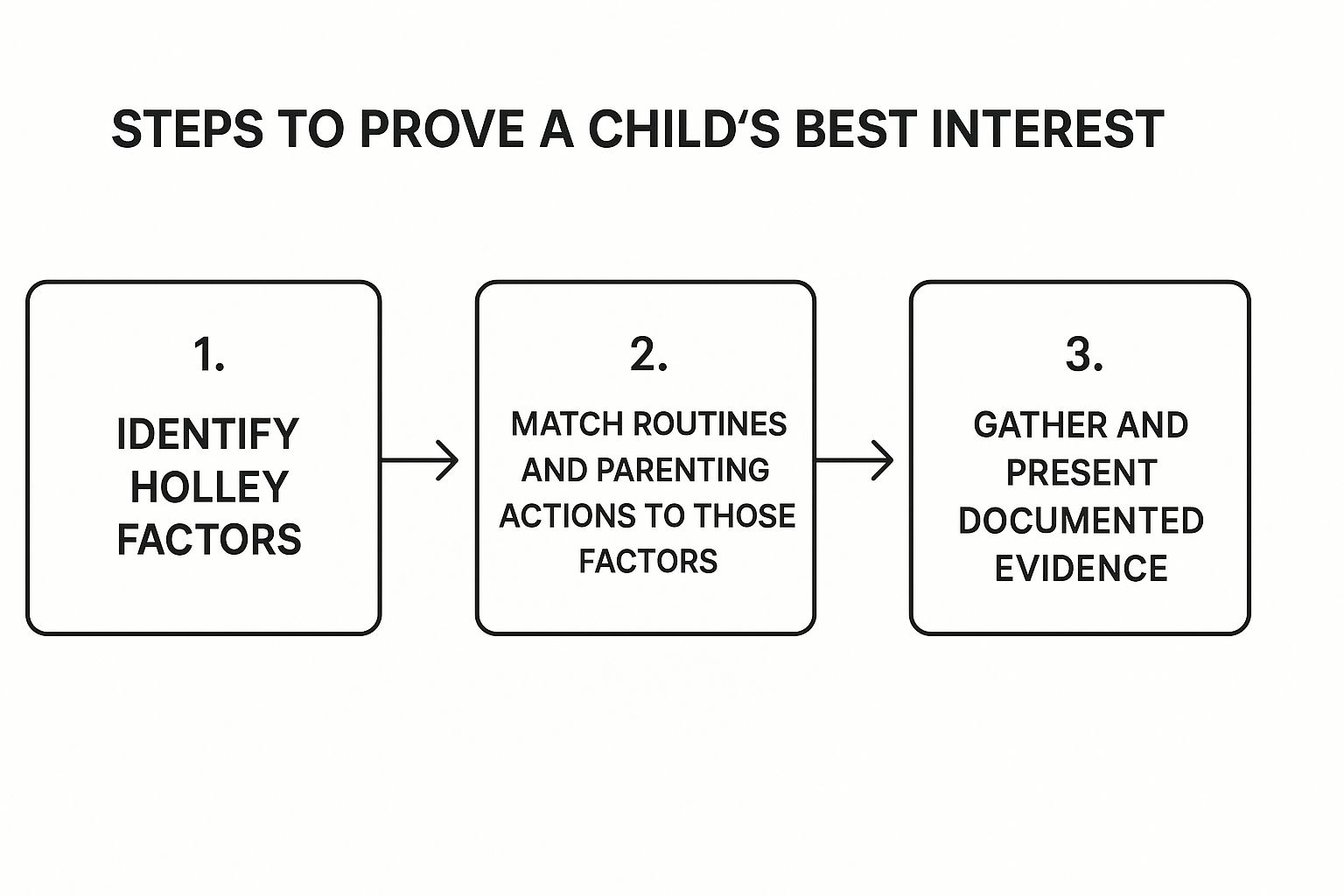
Success boils down to connecting your daily parenting actions directly to these legal factors and backing it all up with solid proof. When you break it down this way, you can turn your everyday involvement into a powerful legal argument that truly shows what is best for your child.
Quick Guide to the Holley Factors
| Factor Category | What the Court Looks For |
|---|---|
| Needs & Well-Being | Evidence of meeting the child's daily physical and emotional needs. |
| Parenting Skills | Each parent's demonstrated ability to raise the child effectively. |
| Stability of Home | The consistency and predictability of each home environment. |
| Emotional Ties | The quality and strength of the bond between each parent and the child. |
| Child's Preference | The wishes of the child (if they are old enough to express them). |
| Dangers & Risks | Any immediate or future emotional or physical dangers. |
| Plans for the Child | Each parent's future plans for the child's upbringing. |
| Parental Conduct | Actions or omissions by parents that may impact the child. |
| Co-Parenting Ability | Willingness to encourage a positive relationship with the other parent. |
This table is a great starting point, but remember, every family is different. The key is to gather specific evidence that tells your unique story through the lens of these factors.
Navigating the Holley Factors Like a Pro

The Holley Factors are the official roadmap a Texas judge uses to decide what's in a child's best interest. But they aren’t just a cold legal checklist. They’re rooted in a real-world understanding of what helps children feel secure, loved, and stable.
When you look at them closely, you’ll probably see that the good parenting you do every day is exactly what the court wants to see. Think of each factor as a chapter in the story of your child's life. Your job is to provide the details that bring that chapter to life for the judge.
The Emotional and Physical Needs of the Child
This is the bedrock of any custody case. It’s about more than just putting food on the table and a roof over their head; it's about nurturing your child’s entire well-being.
To show the court you're meeting these needs, you can provide evidence like:
- A history of consistent medical and dental check-ups.
- Your involvement in their school life, like emails with teachers or attending parent-teacher conferences.
- Proof of a stable daily routine for meals, homework, and bedtime.
A judge wants to see a parent who is actively engaged and provides a predictable, loving environment where a child can truly thrive.
Parental Abilities and Home Stability
This next factor gets into your skills as a parent and the consistency you offer. It’s all about demonstrating sound judgment and being a reliable presence in your child’s life. Do you make decisions that put their well-being first? Is your home a safe and stable place for them?
Evidence here is often about the little things that add up: a clean and safe home, a dedicated space for your child to sleep and study, and your ability to set appropriate boundaries and use positive discipline. This is where your day-to-day actions speak volumes.
For a deeper dive into all the criteria the court considers, you can learn more about understanding Texas custody and the Holley Factors in our detailed guide.
The Texas Presumption of Joint Managing Conservatorship
It's also critical to understand a key concept in Texas law: Joint Managing Conservatorship. This is the legal term for what most people call joint custody. Under the Texas Family Code, courts must presume that naming both parents as joint managing conservators is in the child's best interest.
This means the law’s starting point is that both parents should share the rights and responsibilities of raising their child.
This doesn't automatically mean a 50/50 split of time. It means both parents have legal rights and responsibilities, like making decisions about education and healthcare. The "possession schedule" is what outlines the specific days and times each parent has the child. Showing you can cooperate with the other parent is a huge part of proving this arrangement is in the best interest of your child.
The legal approach to custody has changed a lot over the years. Today, the focus has shifted dramatically toward shared parental involvement, recognizing the unique value both parents bring to the table. This shift makes demonstrating your ability to co-parent effectively more critical than ever before.
Building Your Case with Compelling Evidence
While your testimony in court is important, hard evidence is what backs up your words and turns your claims into a credible story for the judge. This is where you gather real, tangible proof that shows the stable, loving world you provide for your child.
It’s the small, consistent things you do every day that build the strongest cases. Think of yourself as the archivist of your own parenting journey. Every school photo, text message chain, and report card helps paint a clear picture. Your goal is to collect pieces of evidence that connect directly back to the Holley Factors, showing the judge what’s in your child’s best interest, not just telling them.
Documenting Your Daily Involvement
One of the most powerful tools you have is a simple parenting journal. This isn't just a diary for your feelings—it's a factual log of important events, daily routines, and key conversations. A well-kept journal provides a detailed timeline that highlights your consistent involvement and the stability you offer.
Here’s what you should be documenting:
- Key Moments: Note every milestone, parent-teacher conference, doctor's visit, and school play you attend.
- Co-Parenting Communication: Log your conversations and any agreements made with the other parent. This is also the place to note any issues with cooperation.
- Your Child’s Well-Being: Keep track of your child’s emotional state, how they’re doing in school, and their social life.
This detailed record becomes priceless, especially when you need to recall specific dates or events on the stand. A well-organized collection of evidence is also a critical part of how you should prepare for a custody hearing in Texas, giving your attorney the tools they need to fight for you.
Gathering Tangible Proof of Stability
Beyond your own notes, official documents offer objective proof that the court sees as credible and unbiased. These records carry a lot of weight. Start gathering these items now and get them organized so they’re ready to go.
Your evidence portfolio should include:
- School Records: Report cards, attendance records, and positive emails from teachers show your child is thriving and that you are an engaged parent.
- Medical Records: A log of doctor visits, dental check-ups, and filled prescriptions proves you’re on top of your child’s physical health.
- Financial Documents: Proof of a steady income and a history of paying bills on time demonstrates you can provide a secure home.
Part of building a strong case is showing you’re an advocate for your child's needs. This includes understanding your child's educational rights under Section 504 if they have unique learning challenges. Proving you're proactive about their education is a powerful testament to your parenting.
Remember, the goal is to create a complete narrative. A single photo of you at a school fair is good. But that photo, combined with a glowing email from the teacher and a great report card, tells a much richer story. Your consistency is your strength—now is the time to document it.
Showcasing a Stable and Nurturing Home

When a judge evaluates your case, they aren't just looking for love—they're looking for consistency. A stable, predictable home environment is one of the most powerful indicators of a child's future well-being. Proving you provide this kind of home is a non-negotiable part of demonstrating your child's best interests.
But what does "stability" look like as evidence? You’ll find it in the small, everyday details that create a sense of safety and routine for your child. It's about showing the court that your home is the dependable foundation your child needs to grow with confidence.
Painting a Picture of Daily Life
You can illustrate the consistency in your home by focusing on three key areas of your child's routine. Documenting these simple but vital patterns provides a powerful snapshot of the nurturing environment you provide.
- Consistent Schedules: Show that you have established times for meals, homework, and bedtime. A simple calendar or a log in a parenting journal can drive this point home effectively.
- A Supportive Space: Provide photos of your child's personal space—their bedroom, a dedicated homework area, or a safe place to play. This visually confirms you prioritize their comfort and needs within your home.
- Healthy Lifestyle: Document your efforts to provide nutritious meals and encourage physical activity. Demonstrating a commitment to a healthy and sober lifestyle can profoundly impact your ability to provide this environment. Understanding the transformative benefits of sobriety can support your efforts to build the strongest possible case.
A well-structured and thoughtfully designed schedule is key here. You can find excellent guidance on creating a schedule that works for your family by exploring a Texas parenting plan template that outlines these crucial details.
Highlighting Community and Social Connections
Stability extends far beyond the four walls of your home. A judge will also want to see that your child is part of a supportive community network. This includes their friendships, school connections, and involvement in extracurricular activities.
Evidence for this could be as simple as photos of your child with friends, report cards mentioning positive social interactions, or proof of enrollment in sports or clubs.
This evidence is important because it shows the court that removing the child from your care would disrupt not just their home life, but their entire social world. This broader stability is a significant factor in custody decisions.
Recent studies confirm that a child's well-being is tied to much more than just a custody schedule. Research indicates that children in shared custody arrangements often have better outcomes, which is linked to factors like strong parent-child interactions and overall parenting quality rather than just the living arrangement alone.
The Role of Third-Party Professionals in Custody Cases
When you and the other parent have two completely different stories, who is the judge supposed to believe? In many Texas custody battles, a judge will appoint a neutral, third-party professional to be their eyes and ears.
Having a stranger step into your family life can feel invasive and scary. We understand that. But this is an opportunity. It's your chance to give the court a clear, unbiased look at your child's world and show them you're the stable, loving parent they need.
These professionals aren’t there to pick a side. Their entire job is to gather the facts, figure out what your child truly needs, and make a recommendation to the court. How you handle their involvement can be one of the most powerful ways you prove what's in your child's best interest.
Who Are These Professionals? Key Roles in Your Custody Case
You’ll likely hear a few official-sounding titles, and it’s critical to know who’s who. The two most common appointments are an Amicus Attorney and an Attorney Ad Litem.
While they both sound like lawyers for your child, their roles are very different. An Amicus Attorney is appointed to represent the child's best interests to the court. Think of them as an investigator for the judge. They'll meet with you, the other parent, and your child, then tell the judge what they think the outcome should be.
An Attorney Ad Litem, on the other hand, is appointed to represent your child's wishes. This is more common with older, more mature children who can clearly state what they want. Their job is to be the child’s voice in the courtroom. Knowing who you’re working with is the first step to cooperating effectively.
Getting Ready for a Custody Evaluation or Social Study
Sometimes, the court needs an even deeper dive, which leads to a custody evaluation, often called a "social study." This is a comprehensive investigation into your family’s life, conducted by a trained professional like a psychologist or social worker. They will interview everyone, visit your home, and talk to collateral witnesses like teachers, doctors, and family friends.
This process can feel intense, but you can prepare for it.
- Be Honest. These evaluators are experts at spotting inconsistencies. The fastest way to lose credibility is to try and paint a perfect picture. Be open about your strengths, but also acknowledge the areas where you could improve as a parent. Honesty is your best policy.
- Make It All About Your Child. Every answer you give should circle back to your child's needs, not your frustrations with the other parent. Instead of saying, "He's always late for pickups," frame it differently: "Our son really thrives on a consistent schedule. It helps him feel secure, so punctuality is something that makes a big difference for him."
- Keep It Real. Yes, your home needs to be safe, clean, and child-friendly. But it doesn't need to look like a museum. The evaluator wants to see a real home where a child is comfortable, happy, and cared for—not a sterile environment you staged for their visit.
The purpose of a custody evaluation is to give the judge a neutral, expert opinion. Your cooperation, transparency, and unwavering focus on your child during this process will say more about your parenting than any single statement you make.
Common Questions About Texas Custody Cases
When you’re in the middle of a custody case, questions pop up constantly. We understand that this is an emotional and stressful time. Below, we've answered some of the most common concerns we hear from Texas parents to provide you with more clarity and confidence.
How will a new partner affect my case?
It’s natural to want to move on, but when you introduce a new romantic partner, a judge will look at that relationship through one lens: your child’s well-being. The court will be interested in your partner’s background, their character, and, most importantly, the kind of relationship they have with your child.
If your new partner is a stable, positive influence, their presence can be a plus. But if they have a criminal record, a history of substance abuse, or other red flags, it could seriously damage your case. The key is to show the court that this person adds to your child's life, rather than creating instability.
Does my child's opinion matter to the court?
Yes, it does—but it’s not the final word. According to the Texas Family Code, once a child is 12 years of age or older, they have the right to speak with the judge in chambers (privately) to express their preference about which parent they want to live with primarily.
A judge will listen carefully and take what the child says seriously.
While a child's preference is an important Holley Factor, the judge is not required to follow it. The court will weigh the child’s maturity and reasons against all other evidence to make a final decision that serves the child’s best interest, not just their wishes.
What if the other parent makes false allegations?
Few things are more gut-wrenching than being falsely accused, especially when your relationship with your child is on the line. It's a tactic we unfortunately see in high-conflict cases. The most important thing you can do is stay calm and respond with strategy, not emotion.
Do not retaliate with your own false claims, as that will only destroy your credibility.
Instead, your job is to methodically disprove the allegations with facts. Gather every piece of evidence you can—texts, emails, photos, and witness testimony—that contradicts what the other parent is saying. A strong defense is built on truth and consistency. It shows the judge that you are the parent who is stable, reasonable, and trustworthy.
Key Takeaway: Your Next Steps
You now have a solid understanding of how to prove the best interest of the child in a Texas court. It comes down to showing a judge that you provide a consistent, loving, and stable home, using organized evidence that aligns with the Holley Factors. Your job now is to turn this knowledge into a real-world strategy.
This isn’t just a Texas rule. It’s a core principle of human rights, rooted in the UN Convention on the Rights of the Child. This international agreement requires that in all actions concerning children, their best interests must be the top priority. You can learn more about this global legal standard and its impact on custody laws worldwide.
So, what's next? Start by gathering your documents, documenting your involvement, and thinking about who could speak to your parenting skills. Most importantly, don't try to navigate this alone. Getting professional legal guidance is the single best step you can take to protect your rights and secure your child's future.
If you need help with a child custody or visitation case in Texas, our experienced attorneys can guide you every step of the way. Contact The Law Office of Bryan Fagan, PLLC today for a free consultation.