
When your child’s future is on the line, understanding your rights matters most. To win a parental alienation case, you have to do more than just tell the judge your child has been turned against you. You need to show them. This means building a clear, documented timeline of the other parent's manipulative behaviors and proving how those actions have directly harmed your relationship with your child.
It’s about shifting from feelings to facts. You’ll need a solid case built on concrete evidence—think text messages, witness statements, and expert evaluations—that all point to a deliberate campaign to destroy your bond. Your goal is to convince a Texas judge that this behavior is harmful and absolutely not in the best interest of the child.
What Is Parental Alienation in Texas?
There’s a unique kind of helplessness that comes from watching your child pull away because of the other parent's influence. One day things are fine, and the next, your child is distant, angry, or even hostile for reasons you can’t understand. It's confusing, frustrating, and deeply painful.
This isn’t just a kid going through a phase or a simple co-parenting disagreement. What you're experiencing is likely a calculated pattern of behavior designed to damage, and sometimes completely sever, your relationship with your child.
In simple terms, parental alienation is what happens when one parent intentionally manipulates a child to reject the other parent without any good reason. These actions force the child into a loyalty conflict, making them feel like they have to pick a side. Too often, it leads them to reject a loving, perfectly capable parent.
The Best Interest of the Child Standard
You won’t find a law in the Texas Family Code explicitly called "parental alienation." Instead, judges view these toxic behaviors through the single most important lens in any custody case: the best interest of the child.
This principle is the bedrock of Texas family law, outlined in Chapter 153 of the Texas Family Code. The law presumes that having a healthy relationship with both parents is crucial for a child's well-being. A child has the right to be loved and supported by both their mother and father.
When one parent actively sabotages the child’s bond with the other, a Texas court sees that as a direct threat to the child's best interests. The goal isn't to punish the alienating parent—it's to protect the child from ongoing emotional harm. Proving parental alienation is really about showing the court that your child is being manipulated and that you need the court's help to preserve their right to a relationship with you.
Distinguishing Alienation from Normal Conflict
It's critical to know the difference between true alienation and the normal bumps in the road of family life. After a divorce, it's common for a child to feel closer to one parent for a while or to get angry about rules and boundaries. That’s not the same as a systematic effort to destroy a relationship.
It can be tough to tell the difference when you're in the middle of it. This table is designed to help you see the patterns more clearly and figure out if what you're dealing with is typical parent-child conflict or something more destructive.
Parental Alienation vs. Normal Parent-Child Conflict
| Behavior/Sign | Parental Alienation Indicator | Normal Conflict or Estrangement |
|---|---|---|
| Criticism | The child parrots adult-like, unjustified criticisms of you, often using the other parent's exact words. | The child expresses age-appropriate complaints, like disagreeing with rules or consequences. |
| Justification | The child offers weak, absurd, or frivolous reasons for their anger or rejection of you. | The child can clearly state a legitimate reason for being upset, related to a specific incident or your behavior. |
| Lack of Guilt | The child shows no remorse or guilt for their disrespectful or cruel behavior toward you. | The child may feel guilty or apologize after an argument or outburst. |
| Support System | The child's negative feelings extend to your entire side of the family, including grandparents or cousins they previously loved. | The child’s conflict is with you specifically and does not impact their other family relationships. |
| Loyalty Pressure | The child feels they must choose a side and sees one parent as all-good and the other as all-bad, with no middle ground. | The child understands they can love and have a relationship with both parents, even if the parents don't get along. |
Being able to spot these signs is your first step. Now, let’s get into the practical side of things: how to document these behaviors and build a case that a judge will take seriously.
Building Your Case with Concrete Evidence
Moving from feelings to facts is the single most important pivot you can make when fighting parental alienation. We know how painful and chaotic this experience is, but a Texas family court judge can't rule on emotions. They need clear, provable evidence. Your job is to lay out a factual roadmap that shows a consistent, undeniable pattern of harmful behavior.
This is where you start to regain some control. Methodical documentation transforms a gut-wrenching situation into a structured, compelling case. Instead of relying on scattered memories, you're going to build a library of proof that tells the true story on behalf of your child.
The process of alienation is destructive, and it often follows a predictable path. It starts with one parent's deliberate actions, which directly cause a child to resist the other parent, ultimately fracturing their bond.
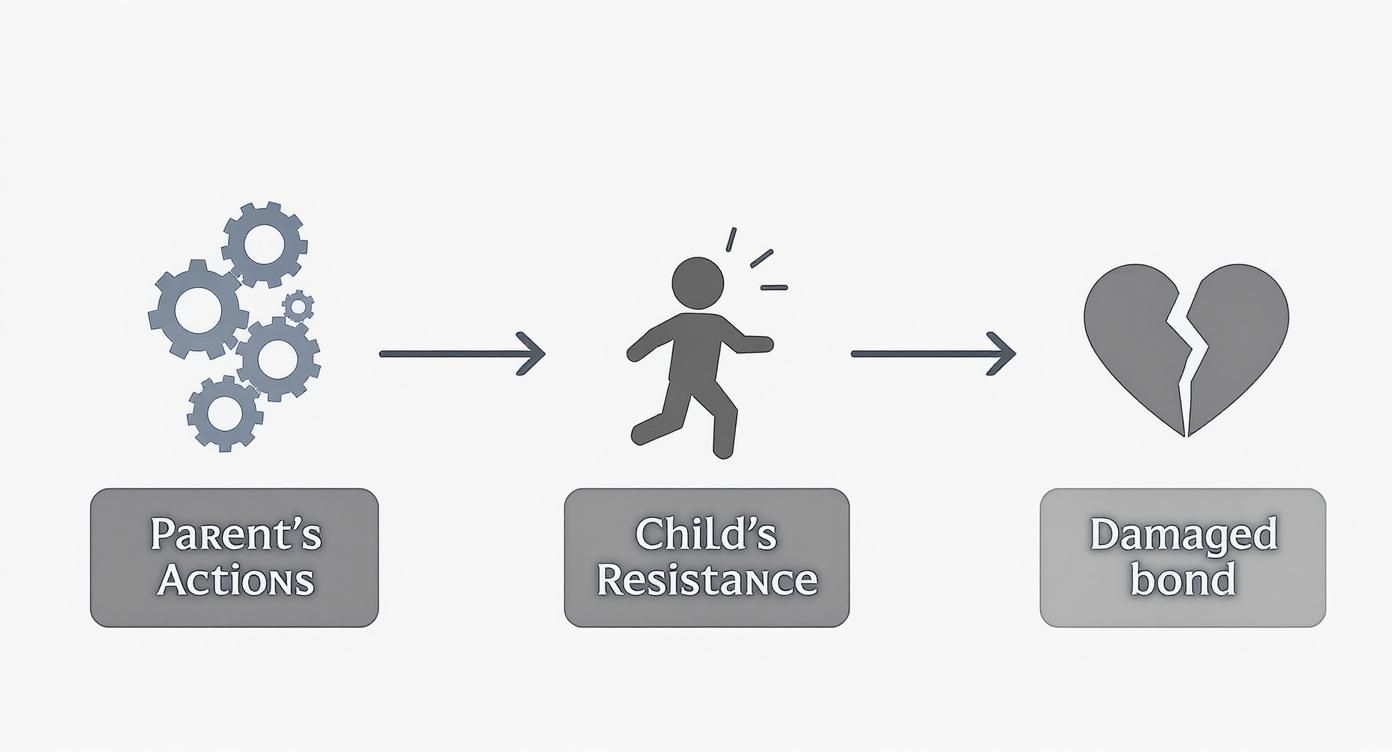
This diagram shows exactly how those calculated behaviors become the starting point, directly causing a child to pull away and damaging the parent-child relationship at its very core.
The Power of a Detailed Journal
Your most powerful tool, day in and day out, is a simple journal. But think of it less as a diary for your feelings and more as a logbook of facts. Every single entry needs to be objective and packed with detail.
For each incident—no matter how small it feels at the time—you need to log:
- Date and Time: Pinpoint exactly when the event happened.
- What Happened: Describe the event using factual, unemotional language.
- Direct Quotes: This is critical. Write down exactly what was said by the other parent or your child. Instead of, "He badmouthed me," you need to write, "Child said, 'Mommy told me you don't love us anymore because you moved out.'"
- Your Child's Reaction: Note any changes in your child's mood, behavior, or attitude before, during, or after an interaction. Were they anxious before a call? Withdrawn after a visit?
- Witnesses: Was anyone else there? A grandparent, a friend, a teacher? List anyone who saw or heard what happened.
This journal does more than just record events; it builds a timeline. Over weeks and months, it can reveal a disturbing pattern that a judge might otherwise miss, showing that what you're describing isn't a one-off argument but a systematic campaign.
Preserving Digital and Third-Party Evidence
So much of this behavior now happens in writing. Text messages, emails, and social media posts can provide the undeniable proof of manipulation you need. You have to preserve this evidence correctly.
Take screenshots of everything, making sure the date and timestamp are visible. We often advise clients to use software or apps designed to download and authenticate entire text threads so they are admissible in court. Never, ever delete a message, no matter how painful it is to read.
Beyond the other parent’s direct communications, start looking for documentation from neutral third parties. This type of evidence is incredibly persuasive to a judge because it comes from an unbiased source.
A well-documented pattern of alienating behavior is far more powerful than isolated anecdotes. Consistency is what turns individual incidents into a compelling case that a court can act upon to protect your child.
Gathering all this information is vital because the burden of proof is incredibly high. The challenge is significant; a U.S. Justice Department study found that when fathers alleged alienation, courts only credited 23% of mothers' counterclaims of abuse. Even more concerning, claims of child sexual abuse were believed in just 2% of these cases, which underscores the immense effort required to build a successful case.
Key Documents to Collect
It's time to start formally requesting and organizing official records. These documents can independently verify the alienating parent’s interference or show the negative impact it's having on your child.
Start with these:
- School Records: Are your child's grades suddenly slipping? Are they missing school, especially on days they are supposed to be with you? Attendance sheets and report cards can paint a very clear picture for the court.
- Medical and Therapy Records: A therapist's notes might document a sudden change in your child's emotional state or even record things your child has said about the other parent. This can be powerful evidence of emotional harm.
- Communication with Teachers or Coaches: If you have emails from a teacher expressing concern about your child's behavior or mentioning things your child has said, save them. These observations from professionals are invaluable.
When you combine your personal journal with these official documents, you create a multi-layered case that is incredibly difficult for the other side to dismiss. Every piece of evidence works together to show that the other parent’s actions are directly harming your child's well-being. This is the foundation for proving that a change is absolutely necessary to protect the best interest of the child—the standard that governs every single Texas custody decision. To learn more, our detailed guide explains how to prove the best interest of the child in Texas.
Leveraging Expert Testimony to Validate Your Claims
When your documentation starts painting a clear picture of alienation, it’s time to bring in a neutral, professional voice to help the court understand the damage. Going toe-to-toe with the other parent can feel like an unwinnable "he-said, she-said" battle. This is where expert testimony becomes your most powerful tool, turning a messy dispute into a professional assessment of your family’s reality.
These experts aren’t on anyone’s “side.” Their job is to give the court an unbiased, child-focused evaluation. Their findings can validate your concerns and give the judge the credible, third-party perspective they need to make a ruling in your child’s best interest.

Child Custody Evaluators: A Neutral Perspective
A child custody evaluator is a mental health professional—usually a psychologist or licensed therapist—appointed by the court to investigate your family’s situation. Think of them as a neutral fact-finder. They don’t just listen to the parents; they conduct a deep dive into the entire family dynamic.
This evaluation is an exhaustive process and typically includes:
- Interviews: Speaking with you, the other parent, and your child separately.
- Observation: Watching how each parent interacts with the child in a natural setting.
- Collateral Contacts: Interviewing other key people in your child’s life, like teachers, doctors, and grandparents.
- Home Visits: Assessing the living environment each parent provides.
- Psychological Testing: Sometimes, tests are used to get a clearer picture of the mental health of both parents and the child.
After this deep dive, the evaluator submits a detailed report to the judge with their professional recommendations for conservatorship (custody) and possession schedules (visitation). Because this report comes from an impartial expert, it carries immense weight in the courtroom. It can be the single most influential piece of evidence in your case.
The Role of a Child’s Therapist
While your child's therapist can't be forced to take sides or recommend a specific custody outcome, their testimony can be incredibly insightful. Their job is to support your child’s emotional well-being, and through that work, they often gain a unique understanding of the pressures and conflicts your child is facing.
A therapist can testify about things like:
- Sudden changes in your child’s behavior or emotional state.
- Statements your child has made about their feelings toward each parent.
- Signs of anxiety, stress, or loyalty conflicts they have observed.
This testimony isn't about blaming anyone. It’s about illuminating your child's inner world for the judge, providing professional context for the behaviors you've been documenting. While Texas has strict rules about therapist-patient privilege, a judge can order a therapist to testify if it's deemed necessary for determining the child’s best interest.
Expert witnesses often base their testimony on specialized evaluations. To get a better sense of the depth of this work, it can be helpful to read about understanding neuropsychological assessments.
Understanding the Amicus Attorney or Guardian Ad Litem
In especially contentious custody battles, a judge might appoint an Amicus Attorney or a Guardian Ad Litem (GAL). While the titles are slightly different, their core function is the same: to represent the best interests of the child. This attorney doesn’t represent you or the other parent; their only client is your child.
The Amicus Attorney acts as the eyes and ears of the court. They will conduct their own investigation, which often means reviewing every document, interviewing everyone involved, and meeting with the child. At the final hearing, they present their findings and make a recommendation to the judge about what arrangement would best serve the child.
The credibility of an Amicus Attorney’s report is powerful. Because their only duty is to the child, their recommendation provides the judge with a clear, unbiased path forward, free from parental conflict.
Getting these professionals involved is particularly critical because of the biases that can pop up in court. A Justice Department-funded study found a shocking reason judges sometimes award custody to an abusive parent: mothers are often not seen as credible, with a staggering two-thirds dismissed as psychologically unwell. This highlights the absolute necessity of credible, third-party expert testimony to overcome potential bias and prove your case.
Presenting a Compelling Case in the Courtroom
All the hours you’ve spent documenting, organizing, and working with experts have led to this. It’s time to take all that preparation and present a clear, persuasive case in the courtroom. This is where your family law attorney steps in to weave every journal entry, text message, and expert report into a powerful narrative for the judge.
The goal isn’t to attack the other parent; it’s to advocate for your child. A judge needs to see you as the reasonable, stable parent focused squarely on your child’s emotional health. Your demeanor, organization, and the clarity of your story are just as crucial as the facts themselves.

Weaving Your Evidence Into a Cohesive Story
Your evidence must tell the story of a once-healthy, loving relationship that was systematically damaged by the other parent's actions. Your attorney will help structure your presentation to guide the judge through this story, both chronologically and thematically. You aren't just listing isolated incidents; you’re connecting the dots for the court.
For example, your attorney might start by presenting photos and old report cards from before the alienation began, establishing your strong, positive bond with your child. Then, they'll introduce the texts, emails, and journal entries that mark the start of the alienating behavior. Finally, they will link those actions to your child's subsequent behavioral changes, all backed up by testimony from teachers or therapists.
The most powerful courtroom strategy is to show, not just tell. By presenting a clear timeline that links the alienating parent's conduct to the negative impact on your child, you make it easier for the judge to understand the harm and the need for intervention.
Preparing Your Witnesses for Testimony
Third-party witnesses can be incredibly influential because they're seen as neutral observers. But they need to be prepared to testify effectively. Your attorney will work with your witnesses—like teachers, grandparents, or family friends—to make sure they understand the process and know what to expect.
A few key points of witness prep include:
- Reviewing the Facts: They’ll go over their own statements or notes to refresh their memory on specific events, dates, and conversations.
- Sticking to What They Know: Witnesses must be coached to only testify about what they personally saw or heard—not what they assume or what you told them.
- Staying Calm Under Cross-Examination: The other attorney will question them. It’s crucial they remain calm, answer honestly, and don’t get defensive.
A well-prepared witness provides credible, firsthand accounts that reinforce your claims and add serious weight to your case.
Your Parental Alienation Evidence Checklist
| Evidence Type | What to Collect | Why It's Important |
|---|---|---|
| Communications | Emails, text messages, voicemails showing manipulation, badmouthing, or interference with your time. | Provides direct, undeniable proof of the alienating parent's words and intentions. |
| Child's Behavior | School records (grades, attendance, behavioral notes), therapist reports, your personal journals. | Documents the "before and after" picture, linking the parent's actions to the child's distress. |
| Witness Accounts | Statements from teachers, coaches, counselors, friends, or family who observed the changes. | Offers third-party validation that corroborates your claims and adds credibility. |
| Financial Records | Receipts or bank statements showing withheld support or interference with shared expenses. | Can demonstrate a pattern of control or punishment that extends beyond emotional manipulation. |
| Expert Reports | Custody evaluation reports, psychological assessments of the child or alienating parent. | Provides a professional, objective opinion on the dynamics at play and the impact on the child. |
This checklist serves as a starting point. Your attorney will help you tailor your evidence collection to the specific facts of your case, ensuring every piece serves a clear purpose in telling your story.
Maintaining Your Composure and Credibility
How you behave in court speaks volumes. We know this process is emotionally draining, but it is absolutely critical that you remain calm, respectful, and factual at all times. The judge is watching you closely, assessing your character and credibility.
Avoid emotional outbursts, sarcastic remarks, or shaking your head when the other parent is speaking. Focus on presenting yourself as the parent who can co-parent effectively and who genuinely supports your child's relationship with both parents, despite the other's destructive behavior. This reinforces your position as the reasonable party acting solely in your child's best interest.
This approach shows the court that your priority is your child’s well-being, not punishing the other parent—a powerful message that resonates deeply with family court judges in Texas. For more guidance, you can explore our advice on how to prepare for a custody hearing in Texas, which offers practical steps for presenting your best self in court.
Anticipating and Countering Common Defenses
Walking into court prepared for the other side's arguments is one of your greatest assets. An alienating parent rarely, if ever, admits to their behavior. Instead, they will come armed with a list of excuses and justifications. Knowing these predictable defenses ahead of time is more than just good preparation—it helps you and your attorney dismantle them piece by piece.
Your goal is to stay calm and focused, reinforcing your position as the reasonable parent who is there to protect your child, not to escalate conflict. It’s all about being proactive, not reactive.
The "Justified Estrangement" Defense
One of the most common tactics you'll face is the claim that the child's rejection of you is entirely your own fault. The other parent will argue it’s not alienation at all, but “justified estrangement” caused by your poor parenting, past mistakes, or some specific incident. They're essentially trying to reframe their manipulation as a natural, logical consequence of your own actions.
So, how do you counter this? Your evidence is everything. This is where your detailed documentation of a previously loving and healthy relationship becomes absolutely invaluable.
- Show the "Before" Picture: Use photos, home videos, old report cards with positive teacher comments, and even testimony from friends and family to paint a clear picture of the strong, positive bond you once shared with your child.
- Pinpoint the Shift: Use your journal and communication logs to show the court exactly when the relationship began to sour. You need to demonstrate how this deterioration lines up perfectly with the separation or the beginning of the other parent’s alienating behaviors.
The point is to prove that your child’s feelings didn't change because of something you did, but because they were systematically influenced over time.
"The Child Is Old Enough to Decide"
Another defense you'll almost certainly hear is that the child is simply mature enough to have their own opinion and has decided—all on their own—that they don't want a relationship with you. The alienating parent will portray themselves as a passive bystander who is merely "respecting the child's wishes." This argument is especially common with pre-teens and teenagers.
While it's true that Texas law allows a judge to consider the wishes of a child 12 years of age or older, it is by no means the deciding factor. Judges know all too well that a child's stated preference can be the result of manipulation.
A child’s stated wish to avoid a parent is not the final word in a Texas custody case. The court’s primary duty is to determine if that wish is authentic or a product of the other parent's influence, always returning to the guiding principle of the child's best interest.
Your attorney can push back on this by highlighting evidence that the child is parroting adult phrases, offering weak or illogical reasons for their anger, or showing an unhealthy, almost fearful loyalty to the alienating parent. Expert testimony from a custody evaluator or therapist is often crucial here to explain to the court how a child's "choice" may not be a true choice at all.
The False Allegation Tactic
This is perhaps the most painful and dangerous defense: when a parent makes false allegations of abuse or neglect to justify cutting off your contact. This tactic not only harms you but also weaponizes the very systems designed to protect children, causing immense and sometimes irreversible damage. It’s a desperate, destructive strategy that courts must handle with extreme care.
It's important to recognize that this tactic can be used against either parent. While alienation can affect anyone, international data shows that these claims can disproportionately impact mothers. For example, in Brazil, 66% of parental alienation cases accused women of this behavior, and in the U.S., an estimated 58,000 children are placed in potentially dangerous situations due to custody decisions influenced by alienation claims, which are often used to counter legitimate abuse allegations. To understand more about this complex issue, you can read about the impact of these claims in domestic abuse cases.
To defend yourself against false allegations, you must:
- Stay Calm and Cooperative: Your first move is to cooperate completely with any investigation by Child Protective Services (CPS) or law enforcement. Getting defensive can be misinterpreted as guilt.
- Present Your Own Evidence: Counter their claims with your own witnesses who can speak to your good character and fitness as a parent.
- Request a Psychological Evaluation: An evaluation of both parents and the child by a neutral, court-appointed expert can often expose the truth behind the allegations.
By thinking through these common defenses ahead of time, you can work with your attorney to build a strategic response for each one. This preparation ensures you are ready to protect your relationship with your child and present the truth to the court.
Common Questions About Proving Parental Alienation
Walking into a parental alienation case, you’re bound to have a million questions swirling in your head. The legal process can feel like a maze, but getting clear, straight-up answers is the first step toward regaining your confidence.
Let's cut through the noise and tackle some of the most pressing questions we hear from parents just like you.
How Long Does It Take to Prove This in Court?
There’s no simple answer here—every case is different. Proving parental alienation isn’t about a single, dramatic “aha!” moment in the courtroom. It’s about methodically building a case that shows a consistent, documented pattern of behavior over time.
A judge needs to see a clear and undeniable history of interference and manipulation. That means the timeline really depends on how long it takes to gather solid proof—your journal, communication logs, school records, and witness statements—and to get experts involved. Think of it as a marathon, not a sprint. The goal is to patiently and persistently show the harm being done to your child's best interests.
Will My Child Be Forced to Testify in Court?
This is a huge fear for most parents. The last thing you want is to put your child through the stress of testifying on a witness stand. Thankfully, the Texas legal system agrees. It is extremely rare for a child to be forced to testify in open court because everyone recognizes how traumatic that would be.
So, what happens if the judge needs to hear from your child directly? If the child is 12 years of age or older, the judge will usually conduct what’s called an in-chambers interview.
An in-chambers interview is a private conversation between the judge and the child, held in the judge's office. It’s a much less intimidating setting. The parents and their lawyers aren’t in the room, which helps the child speak openly without feeling pressured by either side.
This process allows the child's perspective to be heard while shielding them from the adversarial nature of a public hearing. A court reporter is always present to create an official record of the conversation, keeping the process transparent for the attorneys.
What Happens When a Judge Finds Alienation Occurred?
If you successfully prove that parental alienation is damaging your child, a Texas judge has several powerful options. The court's primary goal isn't to punish the other parent, but to fix the situation and act in the child's best interest.
Here are some of the remedies a judge might order:
- Reunification Therapy: This is a common first step. The court can order specialized family counseling designed to safely and methodically repair the damaged parent-child relationship.
- Modifying the Possession Schedule: A judge can change the visitation schedule to give the alienated parent more time with the child. In some cases, this might mean ordering a temporary period of supervised visitation for the alienating parent to break the cycle of manipulation.
- Changing the Primary Parent: This is the most significant step, reserved for severe and well-documented cases. If the emotional harm is substantial and ongoing, a judge can modify the custody order and change which parent has the right to decide where the child lives. In Texas, this means changing which parent is the "primary joint managing conservator."
Next Steps: Protecting Your Child and Your Rights
When you’re facing a custody battle involving parental alienation, it can feel like you're fighting in the dark. But understanding your rights is the first step toward turning on the lights. Proving parental alienation in Texas requires a smart, strategic approach built on solid evidence, always keeping the best interests of your child at the center of everything you do. This journey is tough, but you don't have to walk it alone.
The single most important takeaway? Document everything. Stay calm. Be the reasonable parent, even when it feels impossible. Then, get professional guidance to help you build the strongest case you can. The right advocate can help you cut through the complexities of Texas law and fight to restore the bond with your child.
This process isn't about scoring points against the other parent. It's about protecting your child's fundamental right to have a healthy, loving relationship with both parents. Your focus and composure will be your greatest assets.
Taking clear, decisive action is the most powerful way to safeguard your parental rights and, more importantly, your child’s emotional future. We are here to provide the practical guidance and compassionate support you need.
If you need help with a child custody or visitation case in Texas, our experienced attorneys can guide you every step of the way. Contact The Law Office of Bryan Fagan, PLLC today for a free consultation.