
When your child's future is on the line, understanding your rights matters most. You're considering changing your custody order, a significant step that Texas courts approach with great care. To succeed, you must clearly demonstrate two key things. First, that a material and substantial change in circumstances has occurred since the judge signed your last order. Second, and most importantly, you must prove that modifying the order is truly in the best interest of your child.
Let's walk through what these legal standards mean for you and your family.
How Texas Determines Custody Modifications

Life doesn’t stand still; families evolve, circumstances shift, and what worked for your child two years ago might not be suitable today. The Texas Family Code acknowledges this reality by providing a legal pathway for parents to request a modification.
However, the court sets a high bar to ensure stability for children. The entire process rests on two legal pillars, and you must prove both to be successful.
Pillar 1: A Material and Substantial Change in Circumstances
This is your initial hurdle. You must show the court that a significant, meaningful change has happened since your last order was put in place. This isn't about small disagreements or temporary frustrations. The court is looking for a fundamental shift in the lives of the child or the parents.
What does this look like in the real world? It could be any number of major life events:
- One parent needs to relocate to another city or state for a new job.
- The other parent’s living situation has become unstable or unsafe for the child.
- Your child has developed new medical or educational needs that the current arrangement cannot adequately support.
- A parent’s work schedule has changed dramatically, leaving the child without proper supervision.
These are not minor issues; they are foundational changes that directly impact your child's daily life and well-being.
Pillar 2: Acting in the Best Interest of the Child
Proving a significant change has occurred is only half the battle. The second—and most critical—requirement is showing that the modification you are requesting is in your child's best interest. This is the single guiding principle for every custody decision made in a Texas courtroom.
The court’s primary focus isn't on what's fair to the parents. It's about what will promote the child’s physical, mental, and emotional well-being. Every piece of evidence you present and every argument you make must connect back to this central theme.
A judge will evaluate numerous factors, often called the "Holley Factors," to determine what is best for a child. These include the child's emotional and physical needs, the stability of each parent's home, and any potential dangers. Your job is to paint a clear picture of why your proposed changes will create a healthier, more supportive environment for your child to thrive. This dual requirement is why an estimated 20-25% of custody arrangements are modified after the initial decree, reflecting how often life changes prompt a legal review. You can discover more insights about these child custody statistics to see how common this process is.
Steps to Modify a Custody Order

Before you can argue what's best for your child, you must first prove that a "material and substantial change" has occurred. The Texas Family Code is clear: this change must have happened after your last custody order was signed. Think of your current order as the foundation for your child's stability. A judge is reluctant to disrupt that foundation unless there's a compelling reason. Your task is to show that the ground has already shifted and a new foundation is needed.
What Does the Court Consider a Valid Change?
While Texas judges have discretion, certain situations consistently get their attention. The key is to connect a major life event directly to your child’s environment and daily reality.
Here are some real-world examples that often meet the "material and substantial" standard:
- Parental Relocation: A parent is moving to another city or state, making the current possession schedule unworkable. A possession schedule is the court-ordered calendar that details when each parent has the right to have the child.
- A Risky Living Situation: A parent’s remarriage introduces a person who is a negative or dangerous influence. Or, a parent's living conditions have become unsafe.
- Substance Abuse or Criminal Behavior: One parent has developed a drug or alcohol problem or has engaged in criminal activity that could endanger the child.
- A Child's Evolving Needs: A child is diagnosed with a new medical condition or learning disability that one parent is better equipped to manage.
- Evidence of Neglect or Abuse: There are documented instances of physical, emotional, or educational neglect. This is a major concern for any judge.
- Major Shift in Work Life: A parent's new job requires an overnight shift, regularly leaving the child with inadequate supervision.
These are fundamental shifts, not just disagreements, that alter the circumstances from when the original order was made.
When Is a Change Not Enough?
It's equally important to understand what doesn't usually count. Courts see many petitions filed out of frustration rather than legal necessity. Filing without a legitimate reason can waste your time, money, and emotional energy. Minor disagreements over extracurricular activities, a small pay raise for the other parent, or a new romantic partner who poses no threat to your child typically aren't enough to reopen a case.
A key question to ask yourself is: "How does this change negatively affect my child's physical or emotional well-being?" If you can't answer that clearly and with evidence, the court may not see it as legally significant.
What Qualifies as a Material and Substantial Change?
| Potentially Sufficient for Modification | Generally Insufficient for Modification |
|---|---|
| A parent's relocation that disrupts the child's school and social life. | A parent moving to a new apartment in the same school district. |
| A documented decline in a child's grades or behavior at school. | A disagreement over homework or a single poor report card. |
| Onset of a parent's serious health condition impacting their ability to care for the child. | A parent having a temporary, non-debilitating illness like the flu. |
| A parent's remarriage that brings instability or conflict into the home. | A parent dating a new person who has a positive relationship with the child. |
| Consistent and documented failure to follow the possession schedule. | An occasional late pick-up or a one-time scheduling conflict. |
Understanding this distinction is the first step in building a strong case. It allows you to focus your energy on arguments that matter in the eyes of the law, setting the stage to prove what is truly in your child’s best interest. You can learn more about how to prove what is in your child's best interest in our other resources.
Gathering Evidence for Your Case
Once you've identified a material and substantial change, the next step is to gather the evidence that will bring your case to life for the judge. This isn't about creating drama; it’s about building a factual, organized argument that clearly shows why changing the custody order is necessary for your child's well-being. You can't just tell a judge things are different—you have to show them.
Building Your Documentary Evidence
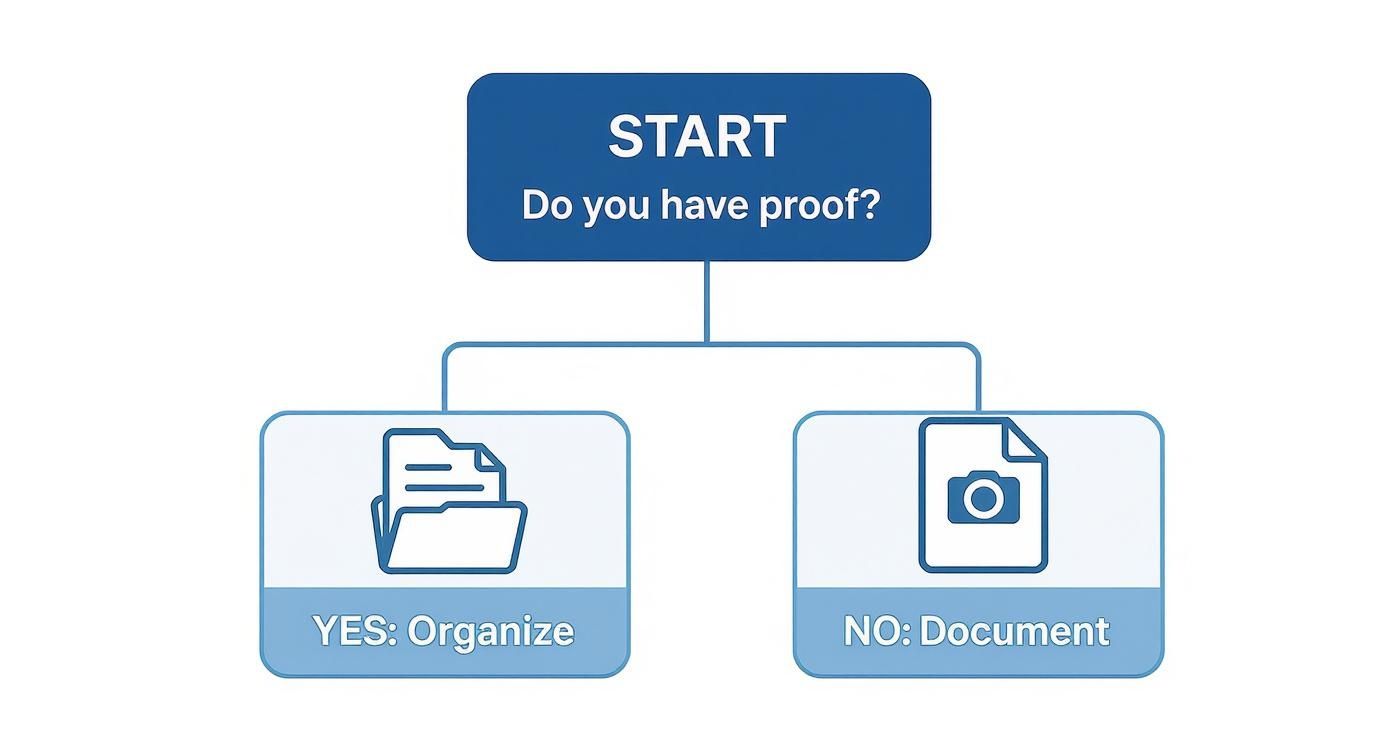
Think of yourself as the historian of your child's recent life. Your mission is to collect documents that paint a clear, undeniable picture. This hard evidence provides the objective backbone for your claims.
Start gathering these items immediately:
- School and Academic Records: Report cards, attendance records, emails from teachers, and disciplinary notices can be powerful signals of instability.
- Medical and Therapeutic Records: Documents from doctors, dentists, and therapists can track your child's physical and emotional health, highlighting any new challenges.
- Communication Logs: This is non-negotiable. Keep a detailed log of every communication with the other parent. Texts, emails, and messages within co-parenting apps are invaluable for creating a factual timeline.
- Calendars and Journals: Use a calendar to track the visitation schedule, noting every time the other parent is late, misses a visit, or fails to follow the court order. A personal journal helps you recall specific incidents and their impact on your child.
When dealing with depositions or witness interviews, using legal court transcription services can turn spoken words into a clear written record that is easy to reference and present.
The Human Element: Witness Testimony
While documents are critical, testimony from neutral, third-party individuals who have firsthand knowledge of your child's life can carry immense weight. These people aren't there to take your side—they're there to advocate for your child.
Consider individuals who can speak to your child's well-being, such as:
- Teachers or school counselors
- Coaches or mentors
- Therapists or pediatricians
- Trusted family friends or neighbors who have witnessed concerning events
Choose witnesses who can offer specific, fact-based observations. A teacher testifying that your child consistently arrives at school tired and hungry is far more powerful than a relative offering a vague opinion.
Leveraging Professional Assessments
In complex cases, the court may turn to the objective assessments of trained professionals appointed to investigate the family’s situation and provide an unbiased recommendation.
An evaluation from a neutral professional can be one of the most influential pieces of evidence in a modification case. Their sole focus is the child's welfare, aligning perfectly with the court's mandate.
Two common professionals in Texas custody cases are:
- Custody Evaluator: A licensed mental health professional who conducts a deep-dive investigation, interviewing parents and the child, conducting home visits, and providing a detailed report to the court.
- Amicus Attorney: An attorney appointed by the court to represent the child's best interests. The amicus acts as the "eyes and ears" of the court, investigating the facts and making a direct recommendation.
The findings from these professionals provide the court with an invaluable, objective perspective. Ultimately, success hinges on transforming your concerns into a well-documented, evidence-based case that always circles back to what is truly best for your child. You can learn more about how to prove what is in your child's best interest in our detailed guide.
Navigating the Texas Court Process
Walking into a Texas courtroom can be intimidating, but understanding the legal journey ahead can turn anxiety into confidence. The process officially begins when you file a Petition to Modify the Parent-Child Relationship. This document informs the court about the major change in circumstances and explains why your requested changes are best for your child. After filing, the other parent must be formally notified through a process called "service."
The First Steps: Temporary Orders and Mediation
Soon after, you will likely have a hearing for temporary orders. This is a mini-hearing where a judge sets temporary rules for custody and visitation that will remain in place while the case progresses, creating stability for your child.
Before a final trial, you will almost certainly be required to attend mediation. This is a confidential meeting where you, the other parent, and your attorneys work with a neutral mediator to find common ground. This is your best opportunity to have a say in the outcome. In Texas, parents typically live under a Joint Managing Conservatorship, meaning they share in the rights and duties of raising their child, even if one parent has the exclusive right to determine the child's primary residence. Mediation is an excellent forum to creatively solve possession schedule issues within this framework.
Preparing for a Successful Mediation
Preparation is key for a successful mediation.
- Know Your Bottom Line: What are your non-negotiables, and how do they benefit your child?
- Identify Your “Gives”: Where can you be flexible without sacrificing your child's well-being?
- Bring Your Proof: A concise summary of your key evidence will support your position.
Mediation isn’t about winning an argument; it's about building a workable future. A successful mediation saves everyone time, money, and stress, resulting in a court order you both helped create.
When an Agreement Isn't Possible: Discovery and Trial
If mediation is unsuccessful, your case moves into the discovery phase. This is the formal, pre-trial process where both sides exchange information and evidence. It includes written questions (Interrogatories), requests for documents (Requests for Production), and sworn testimony outside of court (depositions).
The entire process has its own rhythm. For a more detailed breakdown, you can review a general Texas child custody case timeline and what to expect.
If no settlement is reached, your case will be set for a final trial. Here, your attorney will present all your evidence and witness testimony to a judge, who will make a final, binding decision based on the best interest of your child.
How to Present Your Case in the Courtroom
If your modification case goes to trial, the courtroom is where your preparation pays off. The judge only knows what they see and hear in that room. This is your chance to show you are a calm, credible, and child-focused parent.
Success begins the moment you walk through the courthouse doors. Dress in business attire to signal that you take this responsibility seriously. Be respectful to everyone—the judge, court staff, and even the other parent and their attorney. Always address the judge as "Your Honor." A calm demeanor speaks volumes about your maturity.
Being a Persuasive Witness in Your Own Case
When you testify, you are the most important witness. Your attorney will guide you, but your ability to answer clearly and confidently is crucial. Stay laser-focused on the facts that support your child’s best interest. This isn’t the time to air old grievances.
- Speak Clearly and Calmly: Take a breath before you answer.
- Listen to the Full Question: Make sure you understand what is being asked.
- Answer Only What Is Asked: Give a direct, honest answer, then stop.
Practice your testimony with your attorney beforehand. For more in-depth advice, reviewing tips on how to prepare for a custody hearing can provide a detailed roadmap.
Handling Cross-Examination with Confidence
After your attorney questions you, the other lawyer will conduct a cross-examination. Their job is to test your credibility. The best strategy is to remain calm and tell the truth.
The opposing attorney may use leading questions to box you into a "yes" or "no." If a one-word answer is incomplete, you can say, "Yes, but may I explain?" The judge will almost always allow a brief, factual explanation.
Your goal during cross-examination is to maintain your credibility with the judge, not to win an argument with the other lawyer. Stick to the facts and stay respectful.
Ultimately, winning in the courtroom comes down to showing the judge that you can provide the most stable, supportive, and loving environment for your child.
Key Takeaways and Next Steps
Navigating a custody modification can feel overwhelming, but there is a clear path forward. To succeed, you must prove a material and substantial change has occurred and show the court that your proposed changes are in your child's best interest.
Start gathering your evidence now, stay organized, and always keep your child’s well-being at the center of every decision. This process is not just about a legal outcome; it’s about building a stable and loving future for your child. You have the right to advocate for what is best for your family.
Remember, you don't have to do this alone. A compassionate and experienced legal guide can turn confusion into a confident strategy.
If you need help with a child custody or visitation case in Texas, our experienced attorneys can guide you every step of the way. Contact The Law Office of Bryan Fagan, PLLC today for a free consultation.
Common Questions About Changing a Texas Custody Order
As you consider modifying a custody order, many questions will arise. Here are some straightforward answers to common concerns.
How Long Does a Custody Modification Case Take?
The timeline varies significantly. If you and the other parent agree on the changes, the process can often be completed in a few months. However, a contested case that goes to trial can take a year or longer, depending on the complexity of the issues and the court's schedule.
Can My Child Decide Who to Live With?
Under the Texas Family Code, a judge must interview a child who is 12 years of age or older to hear their preference about who they want to live with.
However, the child's wish is just one factor among many. It is not the final word. A judge’s ultimate decision will always be based on the child's overall best interest.
What if We Both Agree on the Changes?
Reaching an agreement with the other parent is the best-case scenario. This agreed modification is simpler, less stressful, and more cost-effective. Even with an agreement, you must file the proper legal documents and have a judge sign a new, legally binding order to make the changes official and enforceable.
How Much Does a Custody Modification Cost?
The cost depends almost entirely on whether your case is agreed upon or contested. An agreed modification can often be handled for a predictable flat fee. A contested case involving discovery, multiple hearings, and a potential trial will be significantly more expensive. Mediation is often a cost-effective way to resolve disputes without the expense of a trial.
If you need help with a child custody or visitation case in Texas, our experienced attorneys can guide you every step of the way. Contact The Law Office of Bryan Fagan, PLLC today for a free consultation.