
When your child’s future is on the line, understanding your rights matters most. Learning how to write a court motion is a powerful first step. It transforms you from a passive participant in your custody case into an active advocate for your family. This isn’t just about filling out forms; it’s about making your voice heard and giving the court a compelling reason to act on what's best for your child.
Your First Step to Being Heard in Your Custody Case

Navigating a Texas child custody case can feel overwhelming. You know what your child needs, but translating that into the formal language the court requires can seem impossible. This is where a court motion becomes your most essential tool.
A motion is simply a formal, written request asking a judge to make a specific decision or order. Think of it as the official way to raise your hand in the courtroom and say, "Your Honor, we need to address this important issue." Whether you need to adjust a possession schedule, enforce child support, or ask the court to intervene in a crisis, a motion is what sets the legal wheels turning.
Why a Motion Is More Than Just Paperwork
Filing a motion does more than state your request; it legally requires the other parent and the court to respond. This one action can shift the entire dynamic of your case, breaking a stalemate and pushing it toward a resolution. For many parents we work with, understanding this process is a turning point.
It demystifies the court system and provides a concrete way to advocate for your child's best interests—the single guiding principle for every decision a Texas judge makes under the Family Code. As you get started, it's helpful to have a grasp of the entire legal process, including things like understanding legal client intake processes, which is the foundation for any formal legal action.
A well-written motion isn’t just a request; it's a strategic move. It signals to the judge and the other side that you are serious, prepared, and committed to protecting your child’s well-being.
This guide is designed to give you the clarity and confidence to take that first step. We’ll break down how to write and file a court motion in plain English, helping you move from feeling overwhelmed to feeling empowered. While this guide provides a solid foundation, every family's situation is unique. For the initial steps of a case, you can learn more about how to file for custody in Texas in our related article.
How Texas Determines Custody: The "Best Interest" Standard
When your child’s well-being is on the line, filing a court motion isn't just about paperwork—it's your single most important strategic move. A motion is the official, legal way you ask a judge to make a specific, enforceable order. It's the starting point for almost every action you want the court to take in your family law case.
Verbal agreements with an ex can fall apart when things get stressful. A court motion, on the other hand, is a formal request that demands a legal response. It forces the issue, making the other parent and the court address the problem head-on, whether it’s an unsafe living situation for your child or a refusal to follow the current possession schedule.
In Texas, all custody decisions are based on the best interest of the child. This means the judge will consider factors like the child's emotional and physical needs, any danger to the child, the stability of each parent's home, and what each parent has done to support the child in the past. Your motion is your opportunity to show the judge how your request aligns with these factors.
Common Motions That Can Protect Your Family
In Texas family law, different situations demand different motions, each designed to protect your rights as a parent. Some of the most common ones we file for parents include:
- Motion to Modify the Parent-Child Relationship: This is your go-to when there’s been a major life change and you need to permanently alter the existing custody, visitation, or child support order. Under the Texas Family Code, you have to prove a "material and substantial change" has occurred since the last order was signed.
- Motion for Temporary Orders: This is essential when you need the court to make quick decisions while your main case is pending. It can set up temporary possession schedules, establish who pays child support, and even decide who gets to stay in the family home for the time being. In Texas, we often have joint managing conservatorship, where both parents share rights and responsibilities. Temporary orders clarify how that works day-to-day.
- Motion for Enforcement: If the other parent is ignoring a court order—maybe they're not paying child support or they're blocking your court-ordered time with the kids—this motion asks the judge to step in, enforce the order, and hold them accountable.
Putting a Motion into Action: A Real-World Scenario
Let’s look at a situation we see all the time. A father has a standard possession order, but his job suddenly switches him to overnight shifts. It's now impossible for him to care for his kids during his scheduled time, but he and the mother can't agree on a new plan.
Instead of letting the conflict drag on, he files a Motion to Modify the Parent-Child Relationship. This one document kicks off a formal process. It officially notifies the court and the mother about his new work schedule, lays out his proposed solution, and sets a legal deadline for her to respond. Just like that, the conversation shifts from a frustrating stalemate to a structured legal process focused on finding a solution that's in the children’s best interests.
A motion transforms a personal argument into a legal problem that requires a solution. It's often the very thing that forces both parents to the negotiating table, which is where most custody issues are resolved.
This is a point that surprises many parents. For every Texas mother or father gearing up for a custody battle, it's crucial to know that your case will almost certainly not end in a trial. Data shows that parents settle over 90% of custody disputes outside of court through negotiation or mediation. Only a small fraction are ever decided by a judge after a full trial. You can find more details in these child custody statistics.
This shows why learning to use a motion is so powerful—not because it guarantees you'll win in a courtroom, but because it often forces the productive conversations that lead to a settlement.
Anatomy of an Effective Texas Family Law Motion

When you're fighting for your child, every word counts. A court motion is a formal legal document with a very specific structure. Following this structure is your best tool for getting a busy judge to quickly understand who you are, what you need, and why you deserve it.
Think of it as the blueprint for your request. Get the blueprint right, and you're building a strong case. Let's break down each piece so you can put your motion together with confidence.
While the legal format is strict, making it easy to read is just smart strategy. The same principles for writing clear and actionable documents in business apply here—a judge who can easily follow your argument is more likely to be persuaded by it.
The Caption: The Formal Heading
At the top of the first page is the caption. This is the formal heading that acts like the mailing address for your case, telling the court clerk and the judge exactly where this document belongs.
The caption must include:
- The Court: The full, official name of the court handling your case (e.g., "In the 308th Judicial District Court").
- The County and State: Where the court is located (e.g., "of Harris County, Texas").
- The Parties: The full names of the Petitioner and the Respondent, spelled exactly as they are in the original lawsuit.
- The Cause Number: This is the unique number the clerk assigned to your case. It has to be on every single document you file.
Double-check every detail here. A simple typo can cause frustrating delays.
The Title: A Clear Statement of Purpose
Just below the caption, you need to title your document. Be direct and specific so the judge knows exactly what they're about to read.
Good titles look like this:
- "Petitioner's Motion to Modify the Parent-Child Relationship"
- "Respondent's Motion for Enforcement of Possession Order"
- "Movant's Motion for Temporary Orders"
Vague titles like "Motion" or "Request to Court" are a common mistake. Clarity is your best friend.
The Introduction: Who You Are and What You Want
The first paragraph is your formal introduction to the court. It’s where you identify yourself and state the general reason you're filing the motion.
It’s often a single, formal sentence that gets right to the point: "Now comes [Your Name], Petitioner in the above-styled and numbered cause, and files this Motion to Modify the Parent-Child Relationship and would respectfully show the Court the following…" This sentence officially identifies you as the movant—the one asking the court to do something.
The Body: The Heart of Your Argument
This is where you tell your story and lay out the facts for the judge. The body of the motion should be broken down into short, numbered paragraphs. Each paragraph should focus on a single, clear point, making it easy for the judge to read and reference specific details during a hearing.
Most importantly, every statement you make must be truthful. You are signing this document under penalty of perjury. Stick to the facts: what happened, when it happened, and who was there.
Imagine a mom needs to file a Motion for Enforcement because the father keeps missing his weekend visits. Her numbered paragraphs might look something like this:
- "On June 1, 2024, Respondent failed to appear for his court-ordered weekend possession of the child."
- "Respondent provided no prior notice that he would not be exercising his possession."
- "This Court's current order, signed on January 15, 2024, grants Respondent possession of the child on the first, third, and fifth weekends of each month."
This specific, fact-based approach is infinitely more powerful than vague or emotional complaints.
The Legal Basis: Citing the Texas Family Code
After you’ve laid out the facts, you need to connect them to the law. This section explains the legal reason—or "grounds"—for your request. For instance, if you're filing to change your custody order, you'd cite Texas Family Code §156.101, which requires you to prove a "material and substantial change in circumstances."
You don’t have to write a long legal brief. Simply referencing the specific law shows the court you've done your homework and understand the legal test you need to meet.
The Prayer for Relief: Your Specific Request
This might be the single most important part of your entire motion. The "Prayer for Relief" (or just "Prayer") is a clear, itemized list of exactly what you are asking the court to order. Don't be vague. You need to tell the judge the precise outcome you want.
In our enforcement example, the mother's prayer might ask the court to:
- Order the father to strictly comply with the possession schedule.
- Grant the mother make-up visitation for the weekends the father missed.
- Order the father to pay her attorney's fees and costs for having to file the motion.
Key Takeaway: The Prayer for Relief is your direct call to action. If you don't ask for something specifically in your prayer, the judge may not have the authority to grant it, even if you proved you deserve it.
The Signature Block: Making It Official
Finally, you have to sign the motion. Your signature block needs your printed name, address, phone number, and email. When you sign, you are certifying to the court that everything in the document is true and correct to the best of your knowledge.
Below your signature, you need a "Certificate of Service." This is a short statement confirming that you sent a copy of the motion to the other party (or their attorney) and the date you sent it. This proves you’ve followed the rules and notified everyone involved in the case.
To help you keep track of all these moving parts, here’s a simple checklist you can use before filing any motion in a Texas family court.
Checklist for a Texas Court Motion
Use this checklist to ensure your family law motion includes every critical component before you file.
| Component | Purpose | Pro Tip |
|---|---|---|
| Caption | Identifies the court, case number, and parties. | Double-check the cause number and spelling of names against the original petition to avoid rejection by the clerk. |
| Title | Clearly states the purpose of the motion (e.g., "Motion to Modify"). | Be specific. A vague title like "Request" will frustrate the court and opposing counsel. |
| Introduction | Formally identifies you as the movant and introduces the motion. | Keep it to one standard, formal sentence. No need for a long story here. |
| Body | Presents the facts in short, numbered paragraphs. | Stick to one fact per paragraph. This makes your argument clean and easy to follow. |
| Legal Basis | Cites the relevant Texas Family Code section that supports your request. | Mentioning the specific statute shows the judge you understand the legal standard for your case. |
| Prayer for Relief | Lists the specific orders you are asking the judge to make. | Be bold and be specific. Ask for exactly what you want, including attorney’s fees if applicable. |
| Signature Block | Your signature, certifying the facts are true. | Don’t forget to include your current contact information. |
| Certificate of Service | Confirms you sent a copy to the other party or their lawyer. | Note the date and method of service (e.g., via eFile, mail, etc.). |
Getting the structure of your motion right is the first step toward a successful outcome. It shows respect for the court's time and process, and it frames your argument in the clearest, most persuasive way possible.
Building Your Case with Compelling Evidence
A motion can be perfectly written, but without evidence, it's just a stack of paper. The proof you attach gives your motion teeth and convinces a judge to take action. Your goal is to transform your story from a claim you’re making into a fact you can prove. In Texas family court, this means anchoring every request in solid, credible evidence.
Judges can't make decisions based on what you say happened; they need to see what you can prove happened. This is where you connect the dots for the court, showing them why the reality of your situation requires them to grant your motion.
From Words to Evidence
Strong evidence in a custody case isn't always a dramatic revelation. More often, it's a collection of everyday communications and records that, when pieced together, paint a clear picture for the court. Your motion should briefly reference this proof to signal to the judge that your arguments are backed by facts, not just feelings.
Here are some of the most powerful types of evidence we see in court:
- Written Communications: Text messages, emails, and messages from parenting apps can be invaluable. A string of texts showing the other parent consistently missing visitation is far more powerful than you simply stating, "They never show up."
- School and Medical Records: A child's grades suddenly dropping, an increase in absences, or notes from a teacher can demonstrate instability in the other parent's home. Likewise, medical records are critical in cases involving a child's health or safety.
- Financial Documents: For any motion involving child support, pay stubs, bank statements, and tax returns are essential. They provide a clear, factual basis for calculating financial obligations.
- Photographs and Videos: While you must be careful with these, a picture or short video can show what words can't—especially regarding a child's living conditions or a parent's concerning behavior.
Remember, the tone in your motion must stay professional, concise, and objective. Avoid emotional language and personal attacks; that only hurts your credibility. Let the facts and the evidence do the talking.
Adding Weight with a Sworn Statement
To give your factual claims maximum impact, you should attach a sworn declaration or affidavit to your motion. This is a written statement where you swear under penalty of perjury that everything you've laid out is true.
An affidavit transforms your motion from a list of allegations into sworn testimony. It signals to the judge that you are so confident in the truth of your statements that you're willing to swear to them in writing. This adds a huge layer of credibility to your case.
This document also gives you space to tell a more detailed story than the motion itself, referencing specific pieces of evidence you've attached (for example, "A true and correct copy of the text message from June 1st is attached as Exhibit A").
Framing Your Argument Around the Best Interest of the Child
Every piece of evidence and every argument must tie back to one central legal standard: the best interest of the child. This is the only lens a Texas judge will use when making decisions about custody and visitation under the Texas Family Code. Our guide on how to prove the best interest of the child dives deeper into strategies for this critical topic.
For instance, instead of saying, "He is always late," you reframe it to connect to the legal standard: "The child experiences significant anxiety when the Respondent is consistently late for scheduled visitations, which is not in the child's best interest." This small shift connects the other parent's action directly to its negative impact on your child—which is what the judge cares about.
Whether you are a mother or a father, mastering the art of the motion is crucial for protecting your parental rights. By focusing your evidence on the child's well-being, you align your goals with the court's legal duty. You can find more insights on divorce and custody statistics from various legal sources online.
How to File and Serve Your Motion Correctly
You’ve drafted a powerful motion. That’s a huge accomplishment, but the job isn’t done. The final, critical steps are filing it with the court and serving it on the other party.
These procedures are strict. A simple technical mistake can derail your hard work. Let’s walk through how to navigate these final steps correctly, ensuring your motion gets in front of the judge.
Think of it like this: you gather your documents, swear to their authenticity in an affidavit, and then you file them with the court.
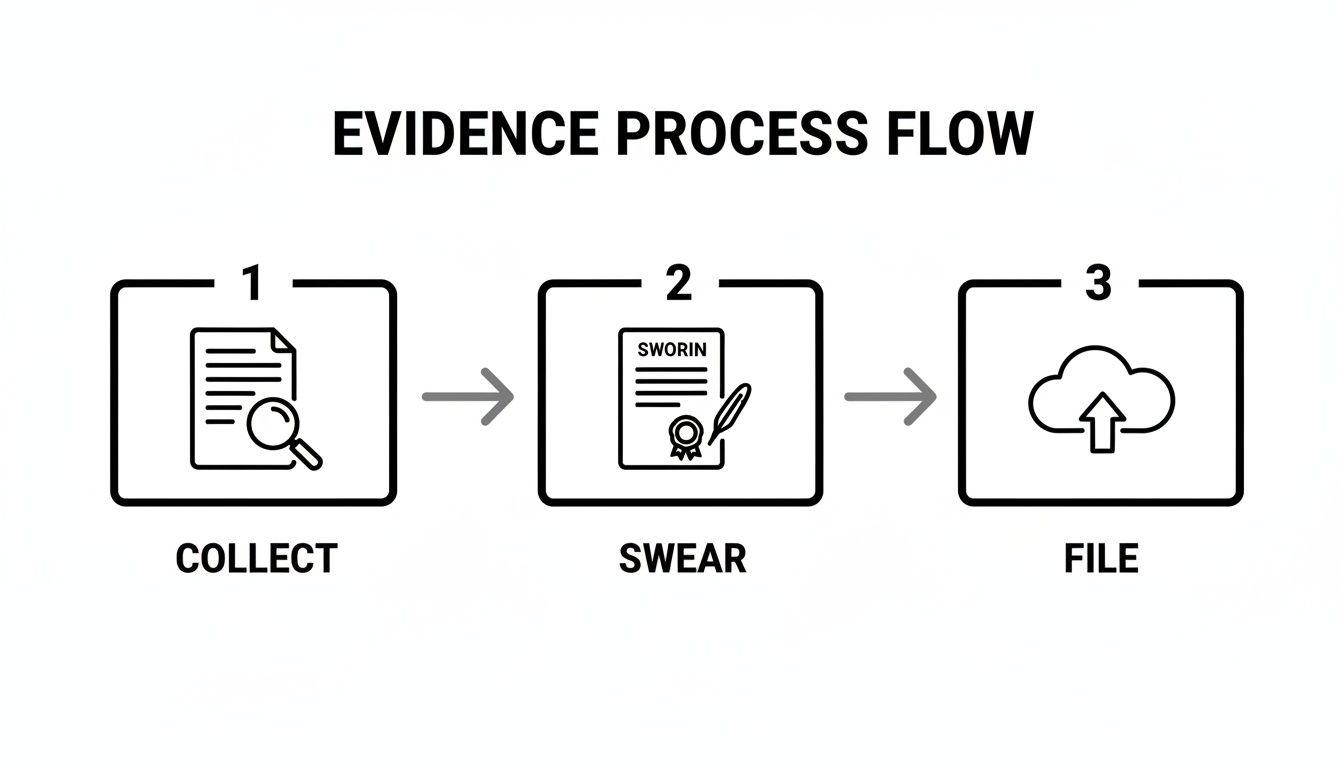
This process ensures that by the time your motion is filed, your claims are backed by sworn evidence ready for the judge’s review.
E-Filing Your Motion in Texas
In Texas, courts require nearly all documents to be filed electronically through the state's official portal, eFileTexas. The system can feel intimidating at first, but it makes the process much faster once you get the hang of it.
First, you’ll need to register for an account and choose an Electronic Filing Service Provider (EFSP). Think of the EFSP as the user-friendly interface that talks to the court’s system for you.
Once you’re ready, you'll upload your motion and any supporting documents as PDFs. Pay close attention to the details. Make sure you select the correct court and enter the case number exactly as it appears on your other documents. One of the most common reasons for rejection is a simple typo in the cause number or party names. Knowing the basics of filing for custody in the correct Texas county can also help prevent these administrative headaches from the start.
The Legal Duty to Serve the Other Party
Filing with the court is only half the battle. You also have a legal obligation to formally notify the other parent (or their attorney) that you’ve filed something. This is called service of process, and it’s a cornerstone of the legal system—it ensures everyone has a fair chance to respond.
Simply emailing or texting a copy is not enough. Proper service must be done in a way you can prove to the court.
Key Takeaway: Failure to properly serve the other party is a critical error. The court cannot hear your motion until you can prove the other side received a copy and had a fair opportunity to prepare a response.
Acceptable methods in Texas include:
- Through the eFileTexas system: This is the easiest way. If the other party has an attorney, the e-filing system will automatically serve them electronically.
- Using a Private Process Server or Sheriff: This is the best method for serving a party who doesn’t have a lawyer. A certified professional will personally deliver the documents and provide a formal "Return of Service" to file with the court as proof.
- Certified Mail, Return Receipt Requested: In some situations, you can serve by mail, but you must get the signed green card back from the other party to prove they received it.
Finally, your motion must include a Certificate of Service at the very end. This is a short, signed statement declaring when and how you sent a copy to the other party. Without it, your filing is incomplete.
What to Expect After Filing a Motion
You’ve drafted the motion, attached your evidence, and filed it. That’s a huge step, and it’s normal to feel a mix of relief and wonder, "…now what?”
The ball is officially in the other parent’s court. Once served, they have the legal right to file a formal, written response. This is their chance to tell the judge why they disagree with your request, supported by their own arguments and evidence.
The Court Hearing
Unless you and the other parent reach an agreement, the next stop is a court hearing. The court will schedule a time for both of you to appear before the judge and make your cases.
This is where your written motion comes to life. The judge will have already reviewed your filing, but the hearing is your opportunity to highlight your most important points and explain directly why your request is in the best interest of your child. Each side gets a limited amount of time to speak, refer to evidence, and answer the judge's questions.
While this guide can help you with the writing and filing process, a contested court hearing is a different arena. Presenting evidence effectively and making persuasive legal arguments on the fly is a skill that takes years of practice. This is often where professional legal expertise becomes critical.
Key Takeaway: Your Next Steps
Filing the motion is a major milestone in advocating for your family, but it’s the beginning of the next chapter, not the end. Here’s a quick recap of what to keep in mind:
- Expect a Response: The other party has the right to file a written opposition to your motion.
- Prepare for Court: Start preparing to go before the judge and verbally argue the points you made in your motion.
- Consider Professional Help: A contested hearing is where an experienced family law attorney’s skills truly shine. They know courtroom procedures and can advocate for you in a way that’s difficult to do on your own.
You’ve put in the hard work to get your issue in front of a judge. Now is the time to ensure you have the right support to see it through to the finish line.
Common Questions About Writing a Court Motion
Drafting something as important as a court motion naturally brings up questions. Here are straightforward answers to the concerns we hear most often from Texas parents.
How Much Does It Cost to File a Motion?
Filing fees vary by county, but you should expect to pay a fee to the district clerk. This is a separate cost from any attorney's fees.
Financial hardship should not stop you from seeking justice for your child. If you have a low income, you can file an Affidavit of Indigency. This is a sworn statement asking the court to waive the filing fees because you can't afford them.
Can I Just Use a Generic Template?
You can find endless legal templates online, but relying on one for a family law motion is risky. A template might give you a basic structure, but it can’t capture the unique facts of your family’s situation or tailor your arguments to the specific judge hearing your case.
Every family's story is different. An effective motion must be customized to your circumstances, highlighting the facts that support your request and framing them within the best interest of the child standard. A generic form can't do that and might not comply with your court's local rules.
A motion tailored to the facts of your case is far more persuasive than a fill-in-the-blank document. Your child's future is too important to leave to a generic template.
What Happens If I Make a Mistake?
It’s natural to worry about making a mistake on such an important document. Minor errors, like a typo, usually aren't fatal to your motion and can often be corrected.
However, significant mistakes can have serious consequences:
- Legal Errors: If you misstate the law or fail to meet the legal standard for your request, your motion could be denied.
- Improper Service: Failing to formally notify the other parent according to court rules means the judge cannot hear your motion, leading to major delays.
- Factual Inaccuracies: Any statement found to be untrue can severely damage your credibility with the judge for the rest of your case.
These potential pitfalls underscore the value of having an experienced attorney draft or review your motion. Professional guidance helps ensure your arguments are strong, your facts are straight, and all procedural rules are followed, giving you the best possible chance at success.
If you need help with a child custody or visitation case in Texas, our experienced attorneys can guide you every step of the way. Contact The Law Office of Bryan Fagan, PLLC today for a free consultation.