
When your child’s future is on the line, few things are more unsettling than getting a legal notice about your finances. Seeing a court document with your name on it, especially one called an Income Withholding Order (IWO), can feel intimidating. But take a breath. This isn’t a penalty.
An IWO—also known as an Order/Notice to Withhold Income for Child Support—is a standard, routine part of almost every Texas child support case. It’s a tool designed to make life easier and more predictable for everyone involved, especially your child.
What an Income Withholding Order Really Means for Your Family
Think of it less like a court summons and more like an automated payment plan for your child's support. It’s a straightforward system. Instead of one parent having to remember to write a check or make a manual transfer every month, the support amount is handled automatically through the paying parent's employer.
This process is built with one goal in mind: to provide a predictable, reliable stream of financial support for the child. It’s about taking the guesswork and potential for conflict out of the equation right from the start, ensuring your child's needs are consistently met.
The Purpose Behind the Order
The Texas Family Code requires an income withholding order in nearly every case that involves child support. Why? Because it benefits everyone by creating consistency and reducing the chances of missed payments or arguments.
Here’s how this automated system helps your family:
- Reliability for the Receiving Parent: The parent or caregiver receiving support (the obligee) can budget for the child’s needs—housing, food, school supplies, healthcare—knowing the money will arrive on time. It removes the stress of uncertainty.
- Simplicity for the Paying Parent: The parent paying support (the obligor) doesn’t have to worry about missing a payment deadline. This protects them from accidentally falling behind and facing potential legal trouble down the road.
- Stability for the Child: This is the most important part. The child gets the consistent financial backing they are legally entitled to, which helps insulate them from the financial ups and downs that can come with separation or divorce.
An income withholding order is a proactive measure, not a reactive punishment. Its whole purpose is to streamline the payment process from day one, making sure a child’s needs are met without interruption or arguments.
It’s just a standard procedure that helps both parents fulfill their court-ordered obligations. When you see it this way, you can approach the document not with fear, but with the understanding that it’s a system designed to protect your child’s best interests. Knowing how it works empowers you to manage your responsibilities and advocate for your family with confidence.
How an Income Withholding Order Is Processed in Texas
Ever wondered what happens after a judge finalizes a child support order? It’s not magic—it's a very specific legal process designed to make sure support payments are consistent and reliable. The moment the judge signs that order, a series of steps kicks off to turn that court document into actual financial support for your child.
It’s a structured path with clear roles for the court, attorneys, employers, and a state agency. Let's walk through it together.
From Court Order to Employer Action
Once the child support order is official, the next step is to create the Income Withholding Order, or IWO. This is the legal document that does the heavy lifting. It’s usually prepared by a private attorney or the Attorney General’s Child Support Division and contains all the critical details: the paying parent’s name, the child’s name, the exact amount to be withheld, and where the money needs to go.
Under the Texas Family Code, this order is sent directly to the paying parent's employer. This isn't optional; it's a legal requirement. Once the employer receives the IWO, they are legally bound to follow it. Their payroll department must set up the deduction and start withholding the specified child support amount from the employee’s paychecks.
This infographic breaks down how the IWO works to automate child support payments.
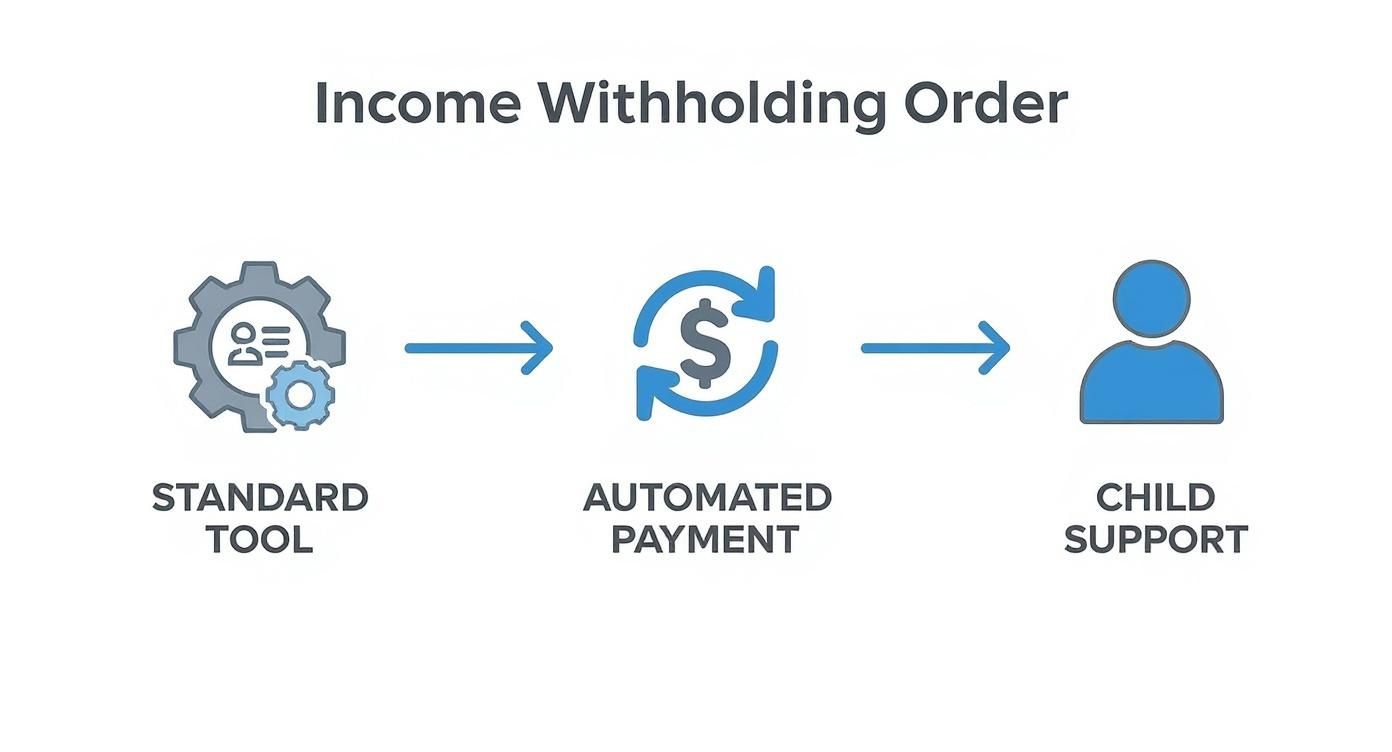
Think of the IWO as the gear that gets the whole system moving, ensuring the funds reliably get where they need to go.
The Role of the State Disbursement Unit
Here’s a common point of confusion: employers don’t send the money directly to the other parent. Instead, all withheld funds are sent to a central state agency. In Texas, that hub is the Texas Child Support Disbursement Unit (SDU).
The SDU is basically a clearinghouse. It has a few critical jobs:
- Receives Payments: It collects child support from thousands of employers all over the state.
- Records Payments: Every payment is officially recorded, creating an accurate legal payment history.
- Distributes Funds: It sends the money to the receiving parent, usually through direct deposit or a state-issued debit card.
This system is great because it creates an official, verifiable record of every single payment, which is a huge protection for both parents.
Modernizing the Process with e-IWO
To cut down on paperwork and speed things up, many employers have gone digital. The federal Office of Child Support Services (OCSS) reported that as of December 2023, over 1,000 employers nationwide were using the e-IWO (electronic Income Withholding Order) system. This is a big deal, as it helps reduce the delays and human errors that come with old-school paper-based processing.
This move to electronic processing is more than just a convenience. It means support payments are far less likely to get lost in the mail or delayed by a simple data entry mistake. It’s a modern fix designed to get support to children faster and more reliably.
Handling these financial documents accurately and on time often requires sophisticated administrative tools. This is where technologies like Intelligent Document Processing can make a huge difference in streamlining these complex tasks. By understanding each piece of this puzzle, you can feel more in control and confident that the system is working as intended for your child.
Your Rights and Responsibilities: A Guide for Parents & Employers
When you’re staring at an income withholding order (IWO), it’s easy to feel like you’ve lost control. But the truth is, Texas law gives specific rights and duties to everyone involved—the parent paying support, the parent receiving it, and the employer processing the payments.
Getting a handle on these roles is the first step toward managing the process with confidence. This isn’t about pointing fingers; it’s about making sure everyone knows their part so the system works smoothly and your child’s needs are met without unnecessary conflict.
For the Parent Paying Support (Obligor)
As the parent making payments, you have rights that protect you from mistakes and ensure the process is fair. You also have clear legal duties you must follow to stay on the right side of the court order.
Your key rights include:
- The Right to Be Notified: You must receive a copy of the income withholding order. This isn't just a courtesy; it's your legal right to know the exact terms before any money comes out of your paycheck.
- The Right to Dispute Errors: If you think the amount being withheld is wrong or that you don’t actually owe the support, you have the right to challenge it. This usually means filing a motion with the court that issued the original order to get the mistake corrected.
Just as important are your responsibilities:
- Reporting Job Changes: You are legally required to notify the court and the other parent within seven days of leaving a job. You also have to provide the name and address of your new employer. Failing to do this can get you into legal trouble.
- Ensuring Full Payment: The IWO is just the delivery mechanism. You are still personally responsible for the full child support amount. If your employer makes a mistake or withholds less than ordered, it's up to you to pay the difference directly to make sure you're caught up.
For the Parent Receiving Support (Obligee)
As the parent receiving support for your child, your rights are all about ensuring consistency and having a clear record of payments. This is what allows you to provide a stable, predictable environment for your child.
Your primary rights are:
- The Right to Timely Payments: You are entitled to get the court-ordered child support on a regular schedule. The money is meant for your child's day-to-day needs, and predictability is key.
- The Right to an Accurate Payment Record: Every payment sent through the State Disbursement Unit (SDU) is officially logged. This creates a legal history that you can use as proof if payments are ever late or missed.
If the payments suddenly stop, you have the right to do something about it. You can reach out to the Office of the Attorney General for enforcement help or talk to a family law attorney about filing a motion to enforce the child support order.
Remember, you also have a duty to report changes that could affect child support, like a new address or if the child is no longer living with you. Keeping the lines of communication open can prevent a lot of legal headaches down the road.
For the Employer
When an employer gets an IWO, they instantly become a key player in the process with serious legal obligations under both Texas and federal law. Not following the rules can lead to steep financial penalties.
An employer’s duties are straightforward:
- Honor the IWO: A legally valid IWO isn't optional. The employer must accept it and put it into action.
- Calculate and Withhold Payments: The payroll team needs to calculate the correct amount to withhold, making sure it’s based on the employee's disposable income and stays within the limits set by federal law (the CCPA).
- Remit Payments Promptly: The money withheld has to be sent to the Texas State Disbursement Unit on time, as required by law.
- Notify the Court of Employment Termination: If the employee quits or is let go, the employer has to let the issuing court or agency know.
Understanding these legal duties is critical for employer compliance with employment law and avoiding trouble. Most importantly, an employer cannot fire, discipline, or refuse to hire someone just because they have an income withholding order. This is illegal retaliation, and employees have strong legal protections against it. If you find yourself in a complicated spot, figuring out how to choose a family law attorney is a crucial first step in protecting your rights.
To make things even clearer, here's a quick breakdown of who is responsible for what when an Income Withholding Order is in place.
Key Responsibilities in an Income Withholding Order
A summary of the primary duties for each party involved in a Texas Income Withholding Order to ensure clarity and compliance.
| Party Involved | Primary Responsibility | Key Action Item |
|---|---|---|
| Obligor (Paying Parent) | Ensure full payment of support and report changes in employment. | Immediately pay any difference if withholding is short; notify court of job change within 7 days. |
| Obligee (Receiving Parent) | Receive payments on behalf of the child and report relevant changes. | Monitor payments via the SDU and report address changes or changes in the child's residence. |
| Employer | Comply with the IWO by withholding and remitting payments correctly. | Set up payroll deductions promptly and send withheld funds to the State Disbursement Unit as required. |
Each person's role is well-defined to keep the system running as intended. Knowing your part helps avoid confusion and ensures the focus stays where it should be: on supporting the child.
How Your Withholding Amount Is Calculated
Seeing a new deduction pop up on your paycheck can be jarring. When it’s for an income withholding order, you absolutely have the right to know how that number was calculated. It’s not a random figure; it’s based on a clear set of state and federal rules designed to be fair while making sure your child gets consistent support.
Let's walk through the math, step by step, so you can feel confident that the amount being withheld is correct.

Starting with the Court-Ordered Amount
The whole process starts with the child support amount set by the judge in your family court case. That figure comes from the Texas Child Support Guidelines, which use a formula based on the paying parent's net monthly resources. The IWO is simply the tool used to collect this already-decided amount.
So, if the court ordered you to pay $800 per month in child support, that’s the starting line for your employer.
Defining Your Disposable Income
Next, federal law comes into play to make sure the withholding doesn't leave you without enough money for your own basic needs. This protection is all about your disposable income. This isn’t your gross pay; it’s the cash left over after all the mandatory deductions are taken out.
What’s considered a mandatory deduction?
- Federal and state income taxes
- Social Security and Medicare taxes (FICA)
- State unemployment insurance
Things like your health insurance premiums, 401(k) contributions, or union dues are not considered mandatory when calculating disposable income for child support. It’s a specific legal definition that’s important to understand.
The Federal Limits on Withholding
The Consumer Credit Protection Act (CCPA) puts a hard cap on how much of your disposable income can be taken for child support. This is a crucial protection for the paying parent. The maximum percentage depends on your personal situation:
- 50% of disposable income if you are currently supporting a second family (meaning, a spouse or another child).
- 60% of disposable income if you are not supporting another family.
- Heads up: these limits can jump by another 5% (to 55% or 65%) if you are more than 12 weeks behind on your support payments.
Your employer has to compare the court-ordered child support amount with the CCPA percentage limit. They are legally required to withhold whichever amount is less. This is how the system balances the Texas court order with federal law.
A Real-World Calculation Example
Let's put it all together with an example. Imagine a parent named Alex with the following finances:
- Court-Ordered Support: $900 per month.
- Gross Paycheck (bi-weekly): $2,000.
- Mandatory Deductions (taxes, etc.): $500 per paycheck.
- Disposable Income: $2,000 (gross) – $500 (deductions) = $1,500 per paycheck.
- Family Situation: Alex is supporting a new spouse, so the CCPA limit is 50%.
Now, Alex’s employer runs the numbers:
- CCPA Limit Calculation: 50% of $1,500 (disposable income) = $750.
- Court Order Per Paycheck: $900 per month ÷ 2 paychecks = $450.
The employer compares the two figures: the $450 from the court order and the $750 CCPA limit. Since the court-ordered amount is lower, the employer will withhold $450 from Alex's bi-weekly paycheck.
This two-step check ensures the full support obligation is met without breaking those federal protection laws. Once you understand this calculation, you're empowered to double-check that your income withholding order is being handled correctly.
Modifying or Stopping an Income Withholding Order
Life happens. Jobs change, kids get older, and what worked for your family a few years ago might not make sense today. If you have a child support order, you know that big life events can make the current payment arrangement feel outdated or unfair. This is a situation countless parents find themselves in.
An income withholding order (IWO) is a direct pipeline to the court's official child support order. Think of the court order as the master plan and the IWO as the tool that executes it. You can't just tell the tool to stop working; you have to go back and change the master plan first. That means you can't alter or stop an IWO on your own—it requires going back to court and formally modifying the child support order itself.
When Can You Change a Child Support Order?
In Texas, you can't request a modification just because you feel like it. The law is specific: you must prove there has been a "material and substantial change" in the circumstances of the child or one of the parents.
So, what does that actually look like in the real world? Here are a few common scenarios where a court might agree to a modification:
- Major Income Shift: A parent experiences a significant, involuntary increase or decrease in earnings. A classic example is a parent being laid off from a long-term, high-paying job.
- Custody or Possession Changes: The amount of time the child actually spends with each parent has changed dramatically from what the original order spelled out. If the non-primary parent is now handling a lot more of the day-to-day care, that could be grounds for an adjustment.
- New Medical Needs: The child develops a chronic health issue that comes with expensive treatments or therapies that weren't factored into the original support calculation.
- Health Insurance Costs Change: The cost of keeping the child on a health insurance plan has gone way up or down.
It's absolutely critical to understand this: only a new court order can legally change what you owe. A handshake deal with the other parent or a quiet word with your HR department won't cut it. Trying to handle it informally can land you in serious legal trouble, including being held in contempt of court.
If you think your situation fits the bill, your next step is to learn how to modify child support in Texas. Getting this right ensures your payments are fair and reflect your current reality.
How to Stop an Income Withholding Order
The good news is that an income withholding order doesn't follow you forever. It's tied directly to your legal duty to support your child, and it has a built-in expiration date. The IWO is designed to terminate automatically once that legal obligation ends.
According to the Texas Family Code, your duty to pay support typically ends when the child:
- Turns 18 or graduates from high school, whichever happens last.
- Gets married.
- Becomes legally emancipated through a court order.
- Enlists in the military.
- Passes away.
Once your obligation is officially over and any past-due support (arrears) is paid in full, a formal order terminating the withholding can be sent to your employer. This is the green light for them to stop the deductions. If money is still being taken out of your paycheck after your obligation has ended, it's time to talk to an attorney. They can make sure the right legal steps are taken to formally shut down the IWO, protecting you from overpaying and closing this chapter of your life cleanly and correctly.
Child Support vs. Other Garnishments: What’s the Difference?
When you see money coming out of your paycheck, it's easy to lump all deductions together. But in the eyes of Texas law, not all payroll deductions are the same. An income withholding order (IWO) for child support is in a league of its own, holding a special, prioritized place that sets it far apart from other financial claims, which are usually just called garnishments.

Getting a handle on this difference can bring a lot of clarity to a stressful situation. While plenty of creditors can legally take money from your wages, the law doesn't see child support as just another bill to be paid. It's treated as a fundamental responsibility.
Why Child Support Always Comes First
Here’s the bottom line: under the Texas Family Code, an IWO for child support almost always jumps to the front of the line, taking priority over other types of garnishments.
So, if you have multiple creditors trying to collect—maybe a credit card company, a hospital, or someone you owe for a personal loan—your child support obligation gets paid first. Period.
The reasoning behind this is simple but powerful: a child’s basic needs for food, shelter, and care come before anything else. The law puts a parent’s duty to their child above most other financial debts. This ensures that kids get the consistent support they are legally entitled to, no matter what other financial pressures a parent might be under.
The only debt that typically competes with—and sometimes even surpasses—child support in priority is a federal tax levy from the IRS. That’s how seriously the law views a parent’s financial duty to their children.
This legal hierarchy isn't meant to be a punishment. Think of it more as a protective measure, a financial safety net designed to make sure a child’s well-being is a top priority for everyone involved.
What About Tax Levies and Other Withholding?
It's true that income withholding is a tool used for more than just child support. The Internal Revenue Service (IRS), for instance, uses income withholding orders all the time to collect unpaid taxes. In fact, in 2024 alone, the IRS issued over 4.6 million of these orders, which shows just how common they are for government debt collection. You can learn more about how the IRS uses these tools to collect taxes and assist taxpayers on their official site.
But even when you're facing a hefty tax bill, the legal system has specific rules to balance these competing demands. Often, arrangements are made so that both child support and tax obligations can be paid at the same time. But make no mistake, the child’s support almost always remains the number one priority. Knowing this helps you see the full picture of your financial responsibilities and why that IWO is treated with such importance.
Common Questions About Income Withholding Orders
When you’re trying to figure out the legal system and your family’s finances, it’s completely normal to have questions. An income withholding order (IWO) is a serious legal tool, and just understanding the day-to-day reality of it can bring a lot of peace of mind. We’ve put together answers to some of the most common concerns we hear from parents just like you.
Our goal here is to give you clear, straightforward answers—the kind that cut through the anxiety and help you handle this process with confidence.
What Happens If I Change Jobs?
This is one of the first and most important questions we get. If you're the parent paying support (the obligor), Texas law is clear: you have to notify the court and the other parent about your new job. Think of an income withholding order as being tied to you, not your job. It will follow you to your new employer.
Your old employer is also legally required to tell the court when you leave. After that, a new IWO will be issued and sent straight to your new employer’s payroll department. It’s on you to make sure this happens smoothly so you don't fall behind on payments during the transition.
Can My Employer Fire Me for Having an IWO?
Absolutely not. Both Texas and federal laws have strong protections against this kind of retaliation from an employer. It is illegal for an employer to fire you, discipline you, refuse to hire you, or penalize you in any other way simply because you have an income withholding order for child support.
These protections exist for a good reason. The law recognizes that having a stable job is the only way a parent can consistently support their child. If you feel like you've been treated unfairly at work because of an IWO, you have legal options.
What Should I Do If the Wrong Amount Is Withheld?
Mistakes happen. If you look at your paycheck and see that the wrong amount has been deducted, the most important thing is to act fast.
Here’s a simple game plan:
- Talk to Your Payroll Department First: Your first stop should be with your HR or payroll contact. They can pull up the IWO they received and double-check their math. A lot of the time, it’s a simple typo that can be fixed right there.
- Notify the Agency That Issued the Order: If your employer says they’re following the IWO correctly, the mistake might be in the order itself. Your next call should be to the agency that sent it—usually the Office of the Attorney General’s Child Support Division or the court that handled your case.
- Consult a Family Law Attorney: If you’re getting the runaround or can’t get a straight answer, it’s time to get some legal advice. An attorney can review the court order and the IWO, pinpoint where the error is coming from, and file the right legal paperwork to get it corrected. This protects you from overpaying or underpaying, which is what’s best for both you and your child.
Key Takeaway: Your Next Steps
An Income Withholding Order can feel overwhelming, but it is a standard and predictable part of the Texas child support system. It is designed to create stability for your child by ensuring payments are made automatically and on time.
- For Parents Paying Support: Understand your rights, especially your right to dispute errors, and fulfill your duty to report job changes.
- For Parents Receiving Support: Know that you are entitled to timely payments and an accurate record, which helps you provide for your child.
- If Changes Are Needed: Remember that only a new court order can modify child support. A "material and substantial change" in circumstances is required to start this process.
Knowledge is your best tool for navigating this process calmly and effectively. Understanding how an IWO works empowers you to ensure it is being handled correctly and to take action if it is not.
If you need help with a child custody or visitation case in Texas, our experienced attorneys can guide you every step of the way. Contact The Law Office of Bryan Fagan, PLLC today for a free consultation.