Skip to content
When your child’s future is on the line, understanding your rights matters most.
If you’re reading this, you may be staring at a custody order, preparing for a hearing, or trying to make sense of what “joint managing conservatorship” means in daily life. Most parents don’t need more legal jargon. They need clear answers about school decisions, doctor visits, schedules, moving, and what happens when the other parent won’t follow the order.
In Texas, the phrase many people call “custody” is usually called conservatorship. And one of the most important concepts to understand is joint managing conservatorship. If you want practical guidance on joint managing conservatorship rights texas, this article breaks it down in plain English so you can see what the law means for your family, your rights, and your next steps.
What Joint Managing Conservatorship Means for Your Family
After a separation or divorce, many parents worry that one of them will “get custody” and the other will be pushed to the sidelines. Texas law usually starts from a different place.
Texas courts generally presume that both parents should be named joint managing conservators, which means they share important rights and duties related to raising their child. Under Texas Family Code §153.131 as summarized here, Texas law establishes a strong presumption in favor of joint managing conservatorship unless credible evidence shows a history or pattern of child neglect, physical or sexual abuse, or family violence.
That sounds formal, but the idea is simple. Texas usually wants both parents involved.
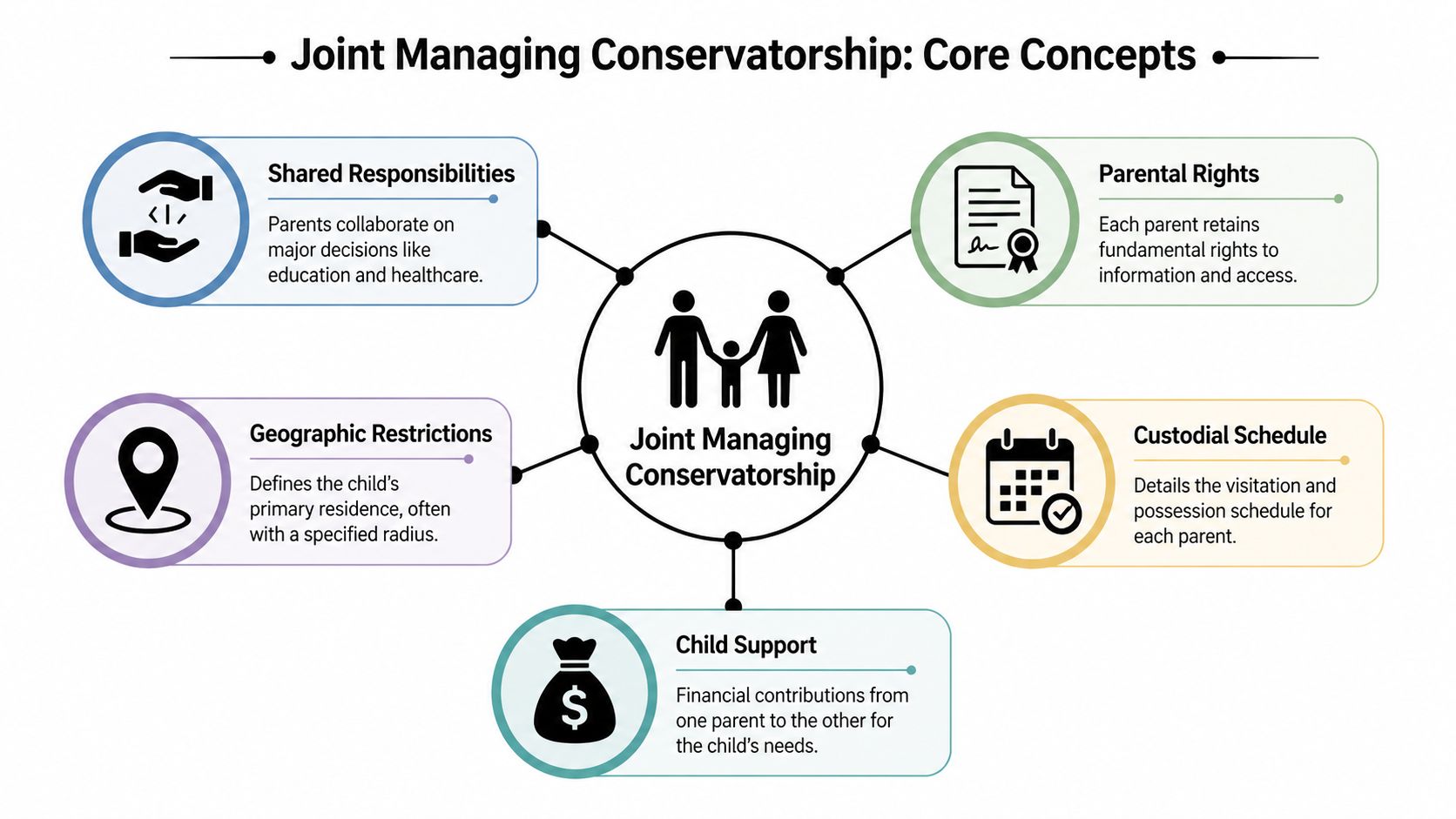
Conservatorship is Texas’s word for custody
When people say “custody,” they’re often talking about several different legal ideas at once:
- Decision-making authority: Who can make major choices about school, medical care, and other important issues.
- Possession and access: When each parent has the child. Many people call this visitation.
- Support obligations: Who pays child support and how the child’s needs are handled financially.
A joint managing conservatorship order deals with all of those pieces, but not always in equal ways.
Think of parents as co-leaders
A helpful way to understand JMC is to think of both parents as co-leaders of the child’s upbringing. Both parents remain legally important. Both usually stay informed. Both usually keep meaningful rights.
But “joint” does not always mean everything is split down the middle.
Joint managing conservatorship is about shared legal responsibility. It is not a guarantee of equal parenting time.
That difference confuses many parents. A mother may worry that joint conservatorship means she has to give up stability. A father may worry that joint conservatorship sounds fair on paper but leaves him with limited time. Both concerns are understandable. The legal label tells you how rights are assigned. The possession schedule tells you when the child is with each parent.
When JMC may not apply
Texas favors shared parenting when it is safe and workable. But child safety comes first.
A court can move away from joint managing conservatorship when there is credible evidence of serious concerns, such as abuse, neglect, or family violence. That doesn’t mean conflict alone always leads to one result or another. It means the court looks closely at what arrangement protects the child and serves the child’s best interest.
For many families, JMC is the starting point because it keeps both parents involved in a child’s life after a breakup. That can bring reassurance. It also brings responsibility. Shared rights only work well when parents understand what belongs to both of them, what belongs to each of them individually, and what may belong to only one parent under the order.
The Specific Rights and Duties of Joint Managing Conservators
Once parents hear they are both joint managing conservators, the next question is usually, “What exactly can I do?rdquo;
That’s the right question. A JMC order is not just a label. It is a set of rights and duties. Some are shared. Some can be exercised independently. Some are given exclusively to one parent.
Shared decisions that usually require cooperation
Some parts of parenting are too important to leave vague. In many JMC cases, major choices should be made together or after both parents have conferred.
These often include matters like:
- Education choices: A school change, special education decisions, or other major academic issues may require both parents to participate.
- Non-emergency medical care: A surgery, specialist treatment, counseling, or other major healthcare decision may call for joint input.
- Welfare decisions: Broader choices affecting the child’s overall well-being may also be assigned jointly.
If your order says the parties must confer, that means one parent should not make a major decision alone and tell the other later. That’s a common source of conflict.
Practical rule: Read the exact words of your order. In Texas family cases, the wording controls.
Rights each parent often has on their own
Even when one parent has less possession time, that parent usually still has meaningful rights. This matters a lot for fathers, mothers, and grandparents trying to stay informed.
Parents in a JMC arrangement commonly retain independent access to basic information about the child’s life, such as:
- School information: Report cards, attendance information, and contact with school staff.
- Medical information: Access to doctors, records, and updates about the child’s health.
- Activities and events: The ability to attend school functions or similar events, subject to normal rules.
These rights matter because they protect the parent-child relationship. A parent should not feel erased just because the child is living primarily in the other home.
The exclusive right that often matters most
Even in a joint arrangement, one parent is often given a few exclusive rights. The biggest one is usually the right to decide where the child primarily lives.
According to this discussion of rights and responsibilities of joint managing conservators in Texas, while most rights are shared in JMC, one parent is typically designated with the exclusive right to determine the child’s primary residence and receive child support. That parent is often called the primary parent, and the other parent usually has a possession order that often results in 30-50% possession time, depending on the schedule ordered.
Most critical exclusive right: The power to designate the child’s primary residence often shapes school enrollment, daily routine, and the overall structure of the case.
That doesn’t make the other parent less important. It does mean the order may assign different roles for the sake of stability.
A day-to-day example
Say your child breaks an arm during your weekend. You can usually handle emergency care right away. But if there is later disagreement about longer-term treatment, the court order may require both parents to confer.
Now take school. Both parents may be able to talk with teachers and review records, but only one parent may hold the exclusive right tied to residence, which can affect where the child attends school.
This is why parents often feel confused. They hear “joint” and assume every right is identical. In reality, JMC works more like a carefully divided bundle of responsibilities.
Duties matter too
Rights get most of the attention, but duties matter just as much. During your time with your child, you are responsible for care, supervision, support, and good judgment. A strong JMC arrangement depends on both parents acting like parents, not just like litigants.
If your order is unclear, that’s not unusual. Many disputes start because the written terms don’t feel obvious in real life. That’s when careful legal review becomes important.
Joint vs Sole Managing Conservatorship What Is the Difference
Many parents hear “joint managing conservatorship” and wonder how different it really is from sole managing conservatorship. The difference can be significant.
Texas generally favors a shared-parenting structure when that serves the child. Sole managing conservatorship is more limited and is usually considered when serious concerns make shared decision-making unsafe or unworkable.
Here’s a simple comparison.
Joint Managing Conservatorship and Sole Managing Conservatorship compared
| Feature | Joint Managing Conservatorship (JMC) | Sole Managing Conservatorship (SMC) |
|---|---|---|
| Basic structure | Both parents share important rights and duties | One parent holds most major decision-making authority |
| Decision-making | Shared in whole or in part, depending on the order | Mostly centralized in one parent |
| Primary residence | Often assigned exclusively to one parent, even though both are JMCs | Usually controlled by the sole managing conservator |
| Role of the other parent | Still has meaningful legal rights under the order | May have more limited rights, often as a possessory conservator |
| Court’s starting point | Texas generally begins with a presumption favoring JMC | Usually requires stronger reasons to move away from shared conservatorship |
| When commonly considered | When both parents can remain involved safely | When abuse, neglect, family violence, severe instability, or similar concerns are present |
Why Texas often prefers JMC
Texas courts usually start with the idea that children benefit when both parents stay involved. That doesn’t mean every family looks the same. It means the law often treats continued parental involvement as the better starting point unless there is a serious reason not to.
For a broader discussion of the distinction, see this guide on sole custody vs joint custody in Texas.
When sole conservatorship may come up
A court may consider sole managing conservatorship when the facts point to serious safety or parenting concerns. Examples can include:
- Family violence
- Child abuse or neglect
- Severe substance abuse
- Extreme inability to cooperate in ways that harm the child
- Long-term absence or inability to parent safely
A request for sole conservatorship is not just a disagreement over parenting styles. It usually involves claims that shared authority would place the child at risk or undermine the child’s well-being.
That distinction matters. Parents often assume that being frustrated with a co-parent is enough to ask for sole authority. Usually, it takes much more than frustration. Courts want evidence, not just anger.
If you’re worried because the other parent is asking for sole conservatorship, try not to panic. Focus on the facts, your history with your child, and your ability to meet the child’s needs. If you’re considering asking for sole conservatorship yourself, make sure your concerns are documented and tied clearly to the child’s safety and welfare.
How Texas Courts Determine the Child's Best Interest
Parents hear “best interest of the child” in almost every Texas custody case, but the phrase can feel frustratingly broad. It helps to know that judges don’t decide this by guesswork. They look at specific facts about the child, the parents, and the family’s daily reality.

What judges commonly examine
Texas family law focuses on what arrangement serves the child’s physical, emotional, educational, and developmental needs. In practical terms, a court may look at issues like these:
- The child’s needs: Does each parent understand and meet the child’s emotional and physical needs?
- Parental judgment: Can each parent make sound decisions about health, education, and daily care?
- Stability: Which home offers a more stable routine for school, medical care, and daily life?
- Co-parenting ability: Can the parents communicate and support the child’s relationship with the other parent?
- Past involvement: Who has been handling school, appointments, routines, and caregiving?
- Safety concerns: Is there any history of abuse, neglect, or violence?
- Child’s preference: In some situations, an older child’s preference may matter.
These are not boxes to check mechanically. Judges look at the full picture.
What this means in real life
A parent can love a child deeply and still struggle to present a strong custody case. Courts don’t decide based on who feels more hurt, who argues more passionately, or who says the other parent is difficult.
They look for patterns.
If one parent regularly attends school meetings, keeps medical appointments organized, supports consistent routines, and encourages the child’s relationship with the other parent, that usually matters. If another parent blocks communication, creates chaos around exchanges, or ignores the child’s needs, that can matter too.
For a helpful overview of this standard, see understanding Texas custody and the Holley factors.
Helpful evidence often includes
Parents sometimes ask what they should gather. Good evidence is usually simple and grounded in daily life:
- Calendars and logs: Records of possession, school events, and medical appointments
- Messages: Clear, respectful communication with the other parent
- School and medical records: Documents that show involvement and follow-through
- Witnesses: Teachers, counselors, relatives, or others with firsthand knowledge
The strongest custody evidence often comes from ordinary parenting. Show up, stay involved, and keep records.
If you want a visual explanation of how courts think through these cases, this video can help clarify the process.
A common misunderstanding
Many parents believe the court rewards the parent who can provide the most money or the nicest home. That can matter at the margins, but it is not the whole test. A judge is usually more focused on the child’s day-to-day care, emotional stability, safety, and the parent’s ability to put the child first.
That’s why a calm, prepared parent often comes across more strongly than a parent who treats the case like a battle to be won.
Enforcing and Modifying Your Joint Custody Order
Your order says pickup is at 6:00 p.m. Friday. You arrive on time, but the other parent says the child has different plans and will not be coming. One missed exchange can feel like a personal slight. Repeated violations turn into a legal problem.
A joint managing conservatorship order works like a rulebook for co-parenting. It only helps if both parents follow the rules that are written down. If one parent blocks possession, cuts the other parent out of major decisions, or refuses access to school or medical information, a court may step in to enforce the order.

When enforcement makes sense
Enforcement usually fits situations where the order is clear, but one parent is not doing what it says. Texas courts can address missed visits, withheld returns, and other specific violations. Depending on the facts, a judge may order makeup time, attorney’s fees, or other remedies allowed by law.
Common examples include:
- Denied possession: You show up for your scheduled time and the child is not made available.
- School or medical decisions made alone: The order requires shared input, but one parent acts without telling the other.
- Blocked information: A parent interferes with access to teachers, doctors, report cards, or records.
- Chronic exchange problems: Late drop-offs, early pickups, or repeated informal changes that slowly chip away at your parenting time.
These problems often start small. A parent asks for a “temporary” change. Then it happens again, and again, until the written order stops matching real life. That is one reason good records matter so much.
What to do before you file
Start with the exact language of your order. Courts enforce specific terms, not general feelings that something is unfair. If the order says who picks up, where the exchange happens, and what time possession begins, you have a clearer path than if the order is vague.
Then build a simple paper trail:
- Read the order line by line. Highlight the provision that was violated.
- Keep a dated log. Write down what happened, where it happened, and who was present.
- Save messages, emails, and call records. Clear communication often becomes key evidence.
- Stay calm in writing. Judges often learn a lot from the tone of the parents’ messages.
- Keep related records together. School notices, medical forms, travel details, and exchange notes should be easy to find.
A practical example helps here. If the other parent refuses your weekend visit, do not send ten angry texts. Send one short message that states the facts, asks for compliance with the order, and leaves room for a reasonable fix. That approach protects your child and your case.
If a hearing happens later, your notes and messages should read like a timeline, not an argument.
Some families also run into language barriers when court papers or prior orders were issued in another country. In those cases, a certified translation for divorce decree may be necessary before the court or your lawyer can use the documents effectively.
Enforcement and modification are different tools
Parents often mix these up, and the difference matters.
An enforcement case asks the court to make the other parent follow the order that already exists. A modification case asks the court to change the order because life has changed in a meaningful way.
That distinction comes up often in real life. If the other parent refuses to follow a clear possession schedule, enforcement may be the right response. If a parent’s work hours have changed so much that the old schedule no longer works, modification may be the better fit.
Common reasons to seek a modification include:
- A major change in the child’s needs
- A parent’s new work schedule
- Ongoing conflict that makes the current terms unrealistic
- A planned move that affects possession and school routines
If a possible move is part of the problem, this guide on relocating in Texas with joint custody explains the questions to address early.
Day-to-day friction points that often lead back to court
Many enforcement cases are not about dramatic misconduct. They grow out of repeated small acts that wear down the order.
One parent may insist on verbal side deals instead of written agreements. Another may agree to swaps, then later deny they happened. Some parents use school events, extracurriculars, or doctor visits as a way to control the other parent’s access. These are common pressure points in joint conservatorship because the order requires two adults to coordinate even when the relationship is strained.
That is why structure helps. Use one calendar. Confirm changes in writing. Follow the signed order unless both parents clearly agree to something different. Informal flexibility can help families. It can also create confusion if no one records what was agreed.
Special concerns for military families
Military parents often face a different kind of custody stress. The issue is not unwillingness to parent. The issue is that duty schedules, training, and deployment can change fast.
If that applies to you, keep every document that explains the schedule change. Save orders, notices, travel details, requests for makeup time, and messages showing your effort to stay involved. A court is more likely to see the full picture when the record is organized and specific.
The same idea applies to the other parent. If military service is affecting exchanges or communication, stay focused on the wording of the order and the facts you can prove. Courts usually respond better to documented patterns than to broad accusations.
You do not have to treat repeated violations as normal. If the order is being ignored, or if it no longer fits your family’s reality, a careful review of the written terms is the best place to start.
Navigating Relocation and Military Service with a JMC Order
Relocation and military service create some of the hardest joint conservatorship problems because they change the practical side of parenting fast. A schedule that worked when both parents lived in the same area may stop working when one parent gets transferred, remarries, or needs to move for work.
How relocation affects a JMC order
Many Texas orders include a geographic restriction. That means the child’s primary residence must stay within a certain area set by the court. The purpose is usually stability. It helps preserve the child’s school routine and makes the possession schedule realistic.
A common scenario looks like this: one parent has the exclusive right to designate the child’s primary residence, but only within a certain county or region. Then a job offer comes from another city. The parent may assume that, because they are the primary parent, they can move without issue. Often, that is not true. The order may require court approval or an agreed modification before the move happens.
If relocation is becoming an issue, this guide on relocating in Texas with joint custody can help you understand the legal questions to ask early.
Moving with a child is not just a housing decision. It can affect school, possession, travel, and the child’s relationship with the other parent.
Military families often need a more flexible plan
Military parents face a different kind of uncertainty. Deployment, training, and reassignment can disrupt ordinary possession schedules even when both parents want to cooperate. In those situations, details matter.
For example, a deployed parent may need temporary adjustments to possession, clear communication rules, and a plan for how the child will stay connected during service. A family may also need updated documents if orders, prior judgments, or related records must be used across state lines or internationally. In those situations, a resource like certified translation for divorce decree can be useful when official legal paperwork must be accurately translated for another agency or jurisdiction.
A practical example
Suppose a mother with the right to determine the child’s primary residence receives a transfer to another part of Texas. The father has regular possession and strong involvement in school and medical appointments. The question is not solely whether the move helps the mother. The court will look at how the move affects the child’s stability and the father’s ongoing role.
Now suppose a father in the military receives deployment orders. He may need temporary changes, a plan for communication, and clear terms about what happens when he returns. In both situations, early action usually gives families more options than waiting until the conflict becomes urgent.
The key is to treat relocation and military service as legal events, not just scheduling problems.
Frequently Asked Questions About Joint Managing Conservatorship
Parents often leave a custody conversation with one or two questions still turning in their minds. These are some of the most common.
Does joint managing conservatorship mean 50 50 possession?
No. Joint managing conservatorship and possession time are related, but they are not the same thing.
JMC usually describes how parental rights and duties are divided. Possession describes when the child is with each parent. Some families do have roughly equal time. Others do not. A parent can still be a joint managing conservator even if the possession schedule is not equal.
If we are joint managing conservators, can one parent still make some decisions alone?
Yes. That happens often.
A Texas order may give some rights jointly, some independently, and some exclusively to one parent. The most common exclusive right is often the right to designate the child’s primary residence. That is why reading the exact language of your order matters so much.
What if the other parent keeps making major decisions without telling me?
Start by documenting what happened and reviewing your order carefully. If the order required shared input and the other parent ignored that duty, enforcement may be an option.
Parents often make the mistake of arguing only about fairness. In court, what matters is whether the order was specific and whether you can prove the violation clearly.
Do fathers have the same right to seek JMC in Texas?
Yes. Texas law does not reserve joint managing conservatorship for mothers. Fathers can seek shared conservatorship, possession rights, enforcement, and modification. In paternity cases, establishing legal parentage is often the first step before those rights can be fully addressed.
What rights do grandparents have in a JMC case?
Grandparents do not automatically become conservators just because they are closely involved in a child’s life. But in some cases, grandparents may seek court involvement, visitation, or conservatorship depending on the facts and the child’s needs.
These cases are very fact-specific. A grandparent who has played a major caregiving role should get legal advice based on the actual family history.
What happens if we agree on JMC but live in different states?
The agreement still needs to work in real life. Long-distance parenting usually requires a more detailed possession schedule, clearer travel terms, and better communication rules than a local case.
Parents should address practical issues such as:
- Travel responsibility: Who books and pays for transportation
- Holiday scheduling: How longer school breaks are divided
- School communication: How both parents stay informed from a distance
- Technology contact: How calls or video chats will happen regularly
Can we just make our own changes without going back to court?
Parents often make informal changes, especially when things are going well. Small agreed adjustments may work for a while. But if the change is important or long-term, it is usually safer to put it into a modified court order.
An informal agreement can fall apart quickly when conflict returns. A signed court order is easier to enforce.
A handshake may solve today’s problem. A clear written order is what protects you tomorrow.
What if my child doesn’t want to go with the other parent?
Do not assume the child gets to decide on their own. A child’s age and maturity can matter, but the court order remains binding unless the court changes it.
If your child is resisting possession because of serious concerns, take that seriously. Document what is happening and speak with a lawyer promptly. If the issue is more about routine resistance, parents usually need a calm, consistent plan rather than a sudden refusal to follow the order.
Is joint managing conservatorship always best?
Not always. It is often the starting point, but every family is different. Shared conservatorship works best when it is safe, workable, and centered on the child. In some situations, stronger limits are necessary.
The right question is not which label sounds better. The right question is which arrangement protects your child and supports healthy, stable parenting.
If you need help understanding your options under a Texas custody order, taking action when a co-parent won’t comply, or seeking a modification that fits your child’s real needs, it helps to talk through the facts with someone who handles these cases every day. If you need help with a child custody or visitation case in Texas, our experienced attorneys can guide you every step of the way. Contact The Law Office of Bryan Fagan, PLLC today for a free consultation.