Skip to content
When your child’s future is on the line, understanding your rights matters most.
You may be reading this because co-parenting no longer feels safe, workable, or even possible. Maybe every school decision turns into an argument. Maybe medical care gets delayed because one parent refuses to cooperate. Maybe you’re worried that the other parent’s behavior is doing real harm. Those fears are heavy, and they’re real.
In Texas, sole managing conservatorship can be a legal way to create stability when shared decision-making breaks down. It isn’t meant to punish a parent. It’s meant to protect a child. If you’re trying to understand sole managing conservatorship texas law in plain English, this guide will walk you through what it means, when courts consider it, how daily life changes, and what steps you can take next.
Your Child's Future When Co-Parenting Is Not an Option
A parent sits in my office and says the same thing in different ways: “I’m not trying to keep my child from the other parent. I just can’t keep letting every decision become a crisis.”
That situation is more common than many families realize. A child gets sick, but the parents can’t agree on treatment. School registration is due, but one parent disappears or objects just to block the process. Therapy is recommended, but signing consent turns into another fight. In homes with high conflict, delay can become its own kind of harm.
That’s where Texas law gives courts another option. Instead of requiring parents to keep sharing major decisions, a judge can place that authority with one parent through sole managing conservatorship. This can create a stable path for school, medical care, counseling, and residence when constant deadlock is hurting the child.
For some families, tools that support communication still help with everyday logistics, even when trust is low. If you’re trying to organize exchanges, school events, and missed weekends, this complete guide to co-parenting calendars can help you think through the practical side. If you also want a broader explanation of how custody works under Texas law, this overview of conservatorship in Texas is a helpful companion.
Practical rule: If shared authority is causing delays in medical, educational, or emotional care, the issue isn’t just conflict between adults. It may be evidence that the current arrangement isn’t serving the child.
Many parents feel guilty even asking about sole conservatorship. They worry it sounds extreme. But when your child needs one responsible adult to make timely decisions, seeking legal protection can be the most careful and child-focused step you take.
The Difference Between Joint and Sole Managing Conservatorship
Texas uses the word conservatorship where many people say “custody.” That alone causes confusion. The easier way to think about it is this: conservatorship is about who has the legal right to make important decisions for a child.
Most parents start with joint managing conservatorship, often called JMC. Texas courts strongly prefer joint managing conservatorship in child custody cases, and reserve sole managing conservatorship, or SMC, for situations where joint decision-making would significantly impair the child’s physical health or emotional development. Texas Family Code §153.004(b) also prohibits appointing joint managing conservators if there is credible evidence of a history or pattern of family violence by one parent against the other parent or a child, as explained in this discussion of sole managing conservator standards in Texas.
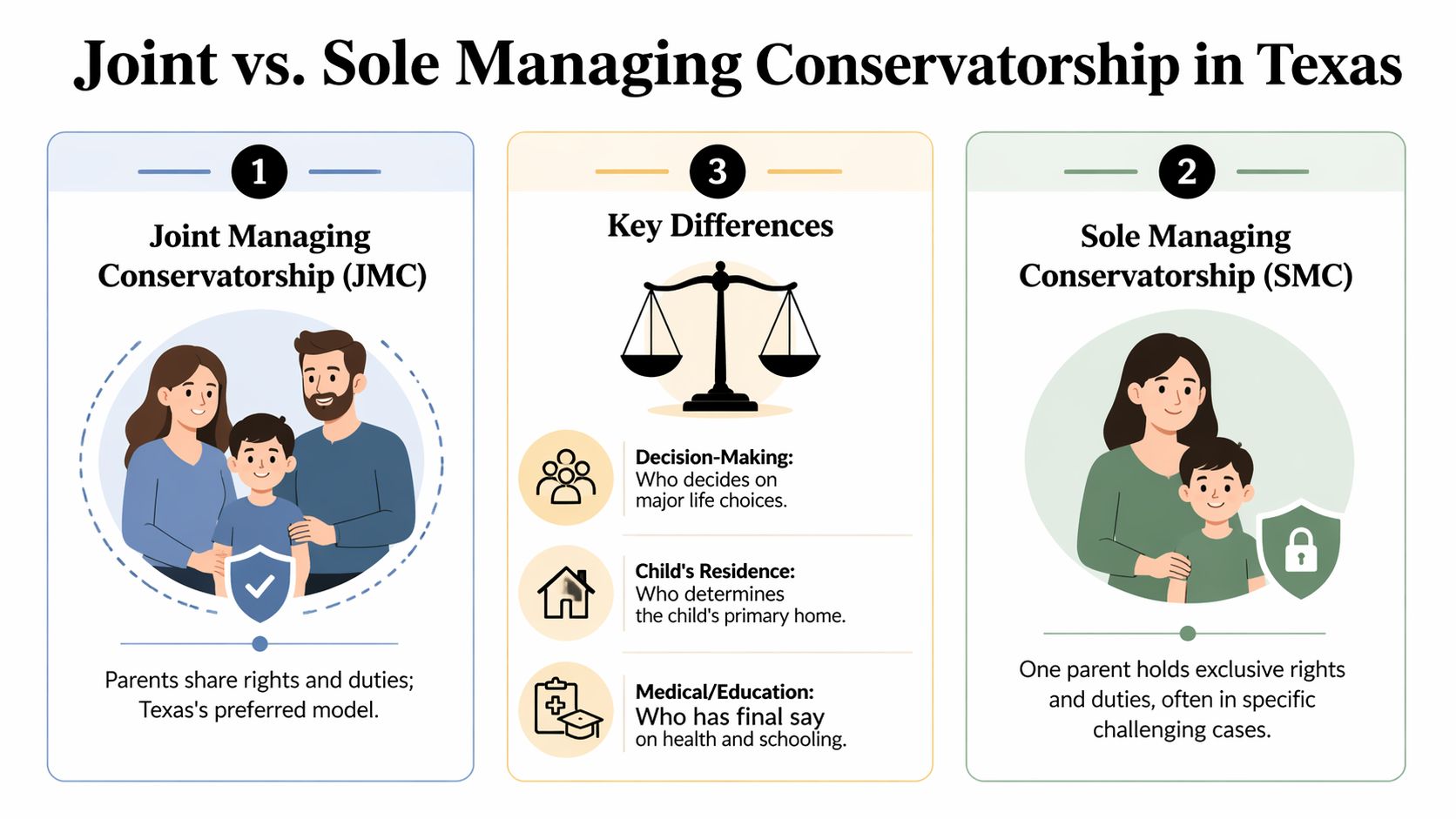
A two-key system versus a one-key system
A simple analogy helps.
With joint managing conservatorship, major decisions work like a two-key system. Parents may share authority over education, medical care, and other important choices, even if one parent has more parenting time. Joint conservatorship does not always mean equal time. It usually means shared legal rights.
With sole managing conservatorship, major decisions work more like a one-key system. One parent has the legal authority to make those decisions without needing the other parent’s agreement.
That difference matters most when time-sensitive issues come up. If a child needs counseling, a school transfer, or medical treatment, a one-key system may prevent paralysis.
What JMC looks like in daily life
In many families, JMC works well enough. Parents may not agree on everything, but they can still communicate and make decisions without placing the child in the middle.
A JMC arrangement often makes sense when:
- Both parents can communicate: They may disagree, but they can still respond, share records, and make decisions.
- The child is safe in both homes: There’s no pattern of abuse, neglect, or serious instability.
- Disputes stay manageable: Arguments don’t stop school enrollment, therapy, or routine care.
For those comparing legal models side by side, this guide on sole vs joint custody in Texas can help clarify how courts frame these choices.
What SMC changes
When one parent is named sole managing conservator, the legal balance shifts. The other parent is often still involved, but usually in a more limited role. That parent may become a possessory conservator, which means they may have possession or visitation rights, but not the same authority over major decisions.
That doesn’t automatically erase the other parent from the child’s life. It changes who has final authority when authority must be clear.
The court’s question isn’t “Which parent is better?rdquo; It’s “What arrangement protects this child and supports stable decision-making?rdquo;
Why parents often get confused
Many people hear “sole custody” and assume it means the other parent will never see the child again. That isn’t necessarily true. Conservatorship and visitation are related, but they are not the same thing.
Others assume that if they do most of the daily parenting, they automatically qualify for sole conservatorship. That also isn’t true. Texas courts start from the idea that shared parental rights often serve a child’s best interests. A parent asking for SMC usually has to prove that shared authority is unsafe or unworkable.
The Exclusive Rights of a Sole Managing Conservator
The phrase sole managing conservator can sound abstract until you connect it to daily parenting. In practical terms, it means one parent holds exclusive authority over certain major decisions that shape the child’s life.
Texas law gives a sole managing conservator nine exclusive rights. These include the right to designate the child’s primary residence, consent to invasive medical, dental, or surgical procedures, make educational decisions, and represent the child in legal actions under Texas Family Code § 153.132.
What these rights mean in real life
When a court grants SMC, it is trying to remove dangerous delay and constant conflict from important parenting decisions.
Here is what that can look like:
| Right | What It Means for Your Child |
|---|---|
| Designating primary residence | You decide where your child lives. That often affects school enrollment, routines, and long-term stability. |
| Medical decision-making | You can consent to invasive medical, dental, or surgical care when needed. |
| Psychological care | You can approve counseling, psychiatric care, or related treatment without waiting for the other parent to agree. |
| Educational decisions | You can choose school placement and respond to academic issues more quickly. |
| Legal representation | You can act on the child’s behalf in legal matters. |
| Passport-related authority | You may handle travel-related decisions and related paperwork more directly. |
| Marriage consent | You hold that authority if the issue ever becomes legally relevant. |
| Military enlistment consent | You hold that authority if the issue ever becomes legally relevant. |
| Management of certain child-related matters | You may control specific administrative and legal issues the order assigns to you. |
One of the biggest day-to-day concerns is school choice. If that issue is already causing conflict in your case, this article about who chooses where a child goes to school in Texas may help you connect the legal rule to the reality your family is facing.
Sole authority doesn’t always mean zero communication
Many parents require reassurance regarding this point. If you are the sole managing conservator, you may still choose to consult the other parent. Texas orders often define who has legal authority, but they don’t necessarily forbid respectful communication.
For example, you might still tell the other parent about:
- School changes: New campus, schedule updates, or academic support plans.
- Medical concerns: Diagnosis, treatment recommendations, or follow-up care.
- Counseling issues: Appointment schedules, provider contact rules, or progress updates.
The key difference is that consultation is voluntary, not required for a final decision when the order gives you exclusive authority.
Daily reality: Sole conservatorship can reduce legal conflict, but it also increases your responsibility. You become the parent who signs, schedules, follows up, and carries the decision through.
The burden parents don’t always expect
Parents often focus on winning exclusive rights, but they don’t always think about the work that comes with them.
If you become sole managing conservator, you may be the person who:
- handles school enrollment forms
- manages child support received for the child’s benefit
- signs consent paperwork
- arranges counseling
- tracks medical records
- deals with passport issues
- responds quickly in emergencies
That can be a relief when the other parent has made cooperation impossible. It can also feel lonely and exhausting. If you’re considering sole managing conservatorship texas cases seriously, it helps to prepare not only for the courtroom issue, but for the practical parenting load that follows.
Proving Your Case What Grounds Justify Sole Managing Conservatorship
Wanting sole conservatorship and proving the need for it are two different things. Texas courts don’t award SMC because one parent is more frustrated, more organized, or more involved. The court looks for evidence that one parent’s conduct creates a real risk to the child and that sole authority is necessary to protect the child’s best interests.

Texas courts require clear evidence of a causal link between a parent’s conduct and child endangerment to grant SMC. Key triggers include documented family violence, child abuse or neglect, chronic drug or alcohol abuse, or a criminal history. Courts also prioritize the stability of the home and the child’s wishes if the child is over age 12, as outlined in this summary of Texas conservatorship standards.
Grounds that often support an SMC request
The strongest cases usually involve more than suspicion. They involve patterns, records, and proof.
A court may take a close look when there is evidence of:
- Family violence: This is one of the most serious issues in any custody case.
- Abuse or neglect: Harm to the child, or failure to protect the child, can change the entire analysis.
- Substance abuse: Ongoing addiction can affect judgment, supervision, and reliability.
- Criminal conduct: Repeated arrests or dangerous behavior may matter if they affect the child’s safety or stability.
- Parental absence or extreme instability: If one parent disappears, refuses responsibility, or creates chaos around every decision, that can become relevant.
The important point is connection. The court usually wants to see how the conduct affects the child, not just how angry it makes the other parent.
Evidence that helps a judge act
A strong case is usually built from documents and testimony, not just emotion. Parents often know something is wrong long before they know how to prove it.
Useful evidence may include:
- Official records: Police reports, CPS records, protective orders, medical records, or school reports
- Digital evidence: Text messages, emails, voicemails, or app messages showing threats, admissions, missed involvement, or refusal to cooperate
- Witness testimony: Teachers, counselors, relatives, neighbors, or caregivers who have seen concerning conduct
- Parenting history: Calendars, journals, and records showing who has handled daily care and who has failed to show up
- Testing results: Drug or alcohol testing when the court allows or orders it
Later in the case, many parents find video guidance useful alongside written information:
What judges often notice first
Parents sometimes bring every grievance they’ve ever had into court. That’s understandable, but not always persuasive. Judges tend to focus on issues that directly affect safety, stability, and decision-making.
That usually means evidence tied to questions like these:
- Is the child safe with both parents?
- Can the parents make major decisions without harmful delay?
- Has one parent created a pattern that threatens the child’s physical health or emotional development?
- Which home is more stable right now?
Bring the court a pattern, not a pile. Organized evidence is often more persuasive than a stack of unrelated accusations.
Practical examples of what matters
If the other parent forgets one dentist appointment, that alone may not support SMC.
If the other parent repeatedly refuses medical care, arrives intoxicated for exchanges, threatens you in front of the child, ignores school issues, and has CPS involvement, that creates a very different picture. The court can then see a pattern of impaired judgment and instability.
That’s why legal strategy matters. A parent pursuing sole managing conservatorship texas relief needs more than a valid fear. They need proof that shows why shared authority is no longer safe or workable.
The Legal Process for Seeking Sole Custody in Texas
It is 2 a.m., your child is asleep, and you are staring at your phone wondering what happens if you file. Will the judge act quickly? Will your child have to keep living in the same unstable routine while the case crawls forward? Those worries are common. The process feels less intimidating once you can see how each stage affects your child’s day-to-day life.

Filing sets the frame for the whole case
A request for sole managing conservatorship usually starts in one of three places: a divorce, a suit affecting the parent-child relationship, or a paternity case. The court cannot grant relief you did not clearly ask for, so the initial filing needs to do more than say you want sole custody.
It should identify the specific orders you need, such as the right to make medical and school decisions, restrictions on the other parent’s access, or supervised visitation if safety is an issue. A petition works like a blueprint. If the blueprint is vague, getting clear temporary protections becomes harder.
Temporary orders can change daily life quickly
For many families, the first major court date matters more than the final trial because it sets the rules everyone must follow while the case is pending. If your child needs immediate structure or protection, temporary orders can address that early.
A judge may decide:
- Where the child stays most of the time
- Who makes urgent medical or educational decisions
- Whether exchanges need limits or supervision
- Whether testing, counseling, or other safeguards are needed
These orders are not just paperwork. They affect school pickup, doctor visits, bedtime routines, and how much conflict your child sees from one week to the next.
If your child is dealing with a real safety problem, ask for protection early and keep documenting what happens after the case begins.
Evidence gathering is the part many parents underestimate
After the case is filed, each side has a chance to request information. Lawyers call that discovery. Parents often picture discovery as a technical legal phase, but in custody cases it is often the stage where a concern turns into proof.
That proof may include school attendance records, report cards, medical records, counseling records when the law allows release, police reports, text messages, email chains, photos, and work schedules. A good case file shows how the problem affects the child over time. It is the difference between saying, "co-parenting is not working," and showing repeated missed medications, ignored school notices, or threatening messages sent before exchanges.
Mediation may still be part of the process
Texas courts often require mediation before a final trial. Mediation is a settlement meeting with a neutral professional who helps parents see whether any issues can be resolved without asking the judge to decide everything.
That does not mean you have to agree to unsafe terms. In some cases, mediation narrows the dispute instead of ending it. Parents might reach agreement on child support or a possession schedule, while leaving decision-making rights for the judge. That can save time, lower expense, and sharpen the focus of the final hearing.
Final orders usually address support as well as authority
A sole managing conservatorship case is rarely only about who has decision-making power. Final orders often also address child support, health insurance, and who pays uninsured medical expenses. Those details matter because the parent carrying most of the daily responsibility usually needs a clear financial structure too.
If you are asking for sole authority, be ready to explain the practical side of parenting. Who gets the child to school? Who schedules therapy? Who handles prescription refills, parent-teacher meetings, and emergency calls from the nurse? Judges look closely at who has been doing those jobs already, not just who says they want to do them later.
Preparing for the final hearing
By the time you reach a final hearing, your job is to present a clear story the court can follow. A custody hearing is less like telling the judge every painful thing that happened and more like laying out a careful timeline with documents and witnesses that support it.
Strong preparation often includes:
- A timeline of major events tied to records
- Witnesses who have firsthand knowledge, such as teachers, counselors, relatives, or supervisors
- Messages and documents organized by topic
- A specific request for which rights you want exclusively and why
Precision matters here. Some parents need full sole managing conservatorship. Others need sole authority over only certain major decisions because partial sharing has caused delays or danger. The more clearly you connect your request to your child’s actual needs, the easier it is for the court to see why the order should change daily life for the better.
Law Office of Bryan Fagan, PLLC handles Texas custody and conservatorship matters as one available legal resource for parents dealing with filing, temporary orders, modification, or enforcement.
How to Modify or Enforce a Custody Order
Some parents don’t need sole conservatorship at the beginning of the case. They need it later, after things change.
A final custody order doesn’t freeze life in place. Children grow. Parents relocate. A parent who once functioned well may later develop a serious substance abuse problem, become violent, or stop cooperating in ways that harm the child. When that happens, a parent may ask the court to modify the existing order.
When modification may be necessary
Texas courts generally require a significant change in circumstances before changing conservatorship orders. The exact proof depends on the facts, but the practical question is usually straightforward: what has changed, and how is that change affecting the child?
Common examples include:
- New safety concerns: Domestic violence, abuse, or neglect after the original order
- Substance abuse changes: A parent develops or relapses into a pattern that affects parenting
- Instability in the home: Repeated moves, unsafe partners, or chronic absence
- Decision-making breakdown: The existing joint arrangement no longer works because major choices are constantly blocked
A parent seeking modification should document what is happening as it unfolds. Waiting until memories fade or records disappear can make a harder case even harder.
How to build a modification case
If you already have JMC and believe SMC is now necessary, think in terms of proof, not frustration.
Helpful steps often include:
- Keep a detailed timeline: Record missed visits, dangerous incidents, school problems, and medical delays.
- Preserve messages: Save texts, emails, app messages, and voicemails.
- Collect neutral records: School notices, medical notes, police records, and counseling recommendations often carry more weight than accusations alone.
- Follow the current order: Judges notice which parent respects court orders even during conflict.
Courts often look for consistent conduct over time. One bad weekend may not change an order. A clear pattern might.
Enforcement is different from modification
Parents often mix these two ideas together, but they solve different problems.
Enforcement means you already have a valid order and the other parent isn’t following it. Maybe they refuse visitation, ignore exchange terms, or violate a restriction in the order. In that situation, the court may enforce the existing terms.
Modification means the current order itself is no longer the right fit. You are asking the court to change rights, duties, or schedules going forward.
Sometimes a case includes both. A parent may first seek enforcement because the other parent keeps violating the order, and then seek modification because those repeated violations show the arrangement no longer works.
Practical advice for mothers, fathers, and grandparents
Mothers often come into these cases worried that they sound controlling if they ask for more protection. Fathers often worry the court won’t take their concerns seriously, especially if they have less parenting time right now. Grandparents may feel unsure whether they even have a voice.
The best approach is the same for all three. Stay specific. Focus on the child. Bring records. Ask for the least restrictive order that still keeps the child safe and stable. That approach is usually more persuasive than broad claims about who loves the child more.
Your Next Steps to Protect Your Child's Future
If you’re overwhelmed, start with the core points and keep them simple.
Key takeaways
- Texas usually prefers shared conservatorship: Sole managing conservatorship is the exception, not the default.
- SMC is about decision-making authority: It gives one parent exclusive rights over major issues like residence, medical care, and education.
- Evidence matters more than fear alone: Courts want proof that shared authority would put the child’s physical health or emotional development at risk.
- Daily life changes after an SMC order: The parent with sole authority often carries more responsibility for records, support, school, and medical logistics.
- Orders can be changed or enforced later: If circumstances shift, you may have legal options.
If your child needs stability now, don’t wait for the situation to get worse. Write down what’s happening. Save records. Get legal advice early, especially if safety, medical care, or school decisions are being disrupted.
You don’t have to figure this out by yourself. If you need help with a child custody or visitation case in Texas, our experienced attorneys can guide you every step of the way. Contact The Law Office of Bryan Fagan, PLLC today for a free consultation.
Frequently Asked Questions About Sole Conservatorship
Does sole managing conservatorship mean the other parent won’t see the child?
Not necessarily. In many cases, the other parent is still named a possessory conservator and may have visitation or possession rights. The court can limit, supervise, or deny access in serious cases, but SMC by itself does not automatically end the parent-child relationship.
Will I get more child support if I become the sole managing conservator?
Not automatically. Child support is usually based on Texas guideline calculations and the facts of the case, not just the title of the conservatorship order. The important practical point is that the sole managing conservator often receives and manages support payments for the child’s benefit.
Can I still talk to the other parent about school or medical issues if I have SMC?
Yes, in many situations you can still communicate. The difference is that you generally do not need the other parent’s agreement if your order gives you exclusive authority over that issue. Many parents still share updates when it helps the child.
Can a father ask for sole managing conservatorship in Texas?
Yes. Texas law does not reserve sole conservatorship for mothers. Fathers, mothers, grandparents, and other qualifying caregivers may seek conservatorship relief depending on the facts and their legal standing.
What if I need to move after I get SMC?
That depends on the wording of your court order. Some orders include geographic restrictions or notice requirements. Before moving, it’s wise to review the order carefully with a lawyer so you don’t create an avoidable legal problem.
If your family is facing a high-conflict custody dispute, a modification request, or an enforcement problem, legal guidance can help you move from fear to a clear plan. The attorneys at Law Office of Bryan Fagan, PLLC help Texas parents, grandparents, and caregivers understand their rights and pursue orders that protect children and preserve important family relationships. If you need help with a child custody or visitation case in Texas, our experienced attorneys can guide you every step of the way. Contact The Law Office of Bryan Fagan, PLLC today for a free consultation.