Skip to content
When your child’s future is on the line, understanding your rights matters most. Facing the possibility of losing your parental rights is one of the most stressful experiences a person can go through. It's not just a legal setback; it's a profound, personal crisis. In Texas, the termination of parental rights is a final, irreversible court action that permanently cuts the legal bond between a parent and child. Courts here don't take this step lightly—it's often called the "civil death penalty" of family law because of its absolute finality.
Understanding What Is at Stake

When your relationship with your child is at risk, the most important thing you can do is understand what’s happening and what your rights are. The idea of parental rights termination in Texas can feel like an avalanche of legal jargon, but it’s a process with specific rules and a very high standard of proof. You are not powerless in this situation.
A court order that terminates your rights strips away all legal ties to your child. This means you would lose the right to make decisions about their education, healthcare, or religious upbringing. It also ends your right to possession and access—what most people call visitation.
The Seriousness of Termination in Texas
Texas courts approach these cases with extreme gravity. Since 2006, the state has terminated parental rights for over 91,500 children, a figure that puts Texas at the top of the nation. In many instances, the Texas Department of Family and Protective Services (DFPS) pushes for termination early in a case, sometimes before a parent has had a real chance to complete reunification services. You can discover more about these trends in family law and what they mean for parents facing this battle.
This reality makes it urgent to understand the legal landscape. A judge will not sever a parent-child bond without compelling reasons, and the law demands a high burden of proof before it will take such a drastic step.
A termination of parental rights is the single most severe action a family court can take. It permanently ends the parent-child relationship in the eyes of the law, severing all rights, privileges, duties, and powers between the parent and child.
To give you a clearer picture, let's break down the core components of what's involved. This table breaks down the essential components of the termination process, giving you a quick reference for the journey ahead.
Key Aspects of Parental Rights Termination at a Glance
| Concept | What It Means for You | Why It's Critical |
|---|---|---|
| Grounds for Termination | The specific reasons the state must prove to the court (e.g., endangerment, neglect). | The state's entire case rests on proving at least one of these grounds. Your defense starts with challenging them. |
| Best Interest of the Child | A separate legal standard the court must find is met, even if grounds exist. | This is where you show the court that keeping your family together is what's truly best for your child's well-being. |
| High Burden of Proof | The state must prove its case by "clear and convincing evidence." | This is a much higher bar than in most civil cases. It's a key protection for your rights as a parent. |
| Irreversibility | Once your rights are terminated, the decision is permanent. There are no do-overs. | The finality of the process underscores the need to build the strongest possible defense from day one. |
Understanding these pieces is the first step toward building a strong, proactive defense for your family.
Why This Knowledge Empowers You
Learning about this process isn't about bracing for the worst; it's about arming yourself to fight for the best possible outcome. When you know the standards a court uses, the steps in the process, and your own fundamental rights, you can turn fear into focused, strategic action.
This guide is here to provide that clarity. We'll explain what the law actually says in plain English, how a judge thinks through these life-altering decisions, and how you can build a strong case to protect your family. You don’t have to walk this path alone.
How Texas Law Defines Grounds for Termination
When you're facing the potential termination of your parental rights, it can feel like the ground is shifting beneath you. The most important thing to know is that a Texas court can't take this drastic step on a whim or because of a personal opinion. The law demands a very specific and provable reason—what we call "grounds"—before it will even consider severing the sacred bond between a parent and child.
Think of it like a prosecutor trying to prove the specific elements of a crime. In a termination case, the person or agency trying to end your rights—whether it's the other parent or Child Protective Services (CPS)—has to present clear and convincing evidence that you've engaged in at least one of the behaviors listed in the Texas Family Code Section 161.001. This is an incredibly high legal bar, and it's set that way to protect your fundamental right to be a parent.
This section is not about placing blame. It’s about giving you the clarity to understand the specific legal arguments you might be up against. When you know the grounds, you can build a stronger defense and focus on the evidence that truly matters.
What Does Endangerment Mean?
One of the most common grounds used in Texas termination cases is endangerment. It’s a broad term, but in the eyes of the court, it means your conduct has endangered the physical or emotional well-being of your child.
Endangerment can cover a wide range of actions, or even a failure to act. The court is looking for a pattern of behavior that created an unsafe or unhealthy environment for your child. This isn't about a single mistake or a bad day; it’s about a course of conduct that puts a child at serious risk.
A few examples of endangerment could include:
- Exposing a child to domestic violence in the home.
- Engaging in criminal activity that puts the child in harm's way.
- Leaving a young child unsupervised for long stretches of time.
- Abusing drugs or alcohol in a way that makes it impossible to safely care for the child.
Proving endangerment requires more than just accusations. The other side has to bring concrete evidence—police reports, witness testimony, medical records—to show a direct link between your actions and a threat to your child's well-being. Understanding how to fight these claims is vital, and you can learn more by reading our detailed guide on how to prove a parent is unfit.
Abandonment and Failure to Support
Two other major grounds for termination are abandonment and failure to support your child. They might sound similar, but they have distinct legal meanings that are crucial to understand.
Abandonment is when a parent has voluntarily left the child alone or with someone else without providing adequate support, and has stayed away for a specific period. Here, the court is really looking at the parent's intent—did your actions show that you intended to give up your parental duties?
Failure to support, on the other hand, is all about financial responsibility. If you have failed to support your child according to your ability for a one-year period ending within six months of the case being filed, that can be used as grounds for termination. It’s about showing a consistent disregard for your financial obligations to your child.
In the eyes of the court, actions speak louder than words. Consistently providing emotional and financial support, even when circumstances are difficult, is one of the strongest defenses against claims of abandonment or neglect.
Other Forms of Parental Misconduct
The Texas Family Code lists several other specific actions that can serve as grounds for termination. These usually relate to a parent's conduct that shows they are unable or unwilling to provide a safe, stable home for their child. A major factor that courts often look at is parental substance abuse, which is seen as creating a significant risk to a child's safety and well-being.
Some of these other grounds include:
- Knowingly placing or allowing the child to remain in conditions or surroundings that endanger them.
- Engaging in conduct that is "prejudicial to the child's well-being."
- Having a mental or emotional illness that renders the parent unable to provide for the child's basic needs.
- Being convicted of certain serious criminal offenses.
Each of these grounds requires specific proof. The key thing to remember is that the burden of proof is always on the party seeking to terminate your rights. Your job, with the help of an experienced attorney, is to challenge their evidence and show the court your unwavering commitment to your child’s best interests.
What "Best Interest of the Child" Really Means in a Texas Courtroom
Even if the other side proves a legal reason to terminate your rights, the fight is far from over. A Texas judge must answer a second, equally critical question before making that final, life-altering decision: Is severing the parent-child bond truly in the best interest of the child?
This isn't just a legal catchphrase; it's the absolute guiding principle for every decision made in a family courtroom. Think of it as the lens through which the judge views everything. Your actions, your stability, your relationship with your child—it all gets examined through this lens. If you’re involved in a case where parental rights in Texas termination is on the table, you have to understand what this standard looks like in the real world.
The person asking for termination has to prove, with clear and convincing evidence, that ending your rights is what's best for your child's future. It’s a separate and massive hurdle they must clear.
The Holley Factors: A Judge's Checklist
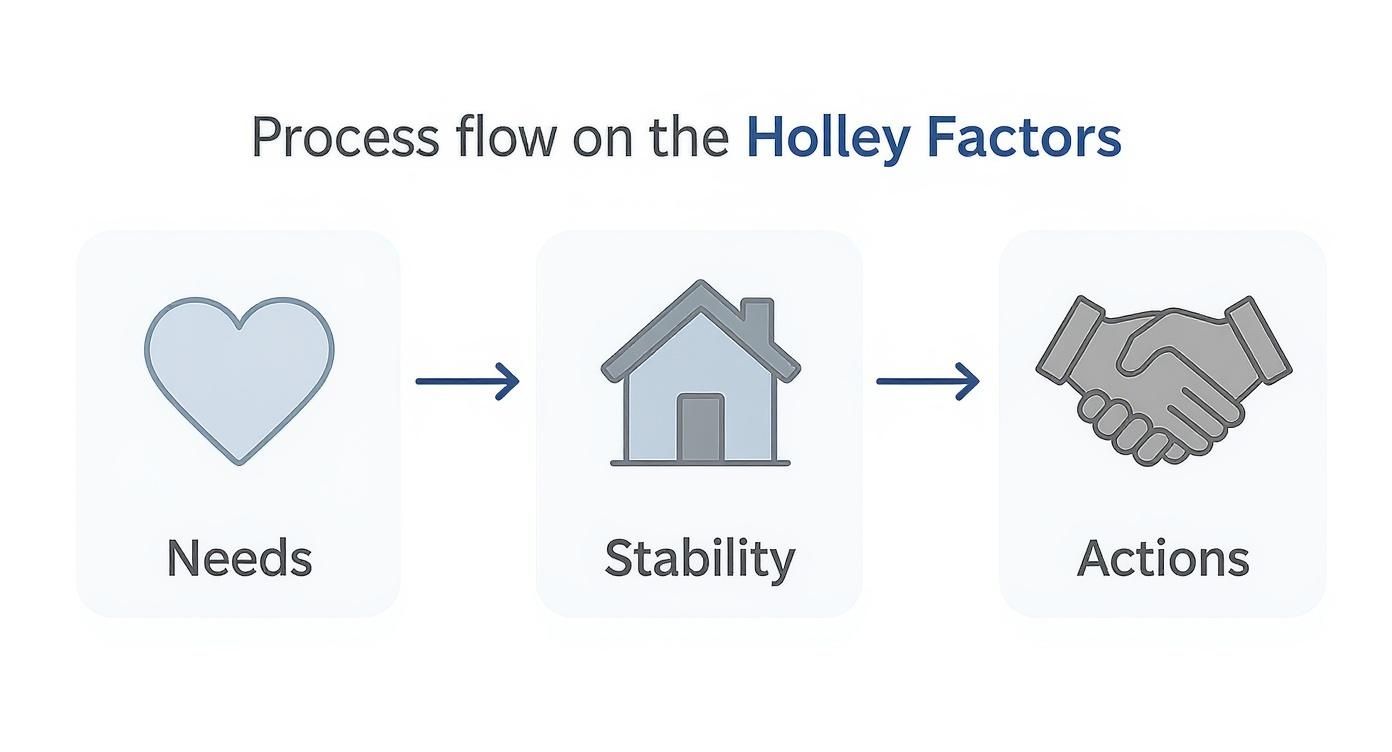
So, how does a judge make such a monumental decision without letting personal feelings get in the way? They turn to a set of guidelines from a famous case, Holley v. Adams. These are now known as the "Holley Factors," and they act as a checklist for figuring out a child's best interest.
While no list can cover every situation, a judge will carefully weigh things like:
- The child's emotional and physical needs, both now and down the road.
- Any emotional or physical danger the child might face.
- The parenting skills of the people involved.
- How stable the home environment is.
- What the child wants, especially if they're old enough to say so.
- Any actions (or failures to act) by a parent that show an unhealthy parent-child relationship.
These factors help the court piece together a complete picture of your child’s life and what they need to thrive.
What This Looks Like in Real Life
Legal terms can feel a bit abstract, so let's bring it down to earth. When a judge looks at the "stability of the home," they’re not just talking about the physical house. They’re looking for proof of a consistent, safe, and predictable environment for the child.
For example, can you show that you've held down a steady job and kept a safe roof over your head? Are you involved in your child’s doctor's appointments and school meetings? These are the kinds of actions that show a commitment to providing the stability every kid needs. On the flip side, a history of constantly moving, job-hopping, or living in chaos can seriously hurt your case.
A judge’s main goal is to make sure the child lands in a safe, stable, and loving environment where they can grow up healthy and happy. Proving you can provide that is the most powerful argument you have.
Showing the Court Your Commitment
The "parental abilities" factor is where you get to show the court you're a capable and loving parent. This isn't about being perfect—nobody is. It's about showing you have the willingness and the ability to meet your child's needs.
Here are a few practical ways to demonstrate that commitment:
- Finish Your Services: If the court ordered you to take parenting classes, go to counseling, or get treatment, do it. Finishing everything on time and successfully shows the judge you're taking this seriously.
- Never Miss a Visit: Show up for every single scheduled visit with your child. Be present, be engaged, and make that time positive.
- Keep a Record: Document everything. Keep a journal of your visits, your phone calls, and every single step you're taking to get your life on track.
Every positive step you take is another piece of evidence in your favor. It helps build a story for the judge—a story that shows keeping your family together is what’s truly in your child’s best interest. You aren't just defending against accusations; you are actively building a case for your family’s future.
Navigating the Step-by-Step Termination Process
When your family's future is on the line, the legal system can feel like a confusing and intimidating maze. Getting a handle on the roadmap for a parental rights in Texas termination case can dial down that anxiety and empower you to take the right steps. The process is highly structured, following a clear path designed to make sure every decision is made with extreme care.
The journey usually kicks off when a formal request, called a Petition to Terminate the Parent-Child Relationship, is filed with the court. Most of the time, this is started by the Texas Department of Family and Protective Services (DFPS)—what most of us know as Child Protective Services (CPS). However, another person, like a stepparent wanting to adopt, can also file one. This petition is the legal document that officially starts the case and lays out the specific reasons why the petitioner believes termination is necessary.
The Initial Stages and Key Players
Once that petition is filed, the court moves quickly to protect the child’s interests. One of the very first things a judge does is appoint an attorney ad litem. This is an independent lawyer whose only job is to represent the child. They’ll meet with the child, talk to parents, teachers, and counselors, and then give the judge recommendations based on what they believe is in the child's best interest.
At the same time, you, as the parent, have a fundamental right to your own lawyer. The court will make sure you have an attorney, even appointing one for you if you can't afford to hire one yourself. This is a critical safeguard because the stakes couldn't be higher.
The legal process for termination is intentionally methodical. Each step, from appointing attorneys to gathering evidence, is designed to ensure a judge has a complete and accurate picture before making a permanent decision about a family's future.
Gathering Evidence and Seeking Resolution
After the first few hearings, the case enters what’s known as the discovery phase. Think of this as the formal investigation where both sides gather evidence to build their arguments. Your attorney and the opposing counsel can request documents, ask written questions (called interrogatories), and take formal testimony under oath (depositions) from witnesses.
During this time, your attorney will be hard at work collecting evidence that backs up your position and challenges the claims made in the petition. This could include things like:
- Proof of Progress: Certificates from parenting classes, pay stubs to show steady employment, or lease agreements for stable housing.
- Witness Support: Statements from family, friends, or counselors who can speak to your parenting skills and the bond you share with your child.
- Your Personal Records: A detailed journal of your visits and communication with your child can be surprisingly powerful.
Before a case ever makes it to a final trial, Texas courts almost always require the parties to try mediation. This is a confidential meeting where a neutral third-party mediator helps everyone try to find a solution they can agree on. While it might not resolve the entire case, it's a chance to find common ground and hopefully avoid a long and emotionally draining trial. It's important to note that while some parents may choose to relinquish their rights to allow for a stepparent adoption, you can explore the complexities of this decision by reading our complete guide to voluntarily terminating parental rights in Texas.
The Final Trial and Court's Decision
If you can’t reach an agreement in mediation, the case will be set for a final trial. This is where both sides present all their evidence and arguments to the judge. Witnesses will take the stand, documents will be submitted as exhibits, and the lawyers will give their closing arguments. As a parent, you have the right to be there, to testify on your own behalf, and to confront the witnesses brought against you.
The judge will listen to everything and must find two things to be true by "clear and convincing evidence"—a very high legal bar. First, that at least one of the legal grounds for termination exists. Second, that termination is in the child's absolute best interest. The court doesn't take these decisions lightly, especially as Texas has worked to reform child welfare, which has led to a reduction in the number of children removed from their homes. These changes highlight the ongoing tension between protecting children and keeping families together.
How to Defend Your Parental Rights

When your relationship with your child is on the line, the first thing you need to understand is that you have rights. A termination case feels like an uphill battle from the start, but the Texas legal system provides powerful protections for parents. It’s not just about knowing the law; it’s about taking action and actively fighting for your family.
First and foremost, you have the right to legal representation. The stakes don't get much higher than this, which is why the court will appoint an attorney for you if you cannot afford one. This ensures you have a knowledgeable advocate in your corner from day one, ready to navigate the complexities of the system.
You also have the right to a fair legal process. This isn’t a one-sided affair. You get to present your own evidence, bring in witnesses to speak on your behalf, and challenge everything brought against you. You are an active participant, not just a bystander in your own case.
Building Your Strongest Defense
Your actions from this moment forward are your most powerful testimony. A judge wants to see a consistent, good-faith effort to do what’s best for your child. The key is to be proactive. You need to show—through your conduct—that keeping your family intact is truly in your child's best interest.
Here are a few actionable strategies that can make all the difference:
- Complete All Court-Ordered Services: If a judge orders parenting classes, counseling, or treatment, make it your absolute top priority. Finishing these services sends a clear message: you are committed to being a safe and capable parent.
- Maintain a Stable Environment: Do everything in your power to provide a stable home. That means holding down a steady job, securing safe housing, and creating a predictable routine for your child whenever they’re with you. Consistency is huge.
- Be Present for Your Child: Never, ever miss a scheduled visit. Make every single moment count. Be engaged, stay positive, and focus entirely on your child’s needs. These visits are your chance to show the court the strength of your bond.
A parent’s consistent, documented effort to meet court requirements and maintain a positive relationship with their child is often the most persuasive evidence presented in a courtroom.
The Power of Meticulous Documentation
In a legal battle, your memory isn’t enough—you need a detailed record. Your best friend in this process is a journal. Start one immediately and document every single interaction and effort related to your case. This creates a clear timeline your attorney can use to build your defense and shut down any false accusations.
Your documentation should include:
- Dates and details of every visit with your child, including what you did together and how it went.
- Records of all communication with CPS caseworkers, attorneys, and the other parent. Log calls, save emails, and keep texts.
- Receipts and proof of financial support, showing you are meeting your obligations.
- Certificates of completion for any classes, programs, or services you’ve finished.
This isn't just about organizing paperwork. It's about painting a clear picture for the judge of your dedication and involvement. Every entry is another piece of the story of a parent fighting to protect their family.
Your Fundamental Rights in Court
Understanding your legal standing is crucial. In Texas, the parent-child relationship is considered a fundamental right, and the law requires a very high standard of proof—"clear and convincing evidence"—before that right can be taken away. This standard is much higher than in other civil cases, giving you a significant layer of protection.
For fathers, the first step is often establishing legal parentage. If paternity hasn't been legally established, you might not have the legal standing to even participate in the case, let alone defend your rights. You can learn more about this vital process by reviewing our guide on how to establish paternity in Texas. Getting your legal rights as a father recognized is foundational to protecting them.
Ultimately, your defense is a mix of knowing your legal protections and taking concrete, positive action. By working closely with your attorney and showing an unwavering commitment to your child, you can build a compelling case that shows exactly why keeping your family together is what’s truly best for them.
Key Takeaways and Next Steps to Protect Your Family
If you're facing a case involving the termination of parental rights in Texas, it’s easy to feel overwhelmed. But right now, clarity and immediate action are your strongest allies. Let's cut through the noise and focus on what matters. The single most important thing to understand is that termination is a permanent and serious action, and it demands a proactive response from you.
Remember, every decision the court makes will be guided by one standard: the "best interest of the child." You have significant legal rights that must be protected every step of the way. The most crucial action you can take is to seek experienced legal guidance without delay. As you consider your next steps to protect your family, understanding the various practice areas within the legal field, particularly the landscape of specialized legal services for family law, can be insightful.
Take Control with Practical Steps
You are your child’s best advocate, but you don’t have to do this alone. Start taking these concrete steps today:
- Gather Documents: Start collecting any relevant paperwork you have. This could be old court orders, text messages, emails, or any proof showing your efforts to support your child.
- Create a Timeline: Grab a notebook and write down a clear timeline of events. This simple step will be invaluable for your attorney later on.
- Seek Legal Counsel: Don't wait. An experienced family law attorney can start building your defense right away.
Understanding your legal options is the first step toward regaining control. A skilled attorney not only defends your rights but also provides the clear, steady guidance needed to navigate this emotional journey.
When you're staring down a legal fight over your parental rights, the questions come fast and furious. They're not abstract legal theories; they're urgent, practical concerns that keep you up at night. Let’s cut through the noise and get you some clear, direct answers to the questions we hear most from parents in your exact shoes.
Can My Rights Be Terminated Without My Consent?
Yes, a court in Texas can terminate your parental rights even if you don’t agree. This is what’s known as an involuntary termination.
But it's not a simple process. The person or agency trying to sever your rights has a heavy burden. They must prove two things with clear and convincing evidence: first, that legal grounds exist (like endangerment or abandonment), and second, that termination is genuinely in your child’s best interest. You have a fundamental right to show up, fight the case, and challenge every accusation they make. That high standard of proof is there to protect you.
What Happens to Child Support if My Rights Are Terminated?
Once the judge signs a final termination order, your legal obligation to pay future child support stops. The parent-child relationship is legally severed, and that includes the ongoing financial duty.
However, it doesn't wipe the slate clean. You are still on the hook for any unpaid child support—what the law calls arrears—that piled up before the date your rights were terminated. The state can, and will, continue to collect on that past-due amount.
"In Texas, the termination of parental rights is considered permanent and final. It is extremely difficult and rare to have a termination order reversed. This is why it is critical to mount a strong defense from the very beginning of the case."
Is It Possible to Get My Rights Back Later?
This is a tough one, but the answer is almost always no. In Texas, terminating parental rights is a permanent, irreversible act. Once that final order is signed, there's no legal path to "reinstate" or get your rights back. It's considered a closed door.
This finality is precisely why the law sets such a high bar for termination in the first place. It’s also why you have to treat the case with the utmost seriousness from day one. Your best—and often your only—chance to protect your relationship with your child happens inside that courtroom, during the initial proceedings.
If you need help with a child custody or visitation case in Texas, our experienced attorneys can guide you every step of the way. Contact The Law Office of Bryan Fagan, PLLC today for a free consultation at https://texascustodylawyer.net.