
When your child’s future is on the line, understanding your rights matters most. The thought of losing your child is every parent’s worst nightmare, and facing the legal process of parental termination of rights in Texas can feel like your entire world is at stake. This guide is here to provide plain-English explanations and practical guidance during what is undoubtedly a difficult time.
Understanding the Finality of Parental Rights Termination
Let's be clear: termination is the permanent, legal severing of the parent-child relationship. Texas courts do not take this step lightly; in fact, it's often called the "death penalty" of family law because of its absolute and irreversible nature. Once a judge signs that order, it legally ends every right and responsibility you have as a parent.
This process can follow two very different paths, and knowing the difference is the first step toward protecting your family.

Two Paths to Termination in Texas
The road to terminating parental rights isn't a straight one. It almost always happens in one of two ways, each with its own legal framework and heavy emotional weight.
- Involuntary Termination: This is what most people think of—a lawsuit filed to end a parent's rights against their will. Most often, the Texas Department of Family and Protective Services (DFPS) initiates these cases. However, the other parent, a grandparent, or another person with legal standing can also file a petition.
- Voluntary Relinquishment: In certain situations, a parent might choose to willingly give up their rights. This is most common in adoption cases, like a stepparent wanting to legally adopt their stepchild. Here, the decision is made to create a stable, legally recognized family unit for the child's benefit.
No matter which path it is, a judge must approve any termination. The court has one single, profound focus: protecting the child.
A court cannot take this step lightly. The law requires "clear and convincing evidence" that termination is in the "best interest of the child." This is an incredibly high legal bar, specifically designed to protect the fundamental bond between a parent and their child.
Why the "Best Interest of the Child" Standard is Key
The phrase "best interest of the child" is the absolute cornerstone of every custody and termination case in Texas. It’s not just a saying; it’s a detailed legal test that judges use to make these life-altering decisions. Even if a parent agrees to give up their rights, a judge will only grant the termination if it genuinely serves the child’s physical, emotional, and developmental well-being.
From the very beginning, know that you have rights and legal options. This comprehensive guide will walk you through them, step by step, empowering you with the information you need to face what's ahead.
The Legal Grounds for Involuntary Termination
When another person—whether it’s the other parent or a state agency like the Department of Family and Protective Services (DFPS)—files a lawsuit to end your parental rights against your will, they can't just show up in court with a vague accusation. The Texas Family Code is very specific: they have to prove clear legal reasons, known as "grounds," for the termination.
A judge simply cannot take away your rights based on a feeling or a general complaint. The person suing you is required to present solid, convincing evidence that your actions (or lack thereof) meet one or more of the precise criteria laid out in state law. Knowing what these grounds are is your absolute first line of defense.
The High Burden of Proof in Termination Cases
Before we even get into the specific grounds, it's critical to understand the incredibly high bar the other side has to clear. In a parental termination of rights in Texas case, the person filing the suit must prove their claims with "clear and convincing evidence."
This isn’t the same standard you see in most other civil cases, like a contract dispute, which only requires a "preponderance of the evidence." "Clear and convincing" is a much stricter, higher standard. It means the evidence presented must be so powerful that it creates a firm belief or conviction in the judge's mind that the allegations are true.
Think of it this way: "preponderance of the evidence" just means "more likely than not"—a little over a 50% chance. But "clear and convincing" is a massive step up from that, a legal safeguard designed to protect the fundamental, constitutional right to be a parent.
Common Grounds for Involuntary Termination
The Texas Family Code actually lists nearly 20 different grounds for involuntary termination. While every case is unique, a few of these reasons pop up in court far more often than others. Let's break down some of the most common ones in plain English.
Endangering the Child's Well-Being
This is one of the most frequently cited grounds in termination cases. It covers any actions that have endangered the physical or emotional well-being of the child.
- Physical Endangerment: This is what most people think of—direct physical abuse, exposing a child to family violence, or even just maintaining a hazardous or unsafe home environment.
- Emotional Endangerment: This is just as serious in the eyes of the court. It can include severe verbal abuse, causing extreme emotional distress, or allowing the child to witness traumatic events like drug abuse.
Crucially, endangerment doesn't require proof that the child was actually harmed. The court only needs to see that the parent's conduct created a potential for danger. For parents who find themselves defending against these claims, it can be helpful to understand more about how to prove an unfit parent to see what kind of evidence the court will be examining.
The court is looking for a pattern of behavior, not just a single mistake. One instance of poor judgment might not be enough, but a consistent course of conduct that puts a child at risk is exactly what the court will focus on.
Abandonment
Abandonment is another serious ground for termination, and it can be established in a few different ways:
- Voluntarily Leaving the Child: This happens if a parent leaves the child with another person or an institution without providing adequate support and with the clear intent not to return.
- Failure to Support: This applies if a parent fails to support the child according to their ability for a period of one year, ending within six months of the date the lawsuit is filed.
- Remaining Away: This can be proven if a parent knowingly stays away from the child's home without the other parent's consent.
Neglect or Failure to Provide a Safe Home
This ground involves a failure to provide the child with essentials like food, clothing, shelter, medical care, or a safe environment. While it often overlaps with endangerment, neglect focuses more on a parent's inaction and failure to meet a child's most basic needs.
Substance Abuse
The law states that engaging in conduct—or placing the child with people who engage in conduct—which endangers the child is a ground for termination. This frequently includes ongoing, unaddressed substance abuse that impairs a parent's ability to care for their child or exposes the child to dangerous people or situations.
Fighting to protect your relationship with your child starts with understanding exactly what you are up against. Knowing these legal grounds allows you and your attorney to build a targeted, effective defense to show the court your commitment to your child's well-being.
Decoding the Best Interest of the Child Standard
When your child’s future is on the line, nothing is more important than understanding what the court is looking for. Even if someone proves a legal reason to terminate parental rights, their case is only halfway done. The judge must then answer a separate, critical question: Is permanently ending the parent-child relationship truly in the best interest of the child?
This isn’t just a legal phrase; it’s the single most important standard in all of Texas family law. Think of it as the ultimate lens through which the judge views every piece of evidence about a child’s life, safety, and future. In any parental termination of rights in Texas case, the final decision will hinge entirely on this analysis.

Introducing the Holley Factors
To bring some structure to this massive decision, Texas courts rely on a set of guidelines known as the “Holley Factors.” These factors come from a landmark Texas Supreme Court case and help judges look at the family’s situation from every possible angle.
There's no magic formula here—one factor doesn't automatically trump another. Instead, the judge weighs all the evidence together to get a complete picture. Knowing what the court is looking for helps you and your attorney build a strong case centered on your child's well-being.
Key Holley Factors the Court Will Consider
While the court can look at anything relevant, these are some of the most significant points a judge will examine. Let's break them down in plain English.
- The Child’s Needs: This covers both current and future needs, physical and emotional. Is the child safe? Do they have special medical or educational requirements that a parent is—or isn't—meeting?
- Parental Abilities: The court scrutinizes the abilities of everyone involved. Can they provide a safe, stable, and loving home? What is their real-world capacity to parent effectively right now?
- Stability of the Home: A judge will always look at the stability of the proposed home. A consistent, predictable home life is seen as a huge plus for a child's development.
- Acts or Omissions of the Parent: The court will review any actions or failures to act by the parent that might show the existing parent-child relationship isn't a healthy or proper one.
- Emotional and Physical Dangers: This factor assesses any immediate or potential danger to the child, both physically and emotionally, not just today but down the road.
The judge’s goal is to create a complete and detailed portrait of the child's life. They are looking for evidence of a parent's commitment, stability, and ability to provide a safe and nurturing future for their child.
Presenting a compelling case on this standard is often the key to protecting your family. For a deeper look, you can learn more about the top considerations for determining the best interest of the child in our detailed guide.
How to Demonstrate Your Child's Best Interest
Proving your child’s best interest is about more than just saying you love them; it's about showing it through concrete evidence and your actions. This is your chance to demonstrate your commitment to providing a safe, stable, and supportive home.
This might involve:
- Bringing in testimony from teachers, counselors, or family friends who can speak to your parenting skills.
- Showing proof of a stable home and consistent employment.
- Completing recommended services, like parenting classes or counseling, to show you are proactive and dedicated.
- Highlighting the strong, positive emotional bond you share with your child.
Ultimately, the court wants to see that you are a safe, capable, and dedicated parent who is essential to your child's happiness and healthy development. Focusing your case on these positive attributes is your most powerful tool in a termination lawsuit.
Navigating the Texas Court Process Step by Step
Getting served with a lawsuit to terminate your parental rights is a gut-wrenching experience. The legal jargon, the strict deadlines, and the sheer emotional weight of it all can feel like you're lost in a maze with no way out. Think of this section as your roadmap—we’re going to break down the complex court process into clear, manageable steps so you know exactly what to expect.
From the moment you receive that first stack of papers to the final day in court, understanding the timeline is key to being an active participant in your own defense. Our goal here is to strip away the anxiety of the unknown and give you the knowledge to work confidently with your attorney and fight for your family.
Step 1: The Initial Petition and Service
The legal battle over parental termination of rights in Texas officially kicks off when someone—an individual or a state agency—files a document called a Petition to Terminate the Parent-Child Relationship. This petition is a formal request asking the court to permanently sever your legal rights as a parent. The person who files it is the "Petitioner," and you, the parent, are the "Respondent."
Once the petition is filed, you have to be officially notified. This isn't a casual heads-up; it's a formal process called "service." A sheriff, constable, or private process server will hand-deliver a copy of the lawsuit and a "citation"—a legal summons ordering you to file a written answer with the court by a very specific deadline.
CRITICAL ACTION: Whatever you do, do not ignore these papers. If you fail to file a formal, written "Answer" by the deadline, the court can issue a default judgment. That means your rights could be terminated without you ever getting a chance to tell your side of the story. Your first and most important move is to call an experienced family law attorney immediately.
Step 2: The Court Appoints an Ad Litem Attorney
Because your child's future is at the heart of the entire case, the court will appoint a special kind of lawyer called an attorney ad litem. This attorney has one client and one job: to represent the best interests of your child.
The ad litem is an independent third party. They don't work for you, and they don't work for the Petitioner. Their role is to investigate and get a complete picture of the situation by:
- Meeting with your child to understand their feelings, fears, and what they want.
- Interviewing you, the other parent, teachers, counselors, family members, and anyone else who plays a role in your child's life.
- Reviewing all the evidence, from school report cards and doctor's notes to CPS files.
- Making a formal recommendation to the judge about what they believe is in the child’s best interest.
The ad litem's recommendation carries a lot of weight with the judge. It’s crucial that you cooperate with them and show them you are committed to doing what’s best for your child.
Step 3: Discovery and Gathering Evidence
After everyone has filed their initial paperwork, the case moves into a phase called discovery. This is the formal process where both sides gather the evidence they need to build their case. Think of it as the investigation stage, where each side gets to find out what facts and proof the other side plans to use in court.
During discovery, the lawyers might use a few key tools:
- Requests for Production: Asking the other side for documents like financial records, emails, text messages, or medical reports.
- Interrogatories: Sending written questions that must be answered under oath.
- Depositions: Questioning witnesses in person, under oath, with a court reporter transcribing everything that's said.
This is where the real work of building a defense happens. Your attorney will use discovery to gather the facts needed to fight the grounds for termination and prove that keeping your parental rights is what’s truly in your child's best interest.
Step 4: Mediation and Pre-Trial Hearings
Before a case goes to a full-blown trial, most Texas courts require everyone to try mediation. This is a confidential meeting where a neutral, third-party mediator sits down with both sides and their lawyers to see if an agreement can be reached. While "settling" a termination case is complicated, mediation can sometimes help resolve certain issues and narrow down what needs to be argued about at trial.
You might also have a few pre-trial hearings along the way. These are shorter court appearances where the judge handles procedural things, like setting deadlines or ruling on legal arguments before the final trial. These hearings keep the case on track and make sure everyone is ready for the final showdown.
Step 5: The Final Trial
If mediation doesn't lead to an agreement, your case will be scheduled for a final trial. This is where both sides present all their evidence, call witnesses to testify on the stand, and make their closing arguments to the judge. It’s the culmination of all the work done up to this point.
After hearing everything, the judge will make the final, life-altering decision. They will decide whether to terminate your parental rights based on that critical two-part test: proving a statutory ground for termination and proving it’s in the child’s best interest.
It's a tough road, but it's worth noting a positive trend in Texas. The child welfare system has seen a major drop in child removals recently. This shift toward family preservation means fewer families are pushed into the system that can lead to termination, creating more chances to access support and stay together. You can learn more about these family preservation trends in Texas on familyfreedomproject.org.
What to Know About Voluntary Relinquishment
Choosing to give up your parental rights is one of the heaviest and most difficult decisions a person can ever make. While involuntary termination is a legal battle forced upon a parent, voluntary relinquishment is a deeply personal choice. It's often made from a place of love, with the goal of giving a child a more stable and permanent home life. But understanding this path means facing its absolute legal finality and the careful consideration Texas courts give to this life-altering step.
This isn't as simple as just signing a piece of paper and walking away. The legal document involved is an affidavit of relinquishment of parental rights, a sworn statement that has to be signed in front of a notary. This most often comes up in cooperative situations, like a stepparent adoption. In that scenario, a biological parent agrees to terminate their rights so their child's stepparent can step in and become their legal parent, creating a solid family unit.
The Legal Process and Its Finality
Even when a parent voluntarily agrees to sign the affidavit, a judge still has the final say. The court’s primary duty never changes, no matter the circumstances: every decision must be in the best interest of the child. A judge will not terminate a parent's rights just to let them off the hook for child support. There has to be a clear, tangible benefit for the child, like the security of being immediately adopted by a loving, stable caregiver.
Once that affidavit is signed, the window to change your mind slams shut almost immediately. Under Texas law, an affidavit of relinquishment is generally irrevocable. This is why it is absolutely essential to get independent legal advice before you sign anything. You have to be fully aware of the permanent consequences this decision has for both you and your child.
The Texas court process for termination, whether voluntary or involuntary, moves through several key stages, from filing the initial petition to the final trial.
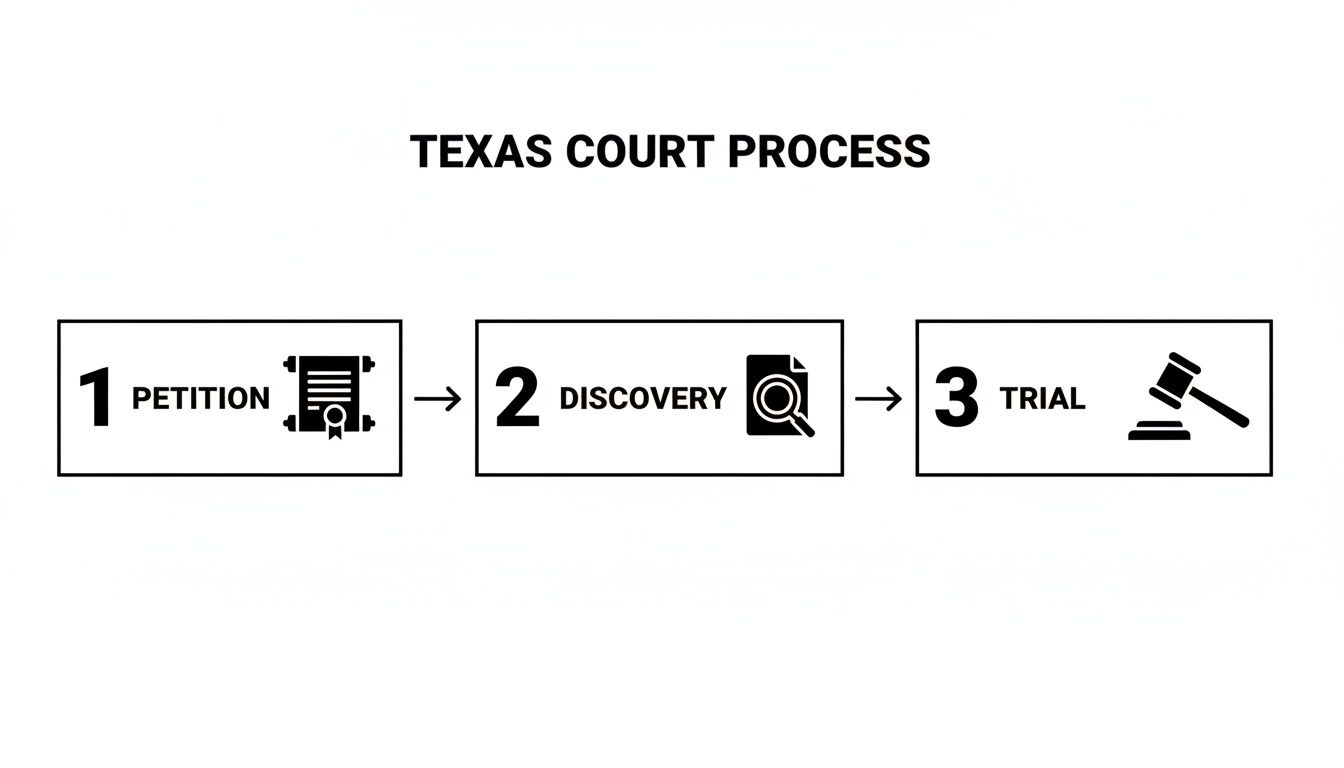
This visual breaks down the journey, starting with the initial petition, moving through the evidence-gathering phase of discovery, and ending with the judge's final decision at trial.
Making an Informed Decision
Voluntarily giving up parental rights is a path people take for many complex reasons, but it's almost always with the child’s future stability at heart. Still, its permanence cannot be overstated. Before you even think about moving forward, you need to understand every single facet of what you are agreeing to. For a more detailed look at this, we have a complete guide to voluntarily terminating parental rights in Texas that explores the process in greater depth.
The court's approval of a voluntary relinquishment is contingent on it serving the child’s long-term well-being. The focus is never on the parent’s convenience but always on the child’s need for a safe, stable, and permanent home.
This decision carries immense emotional and legal weight. Making sure you have compassionate, experienced legal guidance isn't just a good idea—it’s a critical step in protecting everyone involved.
Life After a Termination Order
When a judge signs a final order for the parental termination of rights in Texas, it’s not a temporary setback—it’s an absolute, permanent, and profound legal outcome. The emotional impact is immense, but it's crucial for everyone involved to understand the finality of this decision. This isn't a slap on the wrist; it's a complete severing of the parent-child relationship with lifelong consequences.
The thought of this outcome can bring a wave of grief and uncertainty. So, what does life actually look like after the gavel falls? The legal reality is stark and clear.

The Legal Consequences of a Termination Order
Once that order is signed, every legal right and responsibility connecting you to your child is gone. It's a comprehensive legal reset of your relationship, impacting every corner of your life and your child’s.
This legal separation includes:
- No Right to Possession or Visitation: You no longer have any legal right to see or spend time with your child. This means all court-ordered schedules for seeing your child (known as possession schedules) end.
- No Decision-Making Authority: All your rights to make decisions about your child's education, healthcare, or religious upbringing are extinguished. In Texas, this is tied to the concept of conservatorship, where parents are typically named "joint managing conservators" with shared rights. Termination erases your conservatorship role completely.
- No Right to Inheritance: Your child will no longer have the right to inherit from you if you pass away without a will, and you won't inherit from them either.
- No Right to Information: You are no longer legally entitled to access your child's school records or medical files.
The court's order effectively makes you a legal stranger to your child. This is why Texas courts often call termination the "death penalty" of family law—the outcome is irreversible and total.
How Termination Affects Child Support
A common question we hear is about child support. A termination order ends all future child support duties from the day the order is signed. You will not owe any more payments moving forward.
However, the order doesn't erase the past. Any child support payments that were due before the termination date, known as arrears, are still legally owed. The state can and will continue to collect on that past-due amount even after your rights have been terminated.
The Path to Adoption
Legally speaking, the primary goal of terminating parental rights is to clear the path for a child to be adopted. Once the biological parent-child relationship is legally severed, the child becomes available for adoption by another family—often a stepparent or foster family who can provide a stable and permanent home.
The sheer gravity of this outcome is precisely why a dedicated legal defense is so critical from day one. The emotional toll is undeniable, and acknowledging the grief involved is part of the process. Protecting your relationship with your child means you have to act swiftly and strategically the moment you're faced with a termination petition. Every step you take in court is a step toward securing your child’s future with you still in it.
Your Questions Answered: Common Concerns in Termination Cases
Facing a legal battle over your parental rights is terrifying, and it's completely normal for a flood of questions to hit you all at once. The uncertainty can feel paralyzing, but getting clear, straight-talk answers is the first step toward taking back control. Let's walk through some of the most urgent questions we hear from parents across Texas.
Can My Rights Be Terminated if I Am Not a U.S. Citizen?
Let’s be clear: your parental rights are tied to your relationship with your child, not your immigration status. Under Texas law, every parent, regardless of citizenship, has the absolute right to stand up and defend themselves in a termination lawsuit.
That said, non-citizen parents can run into unique roadblocks, like language barriers or the sheer difficulty of attending court hearings if they're detained or living outside the country. This is exactly why it's so critical to have an attorney who not only knows family law but also understands how to protect your rights in this specific, high-stakes situation.
Will I Go to Jail if My Parental Rights Are Terminated?
This is a common fear, but it's important to separate the two legal worlds. A lawsuit to terminate your parental rights is a civil case, not a criminal one. You will not be sent to jail just because a judge signs a termination order.
However—and this is a big however—the actions that led to the termination lawsuit, like severe neglect, endangerment, or abuse, could absolutely trigger separate criminal charges from the state. The termination case and any criminal case are two completely different legal battles, even if they stem from the same set of facts.
Can I Get My Rights Back After They Are Terminated?
This is a tough question with an even tougher answer. In Texas, a termination order is designed to be final and permanent. The entire point of the law is to give children a chance at stability and permanence, which usually means clearing the path for adoption.
The exceptions to this rule are so incredibly rare they’re almost mythical. This is why you have to fight the case with everything you’ve got from the very beginning. Once that order is signed, there are virtually no second chances.
Does Signing a CPS Safety Plan Mean I'm Admitting Guilt?
No, signing a CPS safety plan is not the same as pleading guilty in court. These plans are put in place as an immediate, temporary measure to make sure a child is safe while CPS conducts its investigation.
But you have to be extremely careful here. The promises you make in that safety plan can—and often will—be used against you later on. If you fail to follow the plan, it can be presented as evidence of a pattern of behavior or proof that you can't provide a safe home. You should never sign or agree to any CPS plan without first speaking to an attorney.
Key Takeaway: Your Next Steps
Facing the potential termination of parental rights is one of the most stressful experiences a parent can endure. The legal standards are high, and the stakes are even higher. The two most important things to remember are that every decision a Texas court makes is based on the "best interest of the child" and that you have the right to a strong legal defense. Do not ignore any legal notices. Your immediate action is crucial for protecting your family.
If you need help with a child custody or visitation case in Texas, our experienced attorneys can guide you every step of the way. Contact The Law Office of Bryan Fagan, PLLC today for a free consultation.